
Response blocking is a behavior reduction procedure used in applied behavior analysis to prevent the completion of potentially harmful behaviors. This technique involves physically intervening to stop a response before it can be completed, thereby preventing potential injury or damage. Understanding response blocking ABA procedures is essential for BCBA candidates and practicing behavior analysts who work with clients exhibiting dangerous behaviors.
Table of Contents
- Response Blocking ABA: What is Response Blocking in ABA?
- Applied Examples and Functional Analysis
- Ethical Implementation and Compassionate Care
- BCBA Exam Focus: Common Traps and Questions
- Quick-Reference Implementation Checklist
- Final Summary
Response Blocking ABA: What is Response Blocking in ABA?
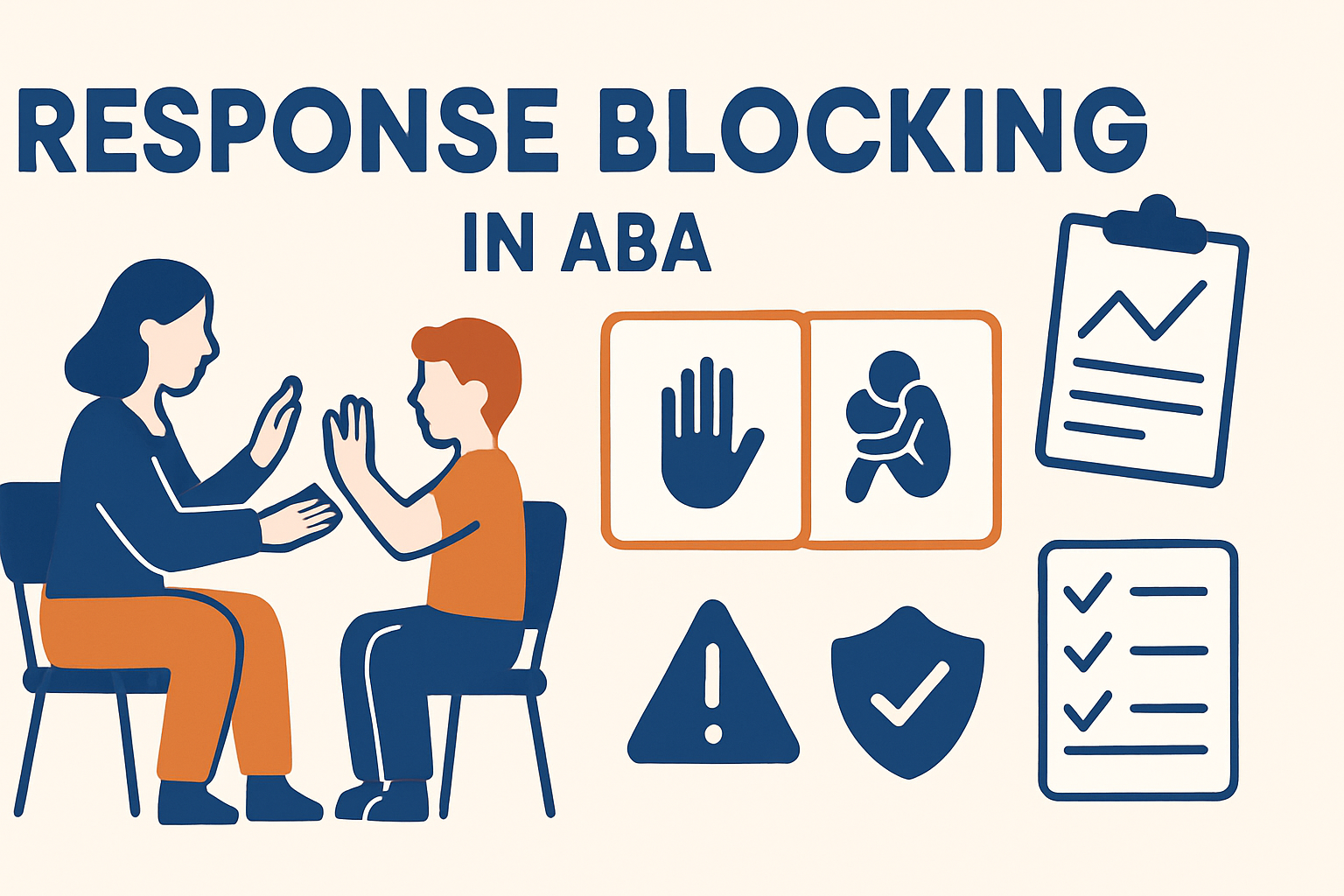
Response blocking is defined as the physical prevention of a target behavior from occurring or being completed. Unlike punishment procedures that add or remove consequences after behavior, response blocking operates by preventing the behavior from reaching its natural conclusion. This distinction is crucial for exam preparation and ethical practice.
Defining the Procedure
Formally, response blocking involves immediate physical intervention when a behavior begins, preventing its completion. The key characteristic is that it stops the behavior chain before reinforcement can be obtained. This differs from punishment because it doesn’t add aversive consequences or remove reinforcers—it simply prevents the behavior from occurring.
When is Response Blocking Considered?
This procedure is typically reserved for behaviors that pose immediate safety risks to the client or others. Common applications include:
- Self-injurious behavior (SIB) such as head-banging or self-hitting
- Aggressive behaviors toward others that could cause injury
- Destructive behaviors that could damage property or create hazards
- Elopement attempts toward dangerous areas like streets or bodies of water
Response blocking should always be part of a comprehensive behavior intervention plan (BIP) that includes reinforcement-based strategies. It’s never used as a standalone intervention.
Applied Examples and Functional Analysis
Understanding response blocking requires examining concrete scenarios through the lens of functional behavior assessment. Each example below demonstrates how response blocking fits within a complete intervention strategy.
Example 1: Blocking Hand-to-Head Striking
Antecedent: Difficult transition from preferred activity to academic task
Behavior: Child raises hand to strike own head
Consequence: Therapist gently blocks hand movement, prevents contact
Hypothesized Function: Automatic negative reinforcement (escape from task demand)
In this scenario, response blocking prevents physical injury while the therapist immediately prompts an alternative response. The intervention is paired with teaching a functional communication response, such as using a break card. This approach addresses both safety concerns and the underlying function of the behavior.
Example 2: Blocking Elopement Attempts
Antecedent: Door to playground opens during indoor session
Behavior: Client runs toward open door
Consequence: Staff blocks path, prevents exit
Hypothesized Function: Automatic positive reinforcement (access to outdoor stimuli)
Here, response blocking addresses a safety-critical behavior while maintaining environmental control. The intervention is immediately followed by redirection to a scheduled outdoor activity, teaching appropriate access to preferred stimuli. This demonstrates how response blocking can be integrated with schedule-based interventions.
Example 3: Blocking Object Destruction
Antecedent: Difficult math worksheet presented
Behavior: Teen grabs and prepares to throw instructional materials
Consequence: Staff intercepts materials, prevents throw
Hypothesized Function: Socially mediated negative reinforcement (escape from academic work)
This example shows response blocking preventing property destruction while maintaining instructional opportunities. The procedure is paired with teaching appropriate escape responses and gradually increasing task demands through shaping procedures.
Ethical Implementation and Compassionate Care
Response blocking requires careful ethical consideration due to its physical nature and potential impact on client dignity. Practitioners must balance safety concerns with respect for individual rights and autonomy.
Aligning with the BACB Ethics Code
The BACB Ethics Code provides specific guidance for procedures involving physical intervention. Key considerations include:
- Client dignity (Code 1.01) – maintaining respect throughout intervention
- Scientific knowledge (Code 1.01) – using evidence-based procedures
- Minimizing harm (Code 2.09) – using least restrictive alternatives
- Informed consent – obtaining permission for physical procedures
- Least restrictive procedures (Code 2.15) – exhausting alternatives first
For more on ethical considerations in behavior analysis, see our guide on ethics in ABA practice.
Integrating Blocking into a Supportive Plan
Response blocking should never operate in isolation. Effective implementation requires integration with reinforcement-based strategies and comprehensive support systems:
- Pair with differential reinforcement of alternative behaviors (DRA)
- Implement functional communication training (FCT) for appropriate responses
- Provide staff training on proper implementation procedures
- Monitor for potential side effects like aggression or emotional responding
- Collect ongoing data to guide procedure fading over time
BCBA Exam Focus: Common Traps and Questions
Exam questions on response blocking often test your ability to distinguish it from similar procedures and apply it appropriately in clinical scenarios.
Key Distinctions Exam Writers Test
Understanding these distinctions is crucial for exam success:
- Response Blocking vs. Response Interruption & Redirection (RIRD): Blocking prevents completion; RIRD interrupts and redirects to alternative behavior
- Response Blocking vs. Physical Guidance: Blocking prevents behavior; guidance assists with correct response
- Response Blocking vs. Restraint: Blocking is brief intervention; restraint involves prolonged physical control
Sample Exam-Style Scenarios
Consider these typical exam questions:
Scenario 1: A client engages in eye-poking during difficult tasks. The behavior analyst implements a procedure where staff gently prevents the hand from reaching the face. What procedure is being used?
Correct Answer: Response blocking – because it physically prevents behavior completion.
Scenario 2: When a child begins to throw toys, staff says “Hands down” and guides them to place toys gently. What procedure is this?
Correct Answer: Response interruption and redirection – because it interrupts and teaches alternative behavior.
For more exam preparation strategies, explore our BCBA exam prep guide.
Quick-Reference Implementation Checklist
Before implementing response blocking, ensure you’ve addressed these critical components:
- Conducted comprehensive functional behavior assessment
- Documented safety justification for physical intervention
- Obtained proper informed consent from stakeholders
- Developed reinforcement-based alternatives to pair with blocking
- Trained staff on proper implementation techniques
- Established data collection system for monitoring effectiveness
- Created fading plan to reduce reliance on blocking over time
- Scheduled regular plan review meetings with treatment team
Final Summary
Response blocking serves as an important safety procedure within comprehensive behavior intervention plans. When implemented ethically and paired with reinforcement-based strategies, it can effectively prevent harm while teaching appropriate alternative behaviors. For BCBA candidates, mastering the distinctions between response blocking and similar procedures is essential for both exam success and ethical practice. Remember that response blocking should always be part of a larger treatment approach focused on building skills and reducing the need for physical intervention over time.
For additional resources on behavior reduction strategies, review our guide on differential reinforcement procedures and consult the official BACB Ethics Code for current standards on physical intervention procedures.
Complete BCBA Exam Prep
Turn this topic into exam-day practice
Practice concepts in context with five full-length 6th Edition mock exams, two bonus practice exams, a 6th Edition study guide, and key-term flashcards—all in one $120 USD package.
Get the $120 All-in-One Prep Pack
Review everything included on the product page before ordering. No pass guarantee is implied.



