

BCBA STUDY GUIDE · VERBAL BEHAVIOR Intraverbal training procedure is not one fixed drill. It is a planned sequence for bringing a verbal response under the control of the right verbal antecedent, while measuring accuracy, prompting, stimulus control, generalization, and maintenance. This guide explains how to choose and evaluate a procedure without treating one study protocol as a universal prescription.
Table of Contents
- What Is an Intraverbal Training Procedure?
- What Should You Assess Before an Intraverbal Training Procedure?
- How Does a Basic Intraverbal Procedure Work?
- How Do You Transfer Stimulus Control?
- When Can Blocked-Trials Training Help?
- How Should Prompting and Error Correction Be Used?
- How Do You Program Generalization and Maintenance?
- What Common Mistakes Weaken an Intraverbal Program?
- What Are the BCBA Exam Takeaways for Intraverbal Training?
- Frequently Asked Questions
- Sources for Further Study
- Take the Free BCBA Mock Exam
What Is an Intraverbal Training Procedure?
An intraverbal is a verbal response evoked by another verbal stimulus without point-to-point correspondence or formal similarity. Answering “What do you drink?” with “water,” completing “Ready, set …” with “go,” or responding to a conversational question can all be intraverbal examples when the relevant verbal antecedent controls the response. The response is not simply an echo of the question, and it is not necessarily controlled by a visible object.
An intraverbal training procedure is the instructional arrangement used to establish that control. It may include target selection, an assessment or probe, an antecedent question, a prompt, a consequence, error correction, prompt fading, and tests for unprompted responding. The procedure should be selected because it fits the learner’s current repertoire and the discrimination being taught—not because a named procedure sounds more advanced.
This distinction matters because correct answers can be produced by the wrong source of control. A learner may memorize one answer after hearing a particular question, respond to the last prompt, or use a picture that is still present. A strong program tests whether the response changes appropriately when the verbal stimulus changes.
What Should You Assess Before an Intraverbal Training Procedure?
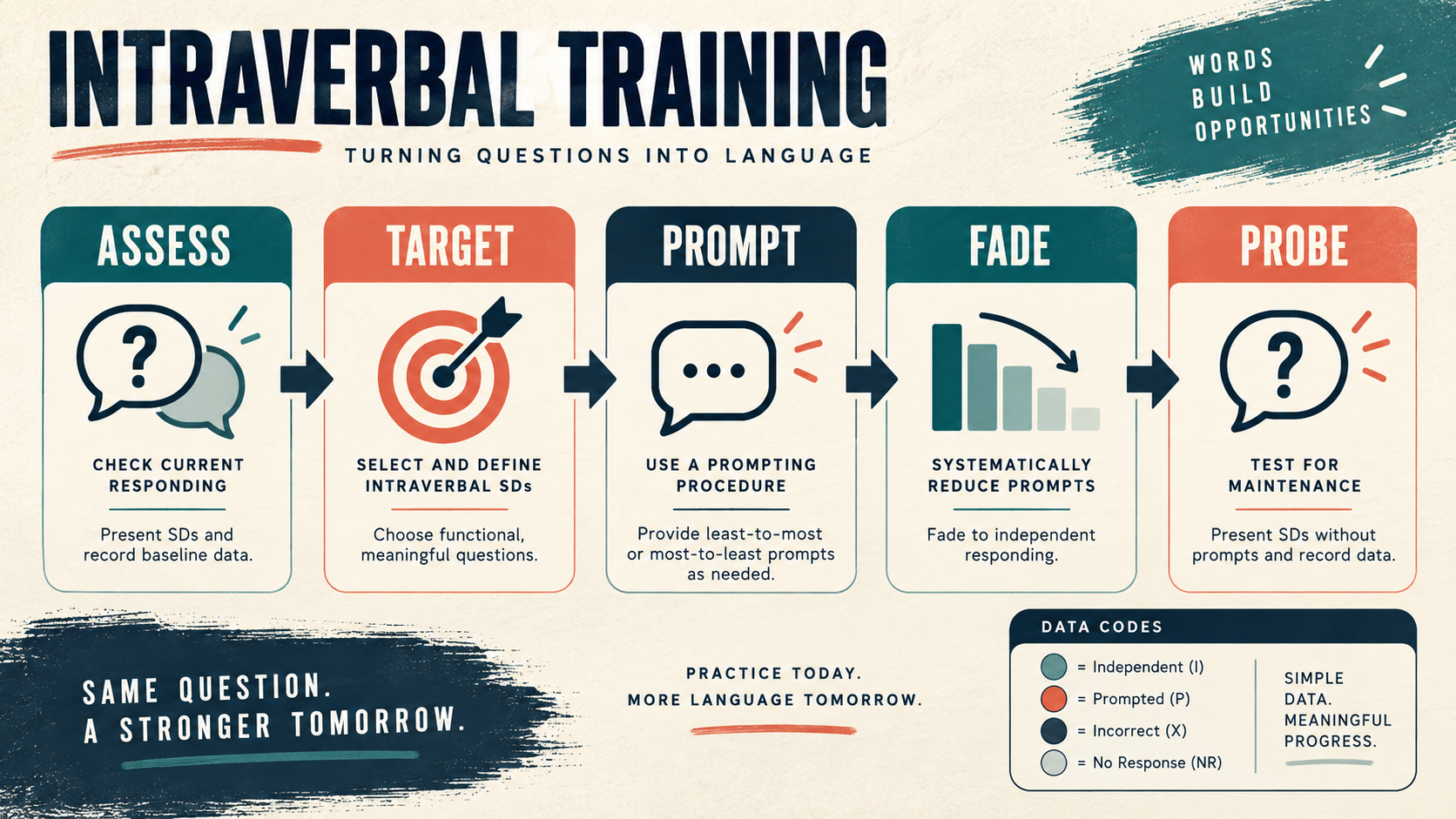
Start with a focused baseline rather than immediately adding prompts. Identify what the learner can already do and where the breakdown occurs. Relevant questions include:
- Does the learner orient to or attend to the speaker’s question?
- Can the learner answer simpler intraverbals, such as familiar fill-ins or one-step questions?
- Is the target response already available as a tact, echoic, sign, AAC selection, or written response?
- Does the learner answer one question correctly but confuse two questions with overlapping words?
- Are response delays, articulation, language access, hearing, motor, or AAC variables affecting performance?
- What communication form is meaningful and accessible for this learner?
Probe the target in a way that can reveal stimulus control. If the goal is to answer “What do you cut with?” with “scissors,” include related but different questions when appropriate, such as “What do you cut?” Do not assume that a correct answer to one question proves the learner can discriminate the question from similar verbal stimuli. The target, acceptable response forms, prompt level, and mastery criterion should be operationally defined before teaching begins.
How Does a Basic Intraverbal Procedure Work?
A basic procedure can be organized as a short teaching loop:
- Present the verbal antecedent clearly and allow the planned response interval.
- Record whether the response is correct, incorrect, absent, delayed, or prompted.
- Deliver the planned consequence for an independent response, such as descriptive social reinforcement or another individualized reinforcer.
- If the response is incorrect or absent, use the least intrusive effective prompt and an established error-correction sequence.
- Fade the prompt and probe the target under the natural or instructional verbal antecedent.
The exact timing and mastery rule belong in the individual plan. Avoid copying a published criterion into every case. A study may use a particular number of consecutive correct responses because it is needed for that design; a clinical program may need a different criterion based on the learner, target, setting, and generalization requirement.
| Decision point | What to define | Why it matters |
|---|---|---|
| Target | The question, acceptable response, communication mode, and context | Prevents vague scoring and respects functional communication differences |
| Prompt | Prompt type, delivery point, and fading plan | Shows whether the verbal antecedent, rather than the prompt, controls responding |
| Consequence | What follows independent and prompted responses | Keeps reinforcement and error correction consistent enough to evaluate |
| Probe | When to test without the teaching prompt and how to sample related targets | Separates acquisition from memorized or prompt-dependent responding |
How Do You Transfer Stimulus Control?
Many intraverbal procedures use a transfer-of-stimulus-control arrangement. The instructor first evokes a response with a prompt that already controls it, such as an echoic or tact prompt, and then gradually transfers control to the question. For example, an instructor may present “What do you cut with?” followed immediately by a model of “scissors,” reinforce the response, and then delay or fade the model across trials. The purpose is not to make the learner repeat the model forever. The purpose is to establish the question as the effective antecedent.
Prompt fading must be visible in the data. If the learner is correct only when the model is delivered, the response is not yet independent. If the learner begins answering before the question is complete, check whether an early fragment of the question is controlling responding. If similar questions produce the same answer, arrange a discrimination probe and teach the relevant difference rather than adding more repetitions of the same question.
Research on intraverbal instruction emphasizes the challenge of multiple control. A response may need to be controlled by more than one verbal component, especially when question pairs differ by a small word or phrase. The practitioner should therefore test the response with varied but meaningful verbal stimuli, not only with the exact sentence used during teaching.
When Can Blocked-Trials Training Help?
Blocked trials are one possible procedure for teaching difficult verbal discriminations. In a blocked arrangement, one target or question is presented repeatedly for a planned block, then another target is presented, and the blocks are gradually reduced or mixed as accurate discrimination develops. A published study of children with autism used a blocked-trials procedure to establish complex stimulus control over intraverbal responses. The procedure included probes and a gradual move toward quasi-random presentation; the results support it as a possible option for some discrimination problems, not as a universal recipe.
Use blocked trials thoughtfully. They may help when the learner is confusing closely related verbal stimuli, but massing one question can also produce narrow responding if the program never tests mixed targets. Add interspersal, varied examples, and probe trials as the learner progresses. If responding falls apart when questions are mixed, that is useful information about stimulus control—not a reason to quietly keep scoring blocked practice as mastery.
How Should Prompting and Error Correction Be Used?
Prompting and error correction should be described before the session rather than improvised after an error. A plan might specify a time delay, a vocal model, a visual or textual prompt, a transfer trial, and the consequence after the prompted response. The least intrusive effective prompt is not automatically the fastest prompt; the best choice is the one that supports learning while allowing prompt fading and learner access.
Record prompted and independent responses separately. A session with 90% correct responses may represent very different learning if one learner answered independently and another required a model on nearly every trial. Also record errors that reveal the pattern: no response, an answer controlled by a related question, an echoic repetition, a response controlled by a picture, or a response in an inaccessible form.
How Do You Program Generalization and Maintenance?
Intraverbal mastery is not complete when a learner answers one adult in one room with one set of materials. Plan probes across communication partners, settings, question wording, topics, response forms, and time. Use sufficient exemplars without turning every session into a random collection of questions. The learner should have meaningful opportunities to use the repertoire in conversation, instruction, daily routines, or other contexts where the response matters.
Maintenance checks should occur after the target has met the stated criterion and again after a reasonable delay. If performance drops, examine whether the skill was over-taught in a narrow format, whether reinforcement changed, whether the response is effortful, or whether the learner needs additional practice. Generalization and maintenance are measured outcomes, not assumptions.
What Common Mistakes Weaken an Intraverbal Program?
- Calling every verbal answer an intraverbal: identify the controlling antecedent and whether there is point-to-point correspondence.
- Scoring prompted answers as independent: record prompt level and independence separately.
- Using one question forever: vary examples and probe related questions so stimulus control can be evaluated.
- Ignoring the communication mode: accept the response form defined as functional for the learner rather than treating speech as the only valid outcome.
- Confusing fluency with generalization: fast answers in massed practice do not prove flexible conversational use.
- Applying a research protocol without its conditions: procedures, participants, targets, and mastery rules from a study cannot automatically be transplanted into every case.
What Are the BCBA Exam Takeaways for Intraverbal Training?
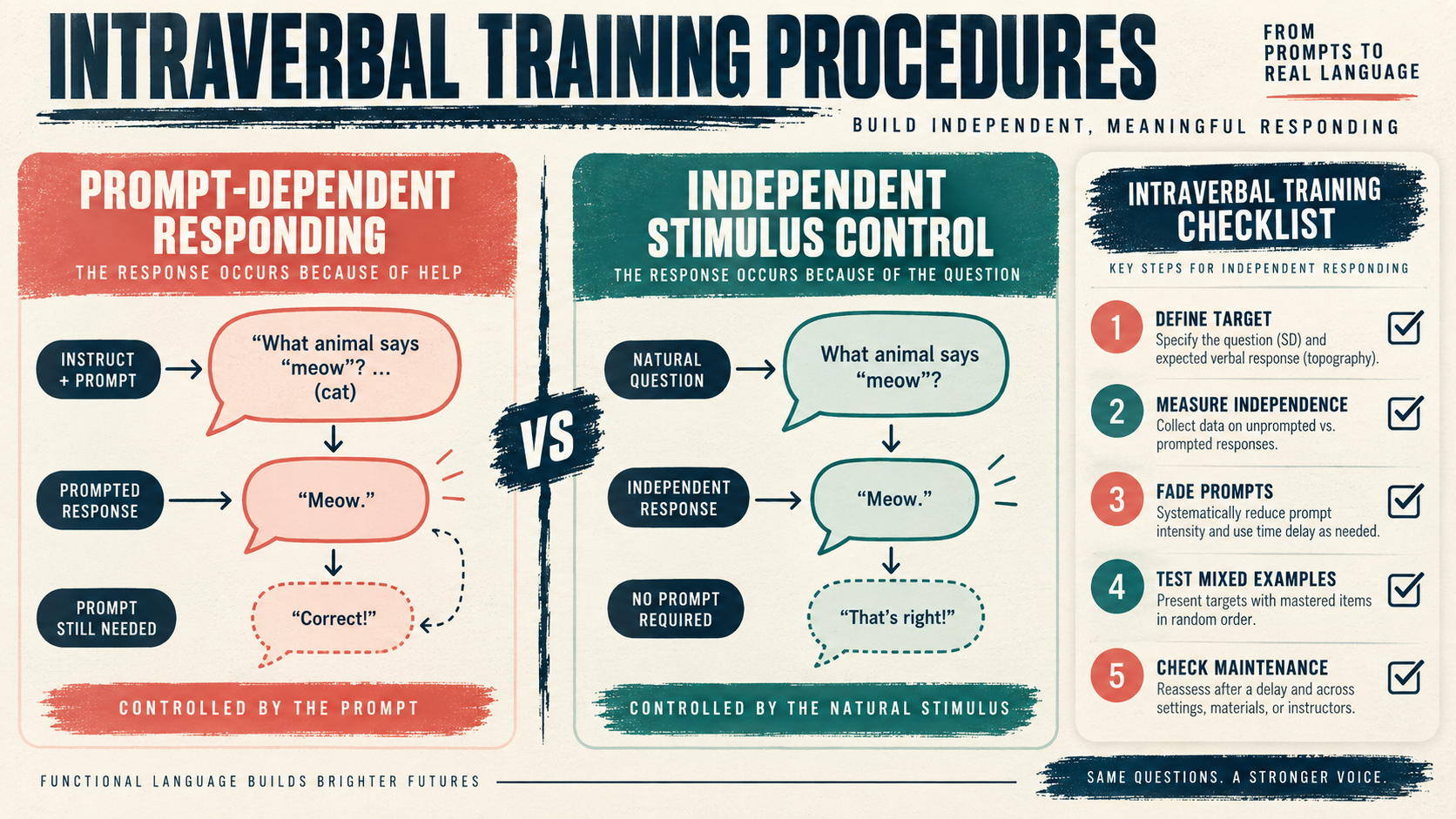
For BCBA exam reasoning, connect the procedure to the controlling variables and the data. A strong answer will usually recognize that:
- intraverbals are verbal responses controlled by verbal antecedents without point-to-point correspondence;
- assessment should identify the current repertoire and the exact discrimination problem;
- prompting is a temporary support whose control should be transferred and faded;
- prompted and independent responding must be distinguished;
- mixed probes, varied exemplars, generalization, and maintenance are needed to evaluate flexible stimulus control;
- a published procedure is an evidence-informed option, not a one-size-fits-all clinical order.
The BACB’s current certification materials place behavior-analytic concepts, measurement, assessment, behavior change, and intervention evaluation within the broader exam context. For practice with scenario-based reasoning, you can also use the site’s free BCBA mock exam. It is an independent study resource, not official BACB content and not a guarantee of a certification result.
Frequently Asked Questions
Is an intraverbal the same as an echoic?: No. An echoic has point-to-point correspondence with a verbal model. An intraverbal is evoked by verbal behavior but does not copy the verbal antecedent in that way. A prompt may temporarily be echoic, but the teaching goal is often to transfer control to the question or conversational cue.
Should I use blocked trials for every intraverbal target?: No. Blocked trials are one option when the data show a difficult discrimination. Use assessment, individualization, prompt fading, mixed probes, and generalization checks to determine whether the procedure fits the learner and target.
What is the most important data point?: There is no single universal data point. At minimum, distinguish independent, prompted, incorrect, and no-response trials in a way that matches the target. Add latency, response form, or generalization data when those variables are important to the instructional question.
Sources for Further Study
- Intraverbal Training for Individuals with Autism: The Current Status of Multiple Control — systematic review of intraverbal training and multiple control.
- Evaluation of a Blocked-Trials Procedure to Establish Complex Stimulus Control — an example of blocked-trials training and probe design.
- A Review of Training Intraverbal Repertoires — review of procedures for establishing and increasing intraverbal repertoires.
- BACB Test Content Outlines — current official certification content resources.
Take the Free BCBA Mock Exam
If you want a low-pressure way to check your recall, use the free practice resource below. Take the Free BCBA Mock Exam



