

Short answer: interspersal ABA usually refers to task interspersal: arranging maintenance or mastered tasks among acquisition or more difficult tasks during instruction. The mix can increase contact with successful responding, vary the response effort, and make the teaching sequence easier to analyze. It is not a guarantee that every learner will learn faster, and it is not the same as a high-probability request sequence. A BCBA should define the arrangement, measure the relevant outcomes, and individualize it.
Table of Contents
- What is interspersal ABA?
- How is task interspersal different from other teaching arrangements?
- What does a bounded task-interspersal example look like?
- How can you measure whether the mix helps?
- What variables should a BCBA individualize?
- What ethical safeguards matter?
- How does interspersal ABA appear on BCBA exam questions?
- What interspersal ABA mistakes should candidates avoid?
- What is a 15-minute interspersal study method?
- Interspersal ABA FAQ
- Take the Free BCBA Mock Exam
For BCBA study, remember the logic rather than a fixed ratio. Ask: Which tasks are already strong? Which tasks are being acquired? How are they ordered? What happens after correct and incorrect responses? Does the arrangement improve acquisition, maintenance, engagement, or only the appearance of smooth instruction? Those questions keep an interspersal ABA answer tied to observable data. Table of Contents
What is interspersal ABA?
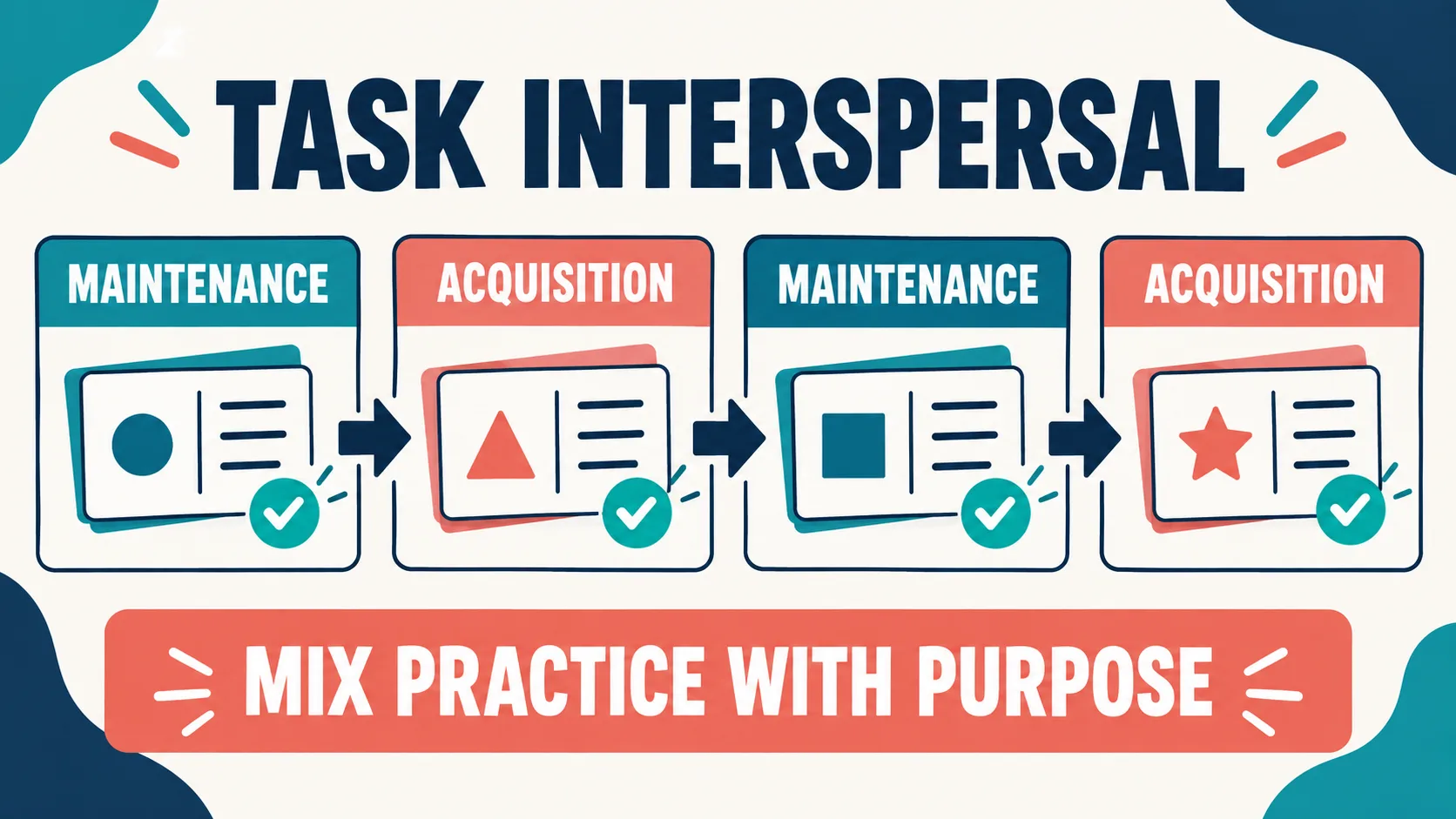
Task interspersal is an instructional arrangement in which different task types are mixed instead of presenting a long, uninterrupted block of one type. In a common example, maintenance tasks that the learner can already perform are placed among acquisition tasks that still require teaching. The maintenance opportunities may contact reinforcement and fluent responding while the acquisition targets provide the learning opportunity.
The word “interspersal” describes the arrangement, not a single universal procedure. Researchers and practitioners have varied the difficulty of the tasks, the ratio of maintenance to acquisition trials, the order of trials, the kinds of prompts, and the reinforcement schedule. A survey of providers working with individuals with autism found that many variations are in use and that providers do not always select the variation most directly supported by the research literature. That is why a strong interspersal ABA definition includes both the sequence and the measurement plan. A compact model is:
- Identify task classes: separate maintenance or mastered responses from acquisition or lower-probability responses.
- Arrange the sequence: place tasks in an intentional pattern instead of an accidental order.
- Teach and respond: use the planned prompt, error-correction, and reinforcement procedures.
- Evaluate the effect: compare acquisition, accuracy, latency, engagement, or maintenance using defined data.
Task interspersal should not be confused with simply changing activities to keep a session interesting. Variety can be useful, but task interspersal is an analyzable arrangement. The analyst should be able to state which tasks were mixed, why they were mixed, and what outcome would support continuing or changing the arrangement.
How is task interspersal different from other teaching arrangements?
Many instructional strategies use words such as “mix,” “sequence,” or “easy.” The controlling features are more important than the label. Use the table as a BCBA study map; the exact procedure still has to be defined in the scenario or protocol.
| Arrangement | Defining feature | What to measure | Common confusion |
|---|---|---|---|
| Task interspersal | Maintenance and acquisition or different task types are mixed within an instructional sequence. | Acquisition, accuracy, latency, engagement, reinforcement density, and maintenance | Assuming one fixed maintenance-to-acquisition ratio works for everyone |
| Massed trials | The same target or response class is practiced repeatedly in a block. | Accuracy across repetitions, error patterns, prompt dependence, and retention | Calling any repeated target “interspersal” because the materials change |
| Distributed trials | Teaching opportunities are spread across time, activities, or settings rather than concentrated in one block. | Performance by interval, context, delay, and generalization | Treating distributed practice as automatically interspersed practice |
| High-probability request sequence | Several requests with a high probability of compliance precede a lower-probability request. | Compliance with the low-probability request, response latency, and problem behavior | Assuming every easy-task mix is a high-p sequence |
| Interspersed requests | Simple requests are inserted among instructional trials, often to alter the immediate instructional context. | Responsiveness, aggression or self-injury, task completion, and instructional integrity | Using the names as synonyms without checking the response sequence |
The distinction between task interspersal and a high-probability request sequence is especially important. A task-interspersal program may mix maintenance and acquisition targets across a session. A high-p sequence is defined by the probability of responding to the requests and by the placement of the low-probability request after the high-probability requests. The fact that both arrangements can include “easy” tasks does not make them identical.
What does a bounded task-interspersal example look like?
Imagine a teaching session for labeling common items. The learner has a stable maintenance response for three familiar labels and is acquiring two new labels. The instructional team defines a trial as presenting the item, delivering the instruction, recording the response, applying the planned prompt or correction if needed, and delivering the programmed consequence. Instead of presenting all new labels in a long block, the team places a maintenance trial between selected acquisition trials.
The example becomes analyzable when the sequence is written down. For instance, the sequence might be: maintenance, acquisition, maintenance, acquisition, maintenance. The labels themselves are not the important part. The BCBA should specify how the order was selected, whether the maintenance responses remain strong, and whether the learner’s acquisition performance differs from a comparison arrangement.
Do not overstate the example. A smooth sequence does not prove that task interspersal caused faster learning. A learner may respond accurately because the prompts were strong, because the reinforcer changed, because the targets became easier, or because the learner had prior exposure. If the question asks for experimental reasoning, identify the variables that were held constant and the variables that changed.
A research-informed example also considers task similarity. Interspersing related tasks may produce different stimulus-control effects than interspersing unrelated tasks. The literature includes studies of task interspersal for object labels, tacts, intraverbals, and other targets; therefore, write the target response and stimulus arrangement explicitly rather than calling every sequence “generalization.”
How can you measure whether the mix helps?
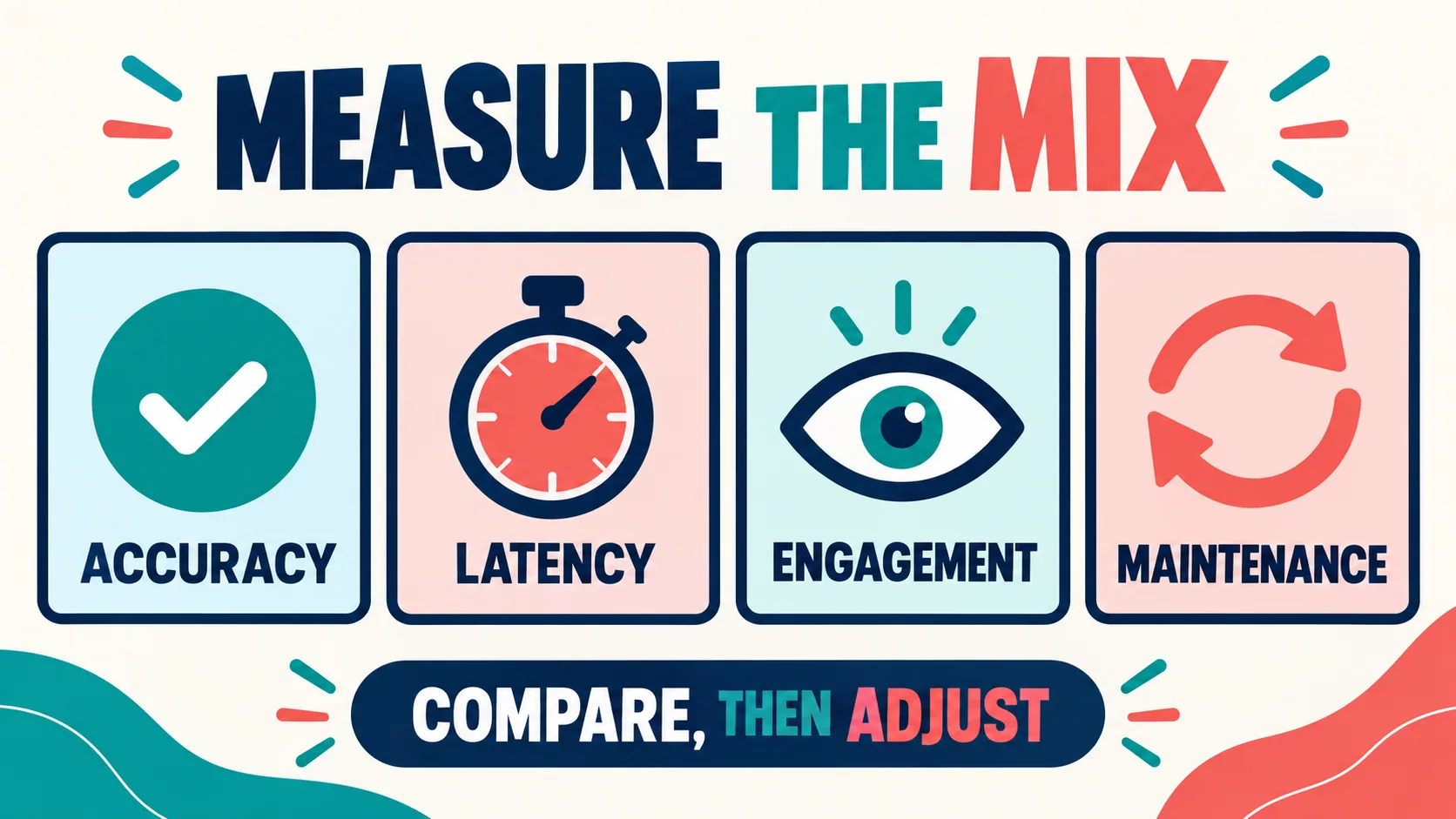
Start with the outcome that matters, not with the assumption that a visually varied session is better. Depending on the instructional goal, useful measures can include percentage correct, independent correct responding, latency to respond, number of prompts, rate of acquisition, maintenance at a later probe, generalization across people or materials, and engagement defined in observable terms.
Keep the data tied to the task class. If maintenance trials are nearly perfect but acquisition trials remain unchanged, the arrangement may be producing a pleasant rhythm without improving the target skill. If acquisition improves but maintenance deteriorates, the sequence may need revision. If responding improves only when the same reinforcer is delivered after every easy and difficult task, examine whether satiation or differential reinforcement is influencing the outcome. Useful comparison questions include:
- Does the learner acquire the target at a faster or more stable rate than under the comparison arrangement?
- Does the learner maintain the previously mastered response when it is revisited?
- Does the sequence reduce latency or problem behavior without increasing prompt dependence?
- Does the effect generalize to another person, material, setting, or task class?
- Is the procedure implemented as written across instructors?
A survey of task-interspersal practices found that providers often rely on clinical judgment or organizational guidance when choosing variations. That finding is a reminder to pair judgment with current research, direct measurement, and supervision. It is not a reason to copy a published ratio without considering the learner and the instructional objective.
What variables should a BCBA individualize?
There is no universal “correct” number of maintenance tasks for every acquisition task. Individualize the task selection, difficulty, order, prompt level, response effort, reinforcer, pace, communication supports, and break arrangement. Consider whether the maintenance task is genuinely fluent, whether the acquisition task is within the learner’s current instructional range, and whether the mixed sequence creates too much switching.
- Task history: confirm that a supposed maintenance task meets its criterion for this learner.
- Response effort: check whether the acquisition task is disproportionately harder than the maintenance task.
- Prompting: plan how prompts and fading will be recorded across both task classes.
- Reinforcement: review density, quality, timing, and possible satiation instead of assuming one consequence fits all trials.
- Communication and breaks: make help, pause, and refusal signals available and meaningful.
Also individualize the definition of engagement. Looking at the instructor, touching materials, or sitting still may not be necessary evidence that the learner is learning. Use the person’s communication mode and meaningful performance measures. Offer a functional way to request help or a break, and treat changes in responding as a cue to examine the arrangement rather than as proof of defiance.
When several providers implement the program, document the sequence with enough precision to support treatment integrity. The task-interspersal implementation survey is useful for studying why variations matter: providers may use different task combinations, reinforcement arrangements, and individualization practices even when they use the same broad label.
What ethical safeguards matter?
Task interspersal is an instructional arrangement, not permission to force participation. The BACB Ethics Code for Behavior Analysts requires behavior analysts to protect client dignity, work within competence, obtain appropriate consent, and use scientifically supported and individualized services. The exact code language and current requirements should be checked directly rather than summarized from a study guide.
In practice, define how the learner can communicate “help,” “break,” or “stop” when feasible and respond to that communication according to the plan. Do not use a maintenance task as a trick to bypass assent or to conceal an aversive task. Do not describe a learner as noncompliant merely because the interspersed sequence is too difficult, too fast, poorly reinforced, or mismatched to the person’s communication needs.
Use supervision and data review when the sequence is not working. A procedure that increases correct responses but also increases distress, escape behavior, or prompt dependence may need a different analysis. Ethical decision-making includes the learner’s welfare, stakeholder input, social validity, and the least intrusive effective arrangement—not just a higher percentage on one data sheet.
How does interspersal ABA appear on BCBA exam questions?
The current BCBA Test Content Outline is the official boundary for exam preparation. “Interspersal ABA” is a study keyword, not a claim that the BACB requires a particular task-interspersal ratio. On a scenario question, identify the arrangement from the facts provided and then choose the answer that matches the stated dependent variable and ethical context. Use this decision sequence:
- Classify the tasks: Are the tasks maintenance, acquisition, high-probability, low-probability, or simply different?
- Classify the order: Are tasks mixed across a session, distributed across time, or arranged as a short high-p sequence?
- Find the outcome: Is the stem measuring accuracy, acquisition rate, latency, engagement, problem behavior, or maintenance?
- Check the evidence: What changed, what was controlled, and what alternative explanation remains?
- Protect the learner: Does the proposed answer preserve consent, dignity, communication, and individualized decision-making?
For deeper comparison, the peer-reviewed study comparing massed-trial, distributed-trial, and task-interspersal instruction shows why the names should be defined before interpreting an outcome. The PubMed record for that comparison is a useful starting point, while the exploratory task-interspersal study provides an applied example with important limits.
What interspersal ABA mistakes should candidates avoid?
- “Mixing tasks is always better.” The effect depends on the learner, target, task arrangement, reinforcement, and measurement.
- “Maintenance means easy for everyone.” A task is maintenance only relative to a defined learner, response, criterion, and history.
- “Task interspersal equals high-p instruction.” Identify the sequence and probability features instead of matching by appearance.
- “More correct responding proves faster acquisition.” Separate acquisition, maintenance, prompts, and generalization.
- “The ratio is the procedure.” A ratio without task definitions, consequences, and decision rules is not enough.
- “A study result is a universal prescription.” Research findings support informed decisions, not automatic copying.
- “Refusal is a behavior to work through.” Check task difficulty, communication, assent, reinforcement, and safety before labeling it.
- “Interspersal is an official BACB requirement.” Use the current Test Content Outline for official scope.
What is a 15-minute interspersal study method?
Draw a five-column grid labeled task class, sequence, prompt, consequence, and measure. Take one practice vignette and fill in only what is stated. Then write whether the arrangement is task interspersal, a high-probability sequence, distributed practice, or not enough information.
Next, change one feature in the vignette. For example, turn the maintenance-acquisition mix into three high-probability requests followed by one low-probability request. Ask what changed in the definition and what dependent variable would be most relevant. This contrast exercise is more durable than memorizing a single ratio.
Finally, write one ethical checkpoint: “What communication or assent signal would make me pause and reassess the arrangement?” Use a free BCBA mock exam for timed practice after you can explain the distinction. It is an independent study resource, not an official BACB examination or a guarantee of a passing result.
Bottom line: Interspersal ABA is an intentional mix of task types, often maintenance and acquisition, within instruction. Define the sequence, distinguish it from high-probability and distributed arrangements, measure the outcome that matters, and adjust based on learner-specific data and ethical safeguards.
Interspersal ABA FAQ
What does interspersal mean in ABA? It generally means placing different task types or response classes among one another during instruction. Task interspersal often mixes maintenance or mastered tasks with acquisition tasks, but the exact arrangement must be defined.
Is task interspersal the same as a high-probability request sequence? No. A high-probability sequence is defined by placing several requests with a high likelihood of compliance before a lower-probability request. Task interspersal is broader and may mix maintenance and acquisition tasks across a teaching sequence.
Why intersperse maintenance tasks? Maintenance tasks may provide opportunities for successful responding and reinforcement while acquisition targets are taught. That possible benefit still has to be evaluated; maintenance tasks can also be poorly selected, too easy, or arranged in a way that does not improve the target skill.
What should be measured? Match measurement to the instructional goal. Accuracy, independent responding, latency, prompts, acquisition rate, maintenance, generalization, engagement, and problem behavior may all be relevant, but one article or program does not need every measure.
Does interspersal ABA guarantee less problem behavior? No. Research findings are context-specific, and task interspersal is not a universal behavior-reduction procedure. Analyze function, task difficulty, reinforcement, communication, and safety rather than assuming that a mixed sequence will solve problem behavior.
Is interspersal ABA an official BCBA requirement? The keyword is not itself an official certification requirement. Use current BACB documents for exam scope and ethics rules, then use peer-reviewed research to understand the instructional concept.
Take the Free BCBA Mock Exam
If you want a low-pressure way to check your recall, use the free practice resource below. Take the Free BCBA Mock Exam



