

Short answer: metacontingency ABA is a way to analyze how coordinated behavior among people produces an aggregate product and how a consequence at the cultural or group level can select the future recurrence of that coordinated pattern. It is not simply a large individual contingency, a synonym for a group contingency, or a BACB credentialing requirement.
Table of Contents
- What is metacontingency ABA?
- How do the three pieces fit together?
- How is a metacontingency different from other contingencies?
- What is a bounded ABA example?
- What is metacontingency not?
- How should BCBA candidates study it?
- What are common exam traps?
- What is a 15-minute study method?
- Metacontingency ABA FAQ
- Take the Free BCBA Mock Exam
The concept is most useful when the unit of analysis is bigger than one person’s response. A BCBA candidate can use it to ask: Who is coordinating with whom? What does the coordinated pattern produce? What consequence affects whether that pattern continues? The research literature uses related terms differently across models, so a good study answer defines the terms before applying them. Table of Contents
What is metacontingency ABA?
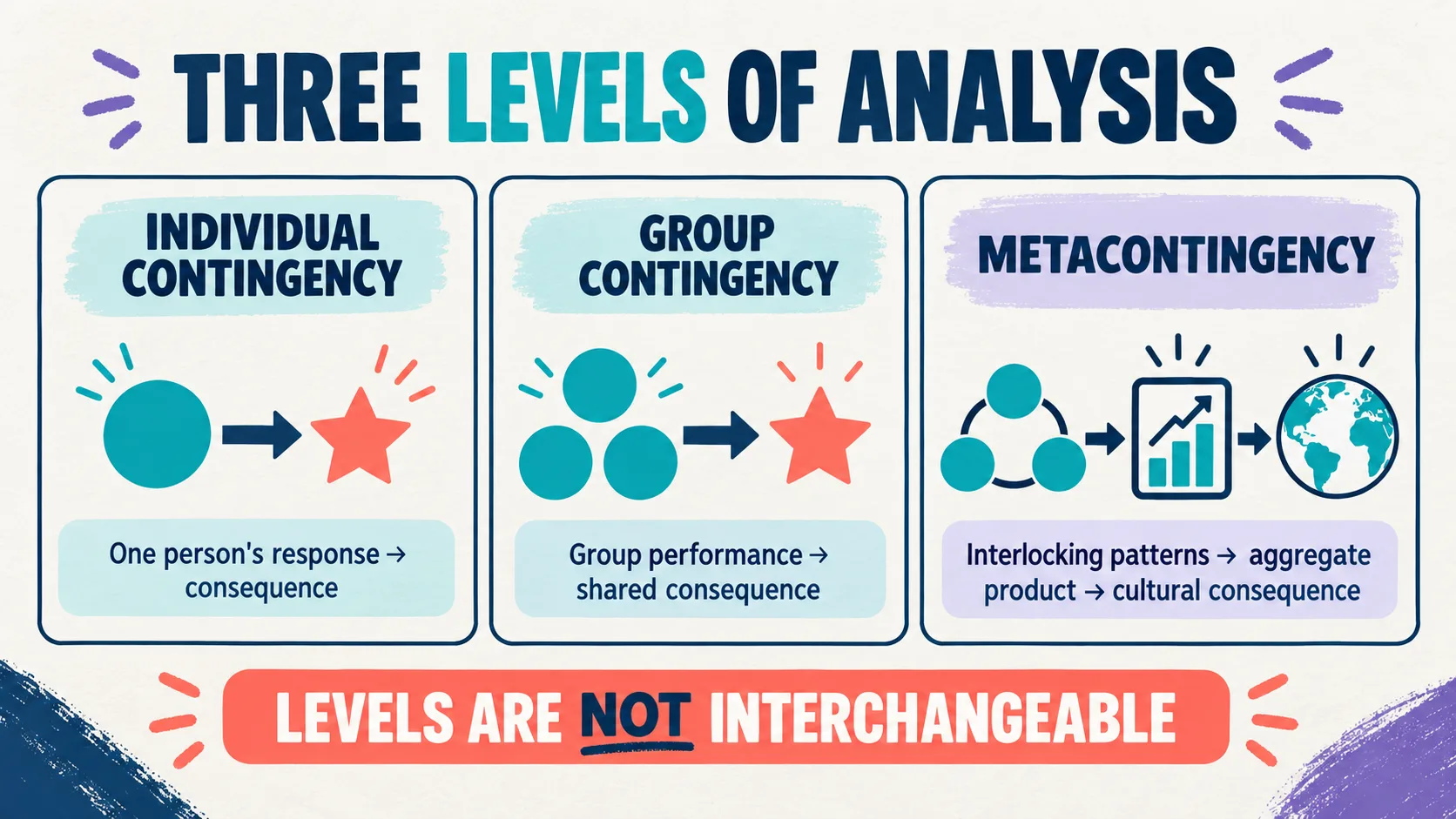
In behavior analysis, a metacontingency describes a relation between interlocking behavioral contingencies (IBCs), their aggregate product, and a cultural consequence. The people involved do not merely act at the same time. Their actions are connected: one person’s behavior changes the conditions in which another person acts, and the coordinated pattern produces an outcome that would not be described adequately by looking at one response alone.
The term is associated with the cultural-level analysis developed in behavior-analytic scholarship, including work by Sigrid Glenn and later conceptual and experimental discussions. The literature is not a single-page glossary, so treat a journal article as a conceptual source rather than assuming that one simplified diagram is the entire theory. The article Contingencies and metacontingencies: Toward a synthesis is a useful starting point for the relationship between behavior, cultural practices, and selection. A compact way to remember the model is:
- IBCs: recurring actions by multiple people are functionally connected.
- Aggregate product: the coordinated pattern produces an outcome or product at the group or cultural level.
- Cultural consequence: a consequence affects the probability that the pattern and product will recur as a unit.
“Cultural” does not necessarily mean a whole country or a formal institution. Depending on the analysis, it can refer to a smaller community, organization, team, or other group whose practices are being selected and transmitted. The key is the level of analysis and the functional relation, not the size of the room.
How do the three pieces fit together?
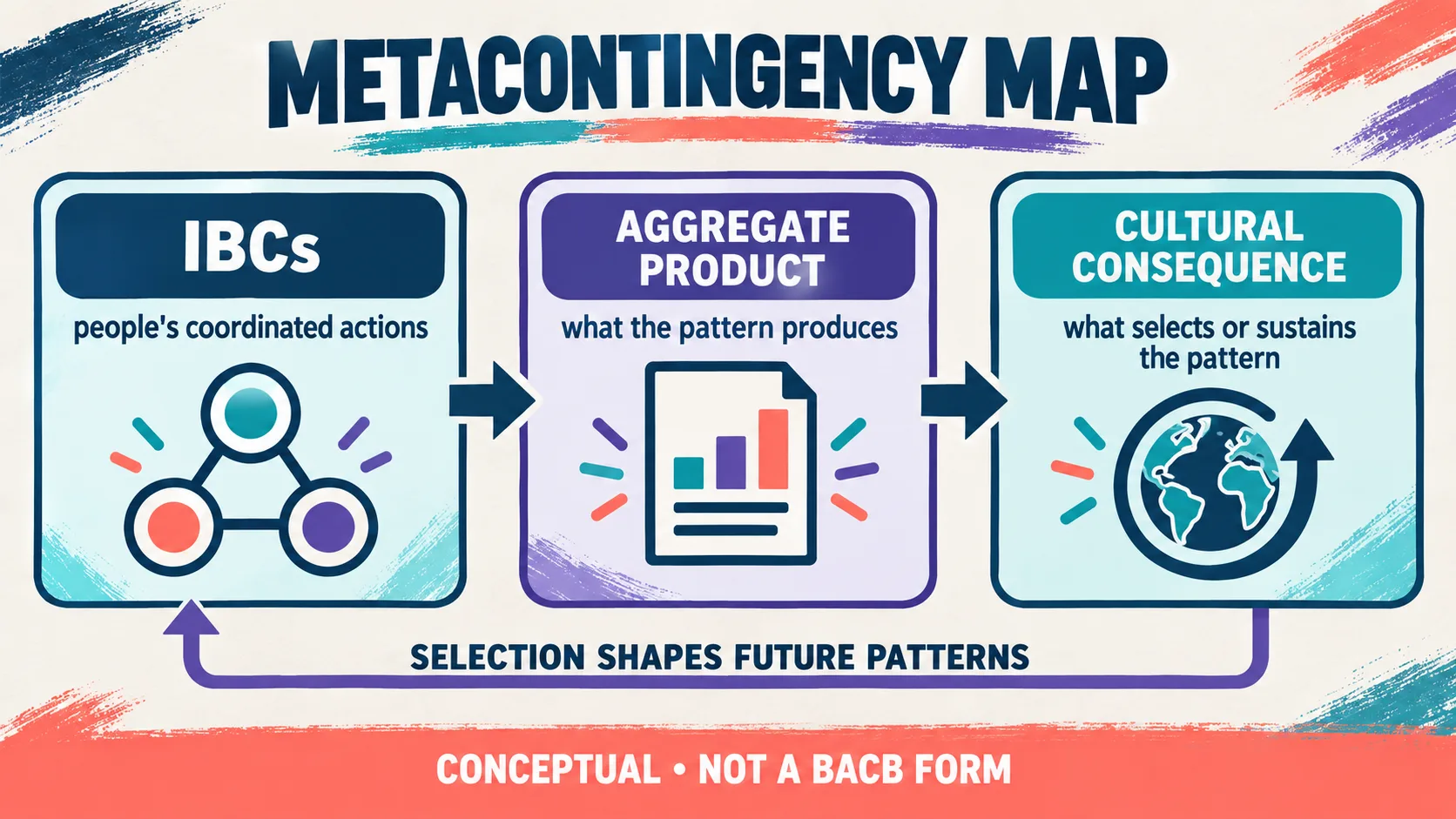
Start with the coordinated pattern, not with the label. Suppose three people repeatedly divide tasks, exchange information, and adjust their actions so that a shared product is created. If the product is then followed by a consequence that makes the coordinated practice more likely to continue, the analyst can ask whether the relation fits a metacontingency model. The three pieces answer different questions:
- IBCs: What does each participant do, and how do the participants’ actions depend on one another?
- Aggregate product: What outcome emerges from the coordination? Is it observable or otherwise defined well enough to analyze?
- Cultural consequence: What consequence selects, sustains, or changes the recurring practice at the group or cultural level?
An individual reinforcer may support one person’s behavior inside the pattern, but that does not automatically make it a cultural consequence. Similarly, a team may produce a shared report once without demonstrating a recurring selected practice. Metacontingency analysis requires attention to recurrence, coordination, the product, and the consequence that operates at the relevant level.
Research on the concept often asks how the components can be described and measured rather than treating the terms as decorative vocabulary. For example, research on description and experimentation in the metacontingency enterprise discusses the importance of connecting conceptual descriptions to observable relations. That is a useful exam habit: translate a broad phrase into actions, products, consequences, and evidence.
How is a metacontingency different from other contingencies?
The words look similar, which is why comparison questions can be difficult. Use the unit of analysis, the product, and the consequence to separate them. The table below is a study map, not a claim that every author uses each term identically.
| Concept | Primary unit | What to identify | Common trap |
|---|---|---|---|
| Individual contingency | One person’s behavior | Antecedent, response, and consequence for the individual | Calling any shared setting a cultural-level analysis |
| Group contingency | Performance of group members or the group | How a shared criterion produces a common consequence | Assuming a common reward proves interlocking contingencies |
| Macrocontingency | Aggregate effect of related individual practices | How separate behaviors accumulate into a larger outcome | Adding coordination that the example never established |
| Metacontingency | Coordinated IBCs and their product | Recurring coordination, aggregate product, and a selecting cultural consequence | Reducing the concept to “people got a reward” |
Terminology can vary by author and research program. The metacontingency terminology discussion is helpful when a question uses words such as aggregate product, cultural consequence, macrocontingency, or interlocking behavioral contingencies. When answer choices use different labels, prioritize the functional description over the most familiar-sounding noun.
What is a bounded ABA example?
Imagine a clinic team reviewing how it hands off a learner’s data between two service settings. One team member records a clearly defined measure, another checks the data against the treatment plan, and a third prepares a concise handoff that allows the next setting to make a timely decision. Their actions are interdependent: the reviewer needs the first record, and the handoff depends on the review.
The aggregate product could be a complete, usable handoff packet that meets a predefined quality criterion. A later group-level consequence might be that the clinic adopts the handoff routine across teams because it reliably supports continuity of decision-making. That consequence could select the practice so it is more likely to recur. The example is deliberately bounded: it describes a conceptual pattern, not a recommendation to change client care without authorization. To analyze the example, write four notes:
- Record the observable action of each participant.
- Draw the dependency between the actions rather than listing them as unrelated tasks.
- Define the shared product in observable or measurable terms.
- Identify the consequence that affects the recurrence of the coordinated practice.
Now test the boundaries. If each person independently completes a form and the forms are merely added together, the analysis may be closer to an accumulation of individual behavior. If a group receives a reward for meeting a deadline but no interlocking pattern or aggregate product is described, the example may be a group contingency instead. The label should follow the evidence.
What is metacontingency not?
Several shortcuts create inaccurate explanations. Metacontingency is not a synonym for teamwork, collaboration, culture, reinforcement, or a group reward. It is not a BACB form, an eligibility pathway, a supervision requirement, or a replacement for functional assessment. It also does not mean that an analyst can infer a cultural consequence from a single successful meeting.
- Not simply “many people”: the actions must be analyzed as coordinated relations.
- Not simply “one shared reward”: the product and level of selection still matter.
- Not automatically a treatment procedure: the term is conceptual and descriptive unless a specific research design is provided.
- Not a BACB rule: do not put it on a certification checklist unless a current official source specifically requires it.
- Not a moral judgment: describe the functional relations and evidence before evaluating them.
How should BCBA candidates study it?
The current BCBA Test Content Outline is the official map for examination content. It does not make every research term a named test task, and the outline should not be used to claim that metacontingency is an official BACB requirement. Instead, use the concept to strengthen reasoning about behavior, contingencies, group processes, experimental description, and cultural or contextual variables when those appear in a scenario. Study it in three passes:
- Definition pass: state IBC, aggregate product, and cultural consequence in your own words.
- Discrimination pass: compare the term with an individual contingency, group contingency, and macrocontingency.
- Application pass: mark what the scenario actually describes and what information is missing.
For a practice question, do not choose the answer that contains the most technical vocabulary. Choose the answer that matches the unit of analysis and the evidence. If the stem describes a single person responding to an antecedent and consequence, stay at the individual level. If it describes coordinated actions that produce a shared product and a consequence selecting the pattern, then a metacontingency explanation may fit.
What are common exam traps?
- Confusing coordination with co-occurrence.
- Calling the shared product a consequence without explaining what it produces.
- Calling an individual reinforcer a cultural consequence without identifying the group-level effect.
- Assuming that a group contingency automatically contains IBCs.
- Using “culture” as a broad synonym for any classroom or clinic.
- Ignoring recurrence and treating one event as a selected practice.
- Choosing a term because it sounds more advanced rather than because the stem supports it.
- Presenting a research concept as if it were an official BACB requirement.
What is a 15-minute study method?
Use a four-column note for one example: participants’ actions, interlocking relations, aggregate product, and selecting consequence. Fill in only what the source or scenario supports. Put a question mark next to any component that is missing. Then write one sentence explaining why the example is or is not enough to call a metacontingency.
Finish with a contrast question: “What would make this a group contingency instead?” or “What evidence would show that the actions were independent?” That contrast is more durable than copying a definition. Use peer-reviewed sources such as the discussions of interindividual performance in metacontingencies and cultural contingencies when you want a deeper research example.
When you are ready to test the broader BCBA reasoning behind the concept, use a free BCBA mock exam as a timed practice step. It is an independent study resource, not an official BACB exam and not a guarantee of a passing result.
Bottom line: Metacontingency ABA is a group- and cultural-level concept. Identify the interlocking behavioral contingencies, define the aggregate product, and show what consequence selects the recurring practice. Then compare the evidence with individual, group, and macrocontingency explanations before choosing a label.
Metacontingency ABA FAQ
What is a metacontingency in simple terms? It is a way to analyze coordinated behavior among people, what that coordination produces, and a consequence that influences whether the coordinated pattern continues. Is metacontingency part of the BACB requirements? It is not a credentialing requirement simply because it appears in behavior-analytic literature. Use the current BACB handbook and Test Content Outline for official certification and examination requirements.
What is the difference between a metacontingency and a group contingency? A group contingency typically describes a contingency involving group performance and a shared consequence. A metacontingency focuses on interlocking behavioral contingencies, an aggregate product, and selection of the recurring cultural practice. The stem must support that additional structure.
Can a clinic team be an example? It can be a bounded illustrative setting if the analysis identifies coordinated actions, a defined aggregate product, and a consequence that affects recurrence. Simply saying “the team worked together” is not enough.
Does a metacontingency require a reward? No single reward formula defines the concept. The important question is what consequence selects or sustains the coordinated practice at the relevant level. Do not substitute a generic token or bonus for the analysis.
Which source should I use for exam study? Use the BACB Test Content Outline for official exam content, then use peer-reviewed behavior-analytic literature to understand the conceptual term. Mark the difference between an official BACB requirement and a research concept in your notes.
Take the Free BCBA Mock Exam
When you are ready to apply the idea, use the free practice resource below for additional feedback. Take the Free BCBA Mock Exam



