
Reducing behavior problems through functional communication training is the title of a landmark 1985 article by Edward G. Carr and V. Mark Durand. The paper is important for BCBA exam preparation because it illustrates a central function-based idea: when problem behavior reliably produces an outcome, teaching an efficient communication response can provide a safer, socially meaningful way to contact that same outcome.
Table of Contents
- Reducing Behavior Problems Through Functional Communication Training
- What Did the Carr and Durand Study Examine?
- Why Must the Communication Response Match the Function?
- What Makes a Functional Communication Response Effective?
- How Does FCT Connect Assessment and Treatment?
- How Should a BCBA Evaluate FCT Data?
- How Do Maintenance and Generalization Fit?
- What Are Common BCBA Exam Traps?
- Frequently Asked Questions
- Sources for Further Study
- Take the Free BCBA Mock Exam
This is a study guide to the article and the reasoning it represents. It is not a learner-specific treatment protocol. A qualified behavior analyst must complete the appropriate assessment, consider communication access and safety, collaborate with the relevant professionals, and monitor data before applying any intervention.
Reducing Behavior Problems Through Functional Communication Training
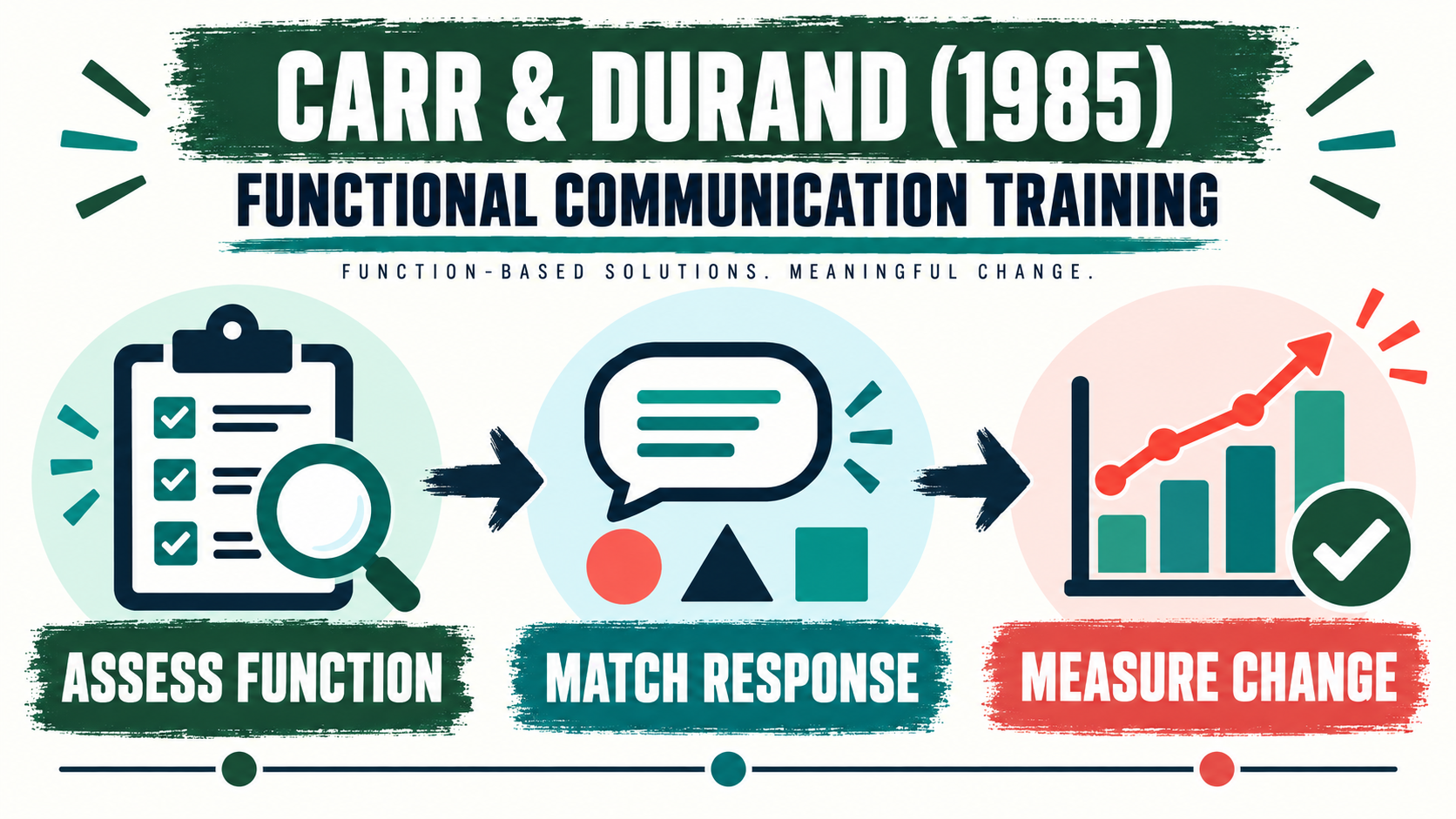
Functional communication training, or FCT, is a function-based differential-reinforcement procedure. The learner is taught a recognizable communication response that produces the same class of reinforcement that previously followed problem behavior. The communication response could be a vocal request, sign, picture exchange, speech-generating-device response, gesture, or another accessible form. The modality is selected for the learner; speech is not automatically the goal.
The logic is different from simply telling someone to “use words” or rewarding any quiet behavior. First, the team asks what the problem behavior has accomplished in that context. If hitting has reliably produced escape from a difficult task, a break request may be relevant. If screaming has produced adult attention, an attention request may be relevant. If the response does not contact the same meaningful outcome, it may not compete with the problem behavior.
The historical contribution of the paper is therefore not a single phrase to memorize. It is the link between functional assessment, communication, reinforcement, and observable behavior change. A BCBA-style question may test whether you can identify that link before selecting a teaching procedure.
What Did the Carr and Durand Study Examine?
Carr and Durand examined whether teaching functionally related vocal responses could reduce problem behavior for children with developmental disabilities. Later reviews describe the study as an early demonstration of FCT in which the communication response was selected to access attention or assistance, depending on the variable maintaining the problem behavior.
That distinction matters. The study did not show that one universal request eliminates every form of challenging behavior. It showed why an analyst should identify the relevant environmental relation and then teach a communication response that can work in that relation. The response must be understandable, efficient enough to use, and reinforced in a way that makes it a practical alternative.
| Question in the study logic | What the analyst examines | Why it matters |
|---|---|---|
| What follows problem behavior? | Attention, escape, access to materials, or another consequence supported by assessment data | The consequence helps identify what the alternative response must contact |
| What should be taught? | An accessible communicative response that is functionally related to the outcome | A response that does not work for the learner will not reliably compete with the problem behavior |
| What should change? | The rate or severity of problem behavior and the rate or independence of communication | Both outcomes are needed to judge whether the replacement is meaningful |
For exam purposes, keep the study’s contribution separate from modern clinical guidance. The original paper is historical evidence. Later research has examined response selection, schedule thinning, generalization, caregiver implementation, and safety in more detail. A good answer recognizes the original function-based principle without treating one early study as a complete protocol.
Why Must the Communication Response Match the Function?
Function is the practical reason FCT is not interchangeable with a generic replacement-behavior list. A break request may be appropriate when behavior is maintained by escape, but it may not address behavior maintained by attention or access to a tangible item. A request for attention may be useful in one context and irrelevant in another.
Suppose a learner throws materials when a task is presented and the assessment supports an escape relation. Teaching “break, please” may be reasonable if the learner can use that response, the task is represented safely, and the plan specifies what happens after the request. Teaching “I want attention” would not be functionally equivalent unless attention is the relevant reinforcer. The analyst should not select a phrase because it sounds polite; the response must have a defensible behavioral relation.
- Define the problem behavior in observable terms rather than relying on labels such as “noncompliance.”
- Identify the antecedent and consequence patterns associated with the behavior.
- Use appropriate functional assessment procedures to test or refine the hypothesis.
- Select a communication response that is accessible, recognizable, and less effortful than the problem behavior when possible.
- Deliver the relevant reinforcer according to the plan while monitoring safety and treatment integrity.
Function does not mean that every problem behavior is intentional communication in a simple everyday sense. It means that behavior is selected and maintained by its consequences in a context. An analyst should also consider automatic reinforcement, medical variables, trauma history, sensory factors, communication access, and other explanations that may affect assessment and treatment.
What Makes a Functional Communication Response Effective?
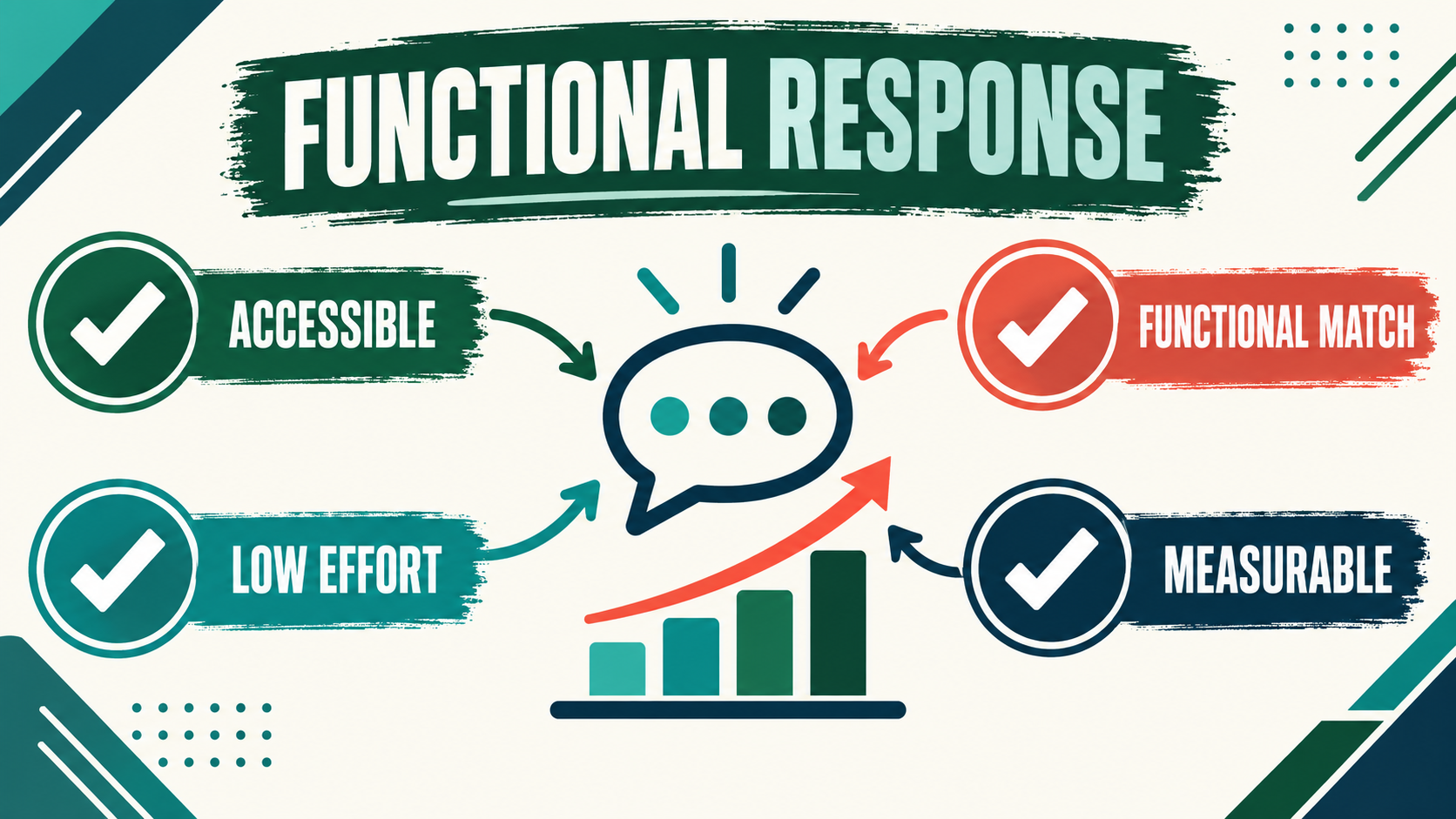
An effective functional communication response has more than a correct label. It must be usable in the moments that matter. The learner should be able to perform it with an appropriate level of support, recognize when it is relevant, and contact a meaningful outcome often enough for the response to become worthwhile.
Consider response efficiency. If the alternative response requires several steps, a fine-motor movement the learner cannot perform, or a long delay before reinforcement, while the problem behavior produces an immediate outcome, the alternative may not compete. The solution is not to blame the learner. The team may need to reduce response effort, improve access, use a different modality, teach caregivers how to respond, or revisit the assessment.
Communication also includes refusal, help-seeking, requesting a pause, and indicating pain or distress. It should not be reduced to requests for compliance or preferred items. A socially meaningful plan supports the learner’s ability to communicate needs, make choices, participate safely, and contact reinforcement in ordinary routines.
How Does FCT Connect Assessment and Treatment?
For a BCBA exam question, the order of reasoning is often more important than the name of the procedure. A defensible sequence looks like this:
- Clarify the behavior. Write an operational definition and identify the dimensions that matter, such as frequency, duration, intensity, or latency.
- Gather assessment information. Review interviews, observations, records, and other appropriate sources. Use a functional analysis when clinically indicated and feasible under competent safeguards.
- Identify the relevant outcome. Determine what consequence is likely maintaining the problem behavior and under what establishing operations it becomes valuable.
- Select and teach the response. Choose a communication form that fits the learner’s repertoire, context, culture, access needs, and response effort.
- Reinforce and measure. Arrange the relevant outcome for the communication response as written in the plan, collect data on both responses, and check implementation fidelity.
- Broaden the skill. Plan for different people, settings, materials, delays, and naturally occurring opportunities without removing a needed communication accommodation.
This sequence does not authorize an untrained person to conduct a functional analysis or to implement a dangerous-behavior plan independently. Severe behavior requires appropriate risk assessment, training, crisis procedures, medical consultation when relevant, and collaboration with the people responsible for the learner’s care.
How Should a BCBA Evaluate FCT Data?
Data should show whether the communication response is increasing and whether the problem behavior is changing under the planned conditions. Depending on the target, the team may record frequency, rate, percentage of opportunities, latency, duration, intensity, prompt level, independent communication, and the delay or schedule under which the response remains effective.
Look at the pattern rather than a single session. A problem behavior can fall because opportunities decreased, demands changed, the person was absent, or staff responded differently. Communication can rise because prompts increased, without showing independent use. Graphs should be interpreted alongside the context, treatment integrity, caregiver reports, and the learner’s quality of life. Ask these review questions:
- Does the communication response occur before or instead of the problem behavior under relevant conditions?
- Is the response independent, or is it still dependent on a prompt that will not be available later?
- Does the response work with the people and materials who normally control the outcome?
- Did the team deliver the programmed consequence consistently and safely?
- What happens when reinforcement is delayed, thinned, or naturally unavailable?
How Do Maintenance and Generalization Fit?
Initial acquisition is only one part of treatment. A learner may request a break with one therapist at a table but not communicate in the classroom, home, community, or during a stressful transition. Generalization planning should be individualized and should not mean removing the communication response to force independence.
Schedule thinning may be considered after the communication response is reliable and the team has a plan for safety and tolerance. The team might gradually arrange longer delays, competing activities, or naturally occurring availability while continuing to reinforce communication appropriately. The goal is durable access to meaningful outcomes, not a silent learner who no longer signals a need.
Maintenance and generalization data should include the conditions that matter to the learner. If a device, picture, sign, or vocal response is the accessible modality, preserve it across settings. Coordinate with caregivers, educators, speech-language professionals, and other providers when communication assessment or assistive technology falls outside a BCBA’s expertise.
What Are Common BCBA Exam Traps?
Questions about FCT often include an attractive answer that skips the function. Watch for these errors:
- Choosing a generic request. The response must match the maintaining reinforcer, not merely sound socially acceptable.
- Teaching before assessing. A replacement response selected without a functional hypothesis may not compete with the behavior.
- Measuring only the decrease. A lower problem-behavior rate is not enough if communication, safety, or access has deteriorated.
- Assuming speech is required. Functional communication can use an accessible alternative modality.
- Confusing FCT with PFA-SBT. FCT can be part of a broader skill-based treatment sequence, but the terms are not identical.
- Ignoring treatment integrity. If staff do not respond as planned, the data cannot be interpreted as if the intervention was implemented correctly.
- Using extinction casually. Any change in reinforcement for dangerous behavior requires careful assessment, safeguards, training, and ethical review.
When an exam stem presents several possible interventions, first identify the function and the assessment information. Then choose the least intrusive, function-based option that teaches a meaningful alternative and can be evaluated with data. Current ethical responsibilities and client dignity remain part of the decision, not an optional add-on.
To practice questions that combine functional assessment, differential reinforcement, communication, measurement, and treatment integrity, try the free BCBA mock exam. It is a study aid, not a BACB protocol, clinical supervision service, or certification guarantee.
Frequently Asked Questions
What is the main idea of reducing behavior problems through functional communication training?: The main idea is to teach an accessible communication response that produces the same class of reinforcement that has maintained problem behavior, then measure whether communication increases and problem behavior decreases under appropriate conditions.
Who introduced functional communication training?: Carr and Durand introduced the early FCT procedure described in their 1985 Journal of Applied Behavior Analysis article. Later reviews expanded the evidence base and described best-practice considerations for assessment, response selection, prompting, reinforcement, safety, and generalization. Is every replacement behavior functional communication training?: No. A replacement response is not automatically FCT. FCT specifically teaches a recognizable communicative response that is functionally related to the reinforcer maintaining the problem behavior.
Can FCT be used without a functional assessment?: FCT should be guided by an appropriate functional assessment or a well-supported functional hypothesis. The assessment method depends on the case, available information, risk, setting, and the competence of the professionals involved.
Is functional communication training the same as PFA-SBT?: No. FCT may be one component of a broader practical functional assessment and skill-based treatment sequence, but PFA-SBT includes its own assessment and additional teaching targets such as tolerance and contextually appropriate behavior.
Sources for Further Study
- Carr and Durand, “Reducing Behavior Problems Through Functional Communication Training” — the 1985 Journal of Applied Behavior Analysis article named by this query.
- Functional Communication Training: A Review and Practical Guide — peer-reviewed review of assessment, response selection, reinforcement, and generalization considerations.
- A Practitioner’s Guide for Selecting Functional Communication Responses — response-selection considerations for function-based communication.
- A Meta-Analysis of Functional Communication Training Effects — review of effects on problem behavior and alternative communication.
- BACB Ethics Codes — official source for current professional and client-protection responsibilities.
Take the Free BCBA Mock Exam
If you want a low-pressure way to check your recall, use the free practice resource below. Take the Free BCBA Mock Exam



