
Texas BCBA certification and licensure planning If you are researching BCBA certification Texas, separate two decisions from the beginning: earning the national BCBA credential through the Behavior Analyst Certification Board (BACB), and meeting Texas requirements to practice or use a regulated behavior-analyst title. They are related, but they are not the same document or authority.
Table of Contents
- Short Answer: Certification and Texas Licensure
- What the BACB Certification Step Covers
- What the Texas License Step Covers
- How to Plan Around the 2027 BACB Transition
- A Texas Planning Matrix
- Common BCBA Certification Texas Planning Mistakes
- When to Begin BCBA Exam Practice
- BCBA Certification Texas FAQ
- Take the Free BCBA Mock Exam
The BACB’s current BCBA resources and handbook explain certification eligibility, examination, and maintenance. Texas’s official licensing information comes from the Texas Department of Licensing and Regulation (TDLR). Review the current BCBA Handbook, the BACB upcoming-changes page, and the Texas TDLR behavior-analyst application page before relying on a date, pathway, or practice rule.
Short Answer: Certification and Texas Licensure
BCBA certification is the national professional credential. Texas licensure is the state authorization that may be required to practice behavior analysis or use a regulated title in Texas, subject to the state’s rules and exemptions. A candidate should plan for both tracks when the intended work falls inside Texas’s licensing scope.
That distinction changes the order of your research. First, confirm which BACB eligibility pathway and application timeline apply to you. Next, check the current TDLR requirements for the Texas behavior-analyst license. Then verify employer, payer, school, and local practice requirements separately. A university page or a third-party study resource may explain one part of the process, but it does not replace the current official authority.
- BACB track: degree or coursework requirements, supervised fieldwork, application, and BCBA examination.
- Texas track: state license application, current certification verification, and Texas practice or title rules.
- Work track: employer, payer, setting, documentation, and supervision expectations.
- Study track: current TCO-aligned review and practice that supports the examination step.
What the BACB Certification Step Covers
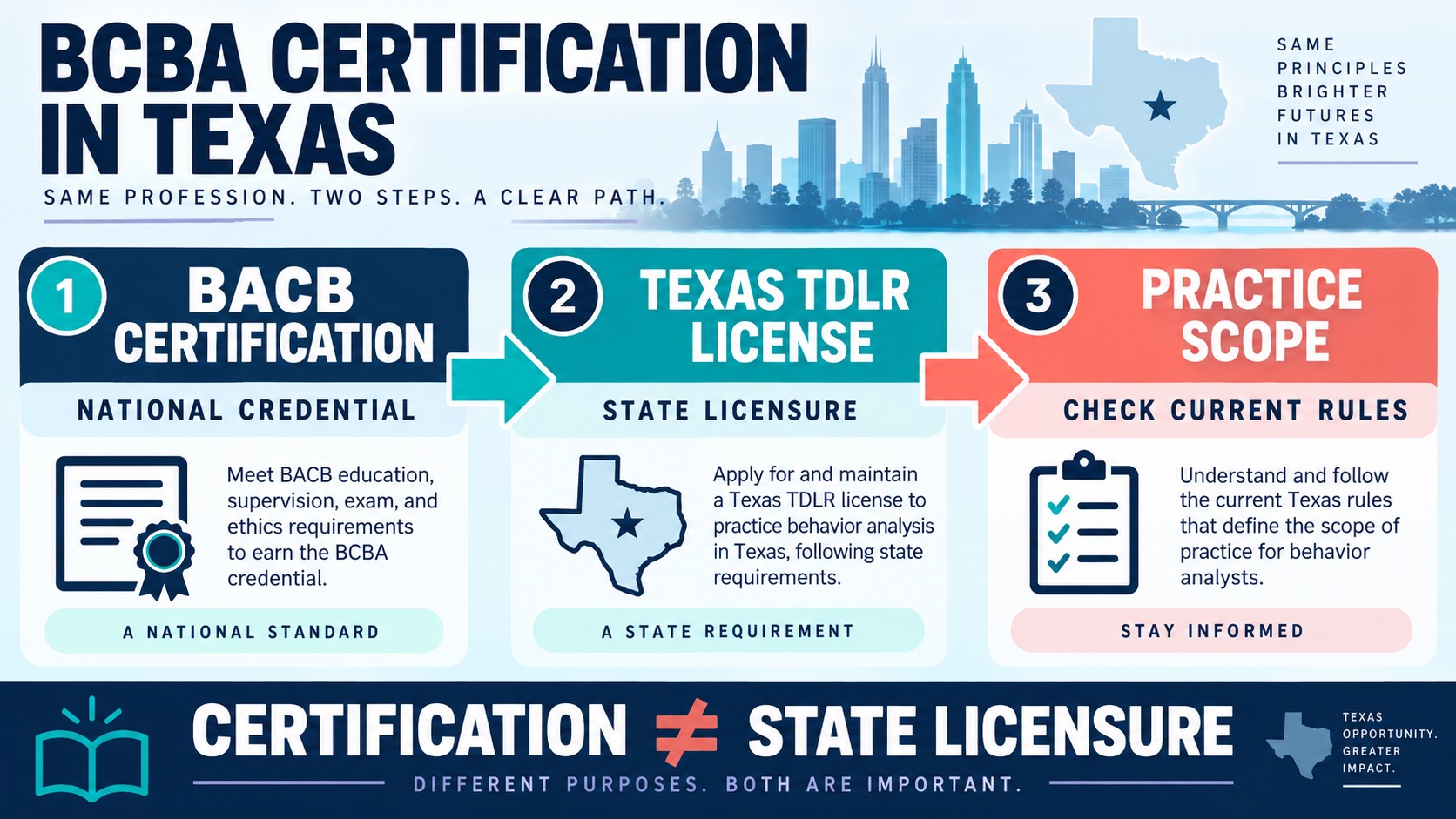
The BACB describes the BCBA as a graduate-level certification in behavior analysis. The certification process is governed by BACB requirements in effect when you apply and schedule the examination. The details can change, so use the current handbook rather than a saved checklist from a previous year. At a planning level, the candidate should identify:
- the degree or education pathway that may apply;
- the behavior-analytic coursework or qualifying program documentation;
- the supervised fieldwork route and verification requirements;
- the application materials and timing; and
- the current BCBA examination content and scheduling rules.
This is a planning map, not an eligibility determination. The BACB states that it cannot provide individualized eligibility guidance outside formal review. If your degree, coursework, fieldwork, or transition status is unusual, compare your documents with the handbook and discuss the question with an appropriately qualified supervisor or mentor before submitting.
For candidates already enrolled in a program, make a document inventory now rather than waiting for the application portal to expose a missing item. Save transcripts, fieldwork forms, supervisor information, course descriptions, and correspondence in one dated folder. The goal is not to guess what the BACB will approve; it is to make the formal review easier to complete accurately.
What the Texas License Step Covers
Texas maintains a separate behavior-analyst licensing process. The official TDLR application page explains who must be licensed, how to apply through TDLR CORE, and what certification status is used for verification. It also notes that a person generally may not practice applied behavior analysis or use the licensed behavior-analyst title in Texas unless the person qualifies for and holds the appropriate license, unless an exemption applies. For a BCBA candidate, the practical questions are:
- Am I planning to practice in Texas, and does the setting fall within the state’s licensing scope?
- Will TDLR verify my current BCBA certification directly, or request additional information?
- What application system, fee, documentation, and renewal cycle are current when I apply?
- Does my employer or payer require additional enrollment or documentation beyond the state license?
Use the TDLR application page and the Texas Occupations Code, Chapter 506 for current state information. This article is not legal advice, and Texas rules, exemptions, agency pages, and application procedures can change. The state step can also affect the timing of employment. An employer may ask whether your certification is active, whether the Texas license has been issued, and whether payer or setting-specific enrollment is complete. Treat those as separate checkpoints. Asking a hiring team which documents it requires can prevent a gap between passing the examination and starting the role.
Texas licensure questions can be especially sensitive when a person works in a school, university, training, or supervised setting. The TDLR page describes exemptions and conditions, but an exemption is not a universal permission slip for every role. Read the current language, document the setting, and ask the responsible organization or agency when the facts are unclear.
How to Plan Around the 2027 BACB Transition
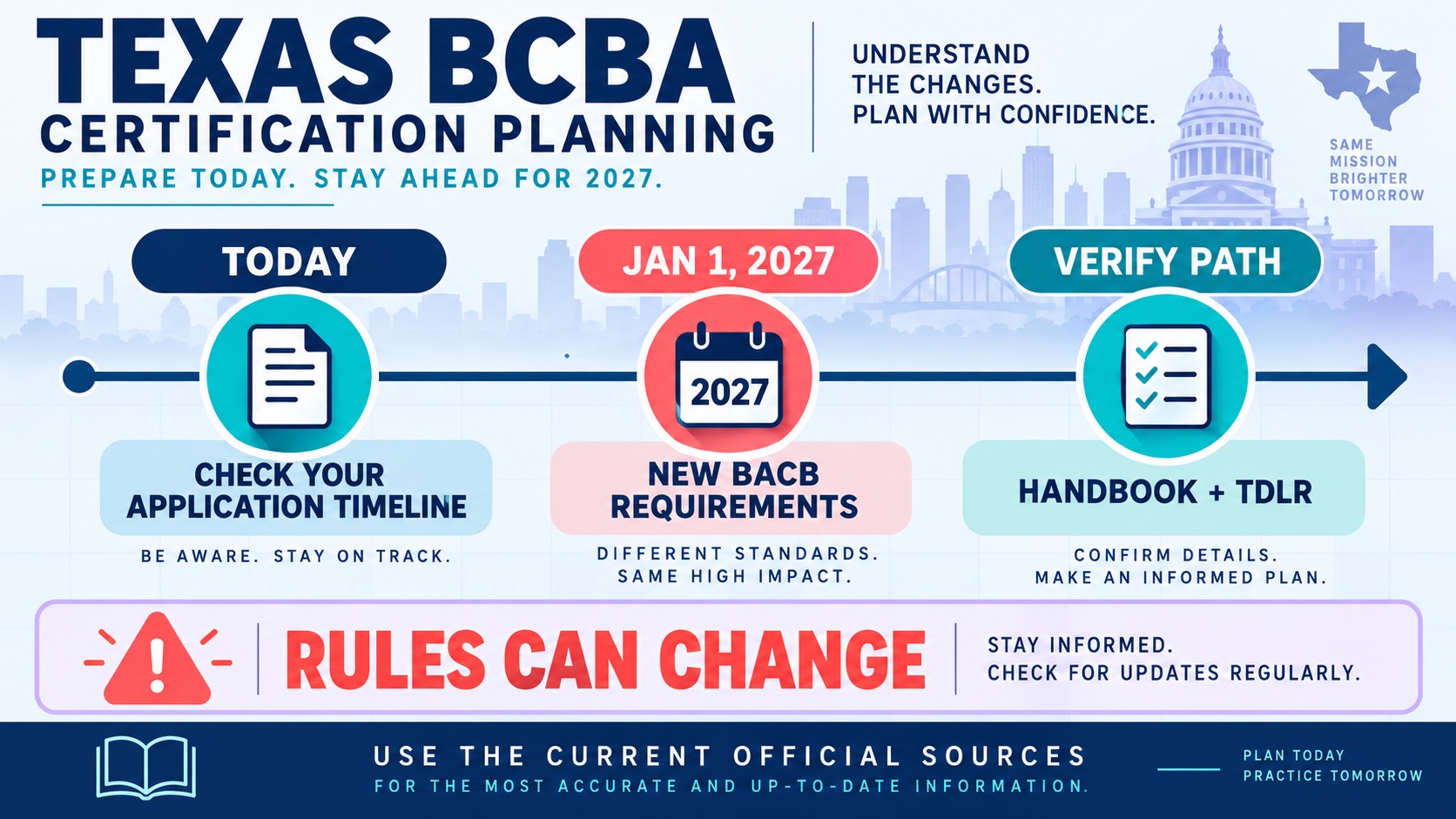
The BACB has announced significant BCBA eligibility and maintenance changes effective January 1, 2027. The current handbook describes 2027 eligibility pathways, and the BACB transition guidance explains how applicants should think about the change. The important planning question is not “Which internet checklist is correct?” It is “Which requirements and examination version apply to my complete application timeline?” Build a dated document checklist:
- Application date: identify when the BACB must receive a complete application, not merely when you begin a course.
- Pathway: compare the current handbook pathway requirements with your degree, coursework, and fieldwork records.
- Transition documents: save the current handbook, transition guidance, and any required forms from official BACB pages.
- Examination timing: confirm which examination content structure and scheduling rules apply to your situation.
- Texas timing: check when TDLR wants current certification verification and what state license steps follow.
Do not assume that starting a program before 2027 automatically locks in every older requirement. Do not assume that a 2027 headline tells you how a specific application will be evaluated. The relevant date, document completeness, pathway, and transition instructions matter.
A useful transition worksheet has four columns: requirement, source, document on hand, and last verification date. Add a fifth column for “question to confirm.” This turns a changing rule environment into a controlled research task. When the official handbook or guidance is updated, you can see exactly which line needs review instead of rebuilding your plan from memory.
Keep screenshots and saved PDFs as working records, but use the live official page for the final check. A saved copy can show what you read at one point in time; it cannot prove that the same rule is still active when you apply. Add the access date to every note and avoid copying a date into a headline without its source context.
A Texas Planning Matrix
Use this matrix to decide which authority to consult. It keeps a high-volume search phrase from turning into one oversized and unreliable checklist.
| Question | Primary authority | What to verify |
|---|---|---|
| Can I apply for BCBA certification? | BACB | Current handbook pathway, education, fieldwork, documents, and timing. |
| Can I practice in Texas? | Texas TDLR and current law | License scope, exemptions, certification verification, and application steps. |
| Which exam content should I study? | BACB | Current BCBA Test Content Outline and examination information. |
| What does my job or payer require? | Employer, payer, and setting | Enrollment, supervision, documentation, and role-specific policies. |
If you are moving to Texas from another state, do not assume that a license transfers automatically because the BCBA credential is national. Confirm whether Texas requires a new application, how current certification is verified, and whether temporary or out-of-state provisions fit your planned service period. State portability is a separate research question.
Common BCBA Certification Texas Planning Mistakes
Most avoidable problems come from mixing authorities or relying on an outdated page:
- Using “certified” and “licensed” as synonyms: keep the BACB credential and Texas license separate in your checklist.
- Following an old pathway chart: requirements and transition documents can change by application year.
- Confusing school admission with BACB eligibility: a program’s marketing statement is not an individualized BACB determination.
- Ignoring the state practice scope: confirm Texas rules before assuming a national credential alone authorizes practice.
- Waiting until exam week to study the current outline: anchor practice to the current TCO and official examination information.
Another common mistake is paying for a program or prep product before defining the decision it must support. A university program may solve an education need, a supervisor may solve a fieldwork need, the BACB may decide certification eligibility, and TDLR may decide state licensure. Ask which gap each product or person can actually address.
When to Begin BCBA Exam Practice
Begin exam practice after you have a current scope map and a realistic document timeline. Practice should answer two different questions: “Do I know the concept?” and “Can I apply it in a mixed scenario under time and reading pressure?” Use a mock exam as feedback, then classify misses by content knowledge, variable discrimination, application, reading, or pacing.
If you are studying for the certification examination, try the free BCBA mock exam for Texas certification preparation as an unofficial practice signal. Review the explanations and connect each miss to the current outline. Keep the licensure checklist separate from the practice score: passing a mock does not create a Texas license, and holding a license does not replace the BACB certification process.
Use practice in two phases. First, take a focused set to learn whether the current outline and your study materials cover the right content. Then take mixed practice to test switching between domains, reading carefully, and choosing the answer supported by the scenario. Log the reason for each miss so the next study block has a concrete purpose.
A strong preparation page should make the next step obvious without pretending that one page can adjudicate your application. If your next action is an official eligibility check, open the current handbook. If it is a Texas license question, open TDLR. If it is a content weakness, use the current TCO and targeted practice. That sequence keeps conversion useful and claims controlled.
BCBA Certification Texas FAQ
Is BCBA certification the same as a Texas behavior-analyst license?: No. BCBA certification is issued through the BACB, while Texas licensure is administered under Texas requirements. A candidate should check both authorities when planning to practice in Texas.
Will the 2027 BACB changes affect every Texas candidate in the same way?: Not necessarily. The effect depends on your application timeline, pathway, documentation, and the transition instructions in the current BACB materials. Verify your situation against the current handbook and transition guidance.
Where should I check the Texas application process?: Start with the official Texas TDLR Behavior Analysts Program application page and current Texas law. Check the application system, certification verification, documentation, renewal, and any applicable exemption before relying on a third-party summary.
Take the Free BCBA Mock Exam
When you are ready to apply the idea, use the free practice resource below for additional feedback. Take the Free BCBA Mock Exam



