
Short answer: Edible reinforcement ABA means delivering a consumable item after a behavior and observing that the behavior becomes more likely in similar conditions. Food is not automatically a reinforcer just because it is edible, preferred, or commonly used in a clinic. In behavior analysis, its function is demonstrated by its effect on future responding.
Table of Contents
- What is edible reinforcement in ABA?
- How do you know food is functioning as a reinforcer?
- What are edible reinforcement ABA examples?
- How does edible reinforcement compare with other reinforcers?
- What safeguards should a BCBA plan?
- How should edible reinforcement be faded?
- What data should be collected?
- What are common BCBA exam traps?
- Edible reinforcement ABA FAQ
- Take the Free BCBA Mock Exam
That distinction matters for both practice and the BCBA exam. A small food item may be useful for initial skill acquisition for one learner, unnecessary for another, or inappropriate because of dietary, medical, cultural, assent, or contextual considerations. A responsible plan identifies whether the item is actually effective, protects the learner’s access and dignity, and includes a path toward less contrived or more naturally occurring reinforcement. Table of Contents
What is edible reinforcement in ABA?
Edible reinforcement is a positive-reinforcement arrangement in which access to a consumable item follows a target response and the future frequency, accuracy, duration, or persistence of that response increases. The item might be a small portion of a food or drink that the learner has selected or accepted. The word edible describes the form of the consequence; reinforcement describes its observed behavioral effect.
On the BCBA exam, edible items are often discussed as possible unconditioned or primary reinforcers because food can have value without a learner first being taught to value it. That classification is not a guarantee that every food will reinforce every response. Motivating operations, current satiation, health variables, learning history, preference, effort, and the timing of delivery can all change the effect.
The BACB BCBA Test Content Outline includes positive reinforcement, unconditioned and conditioned reinforcers, preference assessment, intervention selection, and data-based decisions. For that reason, a strong answer explains the contingency and the data rather than merely labeling a snack as a “reward.”
Edible reinforcement is also different from bribery as an everyday label. A behavior-analytic analysis asks when the consequence was arranged, what response produced access, whether the response increased, and whether the arrangement fits the learner and setting. A catchy label does not replace an operational description.
How do you know food is functioning as a reinforcer?
Preference and reinforcement are related but not identical. A preference assessment can identify items the learner approaches, selects, or ranks highly when choices are offered. A reinforcer assessment or an ongoing response measure tests whether delivering an item after a target response changes future behavior. A learner can choose a cracker during a preference check without working to earn it, and a low-ranked item can sometimes reinforce a particular response in a particular context. Before concluding that an edible reinforcer is effective, ask:
- What is the target response? Define it in observable terms, such as independently touching the correct picture within five seconds.
- What is the contingency? State what happens after an independent, prompted, incorrect, or absent response.
- What changed? Compare responding when the edible is delivered, unavailable, delayed, or replaced by another planned consequence, as appropriate to the teaching design.
- What are the learner’s conditions? Consider time of day, access to meals, health information, allergies, medication effects, cultural context, and the learner’s assent or refusal.
- Can the effect be thinned? A useful teaching arrangement should include a plan to pair, delay, reduce, or transfer the edible when independence and natural reinforcement become stronger.
The site’s ABA preference assessment guide covers the preference-versus-reinforcer distinction in more detail. Use that related page for the assessment framework; this article focuses on the special implementation and ethical questions raised when the candidate reinforcer is food.
What are edible reinforcement ABA examples?
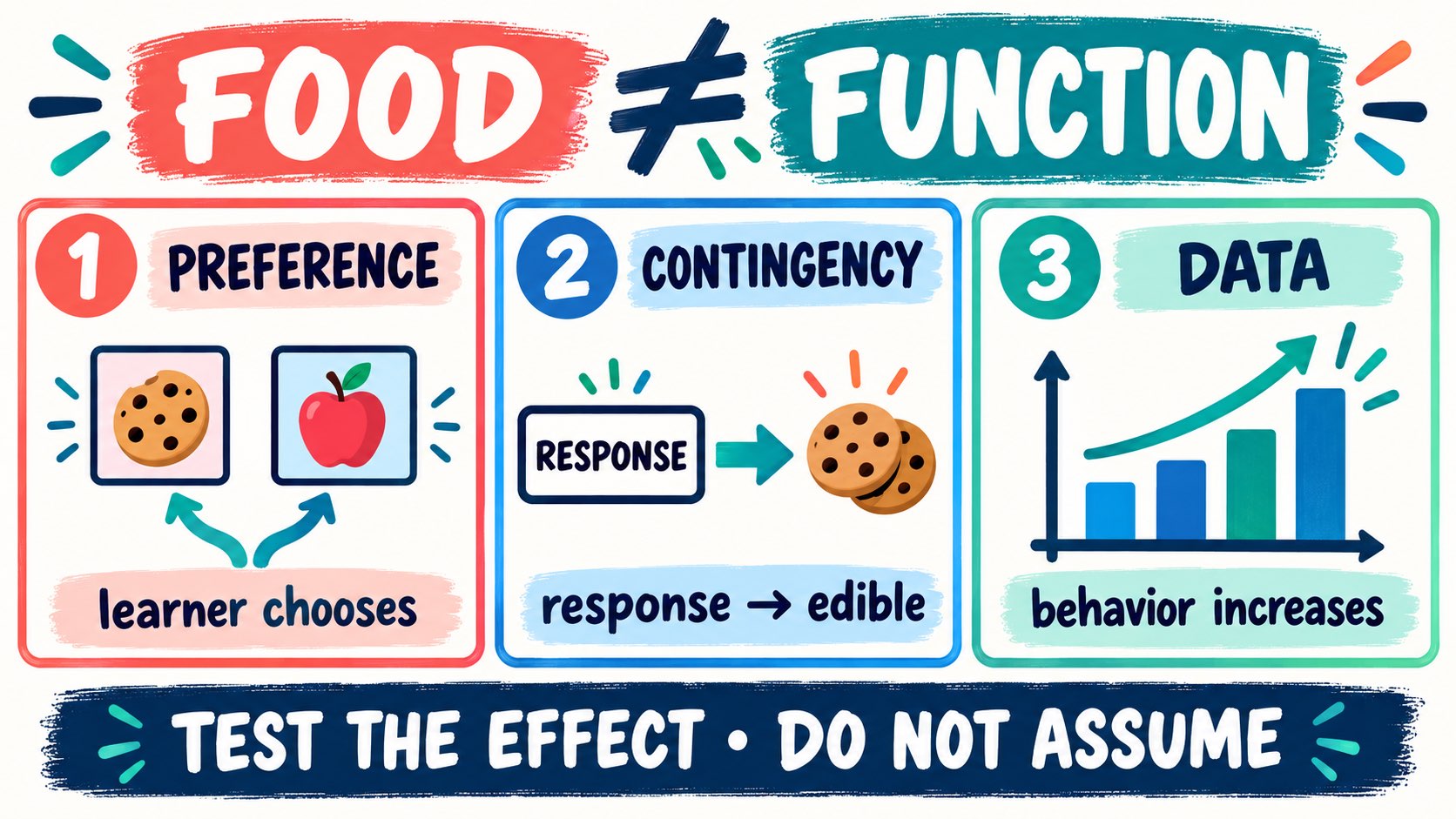
The examples below are educational scenarios, not copy-and-use treatment plans. Each one states the response, the contingency, and the measurement question. A qualified behavior analyst must individualize any real service plan. Example 1: building a new skill: An instructor is teaching a learner to imitate a simple motor action. After an independent imitation, the learner receives a tiny portion of a chosen edible along with behavior-specific praise. The team records independent imitations, prompted imitations, errors, and the delay between the response and consequence. If the rate of independent imitation increases while the contingency is in place, the edible may be functioning as a reinforcer for that response.
The example is not established merely because the learner accepts the food. The key question is whether the target response changes over time and whether the learner can contact reinforcement without excessive prompting. If a social or activity reinforcer works just as well, the team may select that option for better fit or easier generalization.
Example 2: reinforcing functional communication: A learner is taught to request a snack using a picture, sign, speech-generating device, or spoken word, depending on the individualized program. When the request occurs under the planned condition, the team provides the agreed-upon food portion and records independent versus prompted requests. The reinforcement is linked to the communication response, not to silence, forced eye contact, or compliance with an unrelated demand.
This distinction protects the teaching goal. If the learner is requesting food, access to that food may be a natural consequence when appropriate, but the team should still plan communication across people, times, and materials. The existence of an edible consequence does not justify withholding meals, ignoring refusal, or turning a basic need into an unlimited bargaining tool.
Example 3: moving from edible to broader reinforcement: A learner initially completes short academic tasks more consistently when a small edible follows each completed response. The team pairs the edible with praise and a brief preferred activity, then gradually shifts from every response to a token or activity schedule while monitoring accuracy and task engagement. The purpose of the change is not to remove a successful support abruptly; it is to transfer control and make the routine more sustainable. If responding drops sharply during thinning, the team reviews response effort, task difficulty, reinforcement quality, and procedural fidelity. A decrease is information about the plan, not proof that the learner is “unmotivated.”
How does edible reinforcement compare with other reinforcers?
In an exam scenario, classify the consequence by what is delivered and then ask whether it increases behavior. The same learner may have different effective reinforcers across tasks, times, and settings.
| Possible reinforcer | What is delivered? | Useful question | Common fading direction |
|---|---|---|---|
| Edible | A consumable item or drink | Did the target response increase, and is the plan safe and assent-based? | Pair, delay, thin, and transfer to natural or conditioned consequences |
| Social | Praise, attention, interaction, or another social event | Does the learner value the social consequence in this context? | Increase natural delivery and vary communication partners |
| Activity | Access to a preferred action, game, or break | Can the activity fit naturally after the response? | Thin duration or frequency while preserving choice |
| Tangible | Access to an object or material | Is the object available safely and without creating avoidable conflict? | Use tokens, time limits, or naturally scheduled access when appropriate |
| Token or conditioned | A learned item exchangeable for backup reinforcement | Does the learner understand the exchange and can the token bridge the delay? | Thin exchange frequency and contact naturally occurring outcomes |
What safeguards should a BCBA plan?
Food is a powerful and personal stimulus. The BACB Ethics Codes page identifies the current ethics requirements for behavior analysts and emphasizes checking the current code. An exam answer should connect edible reinforcement to client welfare, individualized assessment, informed collaboration, competence, and mitigation of unwanted effects rather than treating food as a default shortcut.
- Confirm relevant information: review allergies, medical or feeding concerns, swallowing and choking risk, dietary restrictions, medication effects, cultural factors, and the learner’s established preferences with the appropriate people.
- Preserve access and choice: do not use deprivation of meals or fluids to manufacture motivation. Offer reasonable choices, respect refusal, and monitor assent or signs that participation is no longer willing.
- Use a clear contingency: define the target response and consequence, deliver the portion consistently, and avoid shifting the requirement after the learner begins responding.
- Plan for dignity and context: consider whether the arrangement is socially valid in the home, school, or community, and whether the learner can use the skill without carrying a clinic-only food system everywhere.
- Monitor unwanted effects: watch for distress, satiation, food refusal, unsafe consumption, competition with meals, or an increase in problem behavior around access, and stop or revise the plan when the risk-benefit balance is not acceptable.
These safeguards are not a substitute for medical, nutritional, or feeding expertise. They are a reminder that reinforcement procedures must fit the person and the setting. The BACB overview of behavior analysis also cautions that resources on BACB.com do not mean every certificant is authorized or competent to practice every procedure in every jurisdiction.
How should edible reinforcement be faded?
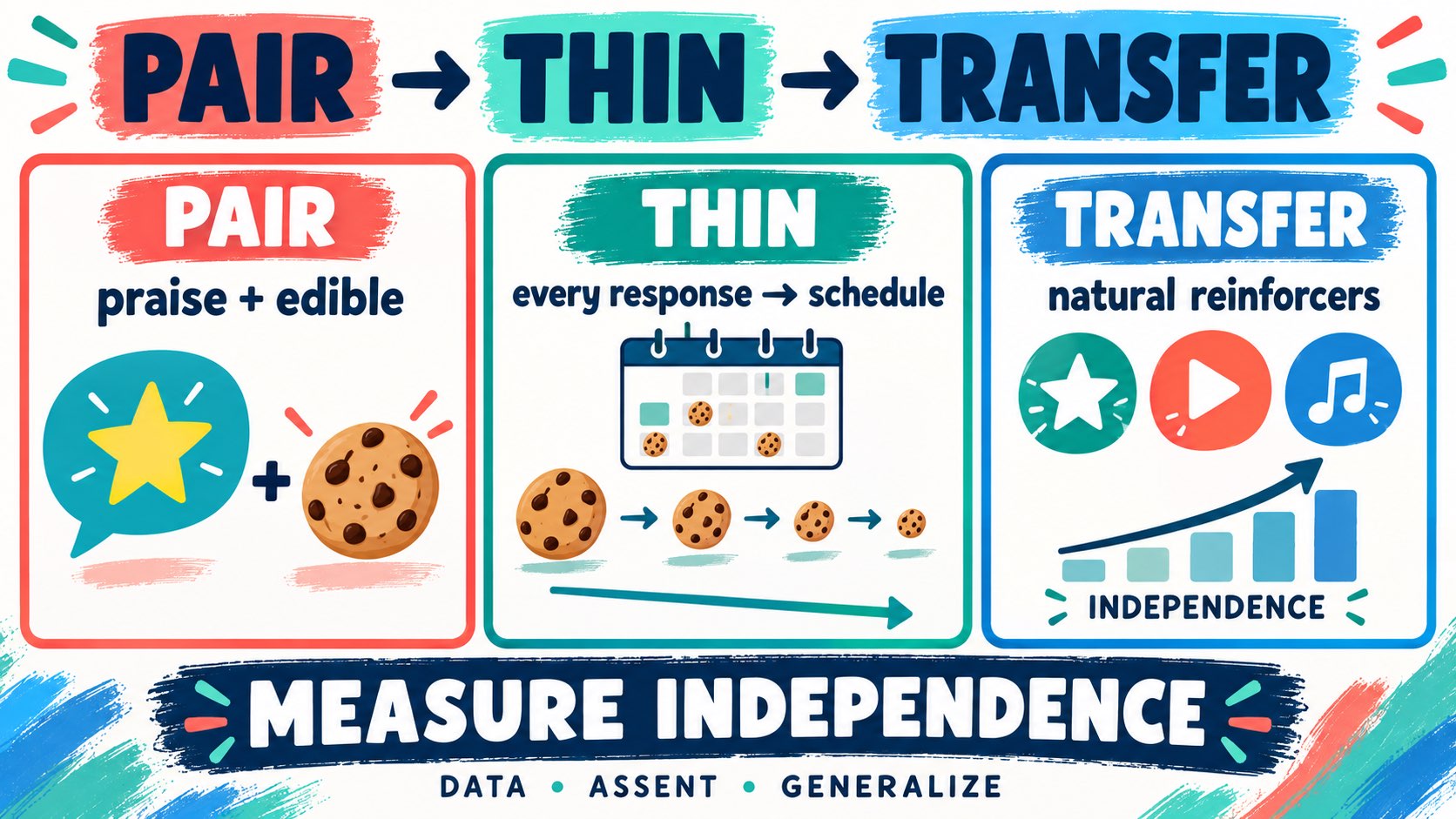
Fading should preserve the target skill while reducing dependence on an artificial or highly specific consequence. The plan may use more than one step, and the data should determine the pace. Abruptly removing a reinforcer because it feels undesirable can produce errors, frustration, or loss of the skill.
- Pair with other consequences: deliver descriptive praise, interaction, tokens, or preferred activities together with the edible when those consequences are acceptable and meaningful.
- Increase response requirements gradually: move from every correct response to a planned schedule only after the learner can contact the skill reliably.
- Thin with a rule: use a defined schedule or criterion instead of changing the delivery unpredictably from trial to trial.
- Transfer to the routine: arrange naturally occurring reinforcement, such as access to a requested item, social participation, task completion, or a meaningful activity.
- Probe generalization: test new people, materials, settings, times, and response forms while keeping the important parts of the contingency clear.
A 2020 peer-reviewed case report on edible reinforcement paired with auditory feedback is a useful study example because it measured the intervention, adjusted the edible component, and examined maintenance and generalization. The Journal of Applied Behavior Analysis article should be read as evidence about that specific intervention and participants, not as a universal recommendation to use food.
What data should be collected?
Data should answer two separate questions: is the learner performing the target response, and how much assistance or reinforcement is still required? A correct response after a prompt or a food consequence is not automatically an independent response.
- Independent response: the target behavior occurs under the planned instruction or natural cue without the added edible or another prompt.
- Prompted response: record the prompt level, delay, or assistance needed before the response.
- Accuracy and rate: calculate the relevant dimension for the target, such as percentage correct, responses per minute, duration, or trials to criterion.
- Latency and errors: track delay to respond, incorrect responses, refusals, and position or selection biases when they affect the teaching question.
- Reinforcer delivery and integrity: record whether the planned portion, timing, schedule, and consequence were delivered as written.
- Generalization and maintenance: test the response with new people, materials, settings, and longer intervals after edible delivery has been thinned.
Data do not need to be complicated to be useful. They do need to separate independent responding from prompted responding and show enough context to explain why performance changed. If a learner responds less after thinning, check the graph, the schedule, task effort, motivation, and procedural fidelity before making a broad conclusion.
What are common BCBA exam traps?
- “Food is always a reinforcer”: the consequence must increase future behavior; its physical form is not enough.
- “Preferred means reinforcing”: selection in a preference assessment does not prove that delivery after a response will increase that response.
- Confusing positive reinforcement with a reward: positive reinforcement is defined by an increase in future behavior after a stimulus is added.
- Calling a food restriction an intervention: a motivating operation is not a license to withhold basic care or ignore health and assent.
- Fading too fast: removing the edible without a functional replacement or adequate data can produce a false conclusion about skill mastery.
- Ignoring generalization: success with one snack, trainer, table, and schedule does not establish durable independent responding.
- Overlooking the target: if the learner is requesting food, the response may have a natural communication consequence; analyze the function and context rather than adding an unrelated demand.
Quick review: identify the target response, state the contingency, verify the behavioral effect, check health and assent boundaries, and name the data that will guide fading. For scenario practice on reinforcement, assessment, ethics, and data-based decisions, try the free BCBA mock exam. It is a study resource and does not reproduce official BACB questions.
Edible reinforcement ABA FAQ
Is edible reinforcement the same as positive reinforcement? No. Edible reinforcement is one possible form of consequence. It is positive reinforcement only when adding the edible increases the future behavior under the relevant conditions. Are edible reinforcers primary reinforcers? Food is often taught as an example of an unconditioned or primary reinforcer, but the effect still depends on the learner, the current conditions, and the actual response change. Do not infer function from the category alone.
Is using food in ABA automatically unethical? No single answer applies to every individualized context. The question is whether the procedure is necessary, safe, client-informed, culturally and contextually appropriate, competently implemented, measured, and subject to review and fading. A plan that ignores health, choice, assent, or basic access raises serious concerns.
How can a team move away from edible reinforcement? Pair the edible with meaningful social, activity, tangible, or conditioned consequences; thin delivery gradually; arrange natural reinforcement; and use data to check that independent responding and generalization remain strong.
What is the best exam clue? Look for the response change. If the question only says that a learner likes or chooses a snack, it describes preference. If the target response increases after the snack is delivered contingently, the item may be functioning as a reinforcer.
Take the Free BCBA Mock Exam
When you are ready to apply the idea, use the free practice resource below for additional feedback. Take the Free BCBA Mock Exam



