
If you are searching for crisis emergency ABA, the key question is not simply how to stop a behavior. It is how to recognize when immediate safety changes the order of priorities. In a true crisis or emergency, protect people, follow the written plan and site procedures, and obtain medical or emergency support when the situation requires it. Do not improvise a restraint, medication decision, or physical intervention from an article.
Table of Contents
- Crisis Emergency ABA: What Does It Mean?
- Routine Behavior Versus Crisis: What Changes?
- What Is the First Priority During a Crisis?
- Why Does Functional Assessment Still Matter After Safety?
- Who Does What: BCBA, RBT, and Emergency Responders?
- What Belongs in a Crisis or Emergency Plan?
- What Are Common BCBA Exam Traps?
- Practice the Safety and Assessment Domains
- Quick Review Checklist
- Take the Free BCBA Mock Exam
- References
For BCBA exam questions, the strongest answer usually respects both time horizons: address immediate danger first, then return to assessment, documentation, treatment integrity, and prevention. The current BACB materials also make role boundaries important. An RBT may implement crisis or emergency procedures according to protocol, while a BCBA is responsible for competent assessment, plan design or modification, supervision, and evaluation within the applicable setting.
This guide is for exam preparation and general education. It is not a personalized crisis plan, medical advice, legal advice, or a replacement for local emergency services, a qualified supervisor, an approved behavior-support plan, or employer and facility policy. Table of Contents
Crisis Emergency ABA: What Does It Mean?
In an ABA setting, a crisis or emergency is a situation in which the usual teaching or behavior-reduction sequence is no longer the first priority because there is an immediate or credible risk of serious harm. Examples can include severe self-injury, dangerous aggression, elopement into an unsafe area, a medical concern, a fire or other environmental hazard, or another event covered by the organization’s emergency procedures.
The label should be based on observable risk and the written criteria for that setting, not on how inconvenient, loud, or socially unusual the behavior appears. A behavior may be intense without being an emergency, while a quieter event such as a medical change or unsafe elopement may require an urgent response. The exam task is to notice the risk variable and select the response that protects the client and others.
Keep two ideas separate. “Crisis response” describes the immediate safety process. “Behavior treatment” describes the assessment and intervention system that may reduce future risk. A crisis plan can be part of a behavior-support plan, but it does not replace medical evaluation, a functional assessment, or a review of whether the intervention is effective and safe.
Routine Behavior Versus Crisis: What Changes?
A comparison helps because many exam distractors sound clinically sophisticated but ignore the urgency of the scenario.
| Feature | Routine behavior target | Crisis or emergency |
|---|---|---|
| First priority | Implement the teaching or behavior-reduction plan with appropriate measurement. | Protect immediate safety and activate the established response process. |
| Decision basis | The operational definition, function-based plan, and teaching objective. | Observable danger, medical or environmental risk, and the setting’s crisis criteria. |
| Next step | Continue data collection and evaluate progress toward the goal. | Use the written protocol, notify the appropriate support, document facts, and review the plan afterward. |
What Is the First Priority During a Crisis?
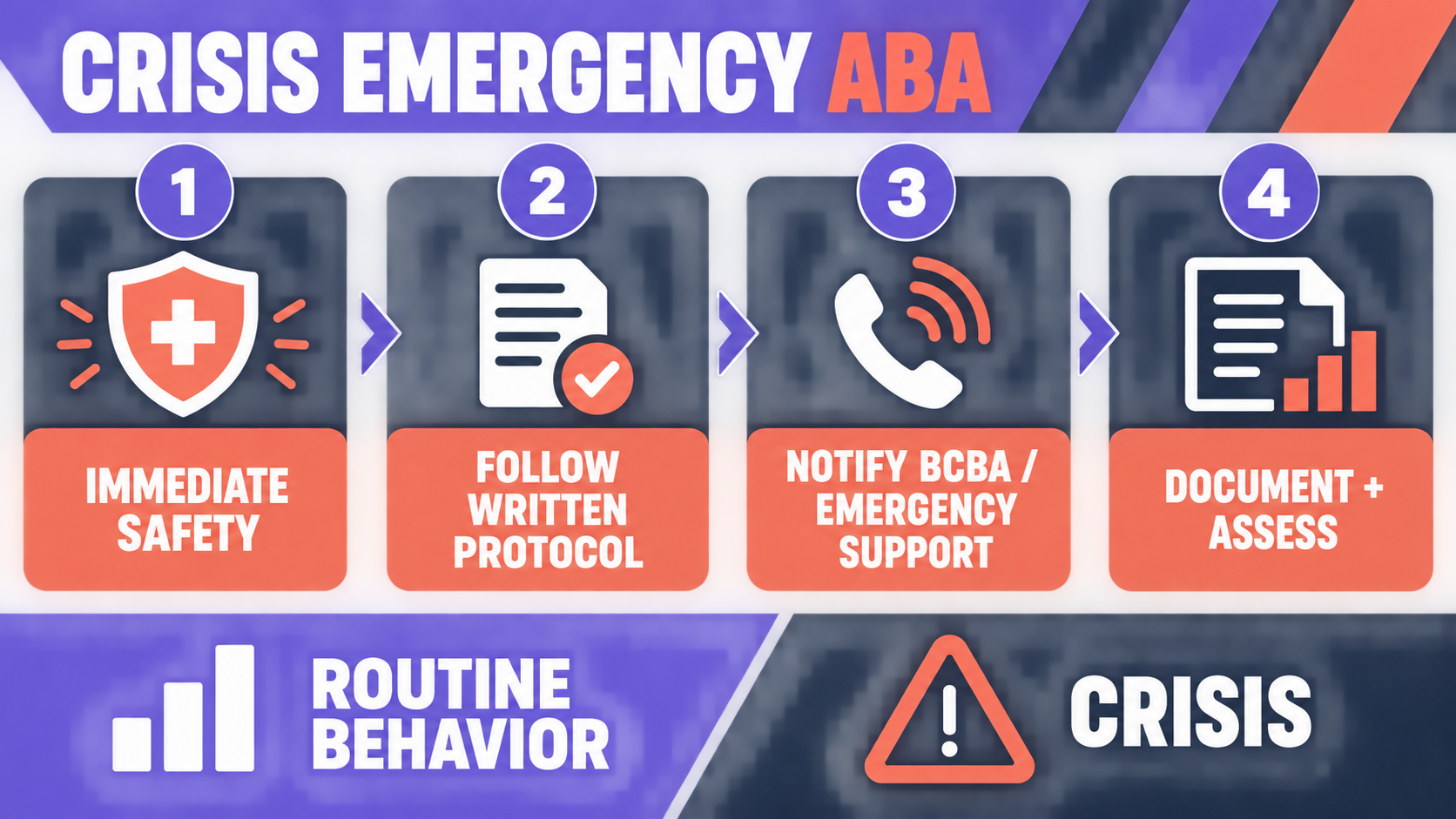
The first priority is immediate safety. In a real event, follow the approved plan and local emergency procedures rather than trying to invent a universal ABA sequence. The exam-ready reasoning can be organized like this:
- Recognize the risk: identify the observable event, who may be harmed, and whether a medical or environmental emergency is possible.
- Reduce immediate danger: use only actions that are authorized, trained, and appropriate to the setting; move away from hazards when that can be done safely.
- Activate the established response: follow the written crisis or emergency procedure, communication chain, and site-specific directions.
- Obtain the right help: contact the supervising BCBA, caregiver, designated leader, medical team, or emergency services according to the plan and the severity of the event.
- Preserve dignity and information: use calm, minimal communication, protect privacy, and avoid unnecessary attention or discussion in front of the client.
Do not let “collect data first” become the wrong answer when someone faces immediate danger. Measurement remains important, but it cannot justify delaying urgent safety action. Conversely, do not label every challenging episode a crisis merely to justify a restrictive response. The protocol should define the threshold, training, authorization, and review process.
Why Does Functional Assessment Still Matter After Safety?
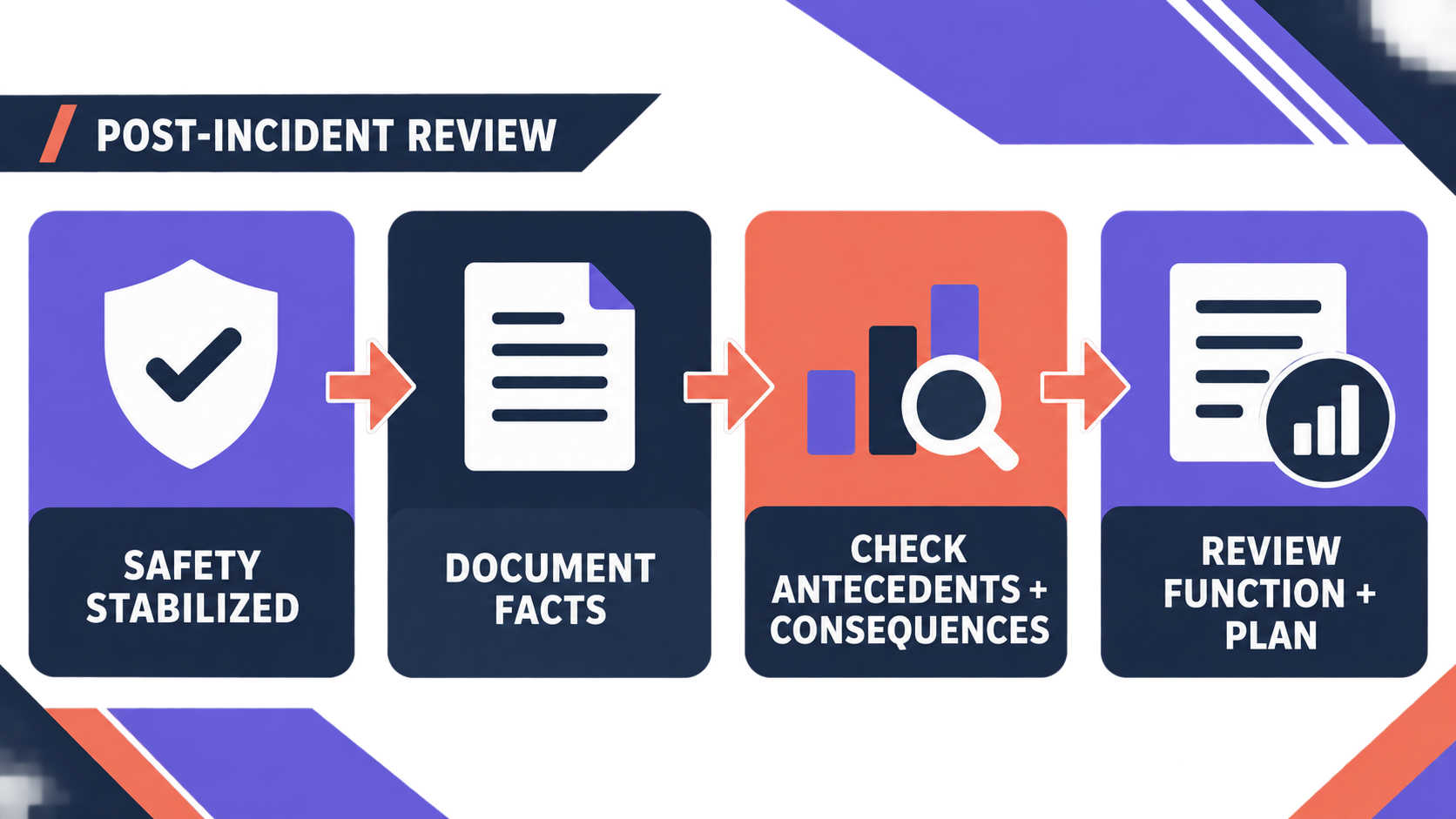
Once the immediate risk is controlled and any medical or emergency needs have been addressed, the team must understand what happened. A crisis response is not a functional assessment. It may interrupt the event, but it does not by itself identify the antecedents, consequences, setting events, medical variables, or maintaining function.
The BCBA Handbook has used an emergency-procedure scenario in its retired sample questions: after emergency procedures are in place to keep a client and others safe, the important assessment step is to determine the antecedents and consequences related to the target behavior. That logic is worth remembering. Safety first does not mean assessment never; it means assessment comes at the right point in the sequence.
Post-incident review should include objective facts, relevant context, the procedure used, who was notified, injuries or medical concerns, the client’s response, and any follow-up required by policy. The BCBA should then evaluate whether the crisis plan is feasible, whether staff were trained and followed it, whether the intervention minimized risk, and whether changes to prevention or teaching are needed. Medical variables and conditions that interfere with service delivery should not be dismissed as “just behavior.”
Who Does What: BCBA, RBT, and Emergency Responders?
Role questions are common because a crisis can involve several professionals at once. The safest exam answer is usually the one that respects competence, authorization, supervision, and the actual scope of the person in the scenario.
| Role | Exam-relevant responsibility | Boundary to remember |
|---|---|---|
| BCBA | Designs or evaluates assessment and intervention, trains and supervises staff, reviews risk, and updates the plan within competence. | A BCBA does not replace emergency medical responders or ignore site policy. |
| RBT | Implements crisis or emergency procedures according to the approved protocol, seeks direction, and reports objective information. | An RBT should not independently design, authorize, or improvise a new crisis intervention. |
| Emergency or medical responder | Addresses the emergency within the responder’s training, authority, and applicable law. | ABA staff should communicate relevant facts and cooperate rather than give medical directions outside competence. |
What Belongs in a Crisis or Emergency Plan?
A usable plan is specific enough to guide trained staff but flexible enough to respect the actual setting. Before an incident, the team should clarify:
- Operational criteria for a crisis, emergency, medical concern, or environmental hazard.
- Who is responsible for immediate supervision, communication, and contacting outside help.
- Authorized procedures, training requirements, contraindications, and actions that are prohibited.
- How to protect the client, peers, staff, visitors, and confidential information.
- Where emergency contacts, health information, consent documents, and relevant plans are stored.
- How caregivers, supervisors, administrators, and medical providers are notified.
- What objective facts must be recorded and how quickly the incident report is completed.
- How the BCBA reviews implementation fidelity, risk, function, and prevention after the event.
The BACB’s continuity guidance also illustrates why a written emergency plan should be shared with key stakeholders when services are interrupted. A plan that exists only in one person’s memory is difficult to implement consistently, supervise, or audit.
What Are Common BCBA Exam Traps?
- Starting with the function: If immediate harm is occurring, protect safety before conducting a full assessment.
- Improvising a restrictive procedure: A stressful moment does not create permission to use an untrained or unauthorized intervention.
- Calling every episode an emergency: Intensity alone is not the same as immediate danger; use the operational criteria and context.
- Making the RBT the treatment designer: Protocol implementation and plan design are different responsibilities.
- Stopping after the incident: Documentation, functional assessment, medical follow-up, and plan review may still be required.
- Ignoring medical variables: A sudden change in behavior may require medical attention or interprofessional consultation.
Practice the Safety and Assessment Domains
When a BCBA practice question describes a crisis emergency, underline the risk, the written protocol, the person’s role, and the requested next step. Choose the answer that protects immediate safety without inventing procedures, then look for the option that returns to objective documentation, functional assessment, supervision, and prevention.
Our free BCBA mock exam can help you practice these “most appropriate next step” decisions under time pressure. Use it as a study aid, not as a replacement for the current BACB materials or case-specific supervision. Try the Free BCBA Mock Exam
Quick Review Checklist
Use this final checklist to turn crisis emergency aba into exam-ready reasoning. The goal is not to memorize a label in isolation; it is to identify the relevant evidence and explain why the best answer fits the scenario. Key ideas to review:
- State the central definition or decision point for crisis emergency aba in your own words.
- Identify the detail that makes crisis emergency aba different from its closest related ABA term.
- Separate the observable facts in a scenario from assumptions that are not supported by the facts.
- Write one example and one nonexample so you can recognize the concept in a new setting.
Exam application checks:
- Ask what the question is actually requesting before comparing the answer choices.
- Mark the antecedent, response, consequence, or other evidence that supports the selected answer.
- Look for a distractor that describes a related process but does not answer the specific question.
Final self-check:
- Explain how you would verify the interpretation with clear observations or data.
- Change one detail in the scenario and decide whether your answer should change.
- Give a one-sentence rationale that a supervisor or study partner could evaluate.
Take the Free BCBA Mock Exam
A useful next step is to apply this idea in a fresh set of BCBA-style practice questions and review the feedback. Take the Free BCBA Mock Exam
References
- BACB BCBA Handbook
- BACB BCBA Test Content Outline, 6th Edition
- BACB RBT Test Content Outline, 3rd Edition
- BACB Ethics Code for Behavior Analysts
- BACB Continuity-of-Services Toolkit



