
A printable functional behavior assessment observation form can organize direct observation, but it cannot replace an operational definition, professional judgment, or the full FBA process. Use the form to record what happened in context, then combine it with the other information needed for a responsible hypothesis and plan.
Table of Contents
- What Is a Printable Functional Behavior Assessment Observation Form?
- What Information Should the Form Capture?
- How Should You Define the Target Behavior Before Printing?
- How Do You Record an ABC Observation?
- What Is the Difference Between Observation and an FBA?
- How Many Observations Should You Collect?
- How Should You Review a Completed Form?
- What Mistakes Make a Form Less Useful?
- Can a Teacher or Caregiver Use the Form?
- What Should a Printable Form Include?
- How Might This Topic Appear on the BCBA Exam?
- Final Takeaway
- Quick Review Checklist
- Take the Free BCBA Mock Exam
When someone searches for a printable form, they usually want something practical: a page that can be printed, carried into a classroom or home, and used without guessing what belongs in each column. A good form reduces memory demands and encourages consistent notes. A poorly designed form can produce vague labels, missing context, and conclusions that the observation does not support.
The IRIS ABC observation form and state education resources such as the Illinois functional assessment observation form show common ways to organize context and ABC information. Treat those documents as examples of data organization. Use current local requirements, trained supervision, and privacy procedures when conducting an actual assessment.
What Is a Printable Functional Behavior Assessment Observation Form?
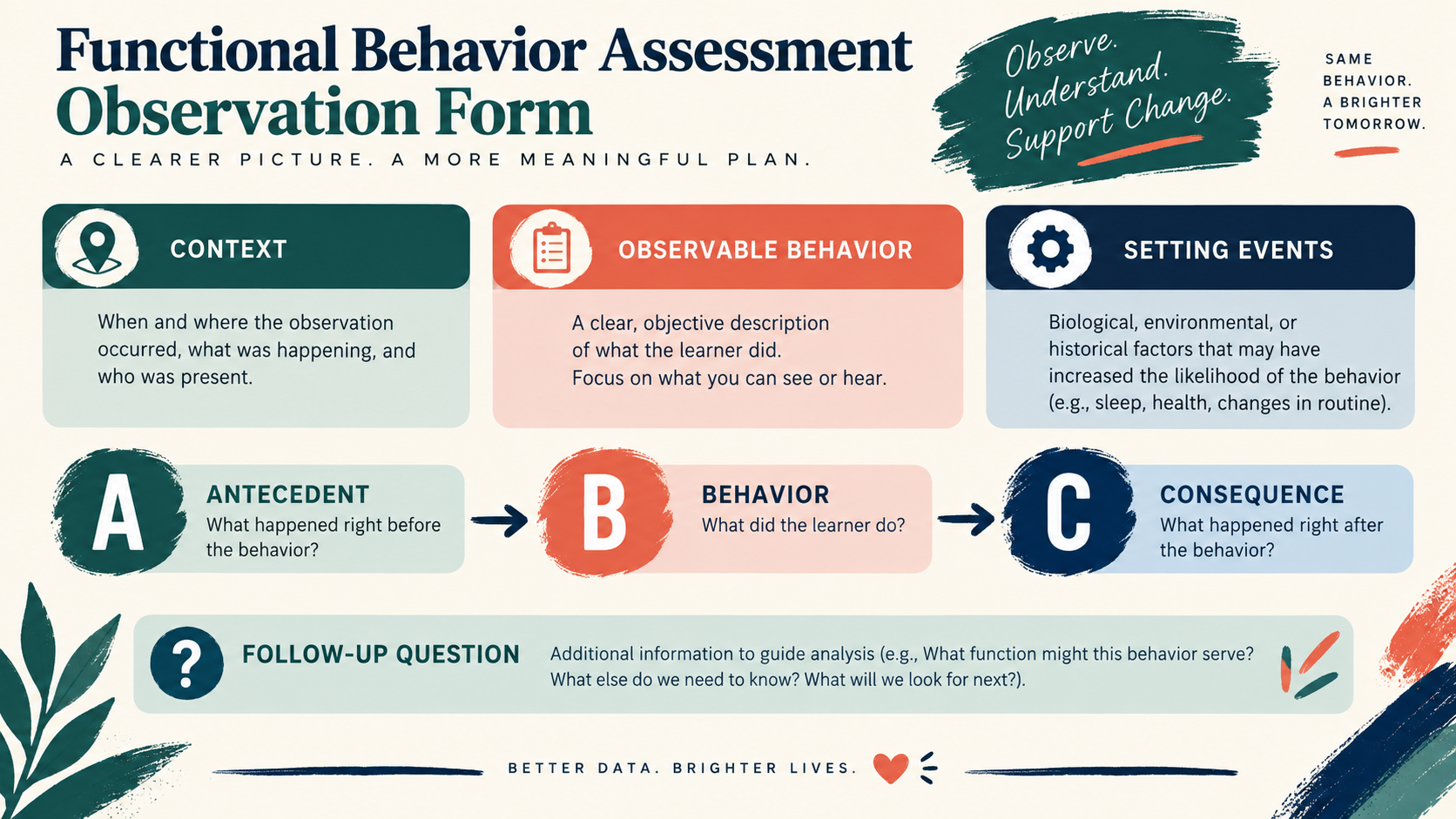
A printable FBA observation form is a structured recording tool for documenting events around a behavior of concern. It may include the setting, observer, activity, target behavior, time, antecedent, behavior, consequence, and notes about relevant context. Some forms also include setting events, response effort, communication, or follow-up questions.
The form does not make the observation objective by itself. Objectivity comes from defining the behavior in observable and measurable terms, recording what was seen or heard, and separating direct observations from interpretations. “Was upset” is an interpretation. “Pushed the worksheet to the floor and said ‘no’” gives an observer something that can be evaluated.
What Information Should the Form Capture?
Choose fields based on the question the team needs to answer. A form should be detailed enough to preserve useful context but simple enough that an observer can record during a naturally occurring routine.
| Field | What to record | Quality check |
|---|---|---|
| Context | Date, time, location, activity, people present, and relevant routine conditions. | Could another reader understand where and when the event occurred? |
| Antecedent | What happened immediately before the target response, including an instruction, change, delay, or access condition. | Is the entry specific rather than “triggered” or “noncompliant”? |
| Behavior | The observable response, with enough detail to distinguish it from other behavior. | Could two trained observers identify the same response from the description? |
| Consequence | What happened immediately after, including changes in attention, task, materials, or interaction. | Does the entry describe what actually occurred, not what someone thinks the person wanted? |
| Follow-up | Questions, missing information, safety notes, and the next data source to consult. | Does it keep a hypothesis separate from a confirmed function? |
How Should You Define the Target Behavior Before Printing?
Write the operational definition before observation begins. Include what counts, what does not count, and when the episode starts and ends if those boundaries matter. For example, “task refusal” could refer to many different responses. A more useful definition might describe turning away from the materials, pushing them more than a stated distance, or saying a specific phrase after an instruction.
Keep the definition tied to the assessment question. If the concern is aggression, record the topography and safety-relevant details. If the concern is delayed communication, record the opportunity, the response form, and the latency. A generic form can hold the data, but the observer still needs a target-specific definition.
How Do You Record an ABC Observation?
Start with the context and activity. Record an antecedent as close to the event as possible, then describe the response without assigning motive, and record the immediate consequence. If several events happen quickly, use a new row rather than combining the entire episode into a paragraph. Mark uncertainty clearly instead of filling a gap with a guess.
For example, an entry might state: “During independent math, the teacher placed a worksheet on the desk and said ‘start.’ The learner tore the top corner and pushed the paper to the side. The teacher removed the worksheet and provided a verbal prompt.” That entry can later support a question about task presentation and escape-related outcomes. It does not prove a function by itself.
What Is the Difference Between Observation and an FBA?
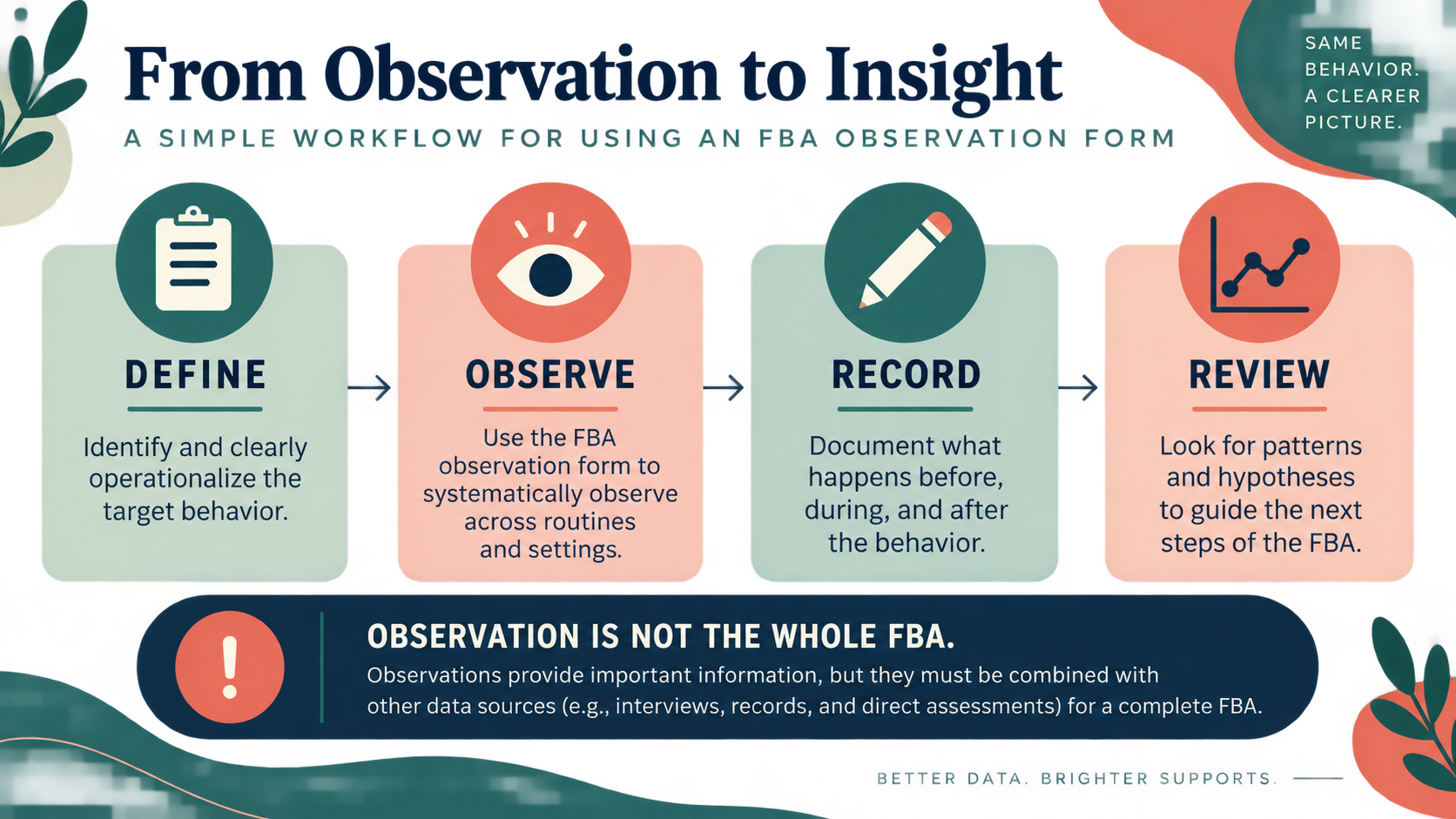
Direct observation is one part of a broader functional behavior assessment. An FBA may integrate interviews, record review, direct measurement, contextual information, and—in appropriate conditions—functional analysis or another assessment arrangement. The precise process depends on the behavior, setting, risk, referral question, and professional requirements.
Observation data can reveal patterns and help a team decide what to examine next. They can also be misleading if observations happen only during one activity, if the behavior definition changes, or if the observer records only dramatic events. A form should support triangulation, not encourage the reader to write a function in the margin and treat it as settled.
How Many Observations Should You Collect?
There is no universal number of rows that makes an FBA complete. The team should collect enough information to represent relevant settings and make the next decision responsibly. Consider whether the behavior occurs often enough to observe, whether the observation includes the conditions named in the referral, and whether reports from caregivers or staff describe important contexts that have not yet been seen.
Varying times, activities, people, and locations can help reveal whether the pattern is stable or context-specific. If safety is a concern, prioritize safe observation and follow the applicable crisis and reporting procedures. Do not ask an untrained observer to provoke behavior or place a learner at risk to complete a form.
How Should You Review a Completed Form?
First check data quality. Are the rows dated? Is the target behavior described consistently? Are antecedents and consequences specific? Are missing details labeled as unknown? Next summarize patterns without overstating them. You might count how often a response followed a particular event or compare what happened after the response across settings.
Then compare the observation with other information. If a teacher reports that the behavior usually occurs after difficult tasks but the observation occurred only during preferred activities, the mismatch is a reason to collect more context, not a reason to dismiss either source. A BCBA can use the combined record to select a next assessment step and identify an initial support that can be monitored.
What Mistakes Make a Form Less Useful?
- Using labels instead of observations: “attention seeking” does not describe what happened before or after.
- Combining antecedent and consequence: the sequence becomes difficult to analyze when all events are written in one undifferentiated note.
- Leaving out the activity: the same response can have a different context during play, instruction, meals, or transitions.
- Assuming the function: a consequence that followed behavior is not automatically the maintaining variable.
- Copying a form without privacy planning: printed pages still contain sensitive information and need secure handling.
- Using the same form for every question: ABC rows, scatterplots, duration records, and interval measures answer different questions.
Can a Teacher or Caregiver Use the Form?
A teacher or caregiver may contribute valuable observations when the team provides clear definitions, realistic instructions, and appropriate support. The form should not become a test of whether a family can perform a clinical assessment. Ask what information is feasible to record within the routine and whether a simpler measure would be more accurate.
Explain the purpose in plain language, identify who will see the record, and create a way to report uncertainty or safety concerns. If the observer records only a few events, those observations can still be useful when their limits are documented.
What Should a Printable Form Include?
A practical one-page form often includes a header for learner and observer information, a target-behavior definition, an activity and setting field, several ABC rows, and space for notes or follow-up questions. Leave enough room to write legibly. A form that fits on one page but forces the observer to use unexplained abbreviations may be less useful than two pages with clear prompts.
Consider making two versions: a detailed version for a trained observer and a simplified version for routine staff or caregiver input. Keep the target definition and response options consistent across versions so the data can be compared.
How Might This Topic Appear on the BCBA Exam?
Exam questions may ask which entry is most objective, which data source is descriptive rather than experimental, or what a BCBA should do before drawing a functional conclusion. Prefer the answer that defines the response, collects information in context, protects the learner, and recognizes the limits of the observation. A form is a tool for measurement and decision-making; it is not evidence that a function has been experimentally demonstrated. Review the official BCBA task list for current assessment and measurement language. State and school procedures may add requirements, so the exam concept should not be treated as a substitute for local policy.
Final Takeaway
The best printable functional behavior assessment observation form is the one that makes the target, context, ABC sequence, and next question clear. Use it to reduce missing information, not to automate professional judgment. Define the behavior, record what happened, protect privacy, compare settings, and combine observation with the other information needed for a complete FBA. For more structured BCBA practice, you can try the free BCBA mock exam. Review each item’s reasoning, especially questions that distinguish observation, descriptive assessment, and functional analysis.
For targeted review, use our printable functional behavior assessment observation form practice questions to apply the concept in exam-style scenarios.
Quick Review Checklist
Use this final checklist to turn printable functional behavior assessment observation form into exam-ready reasoning. The goal is not to memorize a label in isolation; it is to identify the relevant evidence and explain why the best answer fits the scenario. Key ideas to review:
- State the central definition or decision point for printable functional behavior assessment observation form in your own words.
- Identify the detail that makes printable functional behavior assessment observation form different from its closest related ABA term.
- Separate the observable facts in a scenario from assumptions that are not supported by the facts.
- Write one example and one nonexample so you can recognize the concept in a new setting.
Exam application checks:
- Ask what the question is actually requesting before comparing the answer choices.
- Mark the antecedent, response, consequence, or other evidence that supports the selected answer.
- Look for a distractor that describes a related process but does not answer the specific question.
Final self-check:
- Explain how you would verify the interpretation with clear observations or data.
- Change one detail in the scenario and decide whether your answer should change.
- Give a one-sentence rationale that a supervisor or study partner could evaluate.
Take the Free BCBA Mock Exam
When you are ready to apply the idea, use the free practice resource below for additional feedback. Take the Free BCBA Mock Exam



