

Priming ABA practitioners use gives a learner relevant information or practice before a future activity or response is expected. Learn how to distinguish priming from prompting, transition warnings, and generic exposure—and how to measure what actually changes.
Table of Contents
- What Does Priming ABA Mean?
- Why Might a BCBA Use Priming?
- What Are Examples of Priming in ABA?
- How Is Priming Different From Prompting?
- How Is Priming Different From a Transition Warning?
- How Should a Priming Procedure Be Planned?
- What Should the Learner Experience During the Prime?
- How Should Priming Be Measured?
- What Are Common Priming Mistakes?
- How Can Priming Be Faded?
- How Does Priming Appear on the BCBA Exam?
- Key Takeaways
- Sources and Further Reading
- Take the Free BCBA Mock Exam
Priming in ABA is an antecedent strategy that prepares a learner for a later situation by previewing relevant materials, steps, stimuli, or responses before the natural opportunity occurs. A preview might involve looking at the materials, practicing a component, watching a model, reviewing a visual sequence, or contacting a small version of the upcoming task.
The important idea is preparation, not a promise. Priming may make an activity more familiar or clarify what will be relevant, but it does not guarantee compliance, reduce anxiety for every learner, or replace functional assessment. A BCBA should define the target response, select a useful preview, and evaluate the result with data.
What Does Priming ABA Mean?
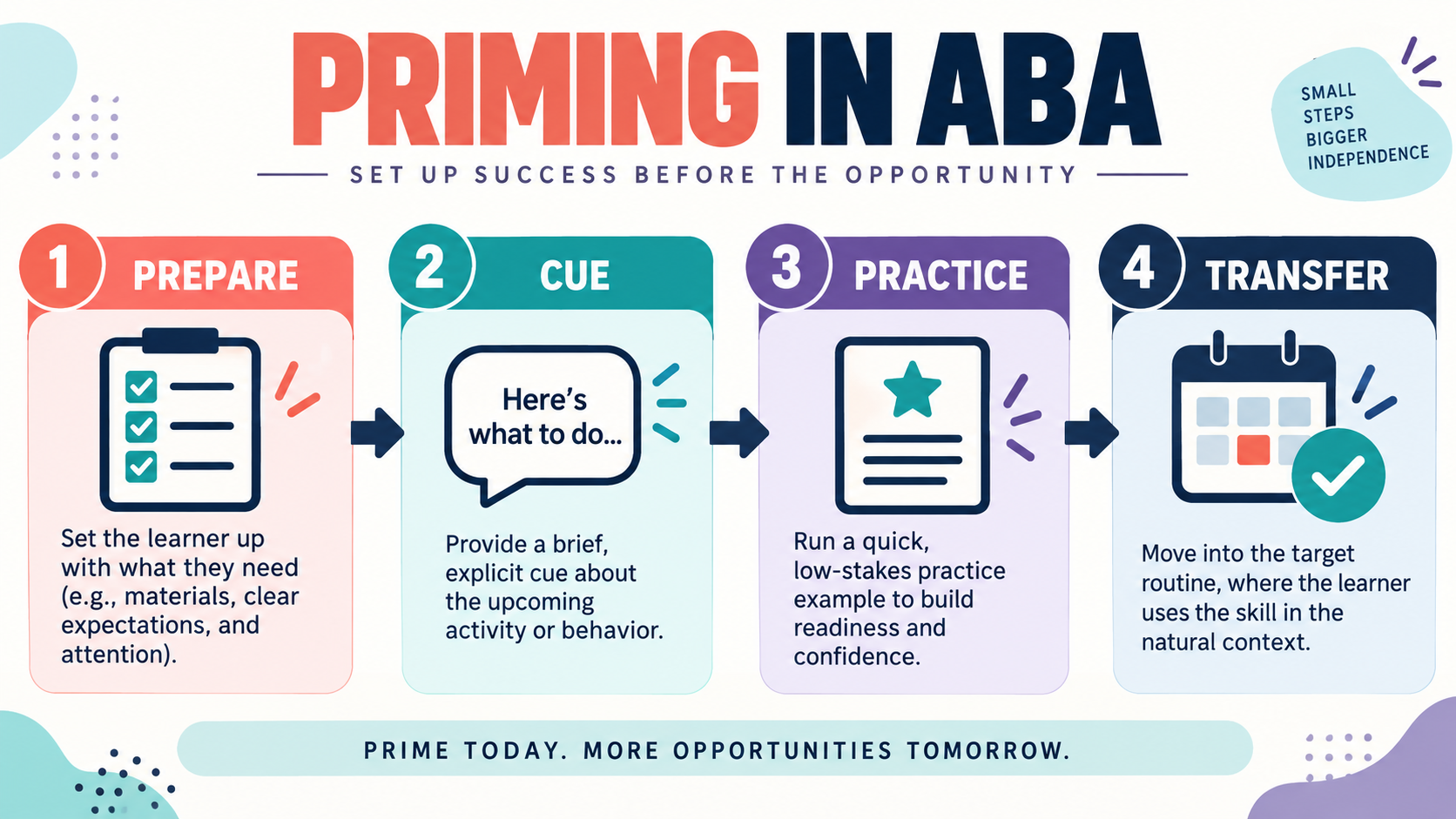
In applied behavior analysis, priming usually means arranging contact with information or practice before the learner encounters the target activity in its ordinary context. The prime is related to what will happen later. If the goal is participating in a group lesson, the learner might preview the group materials or practice the first response. If the goal is using a new routine, the learner might review the sequence or handle the relevant materials beforehand.
Priming is not simply telling someone to “get ready.” The preview should be concrete enough to contact the stimuli, response, or routine that matters. It should also be brief and achievable enough that the learner does not complete the entire activity before the actual learning opportunity.
Why Might a BCBA Use Priming?
A new, complex, or unpredictable activity can compete with the learner’s current response repertoire. Priming may provide an early opportunity to contact the materials, rehearse a response, or discriminate the important features of the task. The later activity can then become a chance to use the skill under more natural conditions.
Priming can support academic responding, social routines, communication, self-care, transitions, and participation in unfamiliar settings. The goal should be meaningful and individualized. If the only outcome is looking quiet or appearing compliant, the team should reconsider whether the target reflects a useful skill and whether the learner has a way to communicate preferences or a need for support.
What Are Examples of Priming in ABA?
Examples depend on the goal and the learner. A teacher might preview a worksheet format before independent work, show a short model before a social routine, practice requesting materials before a classroom activity, or let a learner explore a new item before it is included in a lesson. A caregiver might review a sequence of steps before a community routine. A practitioner might arrange a brief practice with the actual communication response that will be needed later.
These examples are not prescriptions. A preview that helps one learner may be distracting, stigmatizing, or irrelevant for another. Use materials and language the learner can access, and monitor whether the prime creates a new prompt dependency or makes the later activity less natural.
How Is Priming Different From Prompting?
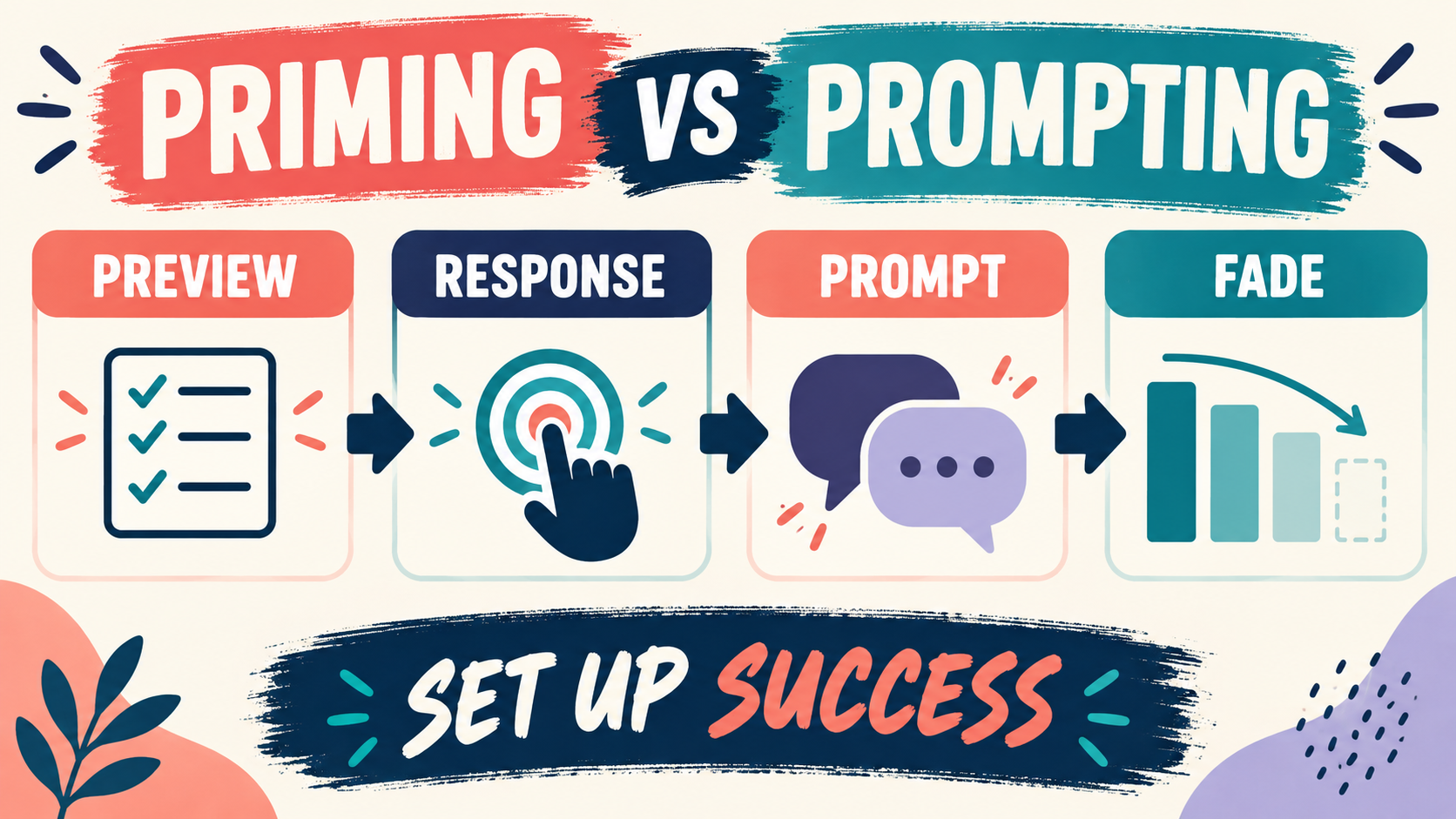
A prompt is an added stimulus delivered to evoke a response under the current teaching conditions. Priming happens before the target opportunity and prepares the learner for what will be encountered later. The procedures can overlap: a prime may include modeling or prompts during a brief rehearsal, but the question is whether that rehearsal is preparation for a later natural opportunity or the actual teaching trial.
| Concept | Typical timing | Key question |
|---|---|---|
| Priming | Before a later activity or natural opportunity | Does the preview prepare the learner to contact the later response? |
| Prompting | During the response opportunity | What added stimulus evokes the response, and how will it fade? |
| Transition warning | Before a change in activity, location, or routine | Does the signal make the upcoming change discriminable? |
How Is Priming Different From a Transition Warning?
A transition warning communicates that something is ending or changing. Priming previews relevant content, materials, or responses for a later activity. A visual schedule can serve both roles if it signals the transition and previews what the next activity involves, but the team should state which function the procedure is intended to serve.
For an exam question, look at the timing and the stated purpose. “Two minutes until cleanup” is primarily advance notice. “Before the new group activity, practice raising a hand and choosing a discussion card” is more clearly a priming sequence. The same tool can be used in different ways, so do not classify it by appearance alone.
How Should a Priming Procedure Be Planned?
Begin with the later response and the conditions in which it should occur. Define what the learner will do, what materials or cues will be present, and what counts as successful participation. Then select a prime that resembles the relevant features without making the learner rehearse an artificial version that will not generalize.
- Identify the skill or participation response that matters in the natural activity.
- Select preview materials, models, practice trials, or visual information that directly relates to that response.
- Keep the prime brief enough to be practical and meaningful.
- Arrange reinforcement for the learner’s communication and target response, not just passive exposure.
- Decide how prompts will be faded and how generalization will be assessed.
What Should the Learner Experience During the Prime?
The learner should contact information that is useful for the upcoming activity. That might be the materials, the response form, the sequence, the location, or a model of the interaction. Avoid adding irrelevant demands or requiring a learner to imitate a socially preferred performance when the actual goal is flexible communication or participation.
Offer choices when possible. A learner may be able to choose which item to preview, whether to watch or handle a material first, or how to request a pause. Choice does not remove the learning objective; it can make the preparation more respectful and informative.
How Should Priming Be Measured?
Measure the later outcome, not only whether the prime was delivered. Depending on the target, record independent responding, accuracy, latency, duration of participation, prompt level, communication, transition completion, or problem behavior. Define when the later opportunity starts so the comparison is meaningful.
Record enough context to see whether the effect generalizes. Compare performance across activities, people, materials, settings, and time. If the learner performs well only immediately after a highly specific prime, the team may need to vary the preview and teach the skill under more natural conditions.
What Are Common Priming Mistakes?
- Calling any explanation a prime: a vague reminder may not provide relevant preview information.
- Measuring delivery instead of outcome: a completed checklist does not show that the later response improved.
- Overprompting during rehearsal: the learner may depend on help that will not be available later.
- Using a generic prime: the preview may not match the actual materials, response, or context.
- Assuming a universal effect: the same prime can function differently across learners and situations.
How Can Priming Be Faded?
Fading might involve reducing the amount of rehearsal, using less specific preview materials, increasing the delay before the natural opportunity, varying the context, or transferring control to the natural cues. Fade gradually enough that the learner continues to contact success, and keep a way to request information or support.
If data worsen during fading, do not simply return to a more intrusive procedure without analysis. Check whether the natural activity changed, whether reinforcement was available, whether the operational definition still fits, and whether the prime was masking a missing skill or a difficult environmental condition.
How Does Priming Appear on the BCBA Exam?
Exam questions may test whether you can identify an antecedent arrangement, distinguish a prime from a prompt, select a measure, or recognize a generalization problem. Choose the answer that matches the timing, the learner’s response, and the scenario’s functional variables. Be cautious with choices that promise reduced anxiety, guaranteed compliance, or an effect without data.
Key Takeaways
- Priming in ABA prepares a learner for a later activity, response, or routine by previewing relevant information or practice.
- Priming is related to, but not identical to, prompting or transition warnings.
- Choose a prime that matches the learner, target response, materials, and natural context.
- Measure the later outcome and monitor prompt dependence, generalization, and communication.
- Do not treat priming as a guarantee or as a replacement for individualized assessment.
Want to practice the distinction? Try the free BCBA mock exam and explain whether each scenario uses priming, prompting, a transition signal, or a different antecedent strategy. Practice can support preparation, but it cannot guarantee an examination result.
Sources and Further Reading
For background, review research on priming as coordinated educational preparation, the Autism Society of North Carolina primer, and the Texas SPED Support definition. For exam-domain context, consult the current BACB Task List and use current official materials when terminology or requirements change.
For targeted review, use our priming ABA practice questions to apply the concept in exam-style scenarios.
Take the Free BCBA Mock Exam
If you want a low-pressure way to check your recall, use the free practice resource below. Take the Free BCBA Mock Exam



