
A practical list of unrestricted activities for BCBA fieldwork, organized by the skill being built, the evidence to keep, and the questions a supervisor should review. If you are searching for a list of unrestricted activities BCBA trainees can use, the important question is not whether a task sounds indirect or whether it happens away from a client. An unrestricted activity is fieldwork that best represents work a behavior analyst performs, is behavior-analytic in nature, relates to client services and trainee goals, and meets the current BACB requirements.
Table of Contents
- What Are Unrestricted Activities for BCBA Fieldwork?
- How the 60% Unrestricted Rule Works
- List of Unrestricted Activities BCBA Trainees Can Discuss
- How to Classify a Fieldwork Activity
- Restricted vs. Unrestricted Examples
- Activities That Need Extra Caution
- How to Document Unrestricted Hours
- What to Check for 2027 Requirements
- Build a Weekly Unrestricted-Activity Plan
- Practice Fieldwork Classification Questions
- Frequently Asked Questions
- Quick Review Checklist
- Take the Free BCBA Mock Exam
The BACB supervised-fieldwork FAQ warns that the same activity can be classified differently depending on context. For example, data collection can be restricted when it is simply part of delivering a treatment procedure, or unrestricted when it supports assessment and future programming. Use this guide to prepare a candidate list, then have your supervisor make the final determination.
What Are Unrestricted Activities for BCBA Fieldwork?
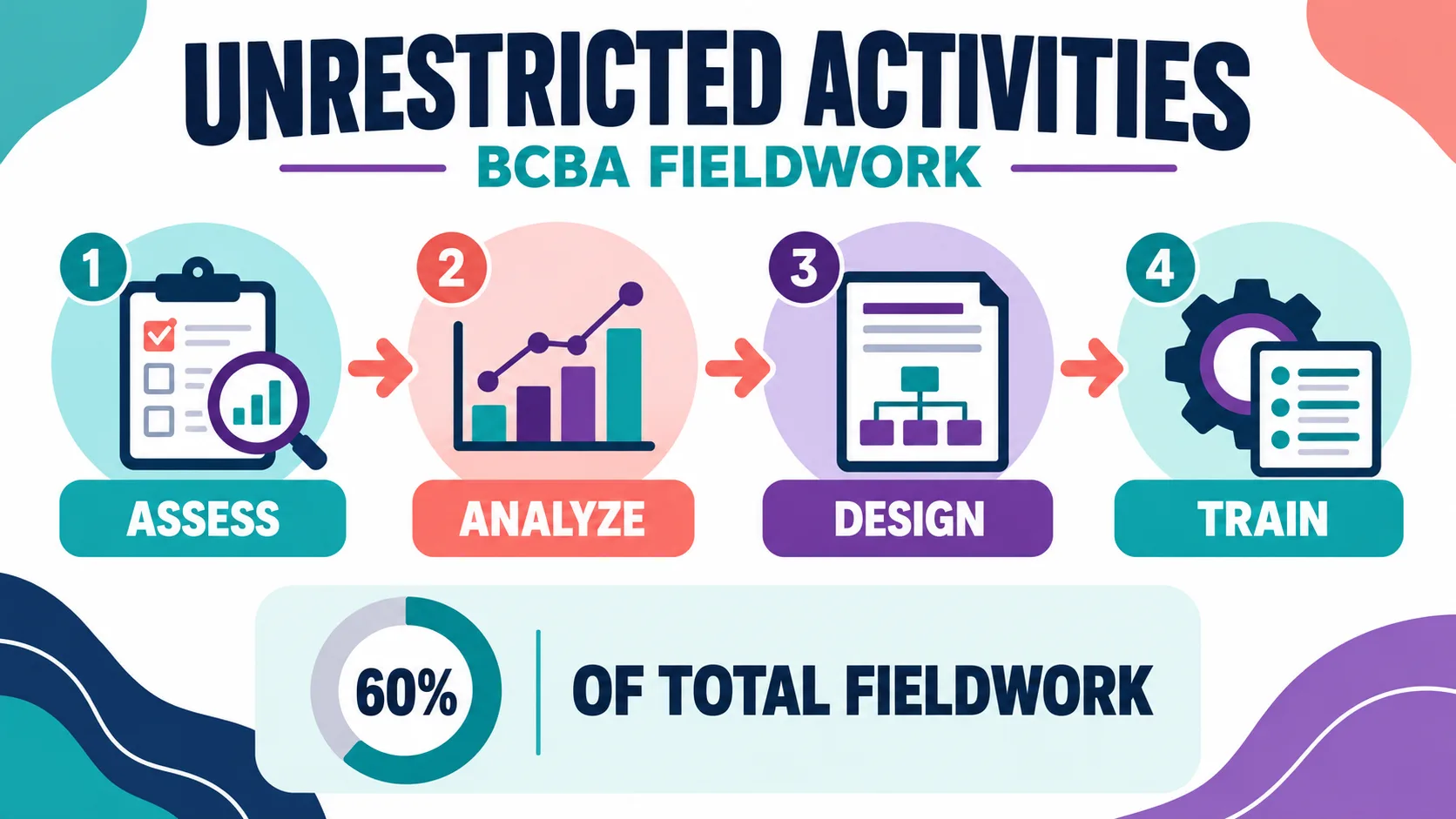
Unrestricted activities are activities that are most likely to be performed by a BCBA. They are not merely office work, paperwork, or any task that does not involve direct treatment. The activity should build behavior-analytic skills that a BCBA uses to assess needs, design or evaluate programs, train others, analyze data, collaborate, and make decisions for clients.
“Unrestricted” describes the fieldwork category, not a promise that every minute of a job qualifies. A task must still satisfy the current handbook, be tied to appropriate clients or services, fit the trainee’s goals, and be completed under the required supervision structure. A supervisor should review both the task and the context in which it occurred.
How the 60% Unrestricted Rule Works
For the current BCBA fieldwork framework, at least 60% of total supervised fieldwork hours must be unrestricted. The remaining hours may include restricted activities, subject to the applicable requirements. The percentage is calculated across total fieldwork, not by assuming that every calendar month must look identical.
For example, if a trainee has 100 total supervised fieldwork hours in a period that will be included in the overall calculation, at least 60 of those hours would need to be unrestricted under the BCBA rule. A local log may show a different monthly mix, but the accumulated record still has to satisfy the current requirements. Use the current BCBA Handbook for the pathway and application-year rules that govern your case. Do not treat the 60% target as permission to label convenient activities without review. The ratio is an outcome of valid classification; it is not the classification test itself.
List of Unrestricted Activities BCBA Trainees Can Discuss
The following list is a planning menu, not automatic approval. Each activity should be behavior-analytic, connected to a real service or client context when required, appropriate for your training goals, and reviewed by your supervisor.
1. Observation and behavior-analytic data collection: Observe a client or service context, collect ABC or other assessment data, and describe the purpose of the observation. Data collection is a stronger unrestricted candidate when it is used to understand the function of behavior, identify programming needs, or guide an assessment—not when it is only the routine measurement embedded in direct treatment.
2. Assessments and assessment preparation: Assist with preference assessments, skill assessments, functional behavior assessments, functional analyses when properly trained, or other assessments related to the need for behavioral intervention. Include the question being answered, the procedures used, the results, and how the results informed a program decision.
3. Writing and revising behavior-analytic programs: Draft or revise goals, teaching procedures, behavior plans, prompting strategies, reinforcement arrangements, data systems, and generalization plans. The work should be individualized and reviewed by the supervisor; copying a generic worksheet without analyzing the client’s needs is weak evidence of BCBA-level skill.
4. Graphing, analyzing, and interpreting data: Graph client data, summarize level and trend, examine variability, compare conditions, and use the results to recommend continuing, changing, or ending a service. Keep the source of the data and the decision it supported so the log shows analysis rather than only software entry.
5. Training staff, caregivers, or other stakeholders: Prepare or deliver behavior-analytic training, model a procedure, check implementation fidelity, and provide feedback. Record the skill trained, the evidence of performance, and the follow-up plan. A general staff meeting without a behavior-analytic training objective may not qualify. 6. Meetings about behavior-analytic programming: Participate in client meetings, treatment-team consultation, caregiver collaboration, or service-planning discussions when you contribute behavior-analytic analysis. Document the problem discussed, your contribution, the decision made, and any action assigned.
7. Literature review and case-related research: Review research that informs a current client’s programming, summarize the relevant evidence, and explain how it affects an assessment or intervention choice. Reading general content for personal interest is not the same as case-related, supervised behavior-analytic research.
8. Preparing for supervision and evaluating implementation: Prepare a case presentation, identify questions for supervision, review treatment integrity, evaluate whether a plan is producing the desired outcomes, or develop a corrective-action recommendation. The record should show what was evaluated and how feedback changed your work.
How to Classify a Fieldwork Activity
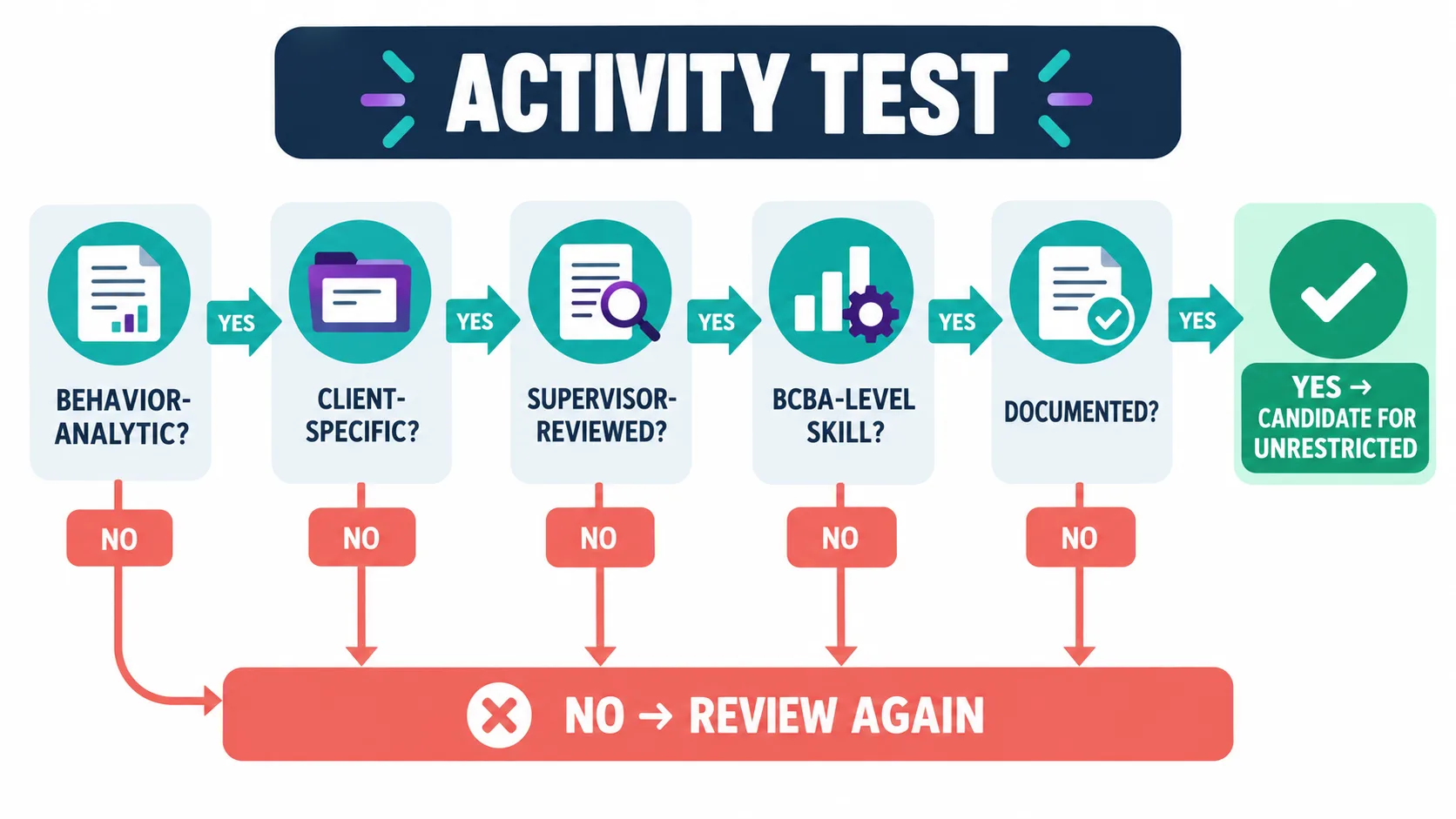
Before placing an activity in your unrestricted column, run it through five questions:
- Is it behavior-analytic? Can you identify the behavioral principles, assessment process, measurement system, intervention, or analytic decision involved?
- Does it represent BCBA-level work? Is the activity building skills in assessment, program design, analysis, consultation, training, or supervision rather than only delivering a procedure?
- Is the context clear? Can you connect the work to a client, stakeholder, service, or behavior-analytic training goal?
- Was it supervised and reviewed? Did the required supervisor know about the activity, provide feedback, and approve the record under the applicable system?
- Can you prove what happened? Does the entry show the date, duration, task, client or case reference, product, feedback, and outcome without exposing unnecessary protected information?
If the answer to one question is unclear, do not inflate the category. Mark the item for supervisor review, gather the missing evidence, and classify it only after the context is resolved.
Restricted vs. Unrestricted Examples
Both categories can be valuable. The distinction is about the nature and purpose of the activity, not whether the work feels difficult or whether it happens in a clinic, school, home, or telehealth setting.
| Activity description | Possible category | Why context matters |
|---|---|---|
| Collecting data while implementing a programmed teaching trial | Often restricted | The primary activity may be direct delivery of an instructional procedure. |
| Collecting data to define a behavior and plan an assessment | Potentially unrestricted | The purpose is assessment and future programming; document that purpose. |
| Running a generic staff meeting | Not automatically unrestricted | A meeting needs a clear behavior-analytic training or consultation contribution. |
| Training caregivers on an individualized behavior program | Potentially unrestricted | Record the program, training method, performance check, and feedback. |
| Entering numbers into a spreadsheet with no analysis | Review carefully | Data entry alone does not show the BCBA-level analytic decision being built. |
Activities That Need Extra Caution
Do not assume that the following automatically count as unrestricted:
- general administrative work, scheduling, billing, or filing;
- watching a webinar or reading a textbook without a client-related application;
- creating generic social-media content or materials unrelated to a supervised case;
- performing a task solely because it is unpaid, indirect, or called “clinical”; or
- working with a client without documenting the behavior-analytic purpose and required supervision.
The label on a job description is not enough. A task called “data analyst,” “case manager,” or “program assistant” still has to be examined by what you actually did and why.
How to Document Unrestricted Hours
A useful log lets another qualified person reconstruct the activity without revealing more confidential information than necessary. For each entry, capture:
| Field | What to record |
|---|---|
| When and how long | Date, duration, supervisory period, and fieldwork category. |
| What you did | Observable actions, product created, data analyzed, or training delivered. |
| Why it mattered | Client or service question, skill goal, and decision the activity supported. |
| Review and outcome | Supervisor feedback, changes made, and the next step. |
What to Check for 2027 Requirements
The BACB handbook includes application-year requirements and a 2027 eligibility framework. The current handbook table describes 2,000 hours for Supervised Fieldwork or 1,500 hours for Concentrated Supervised Fieldwork, with at least 60% of total supervised fieldwork in unrestricted activities. Other details—such as supervisory percentage, fieldwork limits per supervisory period, observations, and individual supervision—also matter.
Do not copy a percentage or example from an old tracker into a 2027 plan without checking the current handbook and your application timing. Keep the source version in your records, ask your supervisor which pathway applies, and treat this article as a planning aid rather than a substitute for the official requirements.
Build a Weekly Unrestricted-Activity Plan
Start with the skills you need to practice, not with a random list of tasks. Choose one assessment activity, one data-analysis activity, one program-design activity, and one consultation or training activity that fit your clients and supervisor’s capacity. Set a small product for each—for example, an assessment summary, a graph with an interpretation, a revised program, or a caregiver-training plan.
At the end of the week, compare the planned activity with what actually happened. Correct the category while the details are fresh, note the feedback received, and check the accumulated unrestricted percentage. A steady record is easier to audit than a last-minute attempt to relabel hours.
Practice Fieldwork Classification Questions
After each missed practice question, write the activity, its purpose, the category you chose, the evidence supporting the choice, and the question you would ask your supervisor. This turns a list of examples into classification skill. Use the Free BCBA Mock Exam to practice fieldwork, supervision, and applied decision questions. Review the explanation, then verify requirements against the current BACB handbook.
Frequently Asked Questions
What is an unrestricted activity for BCBA fieldwork?: It is an activity that best represents work a BCBA performs and builds behavior-analytic skills such as assessment, analysis, programming, consultation, or training. The current requirements and context determine whether it qualifies. What percentage of BCBA fieldwork must be unrestricted?: Under the current BCBA framework, at least 60% of total supervised fieldwork hours must be unrestricted. Check the current handbook for your pathway and application year. Can data collection be unrestricted?: Sometimes. Data collection used for assessment and future programming may be a candidate; routine data collection embedded in direct treatment may be restricted. The purpose and context matter. Can I decide by myself whether an activity counts?: You can prepare the rationale, but your supervisor should review the activity, context, documentation, and applicable requirements before you rely on the classification. Bottom line: Use this list to start a supervisor conversation, then classify each activity by its behavior-analytic purpose, BCBA-level skill, client context, supervision, and evidence—not by its job title.
Quick Review Checklist
Use this final checklist to turn list of unrestricted activities bcba into exam-ready reasoning. The goal is not to memorize a label in isolation; it is to identify the relevant evidence and explain why the best answer fits the scenario. Key ideas to review:
- State the central definition or decision point for list of unrestricted activities bcba in your own words.
- Identify the detail that makes list of unrestricted activities bcba different from its closest related ABA term.
- Separate the observable facts in a scenario from assumptions that are not supported by the facts.
- Write one example and one nonexample so you can recognize the concept in a new setting.
Exam application checks:
- Ask what the question is actually requesting before comparing the answer choices.
- Mark the antecedent, response, consequence, or other evidence that supports the selected answer.
- Look for a distractor that describes a related process but does not answer the specific question.
Final self-check:
- Explain how you would verify the interpretation with clear observations or data.
- Change one detail in the scenario and decide whether your answer should change.
- Give a one-sentence rationale that a supervisor or study partner could evaluate.
Take the Free BCBA Mock Exam
When you are ready to apply the idea, use the free practice resource below for additional feedback. Take the Free BCBA Mock Exam



