

PLACHECK in ABA turns a quick group observation into usable measurement data. Learn the definition, formula, observation steps, graph-reading rules, and BCBA exam traps that make Planned Activity Check easier to apply. PLACHECK in ABA means Planned Activity Check: a group-oriented variation of momentary time sampling. At scheduled check points, the observer briefly scans the group, counts how many eligible members are engaged in the defined activity, and records the result. It is not a running count of every response and it is not a measure of how long each person stayed engaged.
Table of Contents
- What Is PLACHECK in ABA?
- How Is PLACHECK Different From Other Measures?
- How Do You Set Up a PLACHECK Observation?
- How Do You Calculate PLACHECK?
- How Do You Interpret a PLACHECK Graph?
- What Should You Record at Each Check?
- What PLACHECK Mistakes Show Up on the BCBA Exam?
- What Is the Bottom Line?
- Quick Review Checklist
- Take the Free BCBA Mock Exam
The most useful way to study PLACHECK is to connect the label to the decision. If a BCBA wants to know whether a group is engaged during a routine, the observer needs a clear target activity, a defensible denominator, a consistent check schedule, and a summary that can be compared across phases. The current BCBA Test Content Outline places measurement, data display, and interpretation inside the exam content; it does not turn every named procedure into an official BACB rule. Treat PLACHECK as a measurement application to understand, not as a phrase to memorize without context. Table of Contents
What Is PLACHECK in ABA?
PLACHECK is a planned, momentary observation of group engagement. The observer waits for the scheduled signal, scans the defined group, and counts the members who are engaged at that instant. The observation may repeat every 30 seconds, every minute, or at another interval chosen for the measurement question. The important point is that the observer scores the planned moment rather than watching continuously between signals.
Suppose a supervisor wants to estimate how many people in a staff training group are participating in a role-play activity. The operational definition might say that a participant is engaged when they are looking at the assigned scenario, writing a response, speaking during their assigned turn, or completing the specified practice step. The observer checks the group at the timer signal and records the count. “Looks interested” is not precise enough because two observers may score it differently.
The word group matters. PLACHECK can describe group-level participation while still counting individual members. The output is usually a percentage of eligible group members engaged at each check. That makes it useful for a classroom, staff training, group instruction, or another setting where a quick group scan answers the question better than a separate continuous observation of every person.
How Is PLACHECK Different From Other Measures?
Many BCBA questions are solved by identifying when the clock starts, what gets scored, and when the observer records. PLACHECK is easy to confuse with other systems because several procedures use timers. The distinction is not the timer itself; it is the observation unit and the denominator.
| Procedure | What is scored? | Best question | Common trap |
|---|---|---|---|
| PLACHECK | Number of eligible group members engaged at each planned check | What percentage of the group is engaged at the sampled moments? | Calling the result duration or counting only intervals |
| Momentary time sampling | Whether one target person is engaged at the end of each interval | Was the individual behavior occurring at the sampled moment? | Treating the sample as if behavior was observed continuously |
| Partial-interval recording | Whether the target behavior occurred at any point during the interval | During how many intervals did the behavior occur at least once? | Scoring a brief occurrence as if it lasted the whole interval |
| Duration recording | Time from response onset to response offset | How long did the response continue? | Using a PLACHECK percentage to answer a duration question |
How Do You Set Up a PLACHECK Observation?
A defensible PLACHECK starts before the timer starts. The team should decide who belongs in the eligible group, what “engaged” means, how often checks occur, and what happens when someone is absent or outside the activity. If those decisions change from one session to the next, a higher percentage may reflect a different denominator rather than a real behavior change. Use this setup sequence:
- Name the group: list the setting and the people who can be observed during the activity.
- Define the target activity: describe observable actions that count as engaged and examples that do not.
- Set the check schedule: choose the interval, signal, observation window, and scan order before collecting data.
- Set the denominator rule: decide whether absent people, late arrivals, staff, visitors, or people assigned to another activity are eligible.
- Train the observer: practice the scan and compare scoring with another trained observer when reliability matters.
- Record context: note schedule changes, prompts, unusual events, group size changes, and any missed check.
The scan should be brief and consistent. A slow scan that allows the observer to watch some people for much longer than others can quietly turn a momentary system into an uneven observation. The goal is not to create a perfect picture of every second; it is to sample the group in a way that matches the decision and can be repeated.
How Do You Calculate PLACHECK?
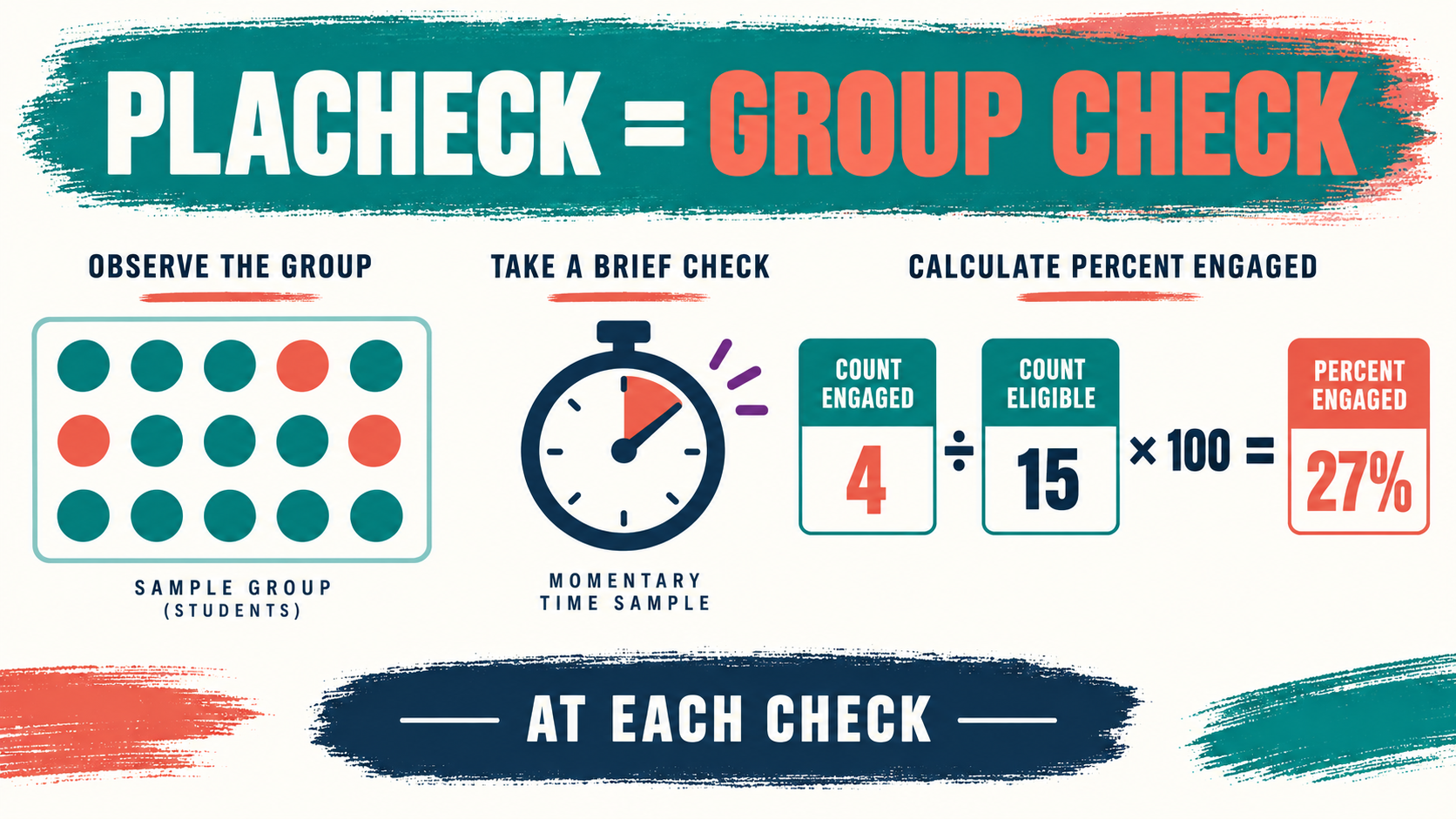
At each eligible check, divide the number of members engaged by the number of eligible members observed, then multiply by 100. In symbols: Percent engaged at a check = engaged members ÷ eligible members × 100 For example, if four of fifteen eligible members are engaged when the signal sounds, the check percentage is 4 ÷ 15 × 100 = 26.7%, usually rounded to 27%. That number describes the sampled moment. It does not mean that the group was engaged for 27% of the entire observation period.
To summarize a session, choose the rule before examining the result. Many teams average the check percentages when each check is intended to have equal weight. If group size varies meaningfully, a pooled calculation can be more transparent: add the engaged counts across checks, add the eligible counts across checks, and divide the first total by the second. The article or data sheet should identify which summary was used so another reader does not mistake a mean of percentages for a pooled percentage.
| Check | Engaged | Eligible | Percent engaged |
|---|---|---|---|
| 1 | 6 | 10 | 60% |
| 2 | 7 | 10 | 70% |
| 3 | 6 | 9 | 67% |
| 4 | 8 | 10 | 80% |
| 5 | 8 | 10 | 80% |
Using the five check percentages above, the equal-weight session mean is approximately 71.4%. The pooled calculation is 35 engaged observations divided by 49 eligible observations, or approximately 71.4% in this particular example. The two summaries happen to be close; they will not always match when denominators vary.
How Do You Interpret a PLACHECK Graph?
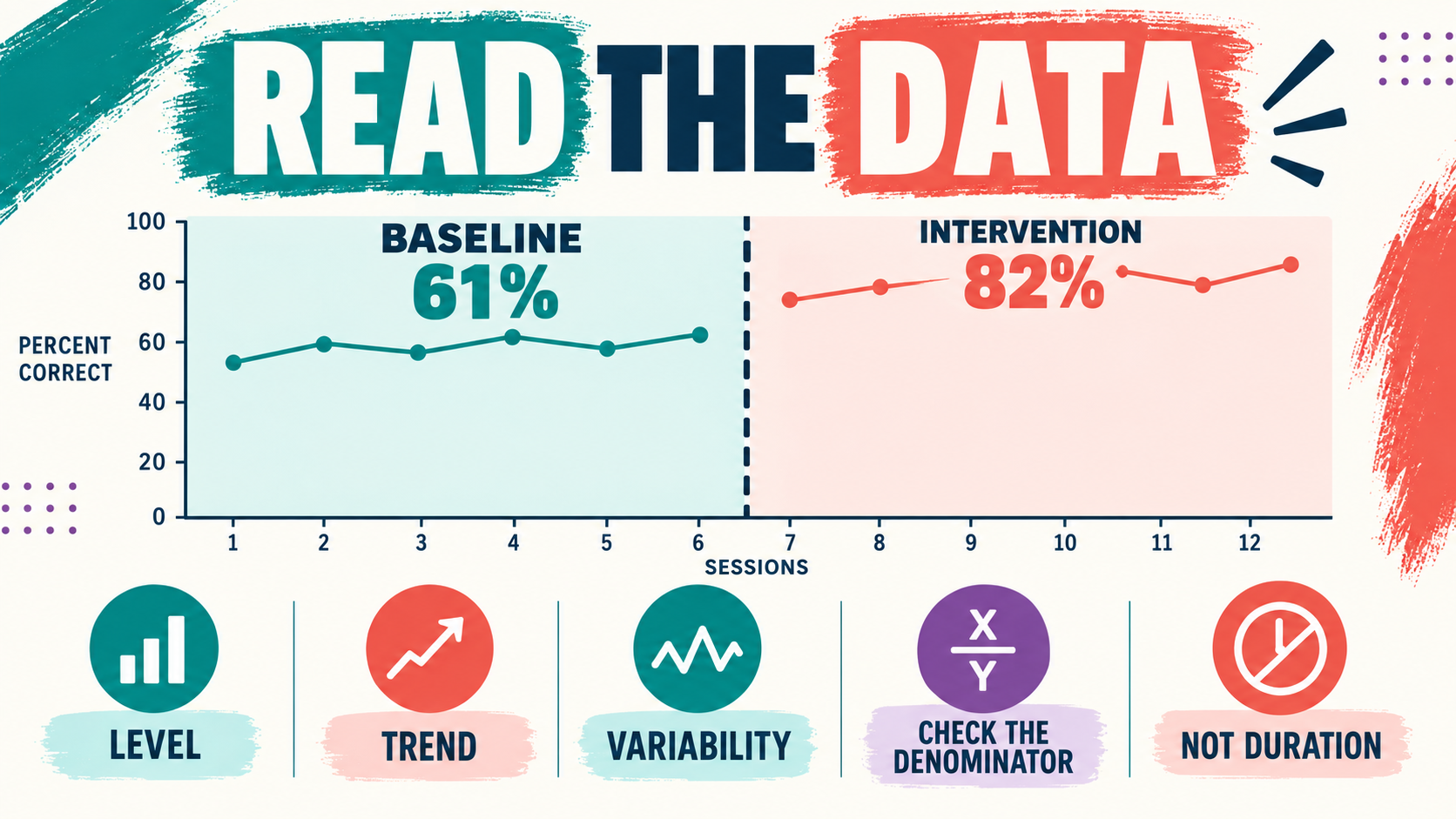
Graph the selected summary in the same order as the checks or sessions, and label the y-axis as percent engaged. If a procedure changes, draw a phase line and label the conditions. A graph should make it possible to see level, trend, variability, and the timing of the phase change without reading the raw data table first.
Imagine a baseline average of 61% followed by an intervention average of 82%. That phase difference may be meaningful, but it is not a conclusion by itself. Ask whether the group definition stayed stable, whether the denominator changed, whether the activity became easier, whether prompts were added, and whether the observer scored the same behavior in both phases. The same percentage can represent different behavior when the eligible group or task changes.
Use the graph to generate the next decision. A stable baseline followed by a quick and sustained increase supports closer review of the intervention effect. A highly variable baseline may call for more observation before a change is attributed to the intervention. A single high check is a data point, not proof of a phase-level pattern.
What Should You Record at Each Check?
A compact data sheet can protect the interpretation later. Record enough information to reconstruct what the percentage meant, but do not fill the form with details that the decision will never use.
- Session date, setting, activity, and observation phase.
- Check number and the planned signal time.
- Number engaged at the check.
- Number eligible at the same check.
- Percentage engaged or the two counts needed to calculate it.
- Absent, late, ineligible, or temporarily unavailable members.
- Prompt, schedule, task, staffing, or environmental changes.
- Missed checks, delayed scans, and the reason for each exception.
If no eligible members are present, the correct entry is not automatically 0%. Zero means that eligible members were observed and none met the engagement definition. When the denominator is zero, use the team’s planned missing-data code and explain it in the notes. If the group is present but no one is engaged, 0% may be correct, provided the operational definition was observable and the check was completed.
What PLACHECK Mistakes Show Up on the BCBA Exam?
Exam questions often change one detail in the scenario and ask which measurement system fits. Read the timing language and the denominator before looking at the answer choices.
- “At the signal” means a momentary check: do not treat it as continuous observation.
- “How many group members are engaged?” points to the PLACHECK denominator: count people, not only intervals.
- “At any point during the interval” points toward partial interval recording: the scoring rule has changed.
- “How long did the behavior continue?” points toward duration: a percent-engaged snapshot cannot answer it.
- A changing group size changes interpretation: check the eligible denominator before claiming improvement.
- No response is not automatically a zero latency or a zero percentage: use the planned missing-data rule.
- One unusual check is not a trend: examine repeated checks and phase-level data.
One final study cue is to ask, “What exactly was observed?” If the scenario says the observer scans a group at planned moments and records the number engaged, PLACHECK is the best fit. If the observer watches a single person throughout an interval, the answer may instead involve continuous recording, duration, frequency, or another interval system.
What Is the Bottom Line?
PLACHECK in ABA is a group-focused momentary sampling procedure. Define engagement, define who is eligible, schedule the checks, count engaged members, calculate the percentage, and interpret the graph with level, trend, variability, phase, and denominator in view. That sequence turns a short scan into data you can defend.
For additional practice separating measurement systems and reading BCBA-style scenarios, try the free BCBA mock exam. Use it as study practice—not as a promise of official questions—and return to the current BACB outline when exam requirements or content references change.
Quick Review Checklist
Use this final checklist to turn PLACHECK in ABA into exam-ready reasoning. The goal is not to memorize a label in isolation; it is to identify the relevant evidence and explain why the best answer fits the scenario. Key ideas to review:
- State the central definition or decision point for PLACHECK in ABA in your own words.
- Identify the detail that makes PLACHECK in ABA different from its closest related ABA term.
- Separate the observable facts in a scenario from assumptions that are not supported by the facts.
- Write one example and one nonexample so you can recognize the concept in a new setting.
Exam application checks:
- Ask what the question is actually requesting before comparing the answer choices.
- Mark the antecedent, response, consequence, or other evidence that supports the selected answer.
- Look for a distractor that describes a related process but does not answer the specific question.
Final self-check:
- Explain how you would verify the interpretation with clear observations or data.
- Change one detail in the scenario and decide whether your answer should change.
- Give a one-sentence rationale that a supervisor or study partner could evaluate.
Take the Free BCBA Mock Exam
If you want a low-pressure way to check your recall, use the free practice resource below. Take the Free BCBA Mock Exam



