

Pivotal behavior in ABA refers to a behavior that can create broader, untrained improvements when it changes. Instead of teaching every single response one at a time, a behavior analyst may target a response that opens the door to many related skills. For BCBA exam preparation, the key is not just memorizing the definition. You need to recognize when a target behavior is likely to produce wide-reaching effects across settings, people, tasks, or response classes.
Many candidates confuse pivotal behaviors with ordinary replacement behaviors, behavioral cusps, or broad treatment goals. The distinction matters because the exam often gives you a scenario and asks which target would be most efficient, most socially meaningful, or most likely to produce collateral behavior change. This guide focuses on how to identify pivotal behavior, how it shows up in applied examples, and how to avoid common exam traps.
Table of Contents
- What Is Pivotal Behavior?
- How to Identify Pivotal Behavior in Scenarios
- Why It Matters for BCBA Exam Questions
- Applied Examples of Pivotal Behavior
- Common Exam Traps and Better Reasoning
- Quick Review Checklist
- Summary
What Is Pivotal Behavior?
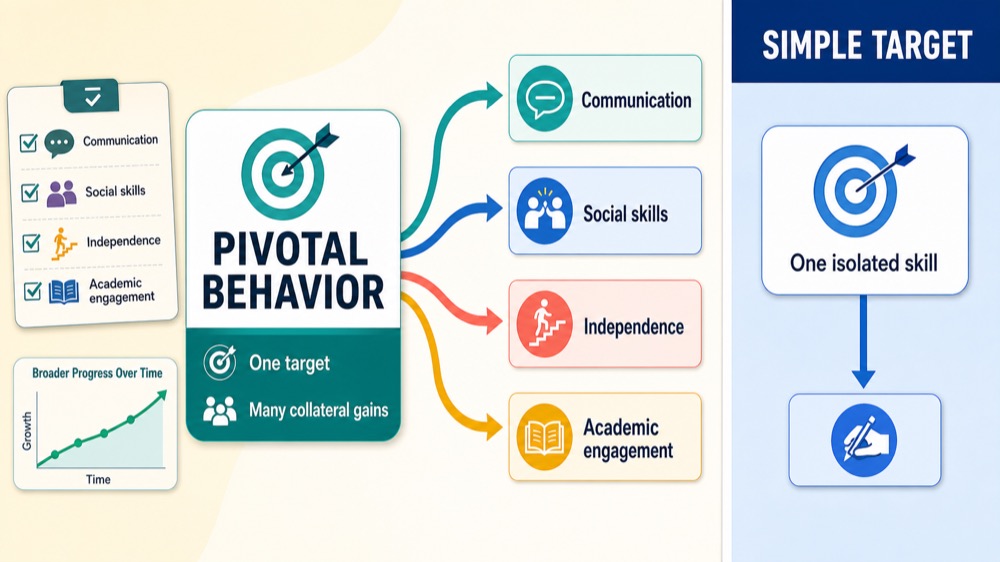
A pivotal behavior is a behavior that, once improved, produces positive changes in other behaviors that were not taught directly. The word pivotal is important: the target acts like a leverage point. A learner who begins initiating communication, for example, may also increase peer interaction, reduce problem behavior maintained by access, and participate more independently in group activities. Those additional outcomes may appear because the new behavior changes how the learner contacts reinforcement in everyday environments.
This does not mean pivotal behavior is magical or automatic. A behavior is only pivotal when there is a defensible reason to expect wider effects and when the data support that change. In applied behavior analysis, you still define the response clearly, measure it consistently, and evaluate whether other socially important behaviors improve. On the exam, look for language such as collateral effects, untrained responses, generalization across settings, or improved access to natural reinforcement.
- Broad impact: the behavior affects more than one narrow skill.
- Natural reinforcement: the learner contacts useful consequences outside the training arrangement.
- Generalization potential: the response can transfer across people, materials, or contexts.
- Measurable change: the target still needs an observable, countable definition.
How to Identify Pivotal Behavior in Scenarios
When a scenario asks you to choose a pivotal target, start by asking what behavior would change the learner’s access to the environment. A narrow target may be useful, but it is not necessarily pivotal. For example, teaching a child to label one picture card may be appropriate, but teaching the child to request help, initiate with peers, or persist during difficult tasks could affect many future interactions. The exam usually rewards the answer that creates the most meaningful and efficient behavior change, not the answer that sounds broad but is hard to measure.
A strong pivotal target should connect to both immediate intervention goals and long-term independence. It should be specific enough to teach and measure, but powerful enough to influence related skills. If the answer choice says “increase motivation” or “improve social skills,” it may be too vague. If it says “independently ask for a break using a three-word mand when work becomes difficult,” it is more behaviorally useful because it identifies the response, the context, and the likely reinforcement pathway.
Why It Matters for BCBA Exam Questions
BCBA exam questions often test pivotal behavior through scenario-based reasoning. You may see a learner with several deficits, a set of possible intervention targets, and a question asking which target would be most efficient or socially significant. The correct answer usually balances behavioral precision with broad applied value. It is not enough for a target to sound important. It has to be observable, teachable, and likely to produce additional beneficial behavior change.
Another common exam pattern is the distinction between pivotal behavior and a behavioral cusp. A cusp gives the learner access to new environments, contingencies, or reinforcers. A pivotal behavior produces widespread behavior change within or across existing environments. These ideas can overlap, but they are not identical. If an answer choice focuses on new access, such as reading opening access to books and online information, the question may be pointing toward a cusp. If it focuses on untrained improvements after one target changes, it may be pointing toward pivotal behavior.
Applied Examples of Pivotal Behavior
Examples are easier to study when you separate the target response from the broader effects it may produce. In each case below, the behavior is not pivotal just because it is useful. It becomes pivotal when changing that response plausibly improves several related outcomes and the analyst can verify those outcomes with data.
- Peer initiation: A learner rarely asks peers to play and often wanders during recess. Teaching the learner to say “Can I play?” may increase peer interaction, reduce adult prompting, and decrease wandering because the learner now contacts social reinforcement more effectively.
- Requesting help or a break: A learner screams when academic tasks become difficult. Teaching a clear mand for help or a short break may reduce screaming, improve task completion, and increase tolerance for instruction across subjects and adults.
- Starting multi-step routines: A learner learns to check a visual schedule, gather materials, and begin the first step. If morning work, transitions, and clean-up routines improve with fewer prompts, the target may be pivotal because it supports multiple adaptive responses.
The exam point is that each example still needs a measurable response definition. “Improve independence” is too broad by itself, but “checks the visual schedule and starts the first listed task within 30 seconds” can be taught, measured, and evaluated for broader effects.
Common Exam Traps and Better Reasoning
The most common trap is treating every important behavior as pivotal. A behavior can be socially significant without producing broad collateral effects. Handwriting, toothbrushing, or matching colors may be important targets, but they are not automatically pivotal. The exam may include an attractive answer that names a valuable skill, while the better answer names a skill that changes access to reinforcement across many situations.
- Trap 1: choosing a vague goal. “Improve motivation” is not a behavior. A stronger answer defines what the learner will do, such as choosing between tasks, requesting help, or persisting for a defined amount of time.
- Trap 2: expecting instant effects. Collateral changes may emerge gradually. A pivotal target still needs ongoing data collection rather than an assumption that broad change happened immediately.
- Trap 3: confusing response classes. A response class groups behaviors by function. Pivotal behavior describes a target whose improvement affects other behavior beyond the trained response.
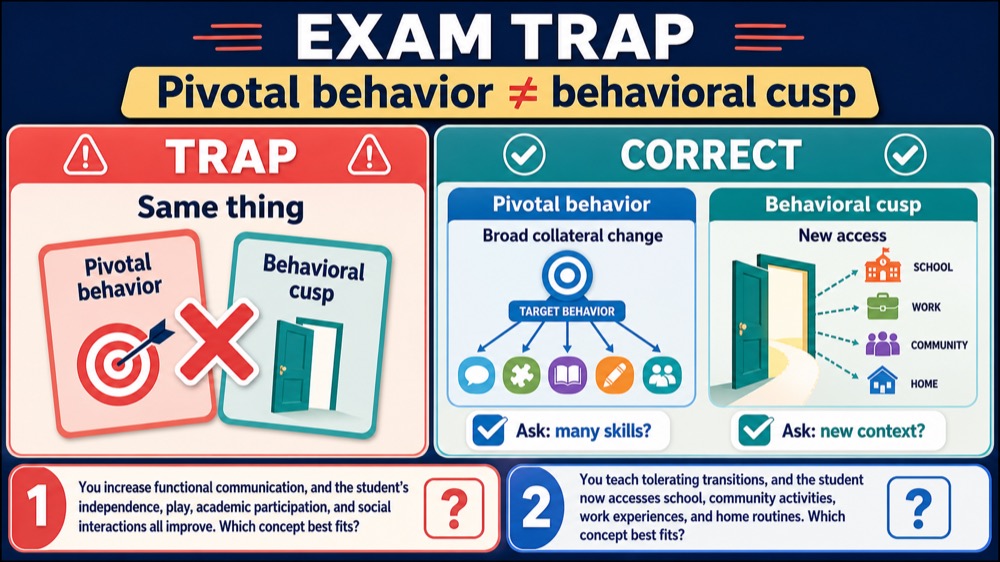
Use exam scenarios carefully. If the question describes several untrained improvements after one target is taught, think pivotal behavior. If the question describes entry into a new environment or contact with new contingencies, think behavioral cusp. If the question describes several topographies serving the same function, think response class. This comparison strategy keeps you from choosing an answer based only on familiar terminology.
Quick Review Checklist
Before answering a pivotal behavior question, slow down and identify the exact behavior, the expected collateral effects, and the evidence provided in the scenario. A good answer should pass all three checks. First, the response must be observable. Second, the target should plausibly affect other important behaviors. Third, the scenario should support that broader effect rather than merely implying that the skill is useful.
- Can the target behavior be directly observed and measured?
- Would changing this behavior contact natural reinforcement more effectively?
- Does the behavior support generalization across people, settings, tasks, or materials?
- Are the broader effects described with data or clear scenario evidence?
- Is the answer more precise than a general goal such as motivation, independence, or social skills?
Summary
Pivotal behavior is useful because it helps behavior analysts choose targets with high instructional value. For BCBA candidates, the exam skill is to identify the target that is both behaviorally precise and likely to produce broader, meaningful change. Do not select the broadest-sounding goal. Select the measurable behavior that changes how the learner contacts reinforcement and supports untrained improvements.
If this concept still feels close to behavioral cusps, response classes, or generalization, practice with scenario questions rather than rereading the definition alone. You can also take the free BCBA mock exam to test whether you can apply pivotal behavior and related ABA concepts under exam-style conditions.
References
- Behavior Analyst Certification Board: BCBA Test Content Outline (6th ed.)
- Cooper, J. O., Heron, T. E., & Heward, W. L. Applied Behavior Analysis.
- Behavior Analyst Certification Board. BCBA examination content and ethics resources.



