
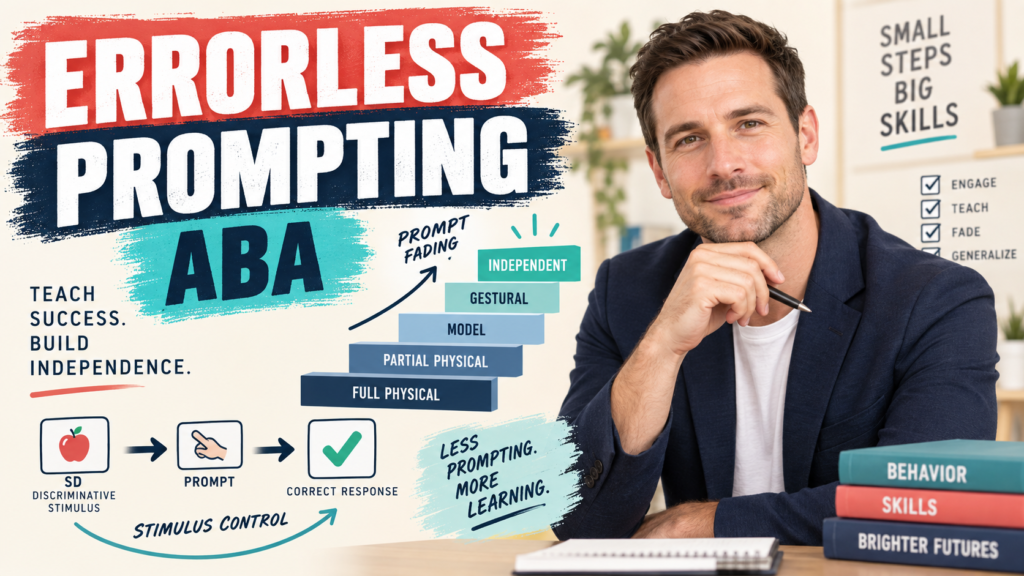
Errorless prompting in ABA arranges a prompt that makes a correct response likely, then systematically transfers control to the natural instruction or stimulus. Learn the rule, compare it with error correction and other prompting strategies, and interpret prompted versus independent data.
Table of Contents
- What Is Errorless Prompting ABA?
- Why Is Errorless Teaching Used?
- How Does Errorless Prompting Transfer Stimulus Control?
- How Is Errorless Prompting Different From Error Correction?
- How Does It Compare With Most-to-Least and Least-to-Most Prompting?
- How Should Prompt Fading Be Planned?
- What Data Should Be Collected?
- What Problems Can Create Prompt Dependency?
- What Ethical Checks Matter Before Using Errorless Prompting?
- How Is Errorless Prompting Tested on the BCBA Exam?
- What Is the Bottom Line?
- Quick Review Checklist
- Take the Free BCBA Mock Exam
Errorless prompting ABA is a teaching approach designed to reduce incorrect responses while a new discrimination or skill is being established. The instructor presents the relevant natural cue and provides a controlling prompt immediately or with very little delay. The learner is then more likely to emit the target response, contact reinforcement, and practice the correct relation.
The word “errorless” should not be read as a promise that a learner will never make a mistake. It describes the arrangement of teaching opportunities: the prompt is delivered early and is strong enough to make the correct response likely. The goal is not permanent prompting. The goal is to transfer stimulus control from the prompt to the natural discriminative stimulus while preserving access to independent responding.
The BACB task-list materials provide exam-scope context for prompting, stimulus control, skill acquisition, and data-based decisions. Exact prompt selection should be individualized by a qualified professional. This article is study guidance, not a universal instructional protocol.
What Is Errorless Prompting ABA?
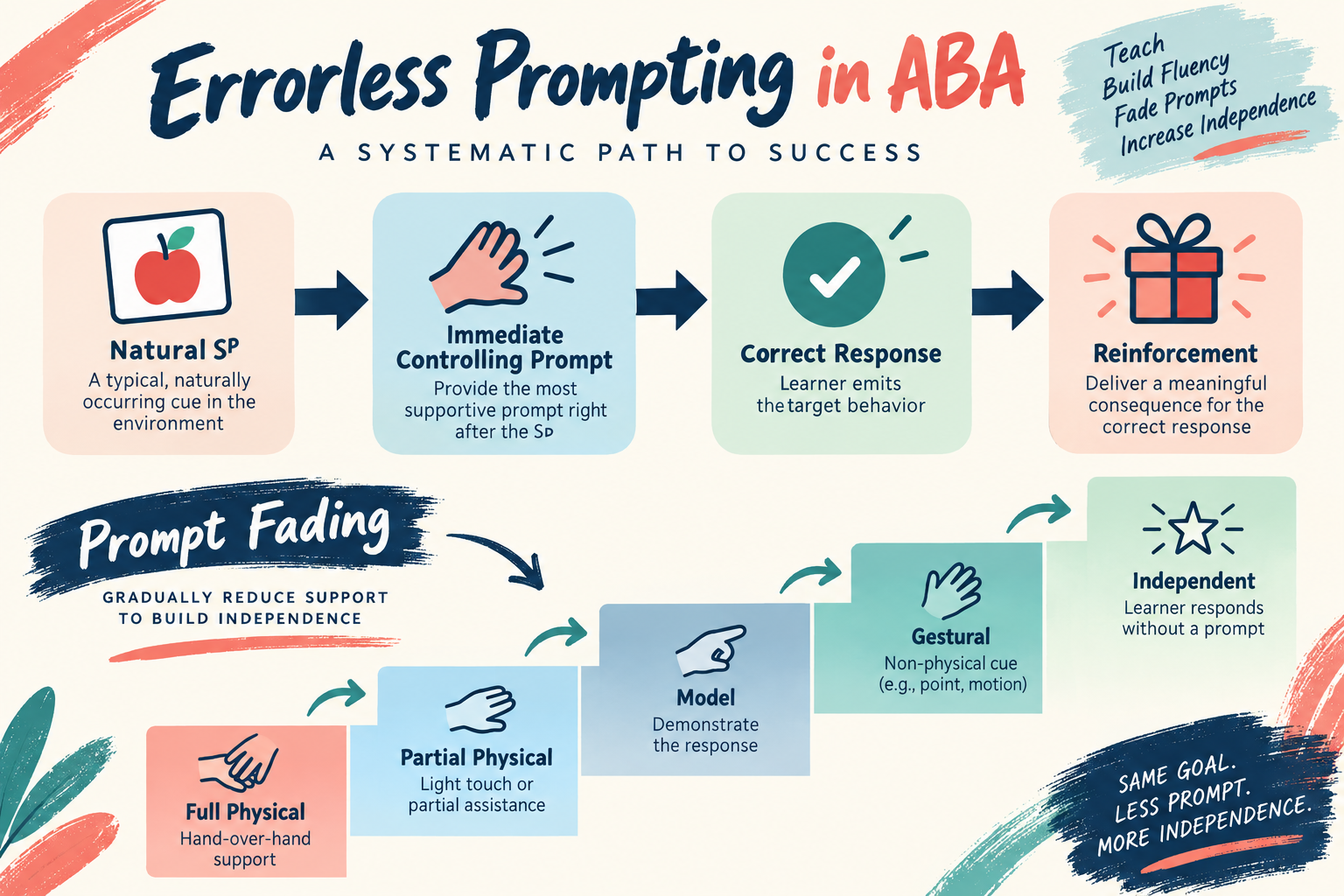
Errorless prompting is a response-prompting arrangement in which the instructor supplies a controlling prompt at the point of the instruction or before an incorrect response is likely. The prompt may be a model, gesture, positional cue, verbal model, physical guidance, or another support, depending on what reliably produces the correct response and what is appropriate for the learner. A simple contingency looks like this:
- The natural discriminative stimulus or instruction is presented.
- A prompt is delivered immediately or after a very short planned delay.
- The learner emits the correct response with the prompt.
- Reinforcement follows the correct response.
- The prompt is faded so the natural stimulus can eventually evoke the response.
The controlling prompt is the least assistive prompt that reliably produces the correct response under the teaching conditions. If a gesture is not strong enough for a particular learner, it may not be the controlling prompt for that skill. The label “errorless” describes the relation between the cue, the prompt, and the response—not a fixed prompt hierarchy that applies to everyone.
Why Is Errorless Teaching Used?
Early errors can contact reinforcement for an incorrect response, create a repeated error pattern, or make the teaching situation frustrating. Errorless arrangements give the learner more opportunities to practice the target response and can make the relevant relation clearer. They may be especially useful when a new discrimination is difficult, when incorrect responding has a history of producing escape or other unwanted outcomes, or when an error is costly or unsafe.
That does not mean errorless prompting is always the best choice. A learner may need opportunities to demonstrate what they can do without prompts, and some skills require a probe, an independent attempt, or an error-correction procedure. The professional decision should consider the learner’s repertoire, the target, the consequences of errors, the least intrusive effective support, and the data.
How Does Errorless Prompting Transfer Stimulus Control?
Stimulus control transfers when the natural instruction or stimulus begins to evoke the target response while the prompt is no longer necessary. Prompt fading is therefore central. If the prompt remains stronger, more noticeable, or more predictive of reinforcement than the natural stimulus, the learner may continue responding only when the prompt appears.
Fading can involve reducing prompt intensity, introducing a delay, changing the prompt’s position, using a less salient prompt, or systematically removing a prompt component. The appropriate method depends on the skill and the learner. A prompt should not be faded simply because a calendar says it is time. Data should show whether the natural cue is gaining control and whether the learner can respond with less support.
How Is Errorless Prompting Different From Error Correction?
Errorless prompting attempts to prevent or minimize errors by delivering the controlling prompt before the learner is likely to respond incorrectly. Error correction allows an independent opportunity first, then uses a correction sequence if the response is incorrect or absent. Both approaches can be part of skill teaching, but the timing of the prompt is the key distinction.
| Feature | Errorless prompting | Error correction | What to monitor |
|---|---|---|---|
| When support arrives | Immediately or before an incorrect response is likely | After an error or no response, according to the correction plan | Prompt timing and the learner’s opportunity for independent responding |
| Primary advantage | Minimizes practice of incorrect responses and may build early fluency | Tests independent responding and teaches a response after an error | Accuracy, rate of learning, and the learner’s response to errors |
| Main risk | Prompt dependence if fading and independent probes are weak | Repeated errors, frustration, or accidental reinforcement of an incorrect relation | Independent accuracy, errors, affect, and generalization |
How Does It Compare With Most-to-Least and Least-to-Most Prompting?
Most-to-least prompting often begins with a highly supportive prompt and systematically moves toward less intrusive prompts. It can be implemented as an errorless arrangement when the prompt is delivered before the learner has a chance to make an error. Least-to-most prompting begins with the least intrusive support and adds assistance if the learner does not respond or makes an error. It can be useful when the learner may already have the skill and the team wants to preserve an opportunity for independent responding.
These labels describe different dimensions. “Errorless” emphasizes minimizing errors through prompt timing and strength. “Most-to-least” and “least-to-most” describe the direction of the prompt hierarchy. A most-to-least sequence may be errorless, but the terms are not interchangeable in every question.
How Should Prompt Fading Be Planned?
Start by defining the target response and the natural stimulus that should control it. Then identify the prompt that currently makes the response reliable, the consequence for a correct response, and the evidence that will trigger a fade. The fade may be a gradual reduction in physical assistance, a delayed prompt, a less salient model, or a change in prompt position.
Plan for independent probes. If every teaching trial includes a prompt, the team cannot tell whether the learner responds to the natural cue. A probe can be brief and carefully selected; it does not require withholding needed assistance throughout a teaching session. Record the learner’s response before the prompt, the prompt level used, and whether the response generalized.
Prompt fading should not be a race toward zero support. A learner may appropriately use an AAC device, visual cue, adapted material, or communication partner. Independence means the learner can access the skill with the supports that are necessary and acceptable, not that every external support disappears.
What Data Should Be Collected?
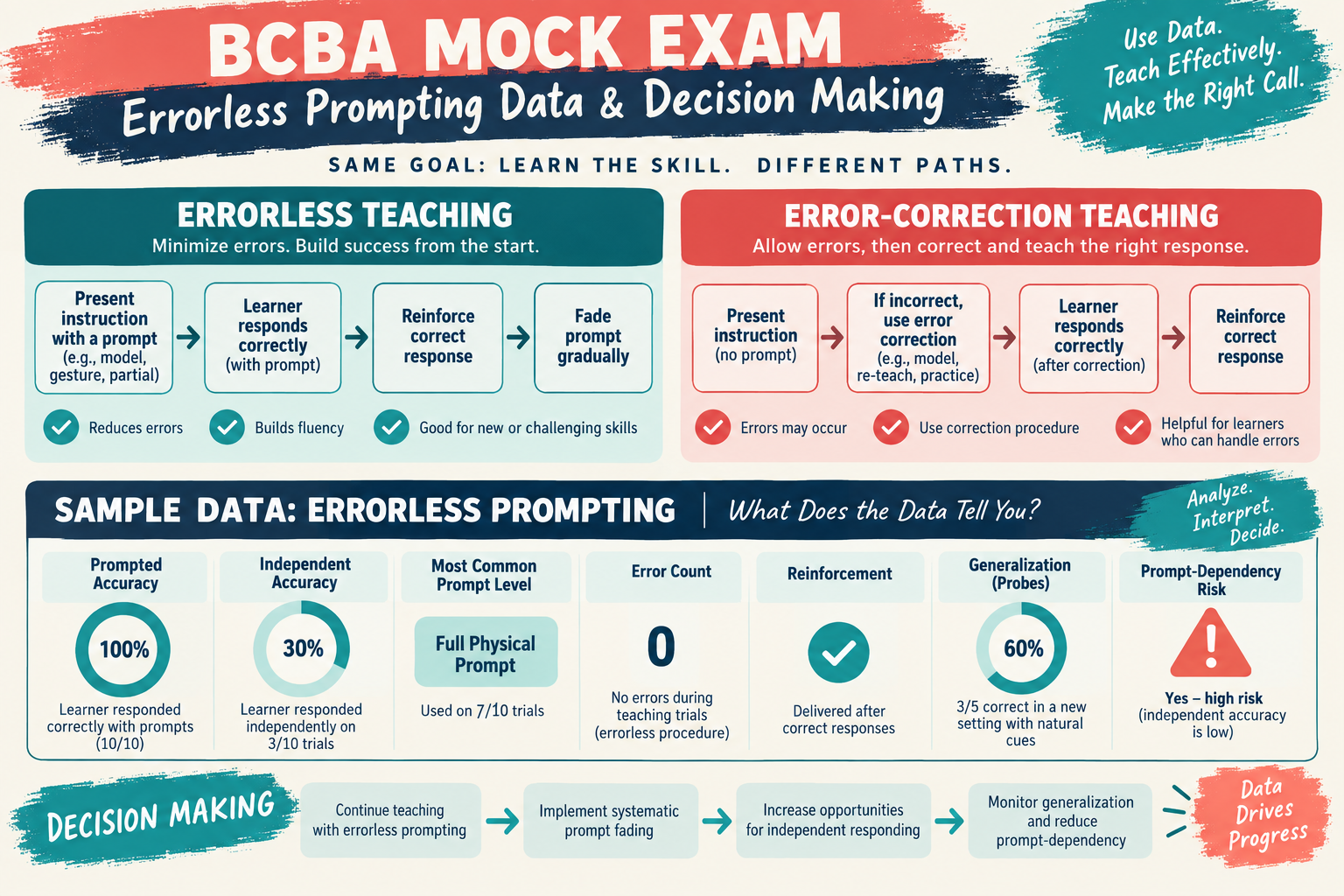
Prompted accuracy is useful, but it is not the same as independent mastery. At minimum, separate independent correct responses, prompted correct responses, errors, no responses, prompt level, and generalization opportunities. Also record the number of opportunities and the criterion used to decide when a prompt should be faded.
- Independent accuracy: correct response after the natural cue and within the defined response window, before the prompt.
- Prompted accuracy: correct response after the planned prompt; do not count it as independent.
- Prompt level: the most intrusive or least intrusive assistance used, according to the data system.
- Error count: incorrect responses and the conditions in which they occurred.
- Latency: time from the natural cue to the independent response or to the prompt.
- Generalization: performance with new materials, people, settings, examples, or communication partners.
For example, 10 out of 10 prompted correct responses with a full physical prompt may show that the prompt currently controls the behavior. It does not show that the natural instruction controls the response. If independent accuracy remains low while prompted accuracy is high, review the fading plan, the discriminative stimulus, the prompt’s salience, and the opportunity to respond without help.
What Problems Can Create Prompt Dependency?
- The prompt is more salient than the natural cue: the learner watches the adult’s hand instead of the instruction or material.
- Fading is delayed: the learner receives the same assistance long after the response is accurate with it.
- Independent probes are absent: the team cannot see whether the skill transfers to the natural stimulus.
- Prompted accuracy is mislabeled: inflated mastery data lead to a premature program change.
- Reinforcement follows the prompt rather than the target relation: the learner may wait for the help that reliably produces the outcome.
- The prompt is inconsistent: different staff use different cues, so the learner cannot discriminate the teaching arrangement.
What Ethical Checks Matter Before Using Errorless Prompting?
The BACB ethics resources are relevant because prompt selection affects dignity, participation, communication, and access to reinforcement. Use the least intrusive effective support, explain the teaching plan to the relevant team, and preserve the learner’s ability to communicate refusal, discomfort, or a need for a break.
Physical prompting requires particular care. It should not be used casually, to force compliance, or in a way that overrides communication. Consider assent, privacy, safety, cultural context, motor and sensory needs, and whether a less intrusive response prompt or visual support could work. Data should guide the plan, but data do not replace professional judgment or the learner’s voice.
How Is Errorless Prompting Tested on the BCBA Exam?
Look for timing language. “The instructor immediately points to the correct card after presenting the instruction” describes an errorless opportunity if that prompt controls the correct response. “The learner responds independently first, and the instructor provides a correction after an error” describes error correction. “The instructor starts with a verbal cue and adds a model only if needed” points toward least-to-most prompting.
Also check the data. An answer that calls 100% prompted accuracy mastery is usually incomplete. The best answer separates prompted from independent responding, includes a prompt-fading plan, checks generalization, and avoids assuming that one prompt procedure is automatically appropriate for every learner or skill.
What Is the Bottom Line?
Errorless prompting ABA arranges early, effective support so the learner is likely to practice the correct response, then systematically transfers control to the natural cue. It is not a promise of zero errors, a replacement for independent probes, or a reason to keep prompts in place indefinitely.
For a structured review of prompting, stimulus control, measurement, and related BCBA concepts, try the free BCBA mock exam. Practice questions can sharpen your discrimination of procedures, but they do not replace supervision, assessment, or an individualized plan.
For targeted review, use our errorless prompting ABA practice questions to apply the concept in exam-style scenarios.
Quick Review Checklist
Use this final checklist to turn errorless prompting ABA into exam-ready reasoning. The goal is not to memorize a label in isolation; it is to identify the relevant evidence and explain why the best answer fits the scenario. Key ideas to review:
- State the central definition or decision point for errorless prompting ABA in your own words.
- Identify the detail that makes errorless prompting ABA different from its closest related ABA term.
- Separate the observable facts in a scenario from assumptions that are not supported by the facts.
- Write one example and one nonexample so you can recognize the concept in a new setting.
Exam application checks:
- Ask what the question is actually requesting before comparing the answer choices.
- Mark the antecedent, response, consequence, or other evidence that supports the selected answer.
- Look for a distractor that describes a related process but does not answer the specific question.
Final self-check:
- Explain how you would verify the interpretation with clear observations or data.
- Change one detail in the scenario and decide whether your answer should change.
- Give a one-sentence rationale that a supervisor or study partner could evaluate.
Take the Free BCBA Mock Exam
When you are ready to apply the idea, use the free practice resource below for additional feedback. Take the Free BCBA Mock Exam



