
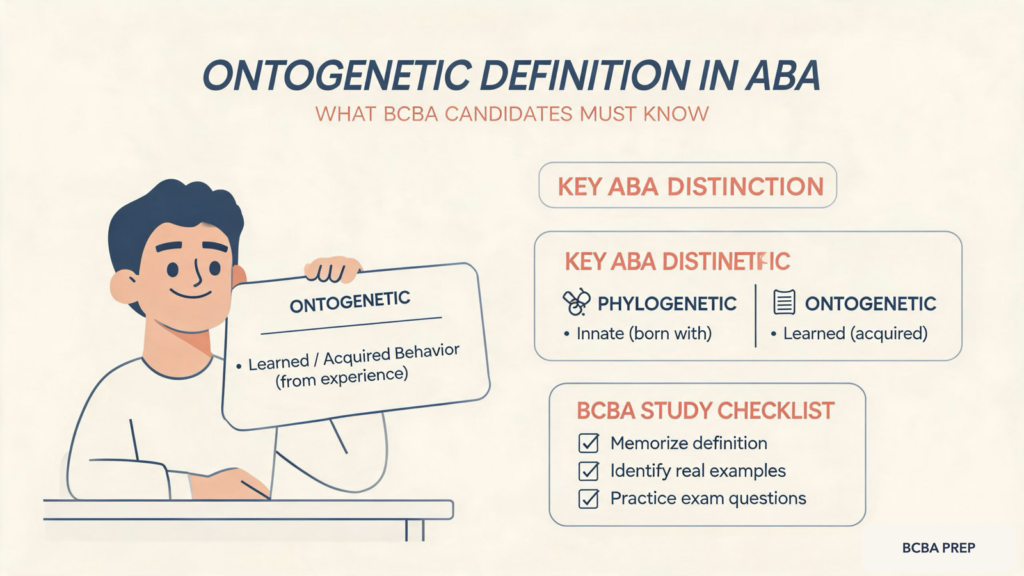
What is Ontogenetic Development?
In applied behavior analysis (ABA), the ontogenetic definition refers to changes in behavior that occur within an individual’s lifetime as a result of learning history. This contrasts with phylogenetic changes, which are evolutionary and shared across a species. Understanding ontogenetic development is essential for BCBA candidates because it frames behavior as a product of past reinforcement and punishment, not innate predispositions.
Table of Contents
- What is Ontogenetic Development?
- Ontogenetic vs. Phylogenetic: Key Distinction
- ABA Examples of Ontogenetic Behavior
- Exam Relevance: What to Expect
- Quick Checklist: Ontogenetic vs. Phylogenetic
- Summary: The Ontogenetic Perspective in ABA
- References
From Biology to Behavior Analysis: The Ontogenetic Perspective
Ontogenetic means ‘development of the individual.’ In ABA, it specifically describes how personal learning history shapes operant behavior. For example, a child says ‘please’ because that response was reinforced previously. Without that history, the behavior would not occur. This is distinct from phylogenetic behaviors like the rooting reflex, which appear without learning.
Why Ontogenetic Matters for BCBA Candidates
The ontogenetic perspective drives intervention design. If behavior is learned, it can be taught or changed. On the BCBA exam, you will be asked to distinguish ontogenetic from phylogenetic influences. For instance, a question might describe a child who cries when denied a toy. The ontogenetic explanation is that crying was reinforced in the past (e.g., parent gave in). Identifying these variables is key to effective behavior change programs.
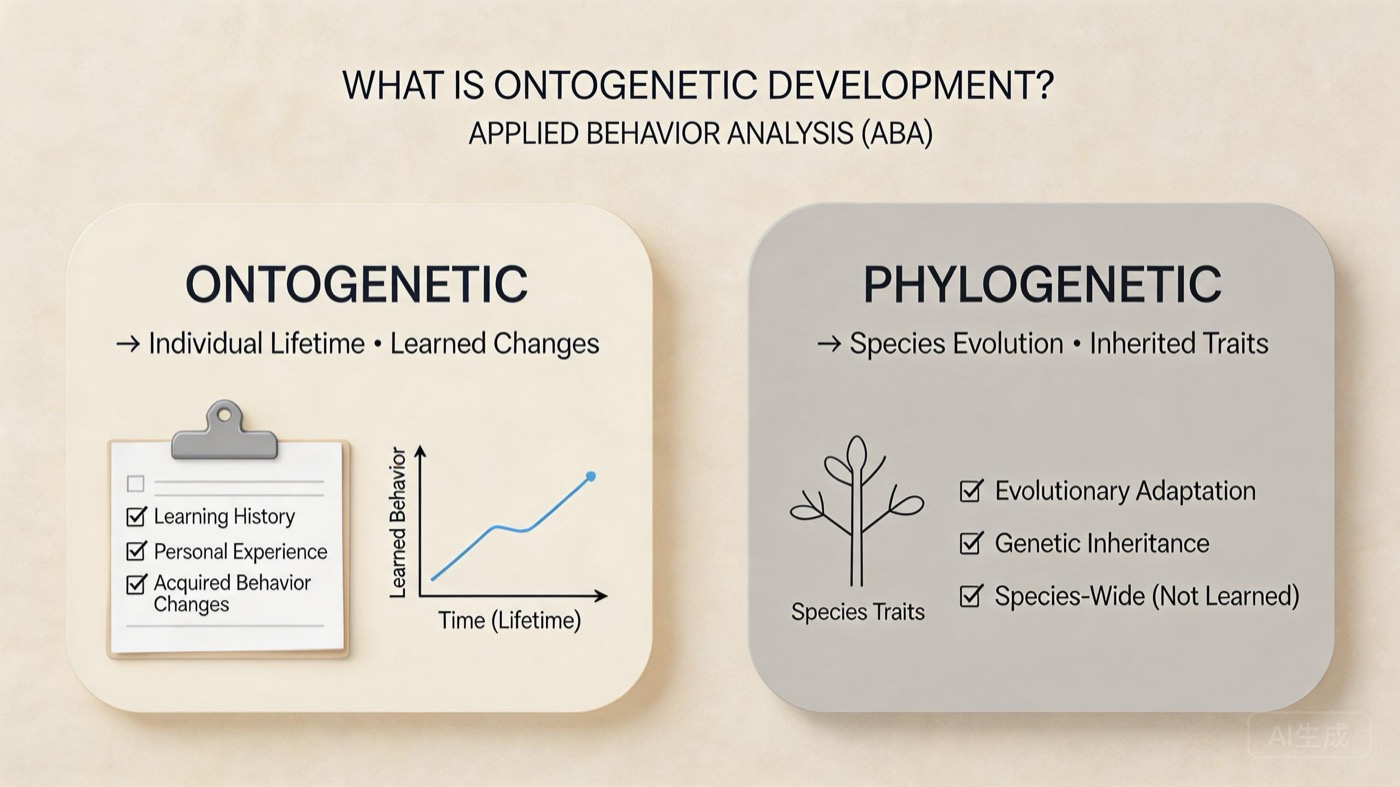
Ontogenetic vs. Phylogenetic: Key Distinction
A common exam trap is confusing these two sources of behavior. Keep the following differences in mind:
- Phylogenetic behaviors are innate, species-typical, and not learned. Examples include eye blinks, sucking reflexes, and fixed action patterns (e.g., bird migration).
- Ontogenetic behaviors are learned through interaction with the environment. All operant behavior falls here. Example: a student raises a hand because that was reinforced by teacher acknowledgment.
- Phylogenetic behaviors are generally stable across individuals of a species; ontogenetic behaviors vary widely based on personal history.
- Phylogenetic behaviors often serve survival functions; ontogenetic behaviors are shaped by consequences in one’s unique environment.
How Phylogenetics Influence Behavior
Briefly, phylogenetic influences are the ‘hardware’ we inherit. They include reflexes, fixed action patterns, and species-specific tendencies. While they set limits, most behavior of interest in ABA is ontogenetic and therefore malleable.
The Role of Learning History in Ontogenetic Behavior
Learning history is the sum of an individual’s past consequences. For example, a child who learned that screaming gets attention will scream again. The screaming is ontogenetic because it was shaped by reinforcement. Changing the environment (e.g., ignoring screaming) can alter that behavior.
ABA Examples of Ontogenetic Behavior
These two ABC examples illustrate how ontogenetic variables explain behavior in real-world ABA practice.
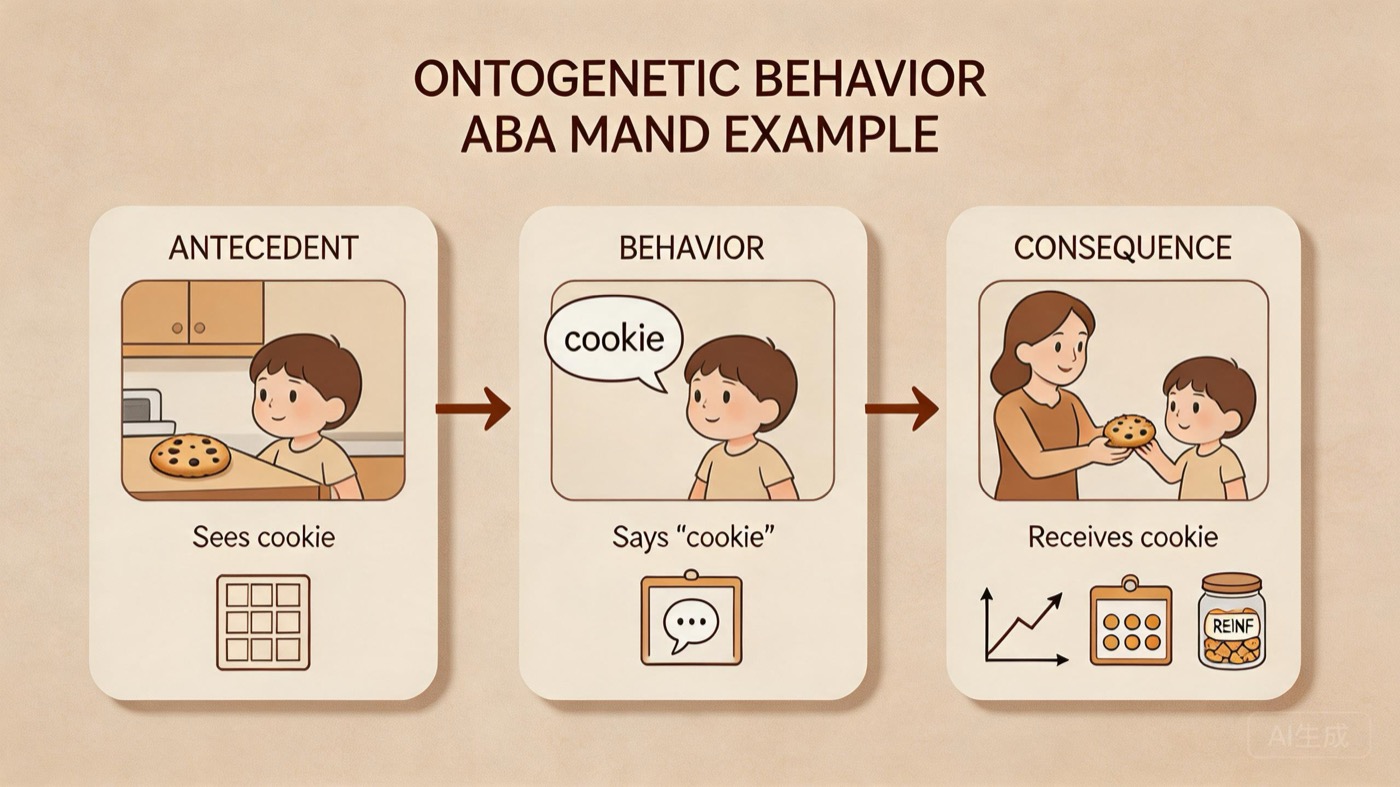
Example 1: Teaching a Child to Mand
Antecedent: Child sees a cookie on the counter.
Behavior: Child says ‘cookie.’
Consequence: Parent gives the cookie. The mand (request) is ontogenetic because it was established through reinforcement. Without a history of receiving cookies after requesting, the behavior would not occur.
Example 2: Reducing Attention-Seeking Behavior
Antecedent: Teacher is working with another student.
Behavior: Student calls out ‘Look at me!’
Consequence: Teacher reprimands ‘Stop calling out.’ The reprimand may actually reinforce calling out if it delivers attention. The ontogenetic explanation: past reinforcement of calling out (attention) maintains the behavior. Intervention would involve withholding attention for calling out and providing it for appropriate requests.
Exam Relevance: What to Expect
On the BCBA exam, you will need to identify ontogenetic influences and avoid common traps. Here are typical pitfalls:
Common Exam Traps on Ontogenetic vs. Phylogenetic
- Trap 1: Classifying a reflex as ontogenetic. Remember, reflexes (e.g., knee jerk) are phylogenetic—they do not require learning.
- Trap 2: Assuming all learned behaviors are purely ontogenetic without considering biological constraints. Some behaviors are easier to learn due to evolutionary preparedness.
- Trap 3: Forgetting that ontogenetic behavior can be altered by changing environmental contingencies. If a behavior is ontogenetic, it is responsive to intervention.
Practice Prompt: Identify the Ontogenetic Factor
Example: ‘A client engages in head-banging to escape demands. Is this ontogenetic or phylogenetic?’ Answer: Ontogenetic, because the behavior was shaped by past negative reinforcement (escaping demands). Use this quick checklist for exam day:
- Is the behavior present from birth (without learning)? If yes, likely phylogenetic.
- Has the behavior changed due to consequences? If yes, it is ontogenetic.
- Can the behavior be modified by altering the environment? If yes, it is ontogenetic.
Quick Checklist: Ontogenetic vs. Phylogenetic
Use this at-a-glance summary for last-minute review:
- Ontogenetic: Learned, changes within lifetime, shaped by reinforcement/punishment, modifiable.
- Phylogenetic: Innate, species-typical, stable, not modifiable through typical behavioral interventions.
- Examples of ontogenetic: requesting, compliance, social skills, aggression maintained by attention.
- Examples of phylogenetic: startle reflex, salivation to food, fixed action patterns.
Summary: The Ontogenetic Perspective in ABA
The ontogenetic definition is a cornerstone of ABA. It reminds us that most behavior of interest is learned through personal history. By analyzing ontogenetic variables—past consequences and environmental conditions—BCBAs can design effective interventions. For further study, review the four functions of behavior and how they relate to learning history. Always remember: behavior is not fixed; it is shaped by experience.



