

A practical way to compare online ABA courses before you pay, enroll, or assume a certificate will satisfy a BCBA pathway. If you search for online ABA courses, you may be looking at very different products under one phrase. A short training, a continuing-education package, a university certificate, a degree, a verified behavior-analytic course sequence, exam preparation, and fieldwork support are not interchangeable. The delivery format is online; that fact alone does not prove BCBA eligibility.
Table of Contents
- Start by naming the course type
- What an online ABA course can and cannot prove
- Classify the course before comparing price
- Check the issuer and the evidence
- Do not confuse Task List alignment with eligibility
- Run the BCBA eligibility check before enrolling
- Ask five pre-enrollment questions
- Separate initial eligibility from continuing education
- Plan around 2027 requirements
- Verify fieldwork support separately
- Build a course comparison sheet
- Use exam practice after the route is clear
- Avoid common online-course traps
- Online ABA courses FAQ
- The bottom line
- Sources to recheck
- Quick Review Checklist
- Take the Free BCBA Mock Exam
The safest decision is to identify exactly what the course is designed to do, then verify the evidence that your intended pathway requires. Use this guide as a pre-enrollment filter. For current eligibility rules, application dates, and documentation requirements, always recheck the BACB BCBA Handbook.
Start by naming the course type
Before comparing tuition, ask: “What credential or record will I have when I finish?” “ABA certificate” can mean professional development at one provider and graduate-level study at another. The label is a starting point, not the evidence.
| Course type | Usually designed for | What you must verify |
|---|---|---|
| CEU or professional training | Learning updates, employer development, or continuing education. | Whether it is maintenance education for an existing credential, not initial BCBA coursework. |
| Short certificate | A focused academic or professional topic. | Issuer, academic level, credits, transcript, and whether the certificate fits your selected pathway. |
| Degree program | A broader undergraduate or graduate qualification. | Degree status, behavior-analytic content, application-date rules, and separate fieldwork requirements. |
| Verified coursework | Meeting a specific coursework route. | Who verifies the content, how it appears in records, and whether it is accepted for your current route. |
| Exam preparation | Reviewing concepts and practicing scenario-based decisions. | That it is preparation only, not a degree, eligibility decision, or authorization to test. |
| Fieldwork support | Finding supervision, a site, or documentation tools. | Supervisor qualifications, written arrangements, countable activities, and current BACB documentation rules. |
What an online ABA course can and cannot prove
An online course can teach concepts, provide assignments, issue a transcript or completion record, and help you prepare for a later decision. It cannot automatically turn a learner into a BCBA, replace a required degree or fieldwork arrangement, or make a provider’s marketing claim an official eligibility determination. Keep three questions separate:
- What did I learn? This is the educational value and content coverage.
- What record did I earn? This is the transcript, certificate, CEU record, or completion document.
- What gate can this record support? That depends on the current BACB pathway, your application date, and the evidence a responsible authority accepts.
The BACB Task Lists describe examination content. A course that says it is “Task List aligned” may be useful for learning or exam preparation, but that phrase does not by itself establish that the course satisfies an eligibility or coursework requirement.
Classify the course before comparing price
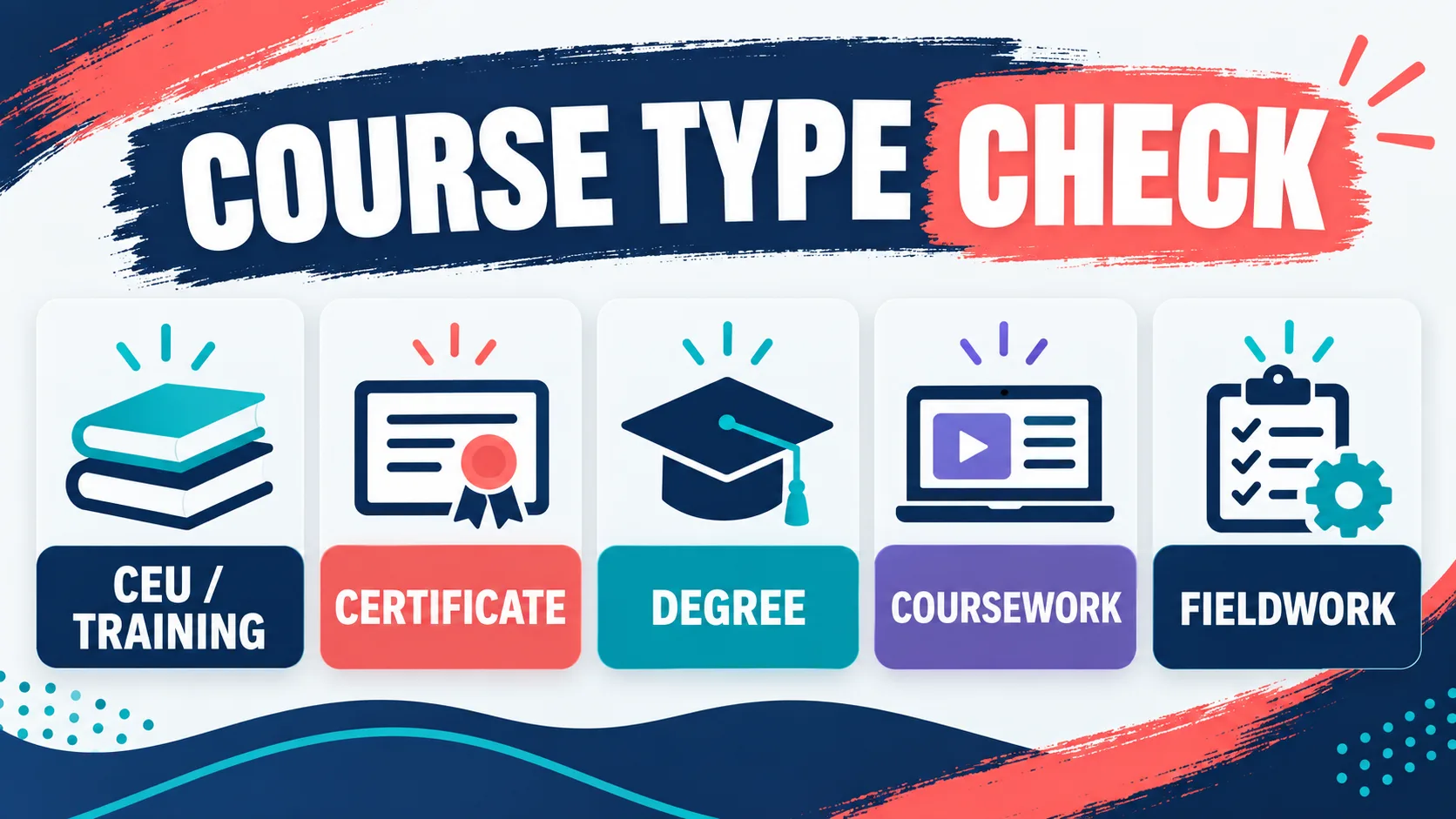
Use the course-type check as a first-pass filter. If a provider cannot clearly tell you which box applies, pause before enrolling. Ambiguity is risky when a quick certificate is marketed as a route into professional certification.
Next, record the provider’s exact words. Save the program page, catalog, syllabus, refund terms, credit information, and the date you checked them. A screenshot or PDF is useful because course pages can change after enrollment. Then compare the saved claims with current official guidance and ask the provider for a written answer to any unresolved question.
Check the issuer and the evidence
The issuer matters because the same topic can be taught by a university, a private training company, an employer, a professional association, or an independent instructor. None of those labels is automatically good or bad. The important issue is whether the record produced by that issuer is the kind of evidence your route requires.
| Evidence item | Question to ask | Save before enrolling |
|---|---|---|
| Issuer | Who legally or academically issues the result? | Institution name, program page, catalog, and contact. |
| Academic credit | Is credit awarded, and where will it appear? | Credit hours, transcript policy, grading rules, and transfer language. |
| Course content | What subjects, learning outcomes, and assessments are included? | Syllabus, module list, required assignments, and completion standard. |
| Pathway statement | Which current pathway does the provider say it supports? | The exact written statement and the date it was provided. |
| Verification owner | Who makes the final determination if the claim is disputed? | Official contact, program advisor response, and any attestation process. |
Do not confuse Task List alignment with eligibility
“Aligned with the Task List” is an informative description of content. It can help you judge whether a class covers the concepts you need to study. It is not the same as “this course is approved for your application.” Ask whether the provider is describing exam preparation, academic coursework, or both, and ask for the record you would receive. This distinction protects your budget. A low-cost exam-prep course may be right after your route is settled but wrong if you still need coursework, fieldwork, or a degree. Match the product to the gate.
Run the BCBA eligibility check before enrolling
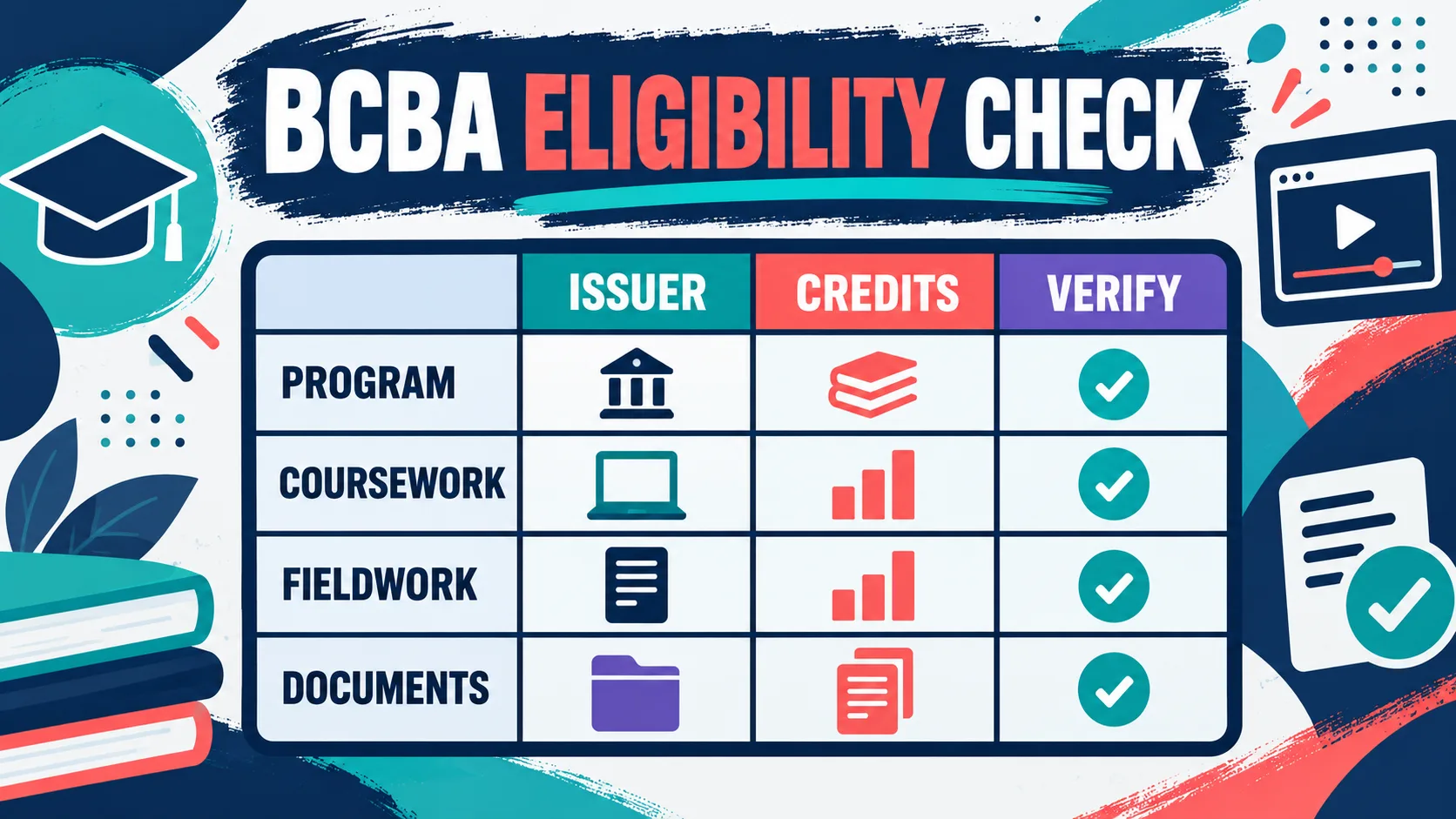
Use the matrix above when you speak with a program or advisor. A “yes” in one column does not create a “yes” in every other column. For example, a program can issue academic credit without providing fieldwork, and a supervisor can support fieldwork without supplying the degree or coursework record.
| Check | What a strong answer includes | Red flag |
|---|---|---|
| Program | The exact credential, issuer, admission rules, and completion record. | A broad promise that the program “leads to” certification without naming the route. |
| Coursework | Subject coverage, credit or record type, verification process, and current pathway fit. | Only a topic list or Task List graphic with no evidence discussion. |
| Fieldwork | Supervisor, site, written arrangement, countable activities, and record process. | “Fieldwork included” with no supervisor or documentation details. |
| Documents | Transcripts, forms, attestations, dates, signatures, and retention instructions. | The learner is told to keep only a payment receipt or completion badge. |
Ask five pre-enrollment questions
- What exact credential, transcript entry, CEU record, or completion document will I receive?
- Which current BCBA pathway does this product support, and what part of that pathway does it not cover?
- Who verifies the course content and record if I need to document it later?
- Does the price include supervision or fieldwork, and if so, who is the supervisor and how are records maintained?
- What rule version and application date did you use when making this statement?
Ask these questions in writing. A sales call can be helpful, but a written answer gives you a record to compare against the syllabus and current official guidance.
Separate initial eligibility from continuing education
Continuing education generally serves people who already hold a credential and need to maintain it. Initial BCBA eligibility is a different problem with its own degree, coursework, fieldwork, application, and examination gates. An online ABA CEU course can be useful and still be completely wrong for someone trying to establish initial eligibility.
Before buying, write one sentence that describes your goal: “I need maintenance education,” “I need verified coursework,” “I need an academic degree,” “I need fieldwork support,” or “I need exam practice.” If you cannot finish that sentence, continue researching the goal before researching providers.
Plan around 2027 requirements
The BACB Recent & Upcoming Changes page lists January 1, 2027 changes affecting core BCBA requirements, including degree, coursework, supervised fieldwork, continuing education, and ongoing supervision. It also lists the discontinuation of Pathways 3 and 4. The exact rule that affects you depends on your pathway and application date.
Do not treat a pre-transition course page as permanent advice. Save the official rule page, record the date, and ask how the curriculum and documentation will be handled if your application crosses January 1, 2027. A vague answer is a reason to delay payment.
Verify fieldwork support separately
Some online programs advertise “fieldwork help,” but support can mean anything from a directory of supervisors to an actual supervised arrangement. Those are different services. Confirm who supervises, whether the arrangement is in writing before supervision begins, what activities count, how monthly records are signed, and what happens if the site or supervisor changes.
| Fieldwork question | Why it affects the decision |
|---|---|
| Who is the supervisor? | You need a real person whose qualifications and availability can be checked. |
| What is signed before work starts? | A written arrangement and current forms help prevent later evidence gaps. |
| How are hours and contacts documented? | A complete record is more useful than an enrollment badge or attendance certificate. |
| What happens if the site changes? | A contingency plan protects the record when employment or supervision changes. |
Build a course comparison sheet
Use one row per provider and one column per decision point. Include cost, format, refund policy, assessment style, access period, record type, pathway statement, fieldwork offering, and verification date. This turns landing pages into an auditable choice. Rank options by evidence quality, not by the most confident headline. A clear syllabus, named issuer, transcript policy, pathway boundaries, and responsive verification contact beat a dramatic “become certified fast” promise.
Use exam practice after the route is clear
Once you have confirmed whether you need coursework, fieldwork, or examination preparation, practice should be specific to the remaining gate. For exam preparation, use scenario questions, record the task-list area behind each error, and revisit the reasoning rather than only memorizing the answer.
If your route is confirmed and you are ready to measure exam readiness, try the Free BCBA Mock Exam. It is a study tool, not an eligibility decision, a fieldwork approval, or authorization to test.
Avoid common online-course traps
- “Certificate” equals certification: a course completion certificate is not the same as professional certification.
- Task List graphic equals accepted coursework: content alignment does not answer the evidence question.
- Fieldwork included: ask for the supervisor, written arrangement, site, records, and contingency plan.
- One price solves everything: degree, coursework, fieldwork, application, and exam preparation may be separate products.
- Old transition advice: rule dates change, so attach every decision to the current official source and your application date.
Online ABA courses FAQ
Can an online ABA course make me eligible for the BCBA exam?: Not automatically. Eligibility depends on the current pathway and the complete set of requirements, not simply the fact that a course is online or uses the ABA label. Verify the course record, your degree, coursework route, fieldwork, application, and examination requirements separately.
Are online ABA certificates the same as a BCBA certification?: No. A certificate may show completion of a professional or academic program. BCBA certification is a separate professional process with current eligibility, application, examination, and maintenance requirements.
Can an online course replace supervised fieldwork?: Do not assume so. Online instruction and supervised fieldwork are different activities. If a provider offers fieldwork support, verify the supervisor, site, written arrangement, activities, and documentation before you count any hours.
Should I choose the cheapest online ABA course?: Choose the option that matches your gate and produces verifiable evidence. A cheap course that does not fit can cost more in replacement coursework, lost time, or documentation repair.
The bottom line
The best online ABA course is not the one with the broadest promise. It is the one whose purpose, issuer, record, pathway boundary, and verification process are clear for your goal and application date. Classify the product first, confirm what it proves, keep fieldwork and eligibility separate, recheck 2027 changes, and use exam practice only after the route is clear.
Sources to recheck
Official references: the BACB BCBA Handbook, the BACB Task Lists, and the BACB Recent & Upcoming Changes page. For related context on online programs, compare the existing online ABA certification guide, online BCBA pathway guide, master’s program guide, and course-sequence verification guide. These resources do not replace current official BACB rules. For targeted review, use our online aba courses practice questions to apply the concept in exam-style scenarios.
Quick Review Checklist
Use this final checklist to turn online aba courses into exam-ready reasoning. The goal is not to memorize a label in isolation; it is to identify the relevant evidence and explain why the best answer fits the scenario. Key ideas to review:
- State the central definition or decision point for online aba courses in your own words.
- Identify the detail that makes online aba courses different from its closest related ABA term.
- Separate the observable facts in a scenario from assumptions that are not supported by the facts.
- Write one example and one nonexample so you can recognize the concept in a new setting.
Exam application checks:
- Ask what the question is actually requesting before comparing the answer choices.
- Mark the antecedent, response, consequence, or other evidence that supports the selected answer.
- Look for a distractor that describes a related process but does not answer the specific question.
Final self-check:
- Explain how you would verify the interpretation with clear observations or data.
- Change one detail in the scenario and decide whether your answer should change.
- Give a one-sentence rationale that a supervisor or study partner could evaluate.
Take the Free BCBA Mock Exam
A useful next step is to apply this idea in a fresh set of BCBA-style practice questions and review the feedback. Take the Free BCBA Mock Exam



