
A one year ABA parent training curriculum should be more than twelve months of handouts. It should help a BCBA and each family select meaningful goals, practice caregiver skills, review evidence, and adapt the plan as routines and priorities change.
Table of Contents
- What a One Year ABA Parent Training Curriculum Should Mean
- Create a 12-Month Parent Training Roadmap
- Build Each Session Around Caregiver Performance
- Measure Progress Without Turning Families into Data Clerks
- Use a Session-Planning Loop
- If You Mean the Named One-Year Curriculum
- Ethics, Consent, and Scope
- Connect the Plan to BCBA Exam Preparation
- Frequently Asked Questions
- Sources and Verification Notes
- Take the Free BCBA Mock Exam
The exact phrase can refer to a named commercial resource, a year-long service plan, or a clinician’s own sequence of caregiver-training lessons. Those are not interchangeable. A product may offer ready-made topics, forms, videos, or homework; a clinical curriculum still has to be individualized to the learner, caregiver context, professional scope, and current service agreement. This is a vendor-neutral planning framework, not a review or endorsement. Use current BACB materials as the authority, then document whether caregiver performance and meaningful routines are improving.
What a One Year ABA Parent Training Curriculum Should Mean
“One year” is a planning horizon, not a promise that every family needs the same visits or lesson order. Plan from family priorities, learner needs, routines, and caregiver readiness rather than a fixed calendar.
- Caregiver competence: the caregiver can describe the goal, perform the agreed procedure, and recognize when to ask for help.
- Routine relevance: training addresses daily situations that matter to the family, such as communication, transitions, self-care, play, sleep routines, or community participation.
- Observable progress: the team uses a small number of feasible measures rather than relying only on impressions or pages completed.
- Generalization and maintenance: the plan tests whether skills continue across people, places, materials, and time, then reduces support when appropriate.
| Planning question | What to document | Evidence of progress |
|---|---|---|
| What matters to this family? | Priority routines, preferred outcomes, constraints, language, culture, and available support. | A goal the caregiver recognizes as useful and can explain in their own words. |
| What skill must be practiced? | The caregiver action, the learner response, the context, and the decision rule. | The caregiver performs the steps with less prompting and more consistency. |
| How will we know? | A feasible measure, collection schedule, and who will review it. | The team can identify a trend and state what action the trend supports. |
| What happens next? | A review date, generalization probe, maintenance step, or referral. | The plan changes for a documented reason rather than because a lesson was completed. |
Create a 12-Month Parent Training Roadmap
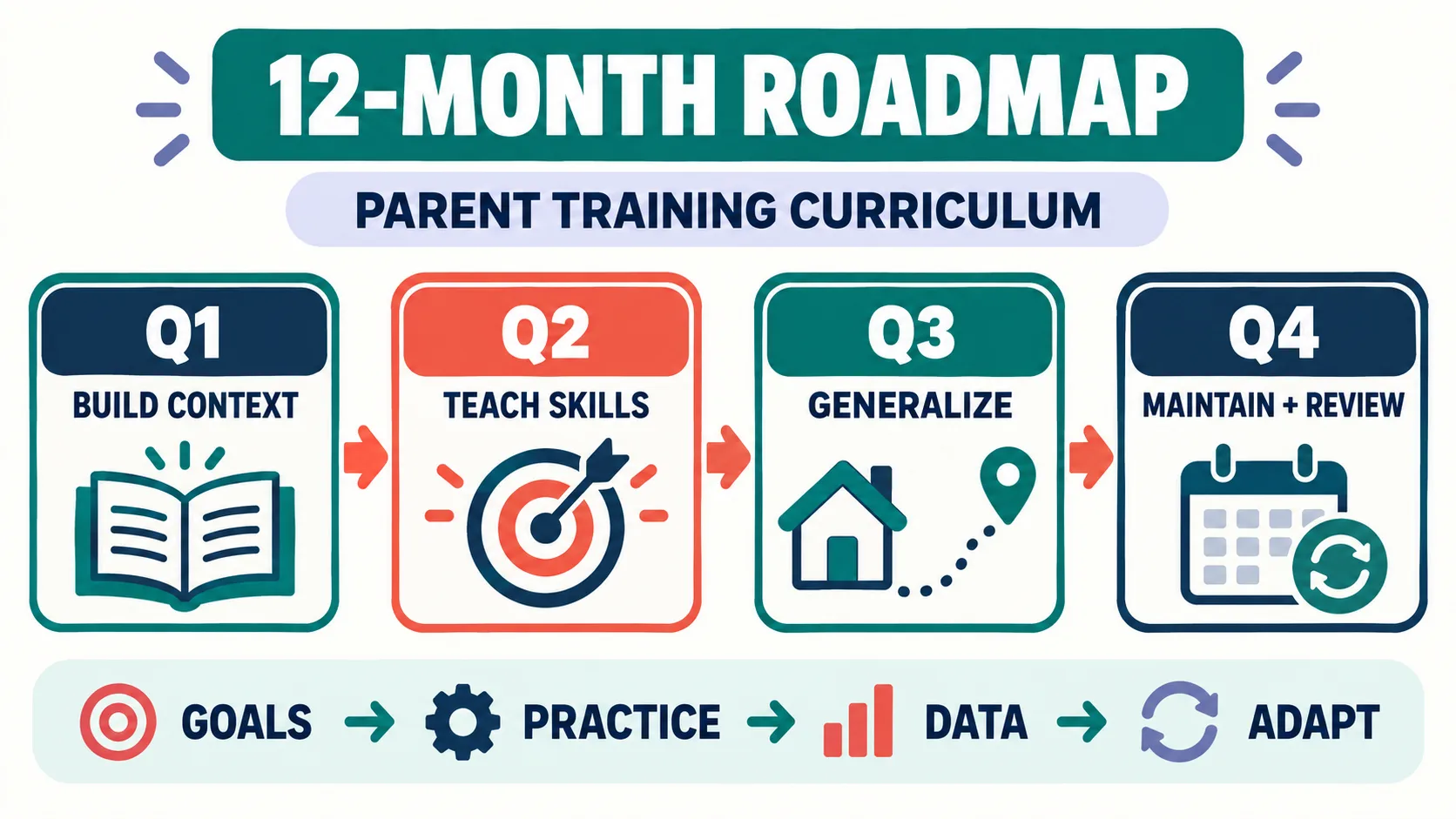
A practical year can be divided into four quarters, but the quarters are decision points rather than four fixed boxes. The current BCBA Test Content Outline emphasizes contextual fit, collaboration, data-based decisions, generalization, maintenance, and evaluation. Those ideas are useful when deciding what the next caregiver-training phase should accomplish.
Begin with a baseline and a partnership conversation. Then choose a small set of teachable caregiver behaviors. In each quarter, record what was introduced, rehearsed, observed in the natural routine, and supported by the data.
| Phase | Primary focus | Useful deliverable | Quarter review |
|---|---|---|---|
| Months 1–3: Build context | Priorities, assent and consent, routine observation, baseline, reinforcement, and clear teaching targets. | A family-owned goal map and one practiced procedure written in plain language. | Can the caregiver explain the goal and perform the core steps with support? |
| Months 4–6: Teach skills | Prompting, fading, shaping, task analysis, prevention, communication, and practice within selected routines. | A brief caregiver performance record with examples, nonexamples, and feedback notes. | Is performance becoming more independent and appropriate to the family’s context? |
| Months 7–9: Generalize | New people, places, materials, times of day, community routines, and coordination with relevant partners. | A generalization probe and a short plan for adapting the procedure without losing its function. | Does the skill hold outside the teaching setting, and what support is still needed? |
| Months 10–12: Maintain and transition | Schedule thinning, maintenance, troubleshooting, caregiver decision rules, referrals, and next-year priorities. | A maintenance and transition plan that identifies when to continue, modify, consult, or close a target. | Can the family sustain the important behavior and recognize when professional input is needed? |
Build Each Session Around Caregiver Performance
Measure what the caregiver does, not only what the clinician explains. Behavior skills training supplies a practical sequence: instruction, modeling, rehearsal, and feedback in a realistic scenario. Keep the practice target narrow. For example, “use a first–then statement during the morning transition and deliver the planned reinforcement after the learner completes the next step” is easier to teach and observe than “improve compliance.” Define what counts as an accurate caregiver response, what support can be provided, and how the team will respond when the routine does not go as planned.
- Instruction: explain the goal, rationale, steps, safety considerations, and the signal that tells the caregiver when to use the procedure.
- Modeling: demonstrate the procedure in the actual routine or a close role-play, including how to respond to a predictable challenge.
- Rehearsal: let the caregiver perform the steps while the trainer observes without taking over too quickly.
- Feedback: describe what was accurate, correct one priority error, and offer another practice opportunity.
- Plan for the week: choose when the caregiver will practice, what data are feasible, and what question should be brought to the next review.
| Session stage | Clinician prompt | Evidence to record |
|---|---|---|
| Connect | What happened in the routine, and what felt workable or difficult? | Caregiver priorities, contextual changes, and barriers to practice. |
| Teach | What is the smallest action that can be explained and shown today? | The caregiver’s explanation and the trainer’s model. |
| Practice | Can the caregiver rehearse the response in a realistic example? | Accurate steps, prompts needed, and the response to a variation. |
| Review | What does the routine data suggest we keep, change, or investigate? | A decision linked to observable information, not a generic score. |
Measure Progress Without Turning Families into Data Clerks
Data collection should answer a decision question. If a caregiver has to record ten fields during a stressful routine, the record may be incomplete and the training plan may become a burden. Start with the smallest measure that can distinguish “the plan is working,” “the procedure is not being implemented,” and “the goal or context needs to be reconsidered.”
| Measure type | Question it answers | Possible response |
|---|---|---|
| Caregiver implementation | Did the caregiver perform the agreed steps? | Re-model, reduce response effort, or advance practice when performance is stable. |
| Learner outcome | Is the target response changing in the meaningful routine? | Check the intervention, measurement, contextual variables, and need for consultation. |
| Generalization | Does the skill occur with another person, place, material, or time? | Plan a small variation and preserve the functional parts of the procedure. |
| Caregiver experience | Is the plan acceptable, understandable, and sustainable? | Adjust effort, language, materials, timing, or referral rather than blaming the family. |
At each review, ask: what improved, what repeated, what helped or blocked implementation, and what decision comes next? This keeps the curriculum tied to evidence.
Use a Session-Planning Loop
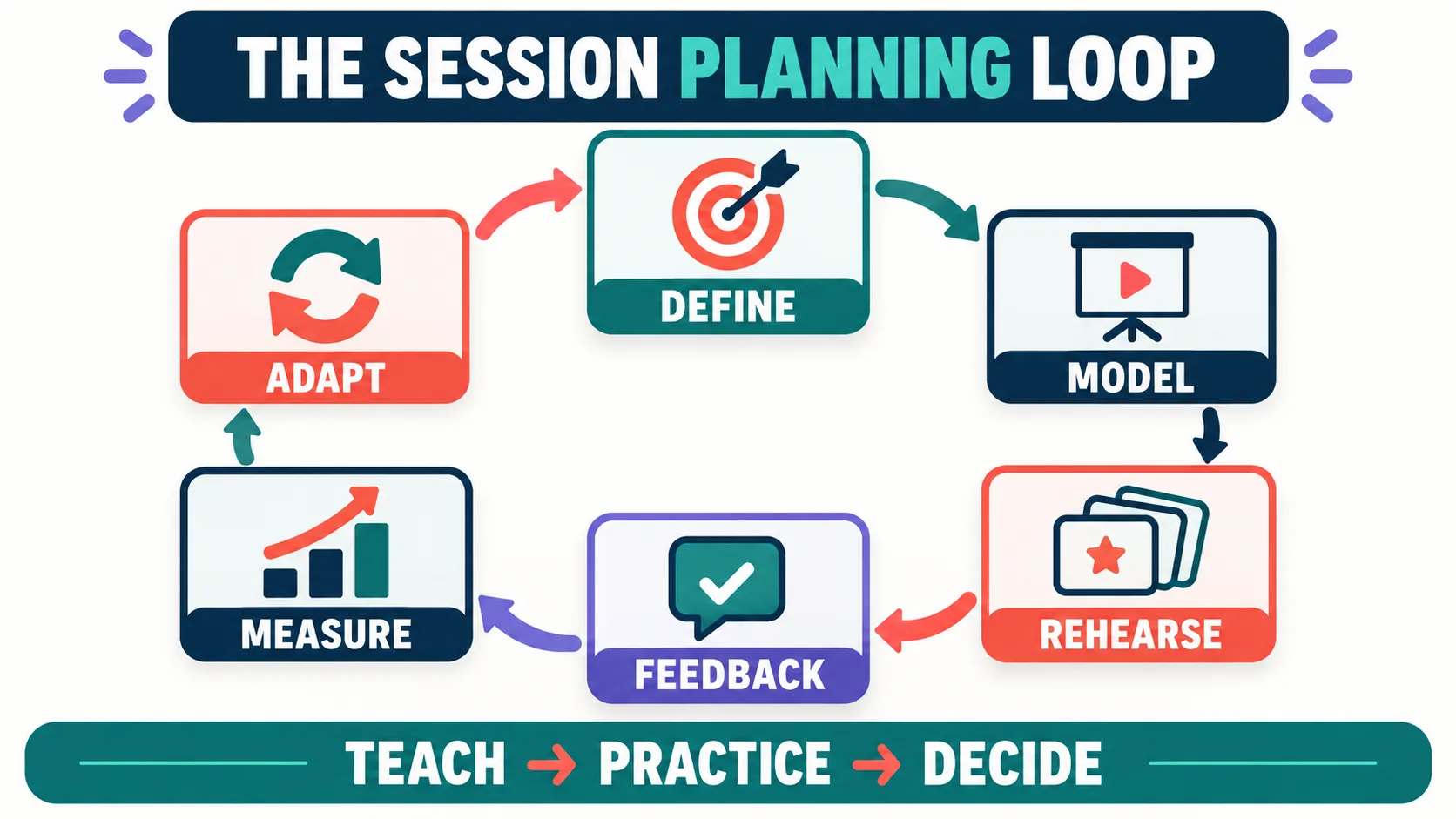
Every session can follow a short loop that keeps teaching, practice, and data connected. The loop is intentionally repeatable, but the content inside it changes with the family’s goals and the learner’s response. A ready-made curriculum can supply examples and handouts; the clinician still decides whether the example fits the current context.
- Define: name the target routine and the observable caregiver action.
- Model: show the action with plain language and a realistic example.
- Rehearse: arrange practice with the materials, people, and distractions that matter.
- Give feedback: reinforce accurate steps and correct one priority error at a time.
- Measure: collect a feasible caregiver or learner measure tied to the decision question.
- Adapt: change the prompt, task, schedule, context, or goal when the evidence and family priorities support a change.
If You Mean the Named One-Year Curriculum
Search results for this keyword prominently surface a named commercial “One-Year ABA Parent Training Curriculum” series. A public product page may describe volumes, lessons, forms, videos, or licensing; those details are useful for comparison, but they are marketing and product information, not a BACB endorsement. The BACB does not turn a commercial resource into an official curriculum simply because it is popular or appears in search results. If you are considering a ready-made resource, check its edition, license, adaptability, sources, and support for data-based decisions before putting it into a service plan.
| Audit area | Questions before adoption | Do not overlook |
|---|---|---|
| Version | What edition and publication date are shown? | A year label does not prove that the material matches current professional rules. |
| Scope | Is it education, caregiver coaching, a clinical protocol, or a bundle of resources? | A handout cannot replace assessment, supervision, or a service agreement. |
| Fit | Can examples, language, goals, and practice conditions be adapted? | One sequence may not fit every learner, caregiver, culture, or routine. |
| Evidence | Does the resource identify sources and explain how progress is evaluated? | “Research-based” language should not replace a clear evidence and decision trail. |
| License | Who may use, copy, translate, or share the materials? | Resolve licensing, privacy, and secure-storage questions before distributing files. |
Ethics, Consent, and Scope
Parent training involves stakeholders, but the caregiver is not simply a delivery mechanism for a clinician’s plan. Clarify who the stakeholders are, whose consent is required, what each person’s responsibilities are, how information will be shared, and how the family can raise concerns. Use plain language and check understanding rather than treating a signed form as proof that the plan is workable.
- Client interest first: goals and procedures should be connected to meaningful benefit and should not be selected only because they are easy to teach or measure.
- Informed participation: explain the purpose, expected effort, foreseeable risks, alternatives, and how the plan can be changed or stopped.
- Scope and consultation: refer or consult when the needs, setting, medical issue, communication need, or risk exceeds available competence or resources.
- Confidentiality: protect family information in handouts, screenshots, case examples, shared drives, and public statements.
- Current rules: review the current BACB ethics-code resources and applicable laws, funder rules, and organizational policies instead of relying on an old curriculum edition.
Connect the Plan to BCBA Exam Preparation
For BCBA candidates, a year-long caregiver-training plan is also a useful way to study applied decision making. When you review a case, identify the stakeholder, the observable target, the contextual variable, the measurement, the intervention choice, the implementation-fidelity question, and the next data-based decision. That reasoning is more durable than memorizing a list of lesson titles.
After you have reviewed the concepts, test the decision process with the free BCBA Mock Exam. Use missed questions diagnostically: classify the error, return to the relevant TCO task or ethics source, write the decision rule in your own words, and schedule a later retrieval check.
Frequently Asked Questions
Is a one-year ABA parent training curriculum always twelve months of weekly lessons?: No. “One year” can describe a resource series, a service-planning horizon, or a sequence of sessions. Frequency should follow the family’s goals, availability, progress, and service agreement. A good plan has review points and can pause, extend, or change phases.
Can the same curriculum be used for every family?: A framework can be reused, but goals, examples, language, routines, materials, and practice conditions should be individualized. The clinician should assess contextual fit and caregiver priorities rather than treating a published sequence as a universal protocol.
What should the first three months focus on?: Start with partnership, priorities, baseline information, clear observable goals, and a small number of caregiver behaviors that can be taught and rehearsed. Add procedures only after the family understands the purpose and has a realistic way to practice them.
How do I know whether a ready-made curriculum is current?: Check the edition, date, cited sources, licensing terms, and how the resource handles updates. Compare its professional and ethical claims with current BACB materials, and do not confuse a product’s “updated” label with official endorsement.
Does the BACB endorse a specific one-year ABA parent training curriculum?: Do not assume endorsement. The BACB’s official materials describe certification, ethics, and professional expectations; a commercial curriculum remains a study or service aid that must be evaluated and used within the clinician’s competence, agreements, and applicable requirements.
Sources and Verification Notes
This article was checked against current BACB materials on the BCBA Test Content Outline, ethics, and supervision, plus public evidence and public product pages used to understand the search landscape. A commercial listing is included for market-context comparison only; it is not a recommendation or endorsement. Requirements, ethics guidance, product editions, and licensing terms can change, so verify the current source before using a curriculum in practice.
- BACB BCBA Test Content Outline, 6th edition.
- BACB Ethics Code for Behavior Analysts.
- BACB Ethics Codes and revision information.
- BACB Supervision, Assessment, Training, and Oversight.
- CDC Treatment and Intervention for Autism Spectrum Disorder.
- National Professional Development Center on Autism Spectrum Disorder evidence summary.
- Public product collection surfaced for query-intent comparison.
For targeted review, use our one year aba parent training curriculum practice questions to apply the concept in exam-style scenarios.
Take the Free BCBA Mock Exam
A useful next step is to apply this idea in a fresh set of BCBA-style practice questions and review the feedback. Take the Free BCBA Mock Exam



