
An ABA exam study manual should do more than collect definitions. It should help you map the current BCBA Test Content Outline to clear explanations, retrieve concepts from memory, practice scenario decisions, and identify what to review next.
Table of Contents
- What an ABA Exam Study Manual Should Do
- The Version and Authority Check
- Map the Manual to the Current Exam Domains
- Build a Weekly BCBA Study Loop
- Manual Review Versus Mock-Exam Practice
- Boundaries, Endorsement, and Exam Security
- Frequently Asked Questions
- Sources and Verification Notes
- Quick Review Checklist
- Take the Free BCBA Mock Exam
If you are searching for an ABA exam study manual, you may be comparing a printed book, a digital guide, a course workbook, or a set of personal notes. The best choice is not automatically the longest or most popular resource. Start with authority and version: the current BACB handbook and BCBA Test Content Outline are the reference points, while any commercial or personal manual is a study aid that must be checked against them.
This guide gives you a vendor-neutral system for auditing a manual and using it efficiently. It does not claim that the BACB endorses a specific publisher, and buying a manual cannot guarantee a passing result. Requirements and exam information can change, so verify date-sensitive details on the official BACB pages before your exam.
What an ABA Exam Study Manual Should Do
A useful manual is a bridge between the official outline and your own decisions. It should help you answer four questions for every topic:
- What is the concept? Can you define it accurately and distinguish it from a close alternative?
- What does it look like? Can you recognize it in a short scenario, graph, measurement problem, or intervention description?
- What would you do? Can you select the next professional action and explain why it fits the evidence?
- What mistake is likely? Can you identify the tempting answer that uses a related term but does not answer the question?
A manual that only asks you to highlight paragraphs may support familiarity without building retrieval or decision-making. A manual that includes explanations, contrasts, examples, self-tests, and space to record errors is more useful because it turns reading into observable study behavior.
| Manual feature | Question to ask | Useful evidence |
|---|---|---|
| Current scope | Does the manual name the current BCBA outline and edition it is using? | A publication or update date, an edition statement, and a visible crosswalk to the official TCO. |
| Concept accuracy | Are definitions precise enough to distinguish similar concepts? | Contrasts such as preference versus reinforcement, descriptive versus experimental analysis, and validity versus reliability. |
| Scenario transfer | Does the resource make you choose an action, not only repeat a definition? | Short vignettes, graph decisions, answer rationales, and explanations of distractors. |
| Error tracking | Can you record why an answer was missed and what evidence would change it? | An error log organized by domain, concept, decision rule, and follow-up review date. |
| Ethics and boundaries | Does it separate exam preparation from unauthorized exam content? | Source citations, no claims of leaked questions, and reminders to follow current BACB rules. |
The Version and Authority Check
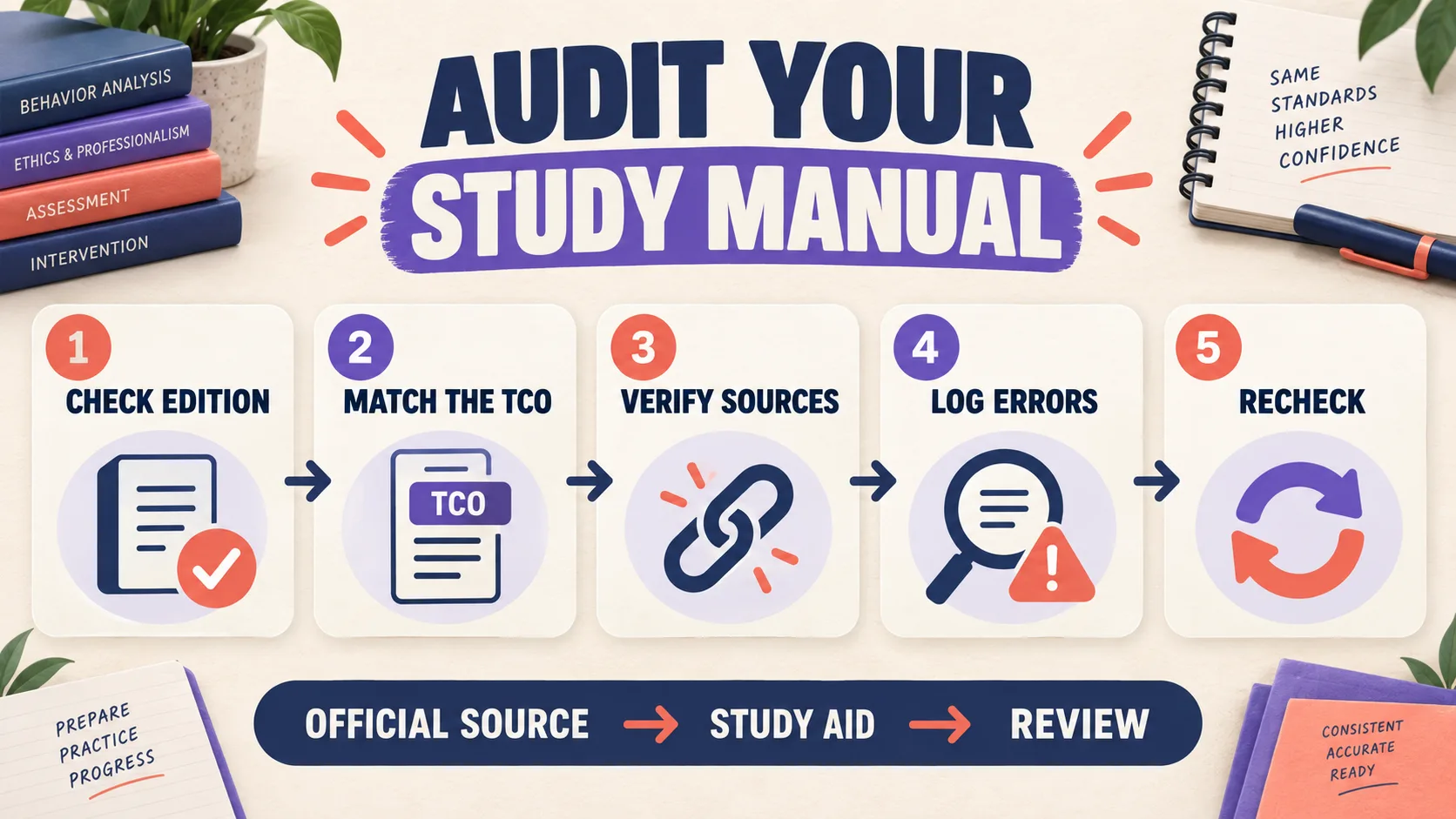
Before you commit to an ABA exam study manual, perform a five-minute authority check. The official BACB materials answer questions about what the exam covers and what rules apply. A study manual can explain, organize, and help you practice, but it should not replace those sources.
- Find the edition: look for the publication date, update date, and the BCBA Test Content Outline edition named by the author.
- Open the official TCO: compare the manual’s headings with the current domains and task statements rather than trusting a cover claim.
- Check the handbook: confirm current examination structure, preparation guidance, security rules, and any transition notice.
- Separate source types: mark what comes from BACB, what is an author explanation, and what is a practice strategy or opinion.
- Set a review date: if the BACB updates the outline or handbook, re-audit the manual before using it as your primary map.
The current BACB examination information page lists the BCBA examination as 185 questions with four hours allotted and four answer choices per question. The current handbook and outline explain that this total includes 175 scored questions and 10 unscored pilot questions. If a manual displays a different structure, do not silently blend the numbers; check which edition and date it is describing.
The BACB also states that it cannot endorse specific study guides and that purchasing study materials does not guarantee a passing result. That is not a reason to avoid study aids. It is a reason to use them as tools inside a plan whose authority remains the current official material.
Map the Manual to the Current Exam Domains
The 6th-edition BCBA Test Content Outline is organized into nine domains. Use a simple coverage sheet to make sure your manual is not strong in concepts but weak in measurement, ethics, assessment, intervention selection, or supervision.
| Current domain | Manual checkpoint | Your study artifact |
|---|---|---|
| A–B: Foundations and concepts | Can you distinguish related principles and explain the behavioral relation? | A contrast table with a fresh example and nonexample for each pair. |
| C–D: Measurement and design | Can you match the measurement or design to the question and interpret the graph? | A graph notebook with one decision sentence per practice item. |
| E: Ethics and professional issues | Does the manual use current ethics language and boundary examples? | A “pause, consult, document, refer” decision checklist. |
| F: Behavior assessment | Can you choose an assessment based on the information needed? | A question-to-assessment map with indirect, descriptive, and experimental distinctions. |
| G–H: Change procedures and interventions | Can you select a procedure, identify the contingency, and evaluate contextual fit? | A procedure card with target, antecedent, consequence, measurement, and decision rule. |
| I: Personnel supervision and management | Can you identify competent training, feedback, and treatment-integrity decisions? | A supervision scenario log with the next action and rationale. |
Coverage is not mastery. A manual may mention every domain and still leave you unable to apply the content. After checking coverage, test retrieval: close the manual, answer a scenario, explain the distractors, and schedule the weak point for another review.
Build a Weekly BCBA Study Loop
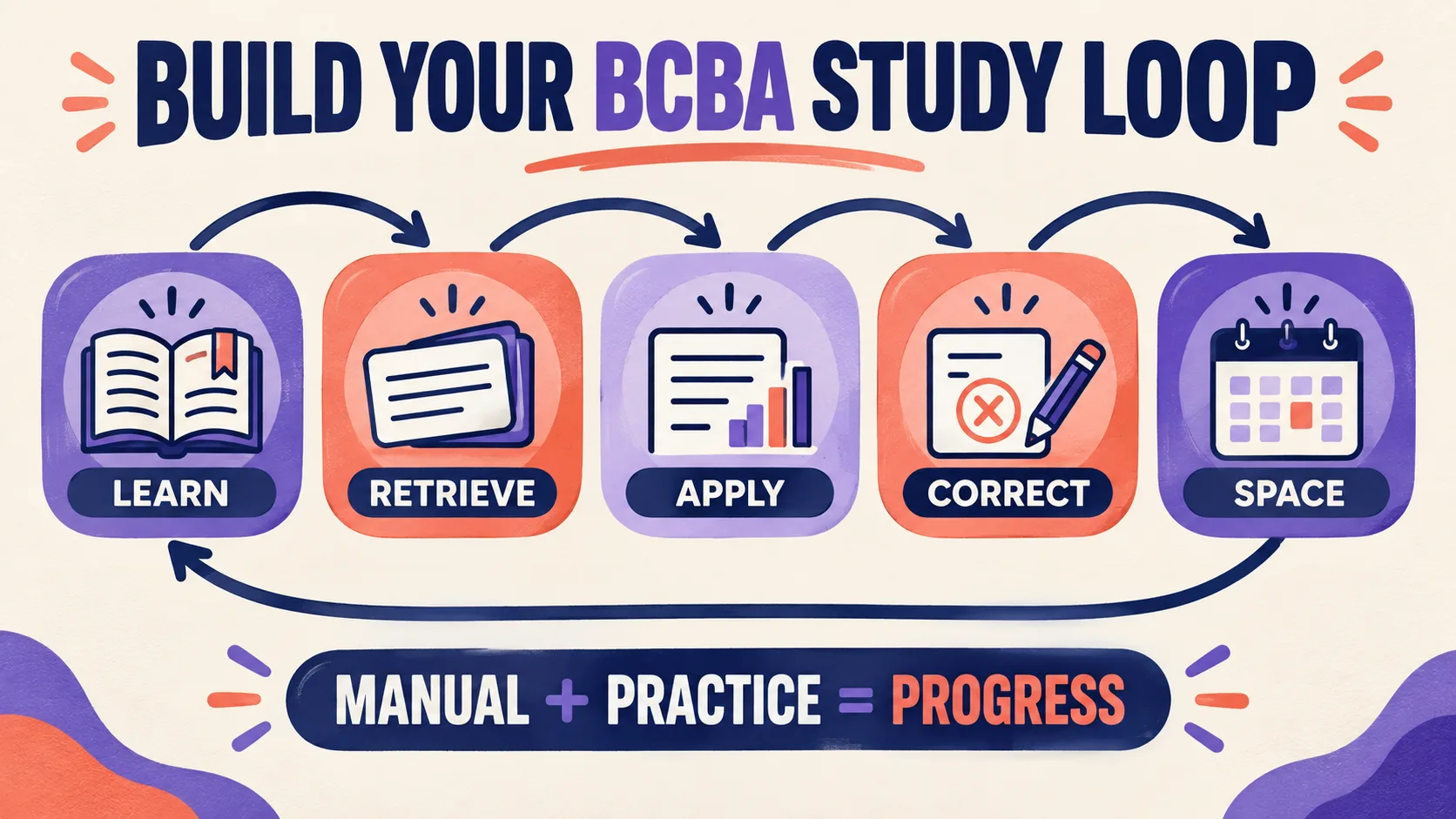
Use the manual as the explanation layer in a repeating loop. A sustainable plan does not require rereading the entire book every week. It cycles through learning, retrieval, application, and correction.
- Preview: choose one narrow task or concept from the TCO and write the question you need the manual to answer.
- Learn: read the relevant section, create a short definition, and record one contrast with a similar concept.
- Retrieve: close the manual and explain the concept from memory or answer a small set of questions.
- Apply: solve scenario or graph items and state the evidence that controls your decision.
- Correct: log the error, identify the distractor pattern, and return to the exact page or official task statement.
- Space: revisit the same task after a delay instead of treating one correct answer as permanent mastery.
| Study block | Manual task | Proof of progress |
|---|---|---|
| Day 1: map | Select the TCO task and scan the relevant manual section. | One-sentence learning target and one source check. |
| Day 2: explain | Create a contrast, example, nonexample, or decision rule. | A closed-book explanation that another learner could follow. |
| Day 3: retrieve | Answer untimed items without looking at the answer first. | An error log that names the controlling evidence. |
| Day 4: apply | Practice mixed scenarios, graphs, or measurement decisions. | A correct answer plus a reason the distractors fail. |
| Day 5: space | Revisit the weakest task after a delay and update the plan. | A next-review date and a smaller list of unresolved errors. |
Manual Review Versus Mock-Exam Practice
An ABA exam study manual and a mock exam serve different functions. The manual supplies explanations and organization. A mock exam tests whether you can retrieve and apply information under constraints. If you use only the manual, you may feel fluent while still missing the decision point in a new scenario. If you use only questions, you may memorize answer patterns without repairing the underlying concept. Use the practice result to choose the next manual action:
- Definition error: return to the manual and write a contrast with the closest term.
- Measurement error: redraw the scenario, identify the dimension of behavior, and justify the measurement system.
- Design error: name the independent variable, dependent variable, prediction, and replication logic.
- Ethics or scope error: consult the current ethics or handbook language rather than relying on a remembered rule.
- Timing error: practice smaller timed sets and review the decision process, not just the score.
When you are ready to make that loop measurable, try the free BCBA Mock Exam. Treat the result as diagnostic evidence: classify each miss, return to the relevant manual section, and schedule a spaced recheck.
Boundaries, Endorsement, and Exam Security
Study preparation has professional boundaries. Do not treat a commercial manual as an official BACB publication, a passing guarantee, or a substitute for your graduate training and supervised experience. Be cautious with resources that do not show an edition, cite their sources, or explain how they handle changes in the official outline.
Exam content itself is confidential. A legitimate study manual teaches concepts, task statements, decision rules, and original practice—not copied or claimed-to-be-real examination questions. The current BCBA handbook explains examination-security expectations and the consequences of unauthorized possession, reproduction, or disclosure of exam materials. A resource that advertises leaked questions is not a shortcut; it is a risk.
Finally, use the manual in a way that respects your own context. If a definition conflicts with the current BACB source, pause and verify it. If you are unsure whether a requirement applies to your eligibility path, consult the official handbook or the BACB rather than guessing from an old edition.
Frequently Asked Questions
What is an ABA exam study manual?: It is a study aid that organizes behavior-analysis concepts, exam-relevant tasks, explanations, examples, and practice activities. It is not automatically an official BACB resource. Check its edition and map it to the current BCBA Test Content Outline.
Does the BACB recommend a specific study manual?: The BACB states that it cannot endorse specific study guides and that purchasing study materials does not guarantee a passing result. Use the current handbook and TCO as the authority, then judge any manual by accuracy, version, coverage, and usefulness for retrieval practice.
How should I use a manual if the exam information changes?: Pause your plan, check the current BACB examination information and handbook, identify which edition the manual uses, and rebuild your TCO crosswalk. Do not assume that a familiar chapter title means the tasks and exam structure are unchanged.
Should I read the manual before taking mock exams?: Use both. An initial small set can reveal what you already know and prevent inefficient rereading. Then use the manual to repair concepts, followed by spaced mixed practice and timed sets as your exam date approaches.
How do I know whether a study manual is working?: Track more than pages read. Look for improved closed-book explanations, more accurate scenario decisions, fewer repeated error patterns, better graph and measurement reasoning, and the ability to explain why distractors are wrong.
Sources and Verification Notes
This article was checked against the current BACB examination information page, BCBA Handbook, BCBA Test Content Outline, official TCO index, and ethics-code resources. Exam structure, eligibility requirements, and transition details can change, so verify the official BACB pages before relying on date-sensitive information.
- BACB Examination Information.
- BACB BCBA Handbook.
- BACB BCBA Test Content Outline, 6th edition.
- BACB Test Content Outlines for BACB Certifications.
- BACB Ethics Codes and related information.
Quick Review Checklist
Use this final checklist to turn aba exam study manual into exam-ready reasoning. The goal is not to memorize a label in isolation; it is to identify the relevant evidence and explain why the best answer fits the scenario. Key ideas to review:
- State the central definition or decision point for aba exam study manual in your own words.
- Identify the detail that makes aba exam study manual different from its closest related ABA term.
- Separate the observable facts in a scenario from assumptions that are not supported by the facts.
- Write one example and one nonexample so you can recognize the concept in a new setting.
Exam application checks:
- Ask what the question is actually requesting before comparing the answer choices.
- Mark the antecedent, response, consequence, or other evidence that supports the selected answer.
- Look for a distractor that describes a related process but does not answer the specific question.
Final self-check:
- Explain how you would verify the interpretation with clear observations or data.
- Change one detail in the scenario and decide whether your answer should change.
- Give a one-sentence rationale that a supervisor or study partner could evaluate.
Take the Free BCBA Mock Exam
A useful next step is to apply this idea in a fresh set of BCBA-style practice questions and review the feedback. Take the Free BCBA Mock Exam



