
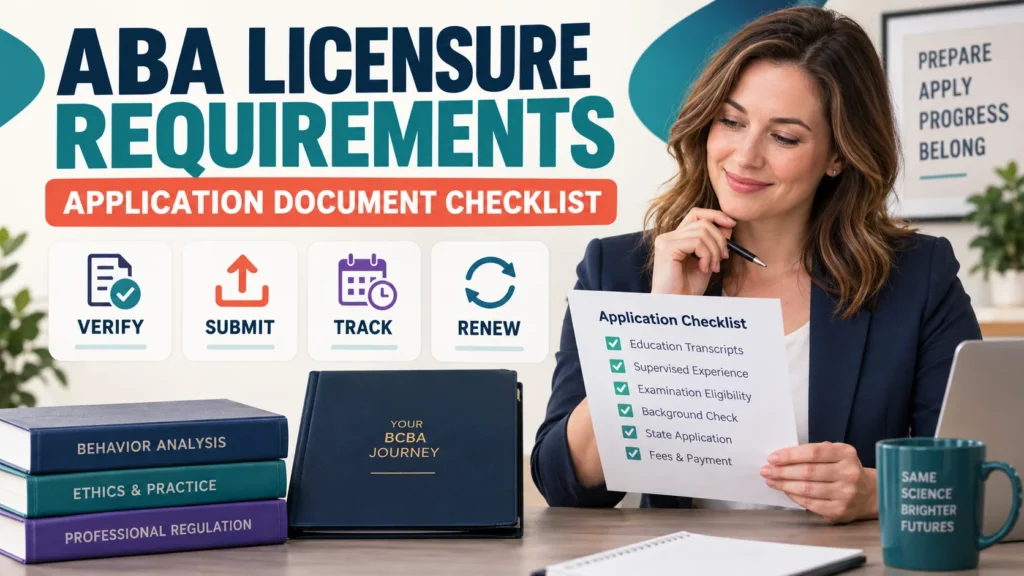
ABA licensure requirements are not one national checklist. A BCBA applicant may need a BACB certification packet, a state-license packet, and employer or payer credentialing documents, each with its own owner, form version, deadline, and renewal rule.
Table of Contents
- What ABA Licensure Requirements Actually Refer To
- Build Three Separate Document Packets
- BACB Packet: Verify Certification Evidence
- State Packet: Turn Law Into a Checklist
- Employer and Payer Credentialing Packet
- Run a Document Version and Deadline Audit
- Common Application-Packet Failure Modes
- Connect the Packet to BCBA Exam Preparation
- Frequently Asked Questions
- Sources and Verification Notes
- Take the Free BCBA Mock Exam
The most common paperwork mistake is treating certification and licensure as the same credential. The BACB controls BCBA certification. A state board controls a state license when that jurisdiction requires one. An employer, funder, or contracting organization may ask for additional evidence before allowing services or billing. These layers can overlap, but one does not automatically replace the others.
This guide focuses on the document chain rather than repeating a general explanation of who makes the rules. It gives you a practical way to identify the source, verify the current version, submit the right evidence, retain a copy, and set the next renewal or re-verification date. It is not legal advice; use the current BACB and state-board instructions for your jurisdiction.
What ABA Licensure Requirements Actually Refer To
Start by writing the requirement owner beside every document. If the source is unclear, do not guess from a social-media checklist or an old application. Open the current organization’s page, record the date you checked it, and save the exact form or instruction link in your tracker.
| Requirement owner | Typical evidence | What can go wrong |
|---|---|---|
| BACB certification | Application, official transcripts, pathway evidence, fieldwork forms, coursework attestation when applicable, and examination steps. | A candidate submits the right document to the wrong organization or uses an outdated pathway rule. |
| State license | State application, license-specific verification, background or jurisprudence items, fees, and renewal evidence. | A national certification is assumed to satisfy a state-specific form, deadline, or training rule. |
| Employer or payer | Credentialing forms, verification letters, liability or background documents, contracts, and payer-specific enrollment evidence. | A license is active, but the organization’s internal credential file or payer enrollment is incomplete. |
| Renewal and maintenance | Continuing education, supervision or practice records, renewal forms, fees, and updated verification. | The applicant tracks only the initial approval date and misses a separate renewal cycle. |
Build Three Separate Document Packets
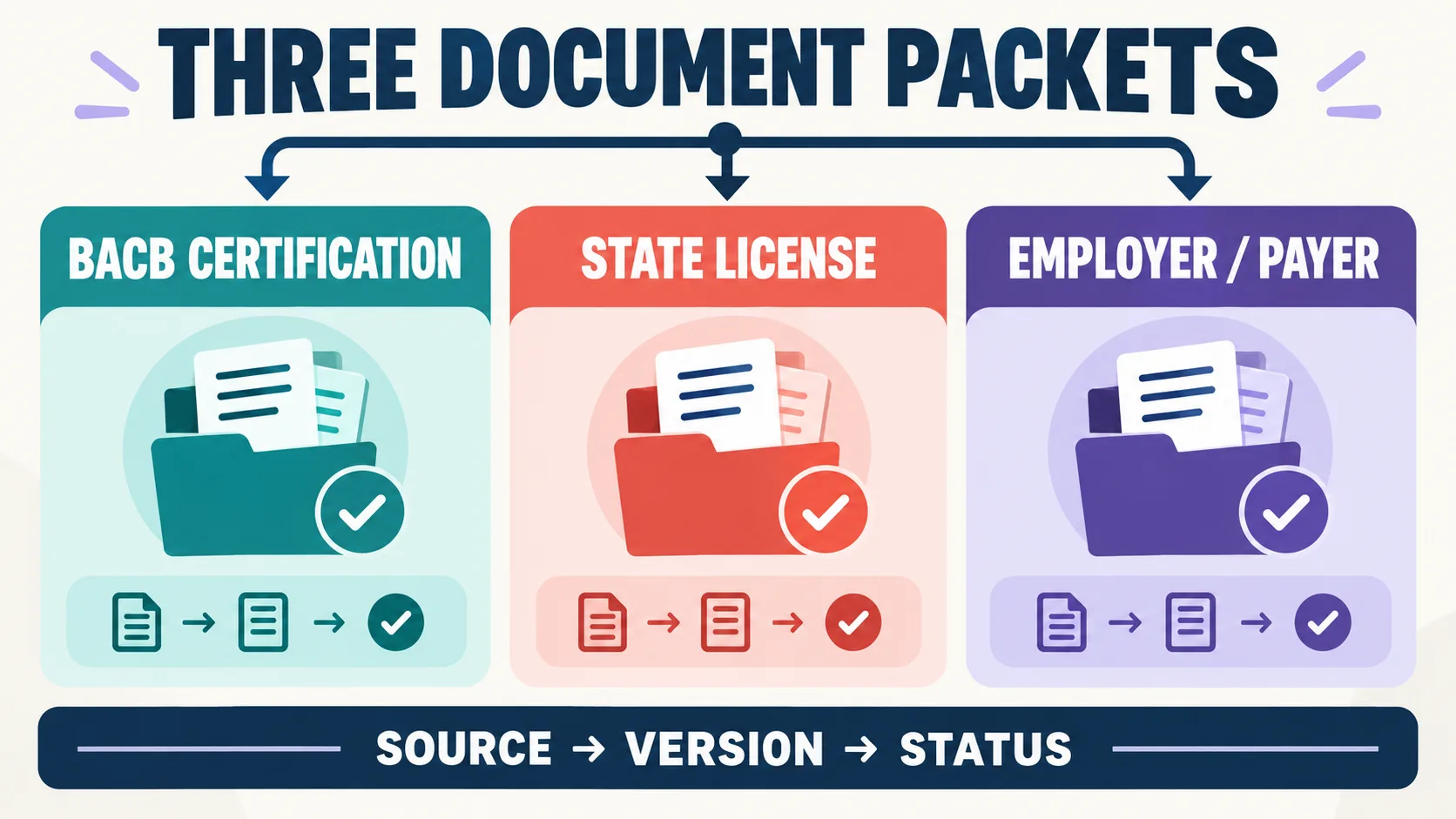
A simple folder structure prevents the most expensive kind of confusion: a document that is valid but stored in the wrong packet. Create three top-level folders or tracker views named BACB, STATE, and EMPLOYER/PAYER. Give every file a plain name that includes the owner, document type, version or date, and status. For example, a file name could be STATE-TX-license-verification-requested-2026-10-14 or BACB-pathway-2-attestation-2026-form-received. The exact naming convention is up to you; the point is to make the source and status visible without opening the file.
- Source: Which organization issued the instruction or document?
- Version: What date, edition, or form number is shown?
- Owner: Who must request, sign, send, or verify it?
- Status: Is it not started, requested, received, submitted, accepted, or needing correction?
- Next date: What deadline, follow-up date, renewal date, or re-verification trigger should be placed on the calendar?
Keep a private copy of the submitted application and supporting evidence. The BACB handbook explains that documents submitted to the BACB may be retained or safely discarded and advises applicants and certificants to retain their own copies. Apply the same practical discipline to state and employer packets, while using secure storage for personal and identifying information.
BACB Packet: Verify Certification Evidence
The BACB packet begins with the pathway and the requirements in effect when you apply. It is not enough to save a screenshot of a program page. Record the current handbook, the pathway you are using, the documents your program or supervisor must submit, and the status of each item in your BACB account.
The 2027 transition makes version control especially important. The BACB states that significant changes take effect January 1, 2027. An applicant who wants review under the current 2022 requirements must have a complete application, including payment and all required documents, received by December 31, 2026. If your plan crosses that date, verify the applicable 2027 requirements instead of assuming that an old checklist continues.
For Pathway 2 applicants, current BACB guidance describes a Pathway 2 Program Contact and coursework attestation process. The BACB also explains that applicants applying on or after January 1, 2027 must meet the 2027 coursework requirements. That is a source-and-attestation check, not a reason to copy a generic list of courses from another candidate.
| BACB packet field | Verification question | Record in the tracker |
|---|---|---|
| Pathway | Which current pathway and handbook section apply to this application? | Pathway, handbook URL, date checked, and program contact. |
| Coursework | Who verifies the coursework and which attestation or transcript must be sent? | Attestor, form version, submission date, and confirmation. |
| Fieldwork | Are the required verification forms complete, consistent, and signed by the right person? | Form type, requirement year, signatures, and copy location. |
| Application | Has the application, payment, and official transcript request been completed in the BACB account? | Receipt, transcript request, application date, and action-item deadline. |
State Packet: Turn Law Into a Checklist
State ABA licensure requirements are jurisdiction-specific. The BACB’s U.S. licensure page can help you find the relevant state information, but the BACB warns that it does not warrant or guarantee the accuracy of the websites linked from that map. The state board, licensing agency, or statute is the place to verify the current application rule.
Do not copy Kentucky, Indiana, New York, or any other state’s checklist and label it “national.” Public state examples show why that fails: one board may ask for a BACB certification verification, another may require a background check or positive-response statement, and another may require transcripts, course descriptions, or a different application form. These are examples of variation, not universal instructions.
- Record the exact board or agency name, official application page, and contact method.
- Confirm whether the application is initial licensure, reciprocity, reinstatement, renewal, or a change of status.
- List every document the board must receive directly, such as an official transcript or certification verification.
- Check background, jurisprudence, mandated training, name-change, and positive-response instructions when the state lists them.
- Record the fee, payment method, expiration date, renewal cycle, and continuing-education source separately from the BACB dates.
| State tracker column | Why it matters | Verification note |
|---|---|---|
| Board and license title | A state may use LBA, LABA, behavior analyst, or another protected title. | Copy the wording from the current official rule, not a third-party guide. |
| Direct-source documents | Some evidence must come directly from a school, BACB, another board, or a background-check provider. | Mark who sends it and whether applicant-uploaded copies are accepted. |
| Deficiency response | A board may set a response window or abandon an incomplete application. | Save the deficiency notice and put the response date on the calendar. |
| Renewal | State renewal can have a different cycle and continuing-education rule from BACB maintenance. | Track the state license expiration independently and verify before renewal. |
Employer and Payer Credentialing Packet
After certification and state licensure are organized, ask the employer, group practice, school, health plan, or funder what it needs for credentialing. This packet may include verification of current credentials, contracts, background checks, liability coverage, tax or business information, payer enrollment, and internal training. The exact list belongs to that organization, not to a generic BCBA blog checklist.
Use a separate status for “license active” and “credentialing accepted.” A payer may need a verification letter or recredentialing form even when the public license lookup shows an active license. If the organization requests sensitive records, confirm the secure submission channel and retain a receipt or confirmation.
Run a Document Version and Deadline Audit
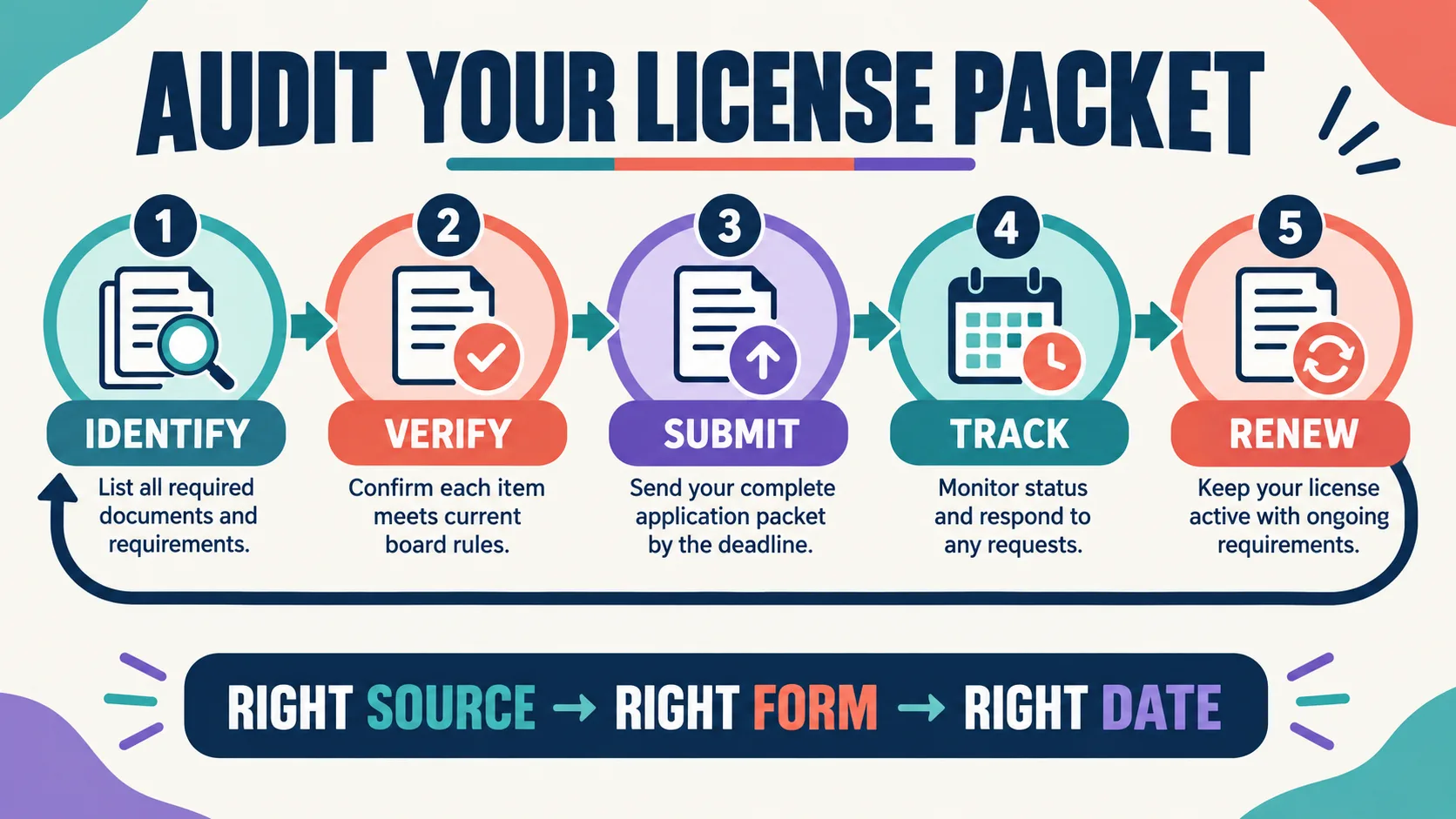
Once the three packets exist, run the same audit before submission and again before renewal. The goal is to catch a mismatch early: a legal name that differs across records, an old form, a missing direct transcript, a payment without a complete application, or a deadline that belongs to a different credential.
- Identify: name the requirement owner, credential, jurisdiction, and application type.
- Verify: open the current official source and record the form version, date checked, and submission method.
- Submit: send direct-source documents through the channel the owner requires and keep the receipt.
- Track: record the application ID, action items, deficiency response, and next follow-up date.
- Renew: set an advance reminder for expiration, continuing education, verification, and employer or payer recredentialing.
| Audit check | Pass condition | If it fails |
|---|---|---|
| Identity | Name, BACB ID, address, and credential names match the source records. | Resolve the name or address discrepancy before submission. |
| Version | The form and requirement year match the current official instruction. | Download the current form and ask the issuer whether the old copy can be replaced. |
| Completeness | Every required field, signature, fee, and direct-source request is accounted for. | Create one action item with an owner and a response date. |
| Receipt | You can prove what was sent, when, where, and under which application. | Request confirmation through the official channel and save the response securely. |
Common Application-Packet Failure Modes
Most delays are not caused by a candidate lacking every qualification. They come from an evidence chain that cannot be matched to the requirement. Before submitting, look for these patterns:
- Credential conflation: certification, state licensure, and employer credentialing are recorded as one status.
- Old transition logic: a 2022 or 2026 checklist is used without checking the 2027 requirements and pathway dates.
- Unclear direct submission: the applicant uploads a copy even though the board or BACB requires the school, program contact, or another agency to send the document.
- Name mismatch: the transcript, application, certification account, and identity document use different names with no supporting record.
- No retention copy: the applicant cannot reconstruct what was submitted when an action item arrives.
- Deadline blindness: the applicant records an application date but not the response window, processing update, or separate renewal date.
Connect the Packet to BCBA Exam Preparation
Document readiness and exam readiness are different tasks, but both reward source-first thinking. When you study a BCBA scenario, identify the authority, the required evidence, the relevant rule, and the next defensible action. Then separate what is explicitly stated from what would need verification in a handbook, ethics code, or state rule.
When the paperwork is organized, use the free BCBA Mock Exam as a diagnostic step. Review missed questions by category—pathway, ethics, measurement, supervision, or application decision—and return to the current source rather than memorizing an answer pattern.
Frequently Asked Questions
Are ABA licensure requirements the same in every state?: No. Some jurisdictions require a separate behavior-analytic license, while others use different regulatory arrangements. The state board or licensing agency controls the current state-specific application, title, fee, verification, and renewal instructions.
Is BCBA certification the same as an ABA state license?: No. BACB certification and state licensure are separate credentials with different owners. An employer or payer may also require its own credentialing evidence even when both credentials are active.
What should I check for the 2027 BCBA transition?: Check the current BACB handbook, the 2027 requirements and transition guidance, your pathway, the complete-application deadline, and any required coursework attestation or transcript. Do not carry a prior-year checklist forward without verifying the source.
Should I upload my own transcript or ask the school to send it?: Follow the exact instruction for the credential and jurisdiction. Some processes require official documents or direct submission. Your tracker should record who sends the document, the accepted channel, and the confirmation date.
How early should I start an ABA license application?: Start early enough to request transcripts, verification letters, background materials, and any state-specific training or forms. Add time for deficiencies and do not assume that a paid application is complete until the licensing body confirms the required evidence.
Sources and Verification Notes
This article was checked against current BACB certification, licensure, application-processing, handbook, and 2027 transition pages, plus official state examples showing why a national checklist cannot replace a state board’s instructions. State examples are illustrative only. Rules, forms, fees, processing times, and renewal requirements can change; verify the official source for your jurisdiction before submitting.
- BACB Licensure of Behavior Analysis in the United States.
- BACB BCBA Handbook.
- BACB 2027 BCBA and BCaBA Requirements.
- BACB University Training and Pathway 2 Coursework Attestation Guidance.
- BACB Application Processing Updates and Document Versions.
- BACB BCBA Application Resources.
- Kentucky official application checklist example.
- Indiana official behavior-analyst licensing instructions example.
- New York official licensed behavior analyst forms example.
Take the Free BCBA Mock Exam
A useful next step is to apply this idea in a fresh set of BCBA-style practice questions and review the feedback. Take the Free BCBA Mock Exam



