

Objective in ABA terms is not one single phrase. It can mean objective wording in an operational definition, a behavioral objective that describes a measurable outcome, or objective language in a session note. The fastest way to answer the question is to identify the task first, then choose the right writing test.
Table of Contents
- Objective in ABA Terms: Choose the Task First
- Write an Objective Operational Definition
- Build a Measurable Behavioral Objective
- Use Objective Session-Note Language
- Run the Observable-to-Measurable Rewrite
- Use the Exam Discrimination Checklist
- FAQ About Objective in ABA Terms
- Take the Free BCBA Mock Exam
Quick answer: objective ABA language describes observable events, uses a measurement that another person could reproduce, and avoids guessing about private states. A definition tells you what counts as the behavior. A behavioral objective tells you what performance should change and by when. An objective session note records what happened, what was measured, and what was done without turning interpretation into fact.
Objective in ABA Terms: Choose the Task First
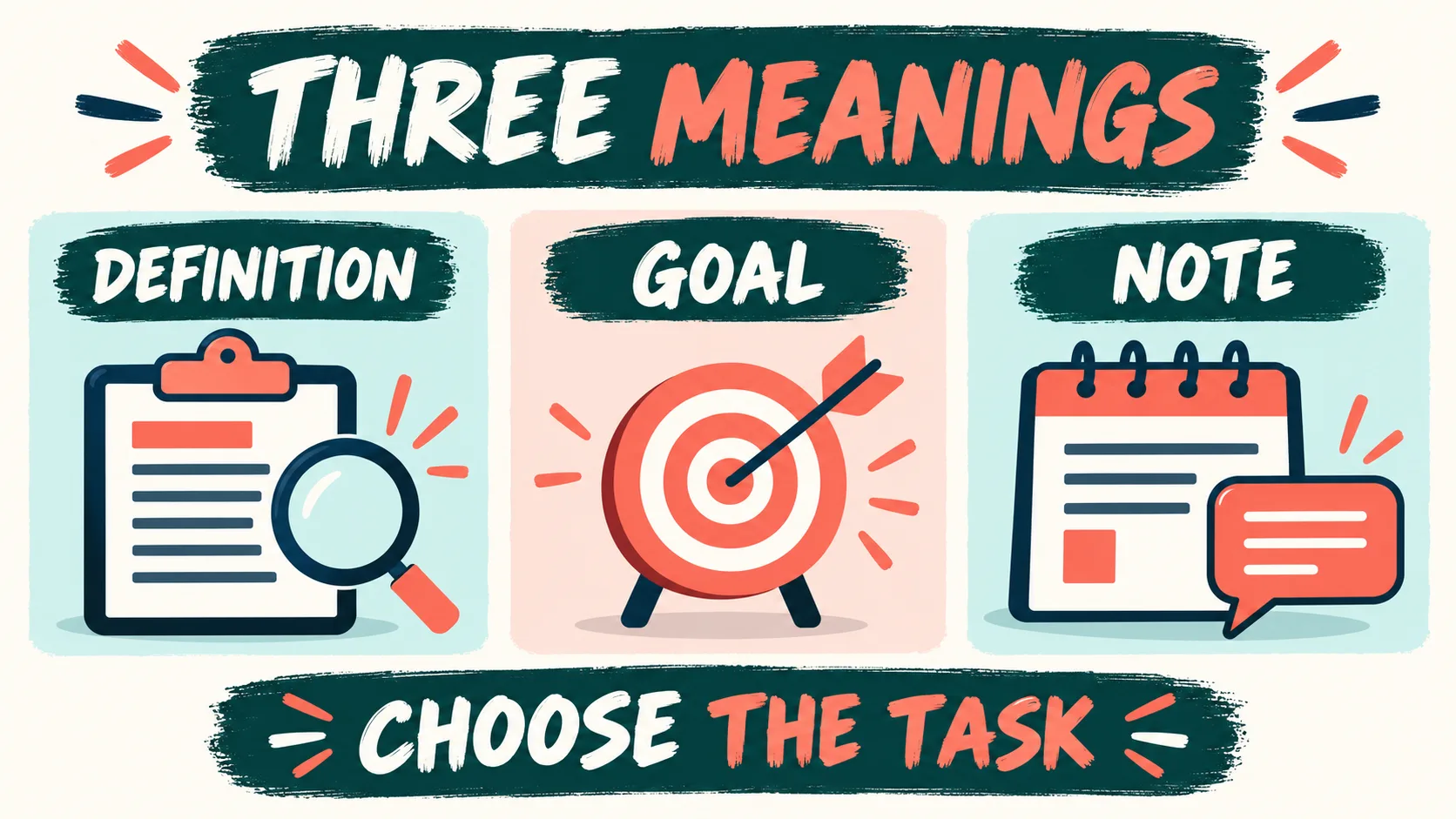
When someone searches for objective in ABA terms, they may be asking for a definition, a goal, or documentation wording. Those products overlap, but they do different jobs. The current objective in ABA terms in the BCBA Test Content Outline emphasizes behavior, measurement, assessment, intervention, and supervision. That makes precision more useful than a generic statement that something should be “objective.”
| Meaning | What it answers | Best test |
|---|---|---|
| Operational definition | What exactly counts as the target behavior? | Could two trained observers score the same event the same way? |
| Behavioral objective or goal | What performance should occur under which conditions and criterion? | Does it name a response, condition, measurement, mastery criterion, and timeline? |
| Objective session note | What happened during the session and what data support that report? | Could a reader separate observation, data, action, and plan from interpretation? |
This distinction also tells you which existing resource to open next. Use the operational definition guide for definition construction, the ABA goal-writing guide for measurable outcomes, and the objective session-notes example for documentation wording.
Write an Objective Operational Definition
An operational definition describes the topography or observable boundary of a response. Avoid labels such as “noncompliant,” “anxious,” or “rude” unless the team has translated them into observable actions. A stronger definition states what an observer can see or hear, when the episode starts, when it ends, and what does not count.
- Name the response: use an action such as pushes, leaves the seat, says “no,” or places the item in the bin.
- Add the boundary: define onset, offset, duration, force, location, or required sequence when those details affect scoring.
- Remove interpretation: replace “seems frustrated” with the observable response and the relevant context.
- Add an example and nonexample: test whether the definition handles close cases consistently.
For example, “The learner is aggressive” is not ready for reliable measurement. “Any instance in which the learner makes contact between an open hand or object and another person’s body with enough force to produce an audible sound or visible movement; the episode ends after 30 seconds without contact” gives observers a more consistent scoring boundary. The exact boundary should still be reviewed by the clinical team and matched to the measurement plan.
Build a Measurable Behavioral Objective
A behavioral objective is a performance statement, not a label for a diagnosis or an internal state. The objective should tell the implementer what to arrange, what response to look for, how to measure it, and what criterion indicates progress.
| Component | Question | Example cue |
|---|---|---|
| Condition | When or with what materials will the response be tested? | Given three pictured choices and a verbal direction |
| Response | What will the learner do that an observer can see or hear? | Selects the requested picture and hands it to the instructor |
| Measurement | How will performance be counted? | Independent correct responses across opportunities |
| Criterion and timeline | How much performance is enough, and by when? | At least 80% across three consecutive sessions |
“The learner will improve communication” is a direction, not a complete objective. “Given a choice board, the learner will select and hand over the requested symbol within 10 seconds in at least 80% of opportunities across three consecutive sessions” is more measurable. The team should confirm that the target is socially significant, feasible, culturally responsive, and linked to baseline data.
- Use a response that can be seen or heard.
- State the condition or opportunity in which the response should occur.
- Choose a measure and criterion that match the skill and baseline.
Use Objective Session-Note Language
Objective notes report observations, data, interventions, and next steps. They do not require a writer to sound cold or omit context. They require the writer to separate what was observed from what is inferred. A note can say that a client cried, pushed materials away, completed four of five trials, or used a prompted request. It should not state “the client wanted attention” as though the private event were directly observed unless the statement is clearly framed as a hypothesis supported by assessment data.
- Observation: what was seen or heard.
- Data: the count, duration, latency, percentage, or prompt level.
- Action and plan: what was implemented and what will be checked next.
| Vague wording | More objective wording | What improved |
|---|---|---|
| The client was upset. | After the worksheet was presented, the client cried, pushed the worksheet 20 cm away, and did not begin within 30 seconds. | Observable response and context |
| The client understood the skill. | The client answered 8 of 10 independent trials correctly without a model prompt. | Data and prompt level |
| The intervention worked well. | Independent requests increased from 4/12 opportunities at baseline to 9/12 opportunities today; continue monitoring across settings. | Comparison and next action |
Run the Observable-to-Measurable Rewrite
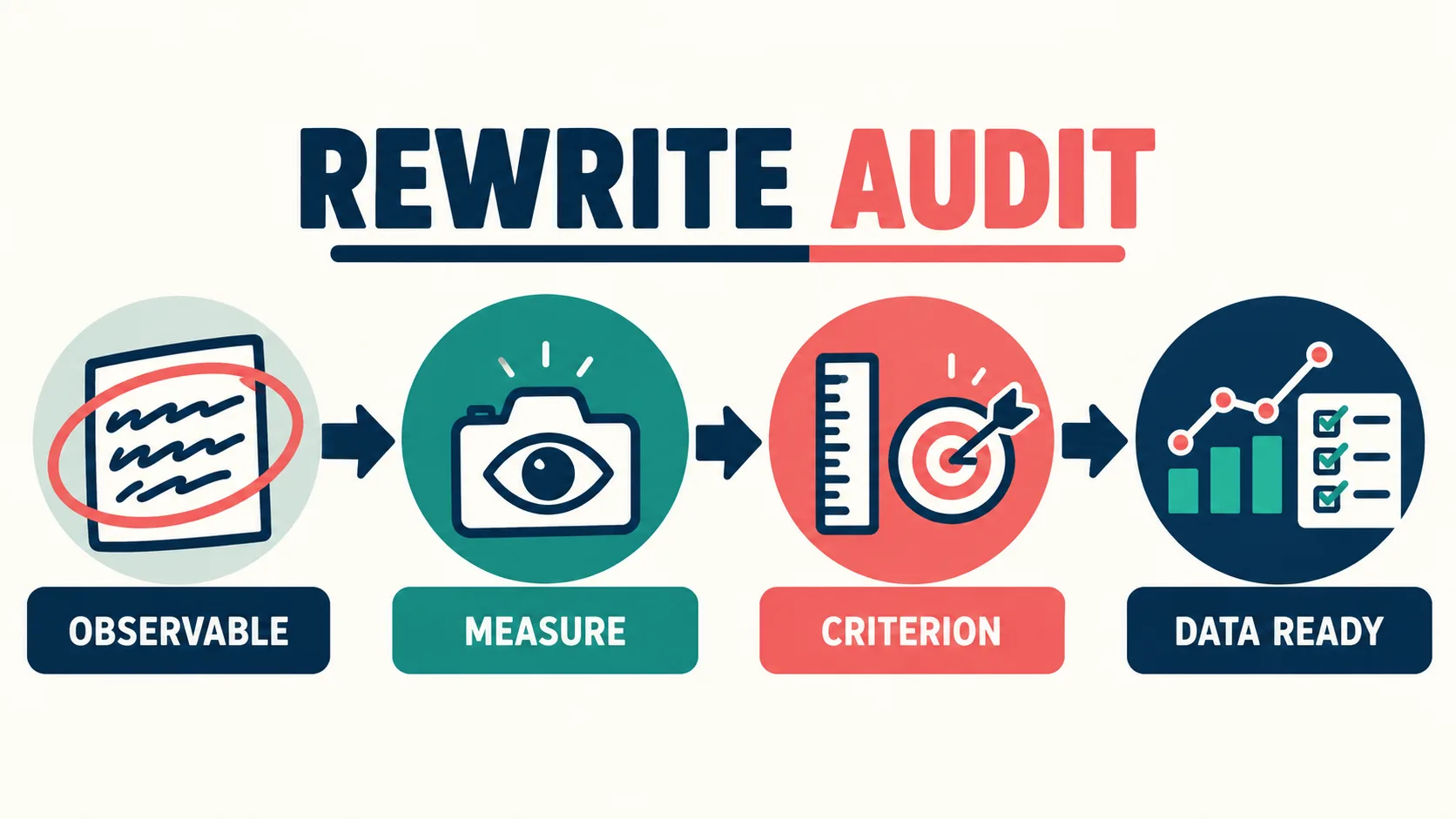
Use this five-step rewrite whenever a goal, note, or study question uses a broad adjective. The aim is not to make every sentence longer. The aim is to make the relevant response and evidence visible.
- Circle the label. Find words such as appropriate, motivated, cooperative, improved, frustrated, or understands.
- Ask what a camera or data sheet could capture. Convert the label into an action, vocalization, latency, duration, rate, percentage, or other defined measure.
- Mark the context. Identify the instruction, material, setting, person, or antecedent that makes the response relevant.
- Set the evidence rule. Add baseline, opportunity count, prompt level, criterion, or comparison period as appropriate.
- Check the reader’s task. Decide whether the final sentence is a definition, a goal, or a session-note observation. Do not mix all three jobs into one field.
- Definition check: Can two observers decide whether the behavior occurred?
- Goal check: Can the implementer identify the condition, response, measure, criterion, and timeline?
- Note check: Can the reader distinguish data, intervention, response, and hypothesis?
Use the Exam Discrimination Checklist
On a BCBA-style question, “objective” usually points you toward observable and measurable language, but it does not automatically tell you which product is being requested. Read the noun around it: definition, goal, objective, note, data, or intervention.
For targeted practice, use the free BCBA mock exam after you can explain why the best wording is observable and measurable. A study question may test operational-definition quality, goal components, measurement selection, or objective documentation; the same word does not mean the same answer format in every scenario.
FAQ About Objective in ABA Terms
Is objective the same as measurable in ABA?: They are related but not identical. Objective wording reports observable events without unsupported interpretation. Measurable wording specifies how performance or behavior will be quantified. A strong ABA goal usually needs both.
What is an objective behavior goal?: It is a performance statement that identifies the conditions, observable response, measurement method, mastery criterion, and often a timeline. The exact components should match the learner, skill, baseline, and clinical plan.
Can an objective session note include interpretation?: It can include a clearly labeled clinical interpretation or hypothesis supported by data, but the writer should not present an inferred internal state as a directly observed fact. Separate observation, data, intervention, interpretation, and plan.
What should I do when “objective” is ambiguous?: Ask whether the reader needs a definition, a goal, or a note. Then choose the corresponding test: observer agreement for a definition, performance components for a goal, and observation-plus-data separation for a note.
Bottom line: objective in ABA terms means more than “professional sounding.” It means the wording points to observable behavior, a reproducible measure, and the correct task. Identify the task first, then write the sentence that another trained reader can use.
Take the Free BCBA Mock Exam
When you are ready to apply the idea, use the free practice resource below for additional feedback. Take the Free BCBA Mock Exam



