

ABA terms and definitions are easier to remember when each term is attached to a decision. A BCBA exam question rarely rewards a vague synonym. It asks you to recognize what a behavior is, select a measurement, identify a process, choose a procedure, or protect a professional relationship. That is why an alphabetical glossary is useful for lookup but incomplete for preparation.
Table of Contents
- ABA Terms and Definitions: Start With the Decision
- Use the Five-Question ABA Term Map
- Route the Term to the Right 6th Edition Domain
- Learn a Term in Four Layers
- Run a 15-Minute Term Audit
- Move Weak Term Families Into Targeted Practice
- FAQ and Study Boundaries
- Quick Review Checklist
- Take the Free BCBA Mock Exam
Short answer: study every important term in four layers: a precise definition, a concrete example, the closest term it is not, and the decision the term supports. The current BACB task-list page points candidates to the BCBA Test Content Outline (6th ed.), and the official outline organizes the exam into nine domains. Use that outline to route your vocabulary, then use scenario practice to prove that you can apply it.
ABA Terms and Definitions: Start With the Decision
The phrase ABA terms and definitions can describe a parent glossary, an RBT reference, a university vocabulary list, or a BCBA exam study system. For this page, the useful unit is not “one word.” It is one word plus the job that word performs in a question.
The BACB explains that, for certification and examinations, ABA is defined by the content of the applicable task lists. That matters because a term can appear in more than one setting while the exam tests a specific distinction. “Duration,” for example, is not just a definition to recite; it is a choice about the temporal dimension of behavior. “DRA” is not just an acronym; it is a behavior-change procedure with an alternative response and a reinforcement contingency.
| If the question asks you to… | Your term family is probably… | What to retrieve |
|---|---|---|
| Describe what happened in observable language | Definition and measurement | Behavior, response, operational definition, dimension, data method |
| Explain why a response changed | Concepts and principles | Antecedent, consequence, reinforcement, punishment, motivating operation, stimulus control |
| Choose what to do next | Assessment and intervention | Assessment type, function, alternative behavior, procedure, integrity, generalization |
| Decide what is professionally acceptable | Ethical and professional issues | Confidentiality, competence, multiple relationships, cultural responsiveness, transition |
This map also tells you how to avoid thin study content. Instead of publishing ten pages that all define “reinforcement,” create one useful explanation for the reader’s task, then link to the site’s deeper reinforcement resources when a separate concept deserves its own page.
Use the Five-Question ABA Term Map
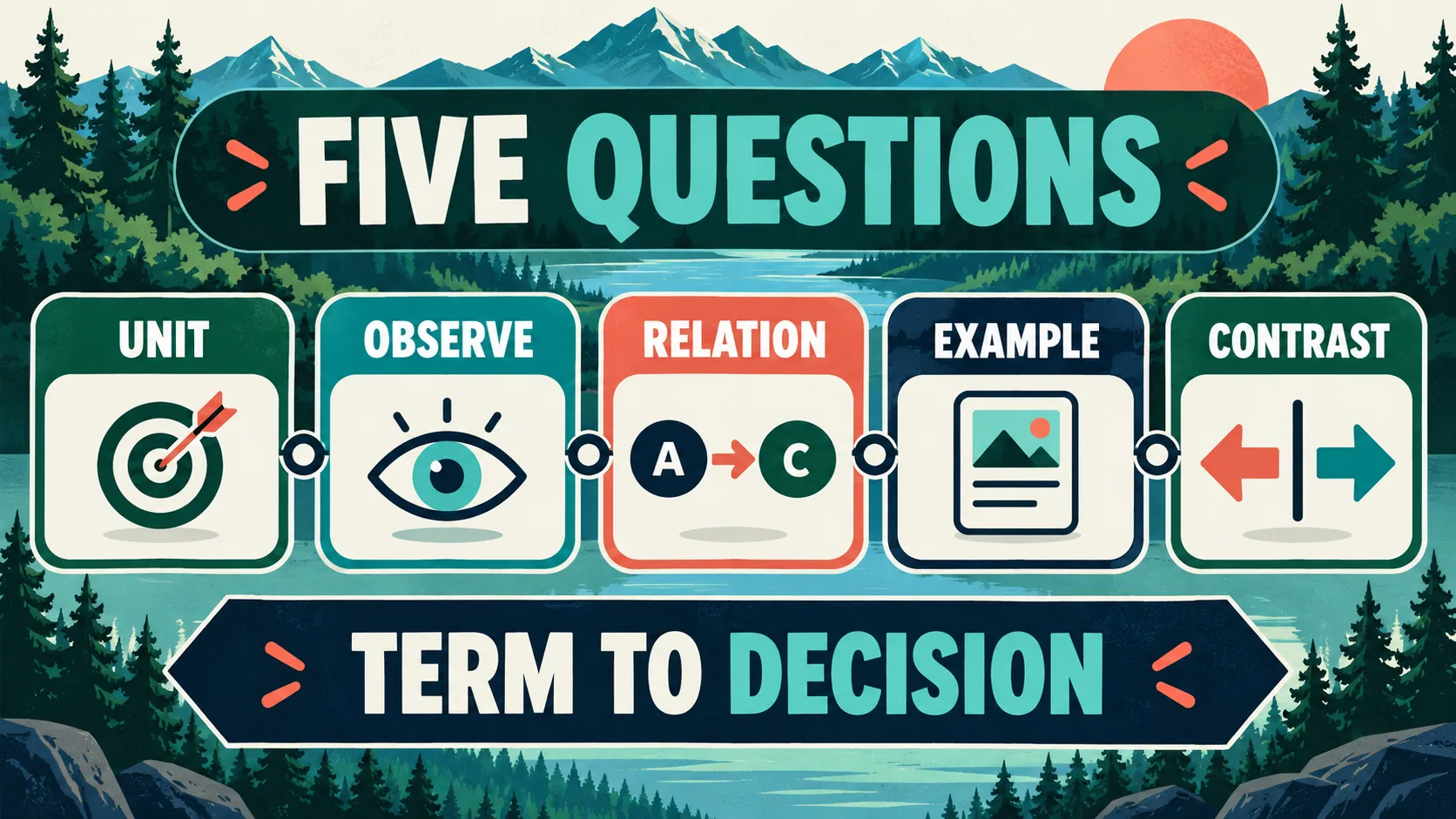
When you meet a new word, answer the five questions below before adding it to a flashcard. The order is deliberate: it moves from what the term means to what you would do with it.
- What is the unit? Is the term about a behavior, a stimulus, a person’s response, an environmental event, a data procedure, or a professional action?
- What is observable? Rewrite the definition so that two trained observers could identify the relevant event. Avoid treating an inferred feeling or trait as if it were a directly measured behavior.
- What changes the relation? Identify the antecedent, consequence, motivating operation, stimulus control relation, or measurement condition that makes the term different from its neighbors.
- What would count as an example? Build a short scenario with a clear setting event, response, consequence, or data record. If you cannot create an example, the definition is probably still too abstract.
- What is the closest contrast? Name one tempting wrong answer and explain why it fails. Contrast is often the missing step between recognizing a word and applying it.
For example, a learner may memorize that latency is the time between an instruction and the beginning of a response. The decision-ready version adds the measurement boundary: identify the instruction, define the response onset, and start and stop the timing consistently. The closest contrast is duration, which measures how long the response continues, not how long it takes to begin.
Route the Term to the Right 6th Edition Domain
The official BCBA Test Content Outline describes 104 tasks across nine domains. You do not need to turn every definition into a statistics exercise, but you do need to know what kind of task the term supports. The domain is a retrieval cue, not a substitute for the definition.
| TCO domain | Term examples | Application prompt |
|---|---|---|
| A: Behaviorism and philosophical foundations | Selectionism, empiricism, pragmatism, dimensions of ABA | Which assumption or dimension is reflected in this statement? |
| B: Concepts and principles | Reinforcement, punishment, extinction, stimulus control, verbal operants | Which relation or process best explains the change in responding? |
| C: Measurement and interpretation | Frequency, rate, duration, latency, validity, reliability, interval recording | Which measure captures the critical dimension with the least distortion? |
| D: Experimental design | Reversal, multiple baseline, multielement, internal validity | What design feature supports prediction, verification, or replication? |
| E–I: Professional application | Confidentiality, functional assessment, prompting, generalization, supervision | What assessment, intervention, ethical action, or supervision decision follows? |
Use the current outline for the exact task wording. The table is a study organizer, not an official redistribution of exam content. Notice that several high-value terms cross domains: procedural integrity connects measurement with intervention, and cultural responsiveness appears in assessment, ethics, intervention, and supervision. When a term crosses domains, create two application prompts instead of two competing definitions.
Learn a Term in Four Layers
A strong definition card should be short enough to retrieve and rich enough to prevent a false match. Use this four-layer format:
- Definition: one precise sentence using the correct unit and relation.
- Example: one realistic scenario that shows the term, not merely repeats it.
- Contrast: one related term that a question writer could use as a distractor.
- Application: one prompt asking you to select, calculate, interpret, or protect something.
Consider response generalization. A weak card says, “The learner performs different responses that serve the same function.” A stronger card adds the application: after teaching a learner to request a break with a card, the learner also requests a break verbally or with a gesture in the same context. The contrast is stimulus generalization, where the same response occurs across different stimuli or settings. The exam-ready question becomes: did the response form change, or did the context change?
| Card layer | Bad shortcut | Better check |
|---|---|---|
| Definition | A synonym or a copied sentence | Could two people identify the same relation from it? |
| Example | A label with no events | Can you point to the antecedent, response, consequence, or data? |
| Contrast | A completely unrelated term | Would the contrast plausibly appear as a distractor? |
| Application | Reciting the definition again | Can you choose a procedure or interpret a scenario without seeing the term? |
Run a 15-Minute Term Audit
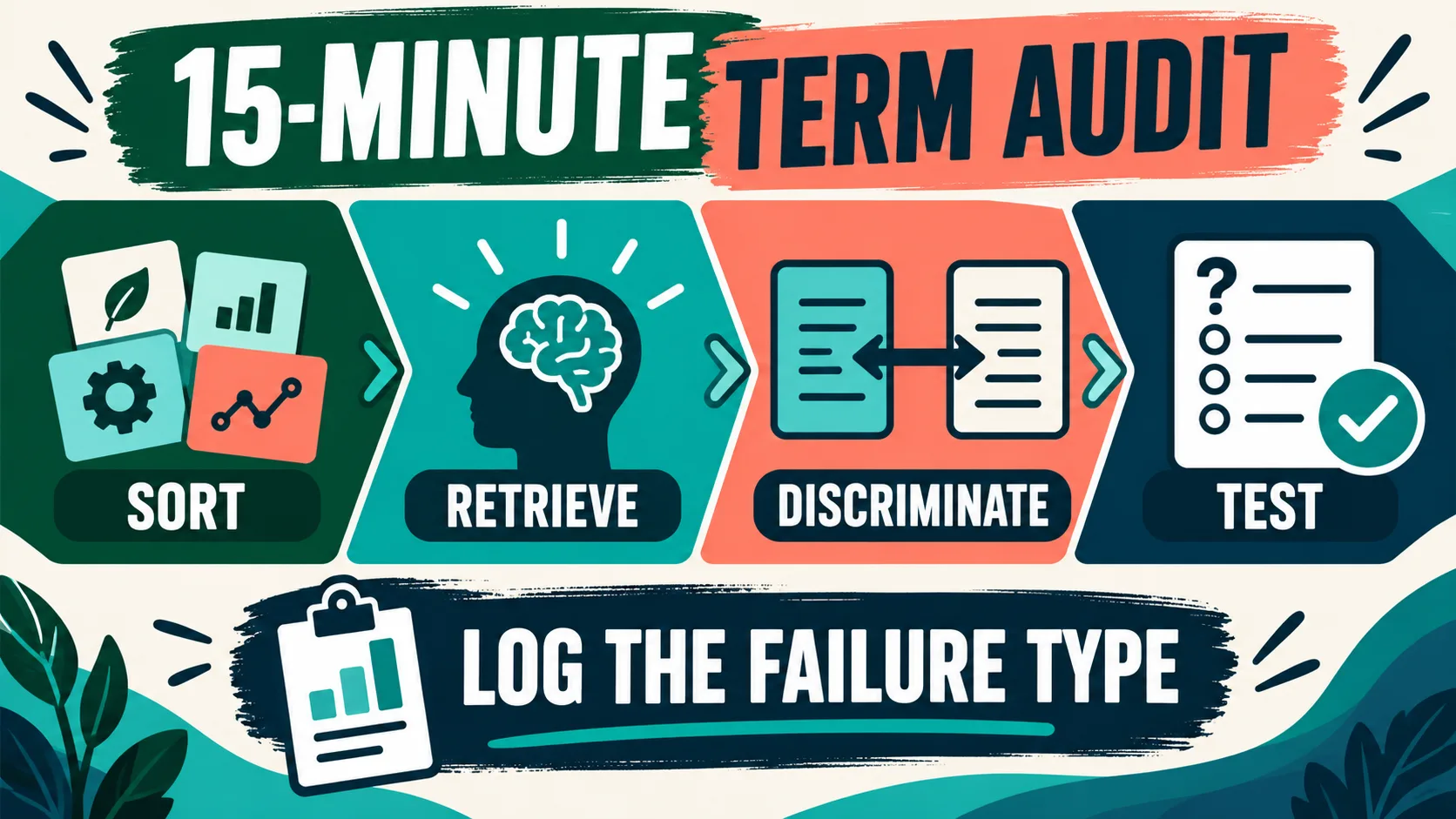
Do not wait until the end of a study block to discover that you only recognize a word. Pick five terms from one family and run the same audit every time.
- Minute 1–3: sort. Put each term into a TCO domain and one decision family: define, measure, explain, choose, or protect.
- Minute 4–7: retrieve. Close the notes and write the definition, example, contrast, and application from memory.
- Minute 8–11: discriminate. Compare each term with its closest neighbor. Mark the exact feature that changes the answer.
- Minute 12–15: test. Complete a scenario question or create one. If you miss it, record the failure type: definition, example, contrast, measurement, or application.
That failure type is more useful than a simple “wrong” mark. Someone who knows the definition but misses the measure needs a different review than someone who confuses two reinforcement procedures. Keep a small error log with the term family, the distractor, and the corrected decision rule.
Move Weak Term Families Into Targeted Practice
Once you have completed the audit, do not immediately take another full mock exam. Start with the smallest useful practice set: one domain, one decision family, and enough scenarios to expose the contrast. For example, a measurement weakness might begin with frequency versus rate, duration versus latency, and continuous versus discontinuous measurement before expanding to graph interpretation.
When your error log shows that you can define the term, explain an example, reject the closest distractor, and select the right action, move to mixed practice. Our free BCBA mock exam can be used as that next checkpoint. Treat the result as a routing signal: review the missed term family, then return to a new scenario rather than rereading the same definition indefinitely.
FAQ and Study Boundaries
Should I memorize every word alphabetically? No. Use alphabetical lookup when you need to find a term, but organize active study by decision family and task-list domain. The exam rewards discrimination and application, not only recognition.
Is a plain-English definition enough? It is a starting point. Keep the technical relation accurate, then add a plain-language explanation and an example. If simplifying removes the measurement boundary or contingency, the definition is no longer safe to use.
Does the 6th Edition TCO replace every textbook definition? No. The TCO tells you the content and skills the examination covers; it is not a complete dictionary. Use current official BACB materials for scope and current requirements, and use authoritative course or textbook resources for deeper explanations.
What if one term appears in several domains? Keep one core definition, then write separate application prompts for the domains. Do not create contradictory cards. The same term may be measured in one question, interpreted in another, and used in an intervention decision in a third.
What should I do after a missed practice question? Name the failure type, rewrite the contrast, and answer a new scenario. A correct definition with the wrong application is not a reason to memorize the sentence harder; it is a reason to practice the decision.
Bottom line: the most useful ABA terms and definitions study system turns vocabulary into behavior-analytic decisions. Route each term, retrieve it in four layers, compare it with its nearest distractor, and verify it in a scenario. That workflow makes your glossary smaller, more memorable, and much closer to the way BCBA exam questions actually require you to think. For targeted review, use our ABA terms and definitions practice questions to apply the concept in exam-style scenarios.
Quick Review Checklist
Use this final checklist to turn ABA terms and definitions into exam-ready reasoning. The goal is not to memorize a label in isolation; it is to identify the relevant evidence and explain why the best answer fits the scenario. Key ideas to review:
- State the central definition or decision point for ABA terms and definitions in your own words.
- Identify the detail that makes ABA terms and definitions different from its closest related ABA term.
- Separate the observable facts in a scenario from assumptions that are not supported by the facts.
- Write one example and one nonexample so you can recognize the concept in a new setting.
Exam application checks:
- Ask what the question is actually requesting before comparing the answer choices.
- Mark the antecedent, response, consequence, or other evidence that supports the selected answer.
- Look for a distractor that describes a related process but does not answer the specific question.
Final self-check:
- Explain how you would verify the interpretation with clear observations or data.
- Change one detail in the scenario and decide whether your answer should change.
- Give a one-sentence rationale that a supervisor or study partner could evaluate.
Take the Free BCBA Mock Exam
When you are ready to apply the idea, use the free practice resource below for additional feedback. Take the Free BCBA Mock Exam



