
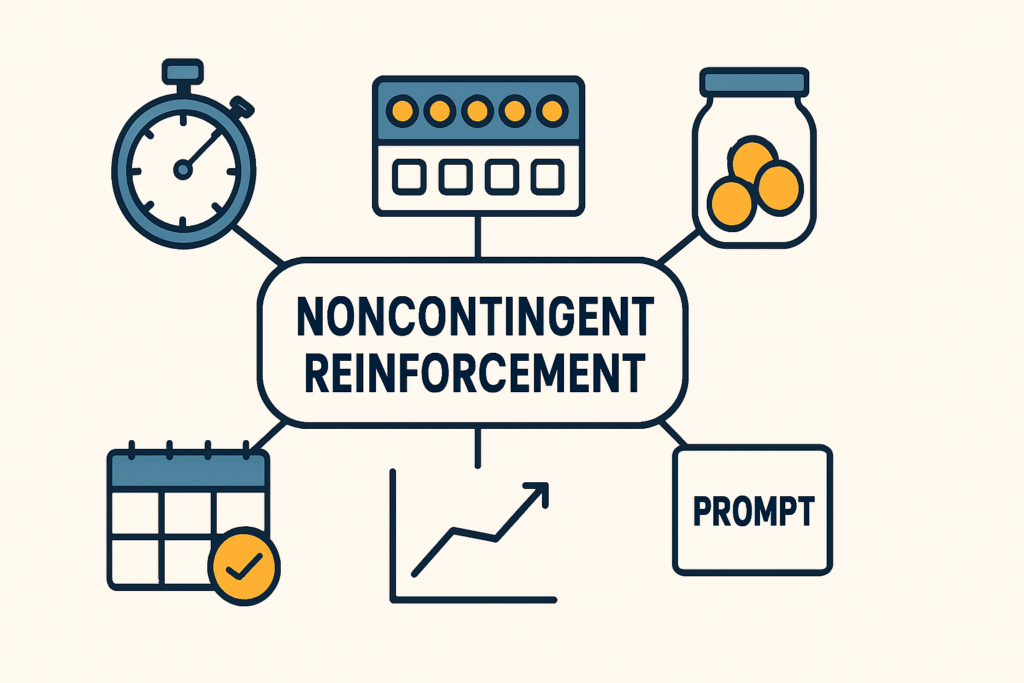
Noncontingent reinforcement represents a powerful antecedent intervention strategy that delivers reinforcement independent of behavior. This approach directly addresses the motivating operations maintaining problem behavior by providing free access to the reinforcer. Understanding NCR is essential for both clinical practice and BCBA exam preparation.
Table of Contents
- What is Noncontingent Reinforcement?
- Applying NCR: Worked Examples from Assessment to Intervention
- NCR and the BCBA Exam: Relevance and Common Traps
- Quick Implementation and Ethical Checklist
- Summary and Key Takeaways
What is Noncontingent Reinforcement?
Noncontingent reinforcement involves delivering reinforcement on a time-based schedule, regardless of the client’s behavior. This antecedent strategy works by altering the establishing operation that makes the reinforcer valuable.
The Core Principle: Delivering Reinforcers Independent of Behavior
NCR functions as an abolishing operation by satiating the client with the reinforcer that maintains problem behavior. The intervention delivers reinforcement on a fixed-time schedule, meaning reinforcement occurs after specific time intervals pass, not contingent on any particular response.
This approach reduces the motivation to engage in problem behavior by making the reinforcer freely available. The key mechanism involves decreasing the reinforcer’s effectiveness through noncontingent delivery.
NCR vs. Other Common Procedures
Understanding how NCR differs from other interventions is crucial for exam success. Unlike differential reinforcement procedures, NCR does not require specific behaviors to occur or not occur.
- DRO (Differential Reinforcement of Other Behavior): Reinforcement contingent on the absence of target behavior during specific intervals
- DRA (Differential Reinforcement of Alternative Behavior): Reinforcement contingent on a specific alternative response
- NCR: Reinforcement delivered on a time schedule, independent of all behavior
NCR is fundamentally an antecedent intervention, while differential reinforcement procedures are consequence-based strategies.
Applying NCR: Worked Examples from Assessment to Intervention
Effective NCR implementation begins with thorough functional behavior assessment. The intervention must match the identified function of the problem behavior.
Example 1: Reducing Attention-Maintained Behavior
Consider a student who engages in pencil tapping during independent work. A functional analysis reveals the behavior is maintained by teacher attention.
- Antecedent: Student working independently at desk
- Behavior: Repeated pencil tapping on desk
- Consequence: Teacher says “Stop tapping” and provides attention
The NCR intervention involves delivering noncontingent attention on a fixed-time schedule. The teacher provides brief positive attention every 3 minutes, regardless of the student’s behavior. This reduces the motivation to tap for attention.
Example 2: Addressing Behavior Maintained by Access to Tangibles
A client engages in yelling during work sessions. Assessment indicates the behavior functions to access preferred items.
- Antecedent: Work demand presented
- Behavior: Loud yelling “I want toy!”
- Consequence: Given preferred toy to stop yelling
The intervention provides noncontingent access to the preferred item on a fixed-time schedule. The client receives 2-minute access to the toy every 5 minutes during work sessions, independent of their behavior.

NCR and the BCBA Exam: Relevance and Common Traps
Noncontingent reinforcement appears in multiple Task List domains. Understanding its proper application is essential for exam success.
Key Exam Links and Task List Items
NCR connects directly to several BACB Task List items. These include interventions based on modifying antecedents and behavior-change procedures.
- Domain G: Behavior-Change Procedures – Item G-14: Use reinforcement procedures to weaken behavior
- Domain G: Antecedent Interventions – Item G-02: Use interventions based on motivating operations and discriminative stimuli
- Domain F: Behavior Assessment – Item F-07: Conduct functional behavior assessments
For comprehensive exam preparation, review our guide on differential reinforcement procedures to contrast with NCR approaches.
Exam Traps to Avoid
Candidates often confuse NCR with other procedures. Watch for these common mistakes:
- Mistaking NCR for a differential reinforcement procedure (it’s not contingent on behavior)
- Forgetting that NCR is primarily an antecedent intervention
- Confusing fixed-time schedules with other reinforcement schedules
- Overlooking the importance of matching NCR to the function of behavior
- Failing to recognize when NCR might produce satiation effects
Quick Implementation and Ethical Checklist
Before implementing NCR, ensure you follow these essential steps and ethical considerations.
- Conduct a thorough functional behavior assessment to identify maintaining variables
- Select a reinforcer that matches the function of the problem behavior
- Determine an appropriate fixed-time schedule based on baseline data
- Monitor for satiation effects and adjust schedules as needed
- Collect ongoing data to evaluate intervention effectiveness
- Consider fading procedures to promote maintenance
- Ensure social validity by involving stakeholders in planning
For ethical guidance on behavior-change procedures, review our ethics in ABA practice guide.
Summary and Key Takeaways
Noncontingent reinforcement offers a valuable approach for reducing problem behavior by addressing antecedent conditions. Remember these critical points:
- NCR delivers reinforcement on a time-based schedule, independent of behavior
- It functions as an antecedent intervention by altering motivating operations
- The intervention must match the function identified through assessment
- NCR differs fundamentally from differential reinforcement procedures
- Implementation requires careful monitoring for satiation and schedule fading
- For additional study, explore motivating operations to deepen your understanding of antecedent variables
Mastering noncontingent reinforcement concepts will strengthen both your clinical practice and exam performance. The BACB provides additional resources on ethical implementation of behavior-change procedures.
Complete BCBA Exam Prep
Turn this topic into exam-day practice
Practice concepts in context with five full-length 6th Edition mock exams, two bonus practice exams, a 6th Edition study guide, and key-term flashcards—all in one $120 USD package.
Get the $120 All-in-One Prep Pack
Review everything included on the product page before ordering. No pass guarantee is implied.



