
What is Least to Most Prompting in ABA?
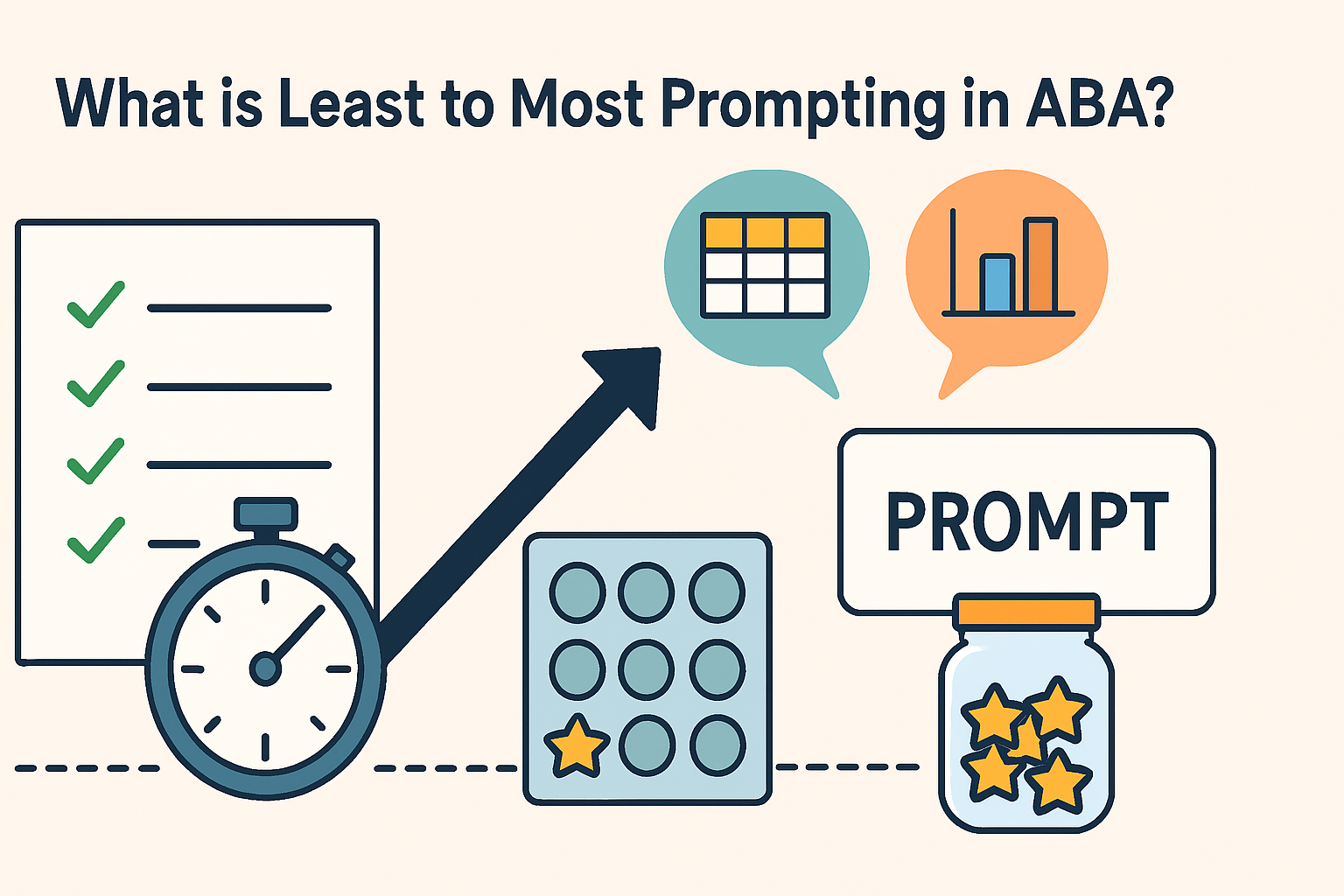
Least to most prompting is a systematic teaching procedure where you begin with the least intrusive prompt and gradually increase prompt intensity only if the learner doesn’t respond correctly. This approach minimizes prompt dependency while promoting independence through careful fading of supports.
Table of Contents
- What is Least to Most Prompting in ABA?
- Implementing Least to Most Prompting: Worked Examples
- Least to Most Prompting on the BCBA Exam
- A Quick-Reference Implementation Checklist
- Final Summary and Key Takeaways
The procedure operates within a response-prompt hierarchy that typically progresses from gestures to verbal cues, then modeling, and finally physical guidance when necessary.
Core Definition and Key Characteristics
This error-correction procedure starts with minimal assistance and systematically escalates support. The fundamental principle is to provide just enough help for success while avoiding unnecessary intrusiveness that could hinder skill acquisition.
- Begins with least intrusive: Start with gestures or indirect verbal cues
- Systematic escalation: Move to more direct prompts only after incorrect or no response
- Promotes independence: Encourages learners to respond with minimal assistance
- Error correction focus: Often used when learners have some existing skill knowledge
- Data-driven decisions: Prompt levels are adjusted based on learner performance data
Least-to-Most vs. Most-to-Least: Choosing the Right Strategy
Understanding when to use least-to-most prompting versus most-to-least prompting is crucial for effective intervention design. These two approaches serve different purposes based on learner skill levels and instructional goals.
- Least-to-most: Best for error correction or when learners have partial skill mastery
- Most-to-least: Ideal for teaching brand new skills to minimize initial errors
- Skill fluency: Least-to-most works well with learners who demonstrate some existing skill components
- Error minimization: Most-to-least prevents early errors that could become learned patterns
- Prompt fading: Both strategies include systematic fading, but starting points differ
Implementing Least to Most Prompting: Worked Examples
Practical application of least to most prompting requires careful analysis of learner needs and environmental factors. These examples demonstrate how the procedure works across different contexts and learner profiles.
Example 1: Teaching a Child to Hang a Backpack (Escape-Maintained)
Consider a scenario where a child needs to learn the routine of hanging their backpack. The discriminative stimulus is the verbal instruction, but the child’s behavior suggests escape motivation.
- Antecedent: SD ‘Hang up your backpack’ presented at classroom entry
- Behavior: Child stands still, looks away, shows no initiation
- Consequence: Implement least-to-most hierarchy starting with gesture toward hook
- Prompt escalation: If no response, provide verbal prompt ‘Put the loop on the hook’
- Final prompt: If still no response, use partial physical guidance to complete action
The hypothesized function of behavior is escape from task demands. Data collection would track which prompt level was needed, informing decisions about when to begin prompt fading procedures.
Example 2: Coaching a Staff Member on Data Collection (Access to Tangible-Maintained)
This adult learner example demonstrates ethical application with staff training. The supervisor uses least to most prompting to teach correct data entry procedures while respecting professional boundaries.
- Antecedent: Request to record frequency data during observation session
- Behavior: Staff member records data in incorrect column on datasheet
- Consequence: Supervisor implements prompt hierarchy starting with gesture to correct column
- Modeling prompt: If error persists, demonstrate correct entry with explanation
- Physical guidance: Only if necessary, use hand-over-hand to guide correct placement
The hypothesized function is access to supervisor attention or tangible help. Ethical considerations include obtaining consent for physical prompts with adult learners and ensuring procedures align with professional ethics guidelines.
Least to Most Prompting on the BCBA Exam
Exam questions about least to most prompting often test your ability to distinguish it from other procedures and select appropriate applications. Understanding common exam traps can significantly improve your performance.
Common Exam Traps and How to Avoid Them
Several predictable patterns appear in exam questions about prompting hierarchies. Recognizing these patterns helps you avoid common mistakes that could cost valuable points.
- Confusing procedures: Mistaking least-to-most for most-to-least or time delay procedures
- Skill level mismatch: Selecting least-to-most when scenario describes learner with zero prerequisite skills
- Error correction oversight: Forgetting that least-to-most can be used within a trial for immediate correction
- Hierarchy order errors: Misidentifying which prompt is least intrusive in given scenarios
- Function neglect: Failing to consider how behavioral function affects prompting effectiveness
Practice Application Prompts
Test your understanding with these exam-style scenarios. For each, consider whether least to most prompting would be appropriate and why.
- Scenario 1: A learner who can independently wash hands but sometimes misses the soap step. Is least-to-most appropriate?
- Scenario 2: Teaching a completely novel vocational skill to an adult with no prior exposure. Would you choose least-to-most?
- Scenario 3: A child who inconsistently follows two-step directions but knows all component steps. Which prompting strategy fits?
These scenarios test your ability to match prompting strategies to learner characteristics and skill levels, a key competency tested on the BCBA exam.
A Quick-Reference Implementation Checklist
Use this actionable checklist to implement least to most prompting effectively in practice and recall key steps for exam questions.
- Assess prerequisite skills: Ensure learner has some existing knowledge of target behavior
- Define prompt hierarchy: Establish clear sequence from least to most intrusive prompts
- Collect baseline data: Measure current performance level before intervention
- Implement systematically: Always start with least intrusive prompt in hierarchy
- Wait for response: Allow adequate time for learner to respond before escalating
- Record prompt level: Document which prompt was needed for each trial
- Analyze patterns: Look for trends in prompt requirements across sessions
- Begin prompt fading: Systematically reduce prompt intensity as skills improve
- Monitor independence: Track percentage of independent correct responses
- Adjust as needed: Modify hierarchy based on learner progress and data patterns
Final Summary and Key Takeaways
Least to most prompting represents a critical skill acquisition strategy that balances support with independence. When implemented correctly, it promotes skill mastery while minimizing prompt dependency through systematic fading procedures.
For exam success, remember that this procedure is best suited for error correction and learners with partial skill knowledge. Always contrast it with most-to-least prompting, which serves different instructional purposes. Practical application requires careful attention to ethical considerations, especially when using physical prompts with any learner population.
To deepen your understanding of related concepts, explore our guides on prompt dependency and errorless learning procedures. For authoritative information on ethical implementation standards, refer to the BACB Ethics Code.
Complete BCBA Exam Prep
Turn this topic into exam-day practice
Practice concepts in context with five full-length 6th Edition mock exams, two bonus practice exams, a 6th Edition study guide, and key-term flashcards—all in one $120 USD package.
Get the $120 All-in-One Prep Pack
Review everything included on the product page before ordering. No pass guarantee is implied.



