

BCBA FIELDWORK · 2027 REQUIREMENTS Non-billable hours as fieldwork hours ABA is a common BCBA-trainee question, but “billable” is not the BACB’s main test. Billing describes whether an employer or funder charges for time. Fieldwork asks whether the activity is behavior-analytic, properly supervised, related to the client or service context, documented, and categorized correctly as restricted or unrestricted under the applicable requirements.
Table of Contents
- Can Non-Billable Hours as Fieldwork Count?
- What Is the Difference Between Billable and Unrestricted?
- What Makes a Non-Billable Hour Countable?
- Which Non-Billable Activities May Qualify as Unrestricted?
- What Usually Should Not Be Counted Without Clear Supervision Rationale?
- What Changes Under the 2027 BCBA Requirements?
- How Should Non-Billable Fieldwork Hours Be Documented?
- What Questions Should a Trainee Ask the Supervisor?
- What Are the BCBA Exam Takeaways?
- Frequently Asked Questions
- Sources for Further Study
- Take the Free BCBA Mock Exam
Can Non-Billable Hours as Fieldwork Count?
Sometimes. The fact that an hour is not billed to insurance, a school, or another funder does not automatically disqualify it from BCBA fieldwork. Conversely, a billable hour does not automatically qualify. The activity must satisfy the current BACB fieldwork requirements and the supervision arrangement that governs the trainee.
The safest short answer is: classify the activity by what you actually did, not by whether someone billed for it. A non-billable functional assessment activity performed under an approved supervision contract may be very relevant to unrestricted fieldwork. A non-billable staff meeting about scheduling, payroll, or general office policy may not be behavior-analytic fieldwork. A billable direct-treatment hour may be restricted, and restricted hours are subject to the applicable limits.
Requirements change by certification pathway and application timing. This page uses the BACB’s current 2027 overview as a planning reference, but the BCBA Handbook, your supervisor, your fieldwork forms, and any transition guidance control a specific application.
What Is the Difference Between Billable and Unrestricted?
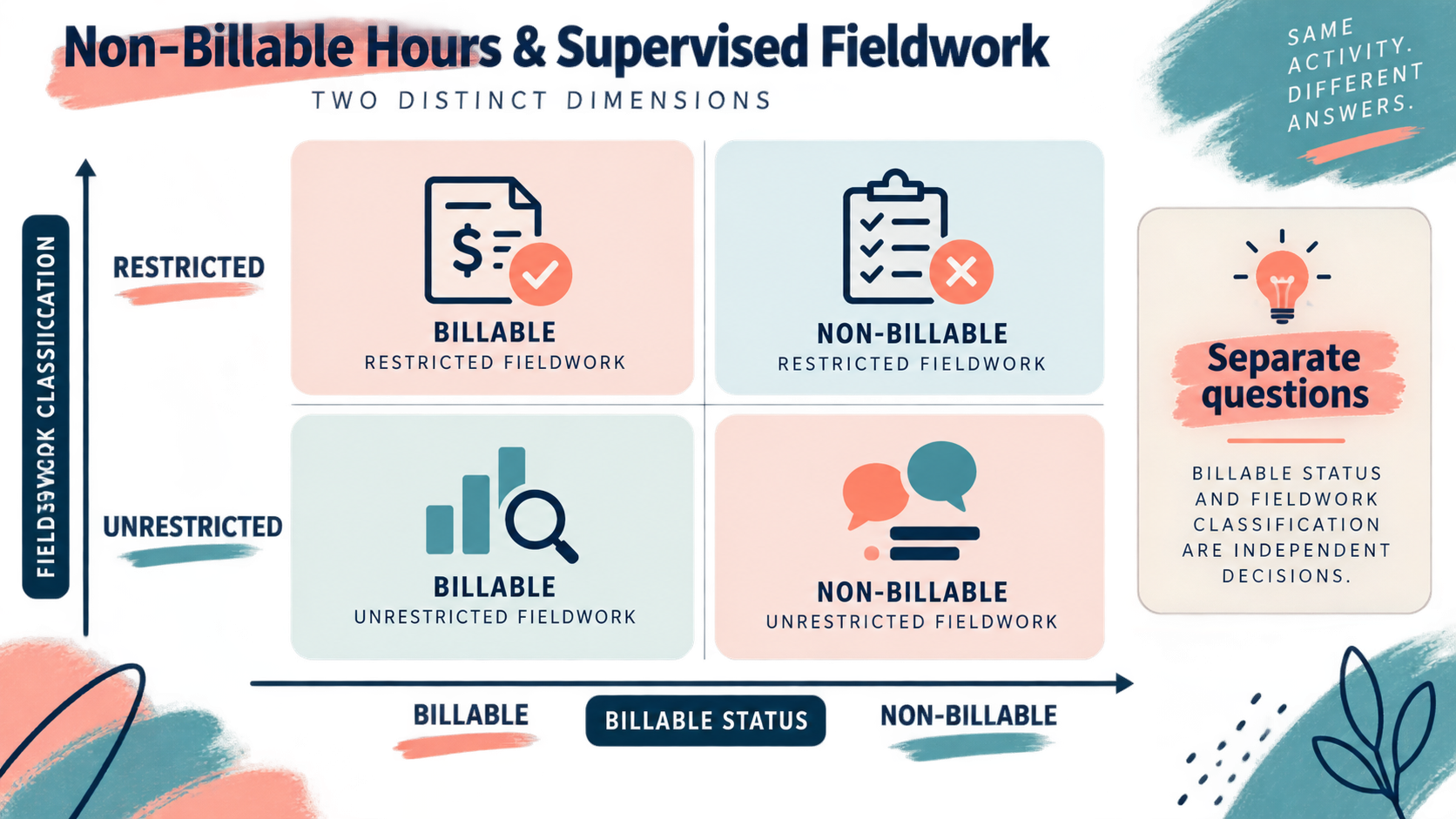
Think of the decision as two separate axes:
| Axis | What it describes | What it does not prove |
|---|---|---|
| Billable / non-billable | Whether an employer, payer, contract, or funding arrangement allows time to be charged | Whether the activity is unrestricted, supervised, or eligible fieldwork |
| Restricted / unrestricted | Whether the task is direct therapeutic/instructional delivery or better represents a behavior analyst’s work developing programs and systems | Whether your employer will pay for the time or a payer will reimburse it |
| Supervised fieldwork | Hours accrued under a qualified supervision arrangement and documented under the applicable rules | That every activity in the same work shift is countable |
For example, a trainee might spend an unpaid hour reviewing a client’s data to decide whether a functional assessment needs to be expanded. That hour could be relevant to unrestricted fieldwork if it meets the full requirements and is appropriately supervised. A different unpaid hour spent completing a mandatory corporate training about timekeeping may be important employment work but not a behavior-analytic fieldwork activity.
What Makes a Non-Billable Hour Countable?
Use a five-part screen before counting the hour:
- Behavior-analytic nature: the task uses or develops behavior-analytic assessment, measurement, intervention, supervision, consultation, or program design rather than general administration.
- Client or service relationship: the task is related to the client, service system, or behavior-analytic work covered by the fieldwork arrangement.
- Qualified supervision: the hour occurs under the applicable supervision contract and requirements, with the supervisor able to evaluate what happened.
- Correct category: the trainee and supervisor classify it as restricted or unrestricted based on the activity and context, not on a preferred percentage.
- Contemporaneous documentation: records identify the date, duration, activity, setting, supervisor, and information needed for the relevant monthly or final verification form.
If one of these answers is unclear, pause before adding the hour to a tracker. Ask the supervisor to review the activity and write a brief rationale. A later audit is easier to address when the record shows how the classification was made than when a spreadsheet contains only a total.
Which Non-Billable Activities May Qualify as Unrestricted?
Examples can include activities that resemble the work of a behavior analyst who assesses, develops, evaluates, and improves programs for others to implement. Depending on the setting and context, a supervisor may determine that the following are relevant:
- participating in or preparing for a functional behavior assessment;
- analyzing data to make a programming decision;
- writing or revising a behavior plan, skill-acquisition plan, or measurement system;
- conducting caregiver, staff, or stakeholder training tied to a client or service program;
- observing implementation and evaluating treatment integrity;
- designing materials or procedures that another person will use with a client;
- participating in case consultation or interdisciplinary coordination that is behavior-analytic in purpose;
- planning generalization, maintenance, social validity, or quality-of-life measures.
The same label can describe different activities. “Data collection” may be restricted when it is simply the direct delivery of a client’s treatment procedure, but it may be unrestricted when the trainee is collecting and analyzing information as part of a functional assessment or program-development decision. The context, purpose, and trainee’s role matter.
What Usually Should Not Be Counted Without Clear Supervision Rationale?
Be cautious with time that is mainly payroll, scheduling, commuting, general staff administration, cleaning, preparing personal study materials, waiting for a client, or completing a company requirement unrelated to behavior-analytic services. Some tasks may be necessary for an organization and still not be fieldwork. “My supervisor knew I was at work” is not the same as supervision of a qualifying activity.
Do not count time merely because it was unpaid, occurred after a session, or happened in a clinic. Do not count a meeting as supervised fieldwork if there was no applicable contract, qualified supervisor, relevant activity, or documentation. If the hour includes multiple tasks, separate the time blocks and classify each block rather than assigning the whole shift the most favorable category.
What Changes Under the 2027 BCBA Requirements?
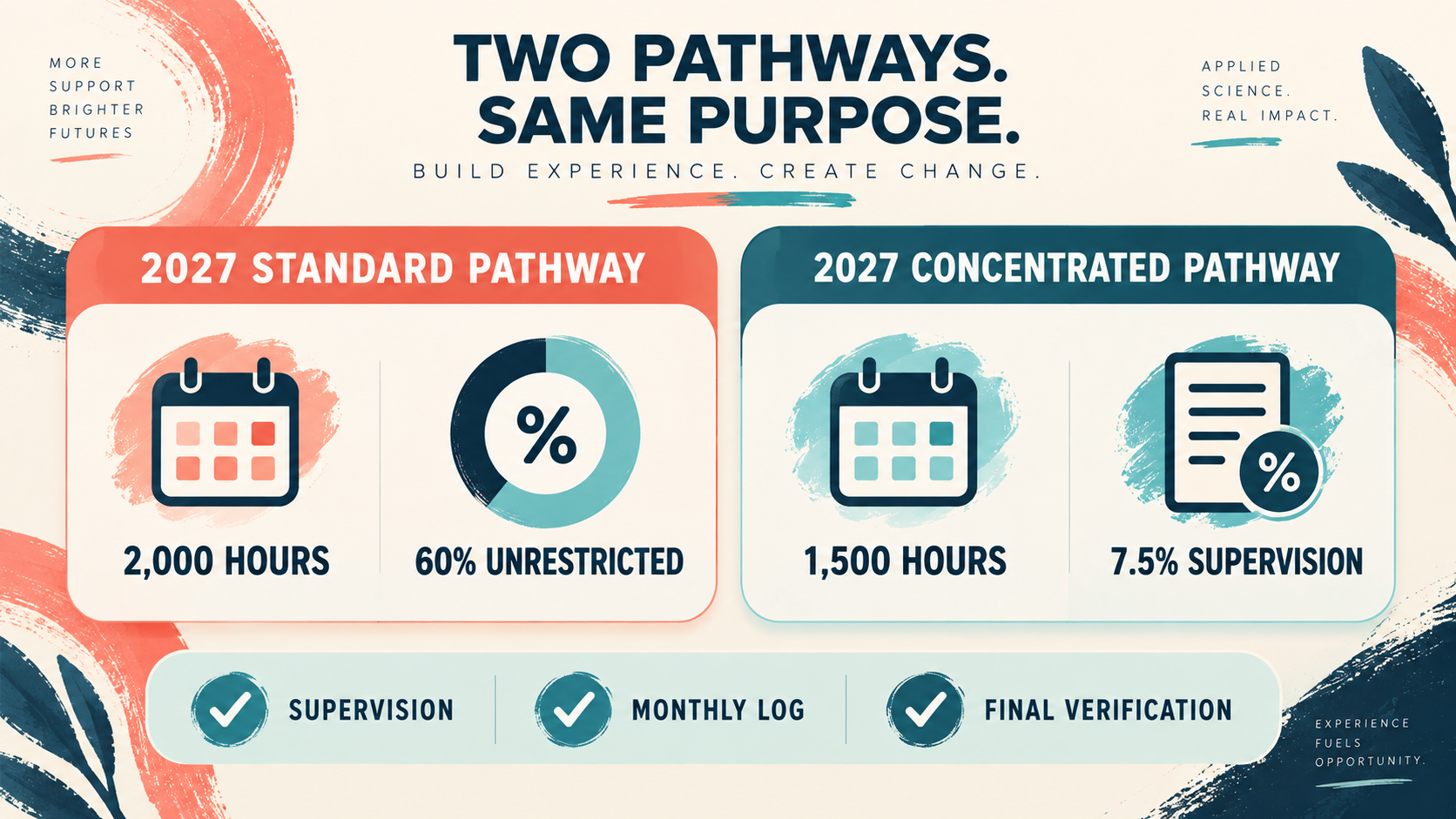
The BACB’s 2027 overview lists two supervised-fieldwork pathways. Standard supervised fieldwork requires 2,000 hours, with supervision at 5% of hours per supervisory period. Concentrated supervised fieldwork requires 1,500 hours, with supervision at 7.5%. The overview also lists a supervisory period minimum of 20 hours and maximum of 160 hours, cumulative client observations, at least 50% individual supervision, and at least 60% of total supervised fieldwork hours in unrestricted activities.
Those figures do not turn every non-billable task into unrestricted fieldwork. The 60% rule is a proportion of qualifying supervised fieldwork hours. It does not mean that 60% of everything you do at work can be counted. The activity still has to meet the definition and documentation requirements, and the applicable BCBA Handbook may provide additional details.
The 2027 transition also introduces new monthly and final fieldwork verification forms for people applying after January 1, 2027. If you are moving between requirements or are unsure which application route will apply, follow the BACB transition guidance and maintain records that allow your supervisor to complete the correct forms. Do not rely on an old spreadsheet column or a social-media summary of the change.
How Should Non-Billable Fieldwork Hours Be Documented?
A strong record answers what, when, where, with whom, under whose supervision, and why the activity belonged in the category selected. A useful entry might say: “September 27, 2026, 2:00–3:00 p.m.; reviewed ABC data with supervisor to identify patterns across settings and draft hypotheses for the FBA; discussed measurement limits and next probe; supervisor provided feedback in real time; classified as unrestricted pending supervisor verification.”
A weak entry might say “admin,” “programming,” or “non-billable work” without describing the behavior-analytic activity. The entry should never include unnecessary identifying information in a public or unsecured tool. Keep records according to the supervisor’s and organization’s privacy requirements.
Use one tracking system consistently. Reconcile the tracker with session notes, supervision notes, calendars, forms, and payroll records when relevant. The purpose is not to make billing and fieldwork identical; it is to make discrepancies visible before an application or audit.
What Questions Should a Trainee Ask the Supervisor?
- Is this activity behavior-analytic in nature, and what is the clinical or program purpose?
- Does it represent restricted or unrestricted work in this specific context?
- Is it covered by my current supervision contract and the correct application pathway?
- What evidence should I keep to show what I did and what feedback I received?
- How does this hour affect my unrestricted percentage and monthly limits?
- Which 2022 or 2027 form will apply to my eventual application?
A supervisor should be able to explain a classification without promising that every hour will be accepted by the BACB. The final eligibility decision belongs to the BACB. When the answer is uncertain, conservative documentation and timely clarification are safer than quietly inflating a total.
What Are the BCBA Exam Takeaways?
For an exam question about non-billable hours as fieldwork hours ABA, avoid choosing an answer based only on whether the time was paid or billed. Look for the option that asks about the activity’s behavior-analytic nature, restricted or unrestricted classification, qualified supervision, connection to the client or service, and documentation.
- Billable and non-billable describe funding or payroll; restricted and unrestricted describe the fieldwork activity.
- Non-billable time can be relevant, but it is not automatically countable.
- Direct implementation is commonly restricted; assessment, analysis, program development, training, and evaluation may be unrestricted when the context supports that classification.
- Under the 2027 overview, at least 60% of qualifying supervised fieldwork hours must be unrestricted.
- Supervision and documentation are part of the eligibility system, not optional paperwork after the hours are finished.
For additional scenario practice, the site’s free BCBA mock exam is an independent study tool. It is not official BACB content and does not guarantee a certification result.
Frequently Asked Questions
Can an unpaid hour count as BCBA fieldwork?: It can, but unpaid status is not the deciding criterion. The activity must satisfy the applicable fieldwork, supervision, classification, documentation, and contract requirements. Can billable direct therapy count?: It may be restricted fieldwork if it meets the applicable definition and limits, but billable status alone does not establish eligibility. Ask the supervisor to classify the activity and track it against the correct pathway.
Does every non-billable BCBA task count as unrestricted?: No. Administrative, payroll, scheduling, commuting, waiting, and general employment tasks are not automatically unrestricted. The activity must represent relevant behavior-analytic work and be properly supervised and documented.
Sources for Further Study
- BACB 2027 BCBA Requirements — official overview of hours, supervision, unrestricted activities, forms, and pathways.
- BACB FAQs About Supervised Fieldwork Requirements — official restricted/unrestricted and supervision clarifications.
- Documenting Fieldwork: Helpful Answers to Your FAQs — current documentation examples and 2027 form context.
- BCBA Handbook — current handbook reference for eligibility and fieldwork requirements.
For targeted review, use our non-billable hours as fieldwork practice questions to apply the concept in exam-style scenarios.
Take the Free BCBA Mock Exam
If you want a low-pressure way to check your recall, use the free practice resource below. Take the Free BCBA Mock Exam



