
BCBA STUDY GUIDE · ETHICS & QUALITY Neurodiversity-friendly ABA means designing behavior-analytic support around dignity, autonomy, communication, meaningful goals, and the lived experience of the neurodivergent person. It does not mean removing measurement or abandoning skill teaching. It means asking a better question: is the behavior change useful and wanted, and does the way we pursue it expand the person’s choices rather than simply make them look more typical?
Table of Contents
- What Does Neurodiversity-Friendly ABA Mean?
- How Should Goals Be Selected?
- What Do Assent and Autonomy Look Like in Practice?
- Which Behaviors Should Be Targeted?
- How Can Data Stay Respectful and Useful?
- How Can the Environment Change Before the Person Does?
- How Should the Team Collaborate?
- What Mistakes Undermine a Neurodiversity-Friendly Approach?
- What Are the BCBA Exam Takeaways for Neurodiversity-Friendly ABA?
- Frequently Asked Questions
- Sources for Further Study
- Take the Free BCBA Mock Exam
What Does Neurodiversity-Friendly ABA Mean?
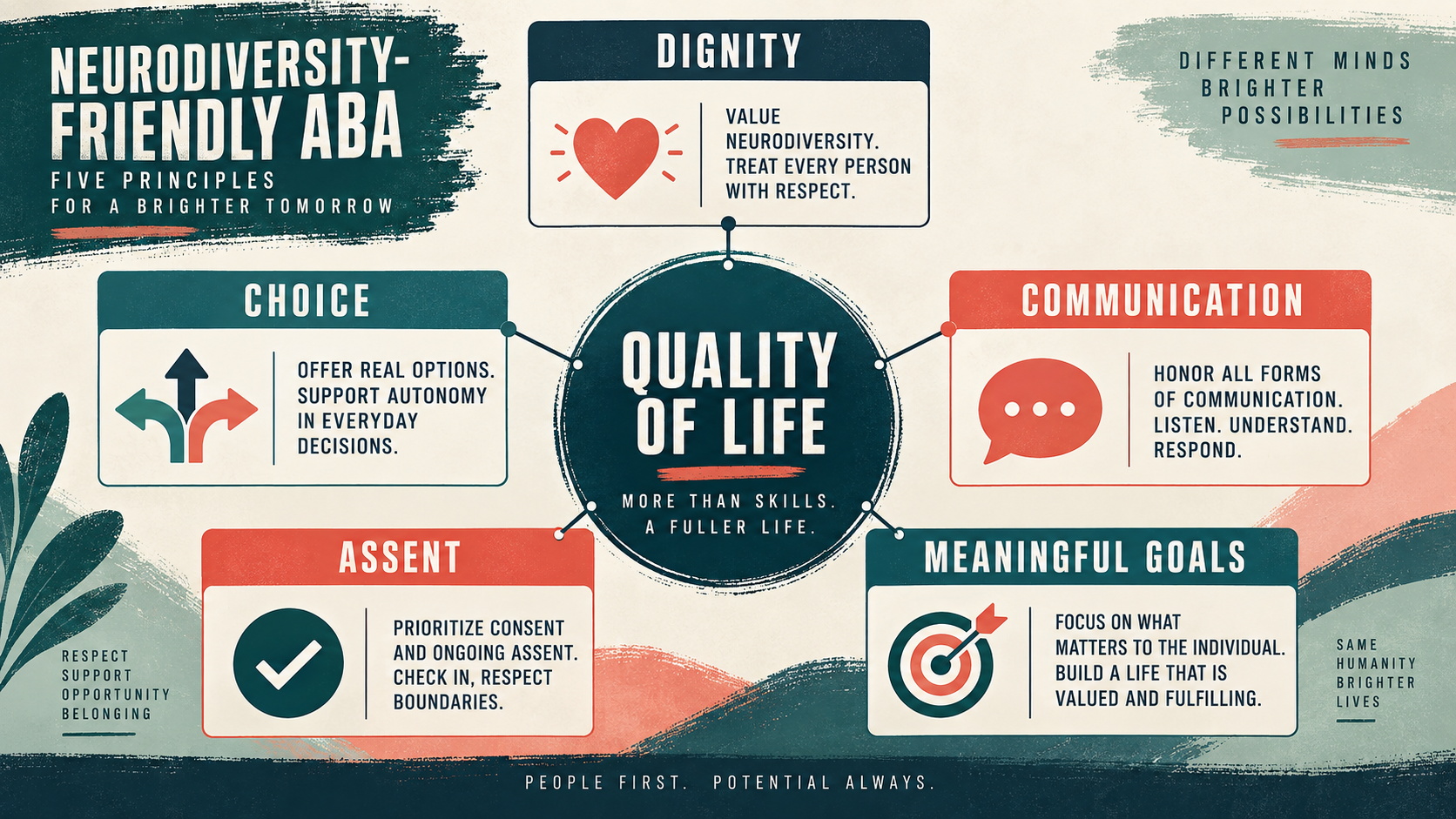
Neurodiversity is a way of recognizing that people’s brains and nervous systems vary. A neurodiversity-friendly ABA approach does not treat difference itself as a defect that must be erased. Instead, it uses behavior analysis to understand what a person is communicating, identify barriers in the environment, teach useful skills, and support self-determination.
The phrase is not a single BACB certification, formal treatment package, or guarantee that every person will experience a service as affirming. It is a practice orientation. The 2024 paper Affirming Neurodiversity within Applied Behavior Analysis argues that providers should listen seriously to autistic people and collaborate with the people most affected by services. A related practice paper describes neurodiversity-affirming behavior analysis through rights, dignity, self-advocacy, client choice, autonomy, and quality of life.
That orientation can still use operational definitions, direct measurement, functional assessment, prompting, reinforcement, shaping, and generalization. The difference is what those tools are for and how decisions are made. Measurement is used to evaluate meaningful support—not to force every person toward a narrow appearance of normality.
How Should Goals Be Selected?
Start with the person’s needs, preferences, communication, safety, relationships, and daily environments. A goal is stronger when the learner or the people who know them can explain why the skill would make life more accessible. “Makes the learner look less autistic” is not a sufficient social-validity rationale. “Helps the learner request a break, navigate a medical appointment, participate in a preferred activity, or communicate a boundary” is more concrete and more connected to autonomy. Goal selection should also look beyond the adult’s convenience. The team can ask:
- Does this target increase access to communication, safety, learning, relationships, or self-care?
- Can the person reject, modify, or pause the activity in an accessible way?
- Is the target needed in the person’s real environment, or only in a therapy setting?
- Would an environmental change solve the problem better than changing the person?
- Could the goal unintentionally reward masking, suppression of regulation, or compliance with unsafe requests?
- How will the team know whether the change improves quality of life?
Goals can address communication, independent choice, coping, self-advocacy, adaptive skills, access to education, employment, community participation, or reduction of behavior that causes injury. The same behavior may have different meanings in different contexts, so assessment and collaboration matter before a target is written.
What Do Assent and Autonomy Look Like in Practice?
Consent and assent are not a single sentence at the beginning of treatment. They are ongoing processes. A person may communicate agreement, uncertainty, refusal, a request for a break, or a preference for a different way of participating through speech, sign, AAC, gestures, movement, facial expression, behavior change, or other signals. The team should know how those signals will be interpreted and what action follows.
Assent-based practice does not mean that a provider stops teaching whenever a learner dislikes a difficult task. It means the provider does not treat distress or refusal as an obstacle to overpower. The team investigates the task, antecedents, communication access, sensory environment, medical variables, response effort, reinforcement, and the possibility that the goal itself is not meaningful. It then adapts the arrangement, offers choices, teaches an accessible refusal or break response, and escalates safety concerns appropriately.
Autonomy is also visible in small decisions: choosing materials, choosing the order of tasks, selecting a communication mode, declining touch, using a regulation strategy, deciding whether to return to an activity, or expressing a different preference. These choices can be measured as meaningful outcomes without turning every choice into a compliance trial.
Which Behaviors Should Be Targeted?
A neurodiversity-friendly approach does not use a simple rule that every repetitive movement is harmless or that every challenging behavior should be ignored. It asks what the behavior does for the person and what risk or barrier is present. A movement may support sensory regulation, joy, communication, or attention. Another behavior may cause injury, block access to food or medication, or make it impossible to communicate a need. Context determines the clinical question.
When behavior is dangerous or severely limits participation, the goal should usually be more than “make it stop.” A functional assessment can identify relevant antecedents and consequences. The plan can teach a functionally equivalent communication response, change the environment, reduce unnecessary demands, provide predictable access to breaks, teach coping or self-management, and address medical or sensory needs with the appropriate professionals. Safety planning should not be used as a cover for unnecessary control.
Target reduction should be paired with replacement and access goals. If a person’s hand-flapping is not harmful and helps them regulate, reducing it merely because it looks unusual may have a different ethical profile than reducing head-hitting while teaching a safer way to request help. The team should document the rationale, listen to the person, measure outcomes that matter, and review whether the intervention is creating new costs such as exhaustion, anxiety, or avoidance.
How Can Data Stay Respectful and Useful?
| Data question | A narrow approach may ask | A neurodiversity-friendly approach also asks |
|---|---|---|
| Did the behavior change? | Did frequency or duration move toward the adult’s target? | Did communication, safety, choice, participation, or quality of life improve? |
| Was the skill acquired? | Can the person perform it under the teaching cue? | Can the person use it independently, flexibly, and in the settings where it matters? |
| Was treatment effective? | Did the graph improve? | What were the learner’s costs, preferences, assent signals, and lived experience? |
| Should the plan continue? | Has the target reached the adult-defined criterion? | Is the plan still needed, respectful, efficient, and aligned with the person’s goals? |
Data do not become less scientific when the team measures quality-of-life outcomes. They become more complete. Depending on the goal, the team might measure independent communication, successful breaks, participation chosen by the learner, generalization, maintenance, injury risk, sleep or fatigue patterns, caregiver burden, and the person’s own rating of comfort or usefulness. Not every variable can be reduced to one number, but the team can still define what it will observe and how it will use the information.
How Can the Environment Change Before the Person Does?
Behavior analysis can examine environmental barriers instead of placing the entire burden on the learner. The team might adjust lighting, noise, task length, wait time, communication access, visual information, transitions, materials, seating, reinforcement options, or the way instructions are delivered. It might teach communication partners to honor a break request instead of requiring escalation before help is available.
This is not a rejection of skill acquisition. Environmental supports and skill teaching often work together. A person may learn to request clarification while the team also makes instructions more accessible. A learner may practice a coping response while the team reduces avoidable overload. A goal should not be considered successful if the person can perform it only in an artificial setting that disappears in daily life.
How Should the Team Collaborate?
Neurodiversity-friendly ABA is not something a BCBA can declare about a program without listening to the person receiving it. Collaboration may include the learner, family or chosen supporters, RBT, BCBA, speech-language pathologist, occupational therapist, teacher, physician, or other professionals, depending on the situation. Each person brings different information, and the learner’s communication and preferences should not be treated as less authoritative because they are expressed nonverbally.
The team should name disagreements instead of hiding them in vague language. A caregiver may prioritize dressing independence; the learner may prioritize privacy and choosing clothing. A teacher may prioritize classroom participation; the learner may need reduced sensory load before participation is realistic. The BCBA can help define the behavior and evaluate the intervention, but should not use behavior-analytic authority to erase a person’s values or another professional’s scope.
Ethical documentation should make the rationale visible: what the person wants or needs, what was assessed, what choices were offered, how assent or dissent was monitored, what outcomes were measured, what risks were considered, and when the plan will be reviewed. The BACB Ethics Code’s principles of benefit, compassion, dignity, respect, integrity, and competence provide an important professional reference.
What Mistakes Undermine a Neurodiversity-Friendly Approach?
- Changing the label but not the goal: calling a compliance target “self-regulation” does not make it autonomy-supportive.
- Equating eye contact or stillness with engagement: measure attending and participation in ways that do not require a particular autistic presentation.
- Ignoring distress data: a flat behavior graph does not prove that a plan is harmless or effective.
- Using assent as a one-time form: keep monitoring assent and dissent during the service.
- Treating self-advocacy as problem behavior: first ask whether the person is communicating a boundary or unmet need.
- Promising that all ABA is affirming: describe the actual goals, procedures, safeguards, and review process.
What Are the BCBA Exam Takeaways for Neurodiversity-Friendly ABA?
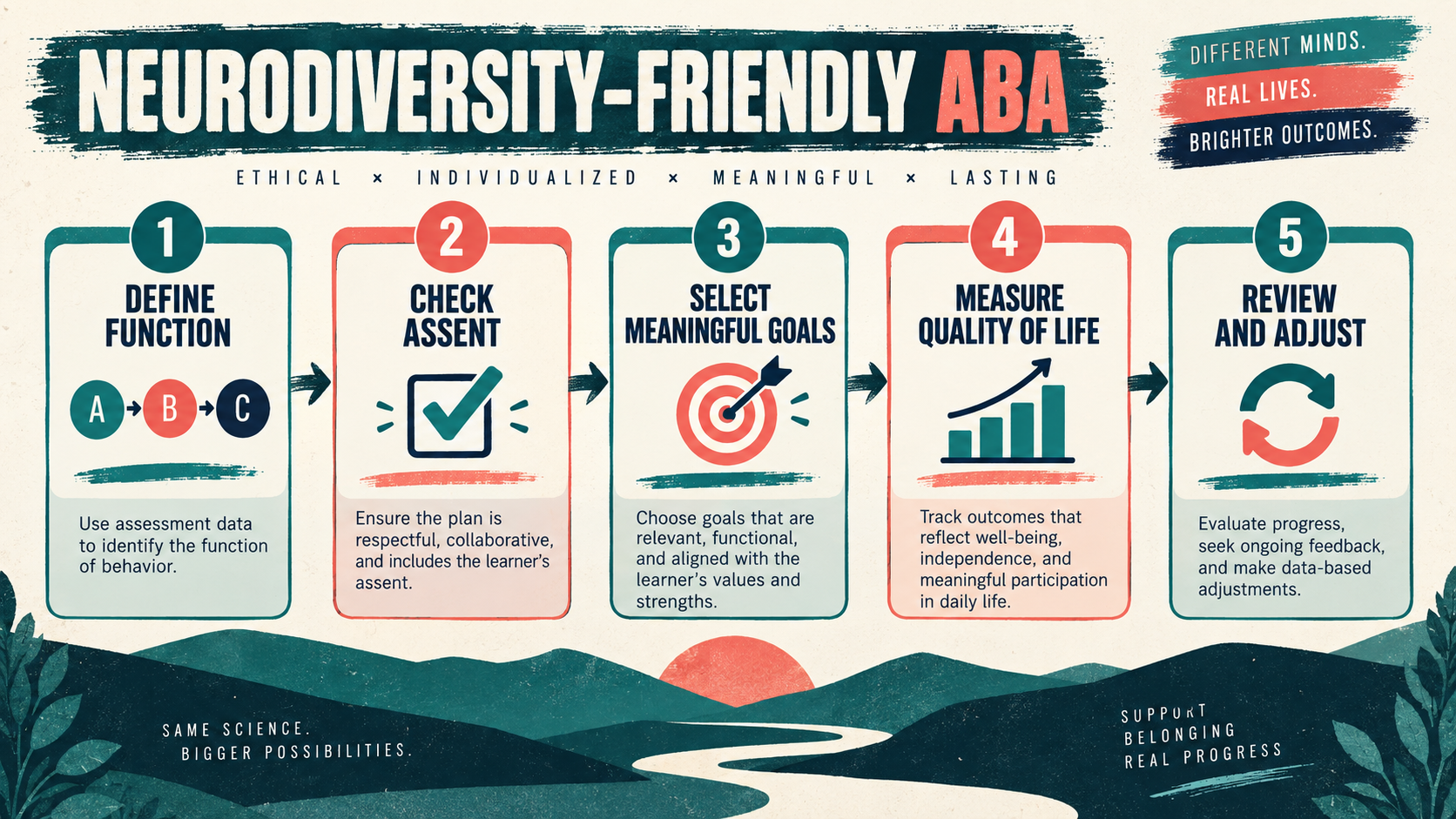
For BCBA exam questions that involve ethics, social validity, assent, treatment selection, or autism support, look for the answer that integrates behavior-analytic rigor with the client’s rights and meaningful outcomes:
- define the target and function without assuming that difference is pathology;
- select goals that improve access, communication, safety, independence, participation, or quality of life;
- include the learner’s preferences, assent, dissent, and self-advocacy in decisions;
- consider environmental change and accommodations, not only behavior change;
- measure both skill outcomes and relevant costs or quality-of-life effects;
- collaborate within competence and coordinate with other professionals when needed;
- review the plan when data, distress, or stakeholder feedback show that the fit is poor.
The site’s free BCBA mock exam can provide additional scenario practice. It is an independent study resource, not official BACB content and not a guarantee of a certification result.
Frequently Asked Questions
Is neurodiversity-friendly ABA still ABA?: It can use behavior-analytic assessment, measurement, reinforcement, prompting, shaping, and generalization while changing the goals, safeguards, and decision process. The label alone is not enough; evaluate the actual target, procedure, consent or assent process, and outcomes.
Does neurodiversity-friendly ABA mean never reducing a behavior?: No. The team may need to reduce behavior that causes injury or severely restricts access to communication and daily life. The ethical question is why the behavior is targeted, what it communicates, what replacement and environmental supports are provided, and whether the intervention respects the person’s autonomy and quality of life.
What should a learner do if a goal feels wrong?: Communicate the concern in the most accessible way available and ask the team to review the goal, the rationale, the data, and the assent process. A learner’s refusal, distress, or request for a different approach is information that should be taken seriously, not automatically treated as noncompliance.
Sources for Further Study
- Affirming Neurodiversity within Applied Behavior Analysis — peer-reviewed discussion of listening to autistic stakeholders and improving ABA practice.
- Neurodiversity-Affirming Applied Behavior Analysis — practice framework focused on dignity, self-advocacy, choice, autonomy, and quality of life.
- Upholding Anti-ableism in Applied Behavior Analysis — strengths-based considerations for goals and direct service.
- BACB Ethics Codes — current official ethics-code landing page.
Take the Free BCBA Mock Exam
If you want a low-pressure way to check your recall, use the free practice resource below. Take the Free BCBA Mock Exam



