

A practical BCBA guide to multiple exemplar training: vary the right conditions, test new examples, and let data—not guesswork—define generalization. If you are searching for multiple exemplar training in ABA, the short answer is this: multiple exemplar training ABA teaches the same functional skill across a planned range of examples, people, materials, or settings so the learner is more likely to respond under new conditions. The goal is not to make instruction random. The goal is to expose the learner to the dimensions that matter, while keeping the target response and reinforcement clear.
Table of Contents
- What Does Multiple Exemplar Training ABA Mean?
- A Five-Step Multiple Exemplar Training Procedure
- Worked Examples of MET in ABA
- What MET Is—and Is Not
- The Generalization Probe and Data Rule
- Common Mistakes and BCBA Exam Traps
- Frequently Asked Questions
- Quick Review Checklist
- Take the Free BCBA Mock Exam
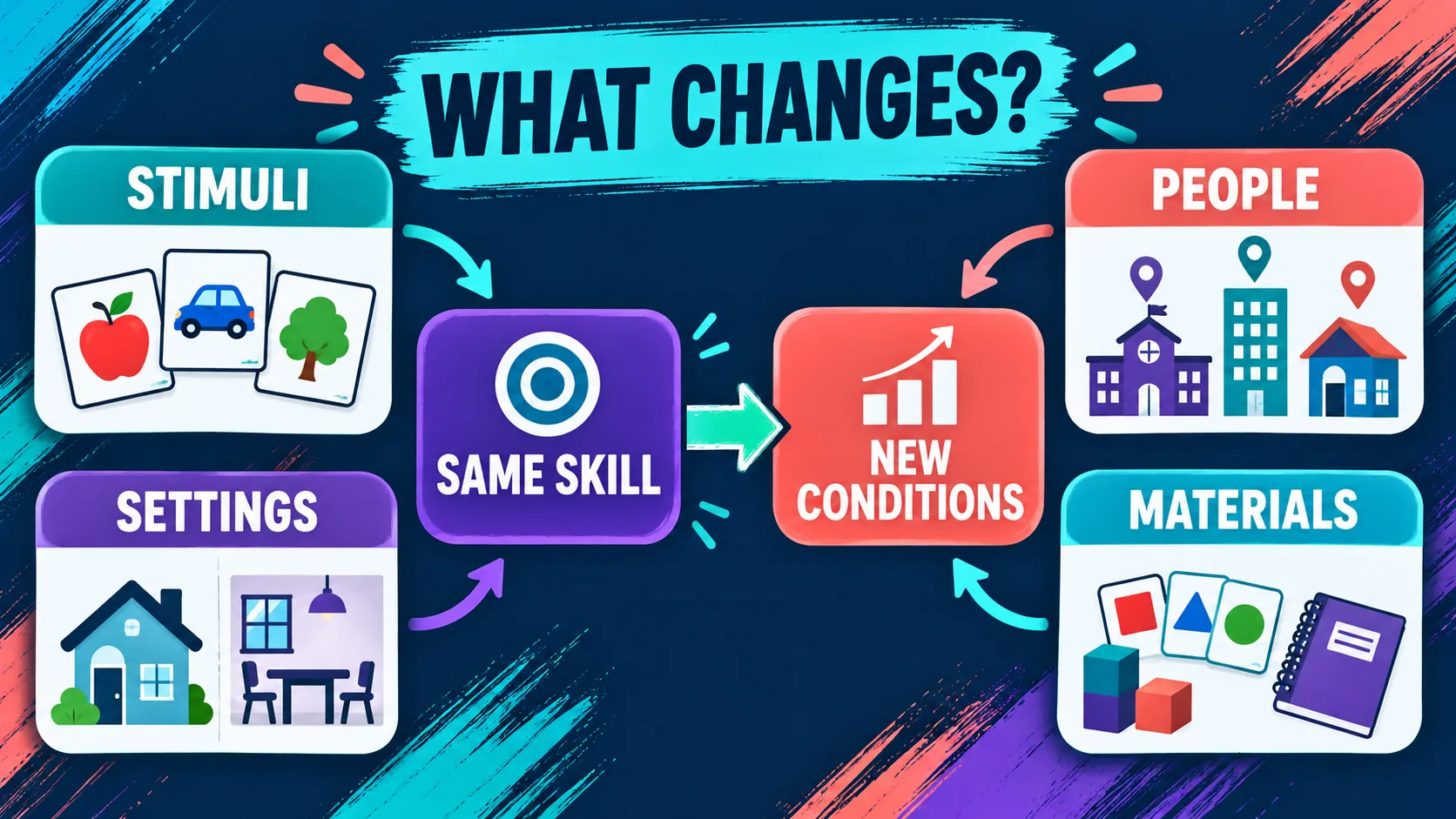
For example, teaching a learner to request help from one therapist with one picture card may produce a narrow skill. Multiple exemplar training (MET) would deliberately vary the communication partner, materials, wording, and natural opportunities while measuring whether the learner still requests help. If the skill only occurs in the original room, “mastery” has not yet demonstrated useful generalization.
Quick answer: MET is a planned generalization procedure. Define the target, identify the relevant variation dimensions, teach across representative exemplars, probe an untrained condition, and adjust the plan from data. It is different from simply drilling one example or adding random variety without a measurement rule.
What Does Multiple Exemplar Training ABA Mean?
An exemplar is a particular example of a stimulus, response, person, material, or situation involved in a skill. Multiple exemplar training deliberately teaches with more than one example so the learner contacts relevant similarities and differences. A skill can then come under the control of the important features of the situation instead of an accidental feature such as one therapist’s voice, one worksheet, or one room.
MET is closely related to programming for stimulus and response generalization. Stimulus generalization means the same response occurs with different but relevant stimuli. Response generalization means different responses in the same functional class occur. The procedure should match the problem. If the learner says “help” only to one adult, vary the people and settings. If the learner uses only one acceptable request form, teach and reinforce several functional response forms when that is appropriate. The BCBA Test Content Outline includes stimulus and response generalization and processes that promote emergent or generative performance. The exam may test the controlling variables rather than use the phrase “multiple exemplars” directly.
| Question | What to identify | Example |
|---|---|---|
| What is the skill? | The observable response class and its function. | Requesting a break appropriately. |
| What should vary? | The dimensions likely to change in the natural environment. | People, rooms, task materials, and wording. |
| What must stay clear? | The relevant antecedent, response definition, and consequence. | A break request contacts a brief, planned break. |
A Five-Step Multiple Exemplar Training Procedure
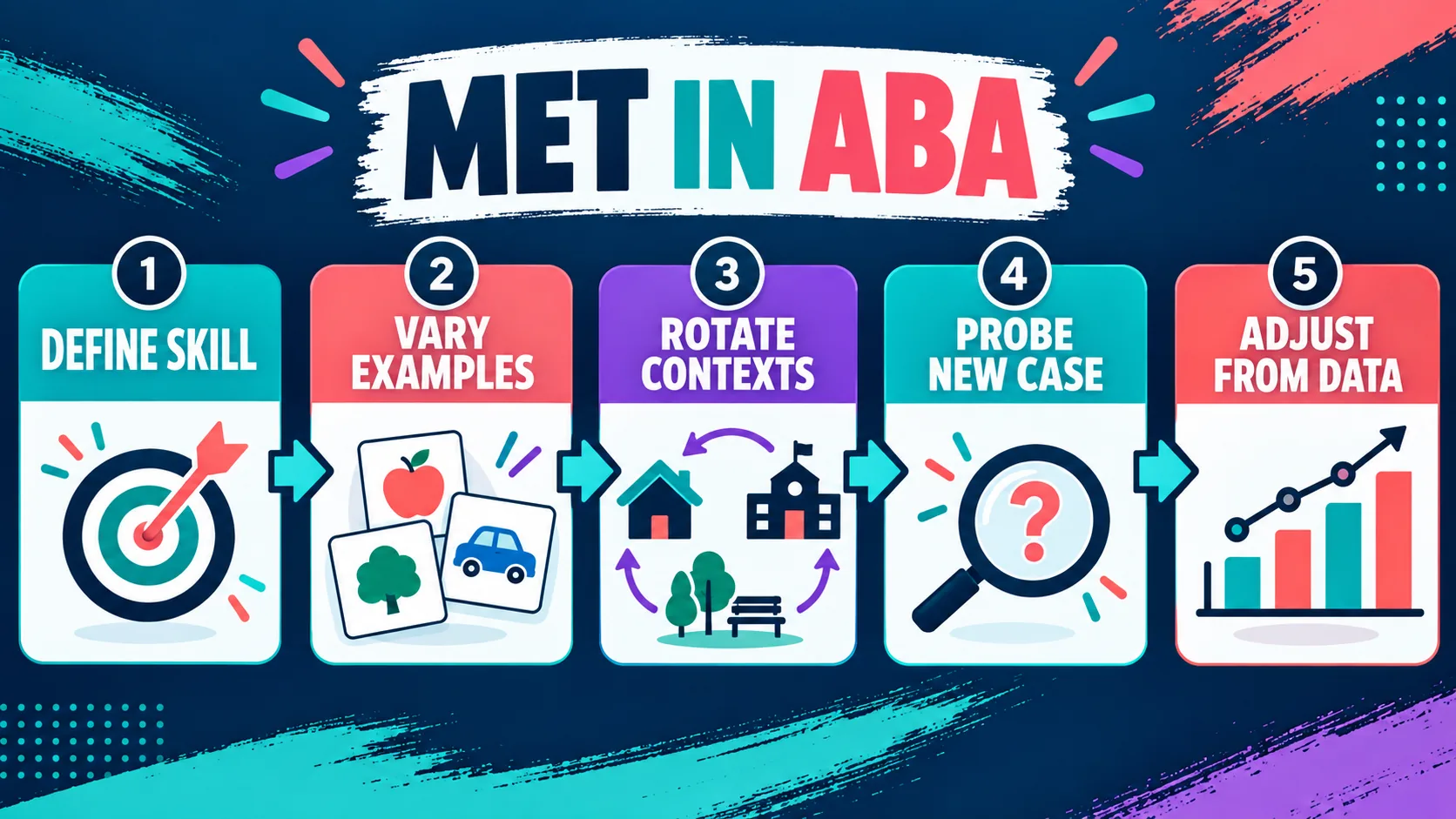
Use the following procedure as a planning framework. It is not a fixed protocol or a promise that a certain number of examples will work for every learner. The supervisor should adapt the plan to the learner, target, setting, safety needs, and available data.
- Define the functional target. Write what the learner will do, when the response is available, what counts as independent, and what consequence maintains it. “Generalize communication” is too broad; “hands over the break card or says ‘break’ within five seconds of a difficult task” is more measurable.
- Map the variation dimensions. List what can change in the natural environment: people, locations, materials, task examples, wording, distance, time of day, or response form. Separate relevant dimensions from distracting changes. Varying everything at once can make it difficult to identify why performance changed.
- Select representative exemplars. Choose examples that sample the range the learner is likely to encounter. Include easy and harder examples, common and less familiar materials, and more than one partner when those differences matter. The set should be purposeful, not merely large.
- Teach and rotate. Arrange instruction so examples are mixed or rotated according to the teaching plan. Deliver prompts and reinforcement consistently, then fade prompts so the natural cue—not the trainer’s prompt—controls the response. Record performance by exemplar or condition.
- Probe an untrained condition and adjust. Present at least one meaningful new combination without immediately teaching it. Measure independent responding, errors, prompt level, latency, or other dimensions that matter. If generalization is weak, analyze which dimension was missing and add targeted exemplars rather than simply repeating the original drill.
A strong MET plan makes its variation visible. If a learner practices “sort by color” with three cards but every card has the same shape, size, table, and instructor, the plan may not sample the stimulus dimensions that occur outside therapy. On the other hand, if the target is color discrimination, changing color while keeping the relevant teaching arrangement clear is more important than changing the room just for variety.
Worked Examples of MET in ABA
Communication example. A learner is taught to request a preferred item using speech, a sign, or an AAC selection. The team rotates items, partners, rooms, and routines while recording response form, independence, prompt level, and the consequence. A new partner and item then test whether the response class transfers. Social-skill example. For sharing, the team varies materials, partners, game rules, and locations while keeping the response definition observable. The goal is representative practice, not forcing every possible situation.
Academic example. For identifying a main idea, the team varies topic, text format, question wording, and instructor while tracking independent accuracy. If errors appear only when wording changes, add wording exemplars rather than simply adding more topics.
These examples show why MET is not just “more practice.” The plan asks which features should vary, which features should remain stable enough to support learning, and how the team will decide whether the response generalized.
What MET Is—and Is Not
Several ABA terms sit close together. On the BCBA exam, the best answer usually depends on the exact learning history and what changed in the vignette.
| Approach | Core idea | Key distinction |
|---|---|---|
| Multiple exemplar training | Teach across a planned set of varied examples. | Variation is intentionally selected and measured. |
| Train sufficient exemplars | Continue adding or teaching examples until generalization is demonstrated. | Emphasizes the data-based stopping decision; it is related to, but not identical with, MET. |
| Training loosely | Vary noncritical features of instruction rather than delivering every trial identically. | Variation is less tightly scripted; it still should not obscure the target or risk. |
| Drilling one example | Repeated practice with the same or nearly identical example. | May build narrow fluency but does not by itself demonstrate generalization. |
The Generalization Probe and Data Rule
A probe is the decision point in a MET plan. Without it, correct training performance may be mistaken for transfer. Probe conditions should be meaningful and safe, use the operational definition, and avoid unnecessary prompts that hide natural stimulus control.
Match measurement to the target: record independence and prompts for requests, opportunities with new partners or settings for social responses, and correct responses across new materials for academic skills. Add latency, errors, or maintenance when they matter.
| Probe result | What it may mean | Next question |
|---|---|---|
| Independent in new conditions | The selected exemplars may have sampled the relevant range. | Does the skill maintain over time and contact natural reinforcement? |
| Correct only with prompts | Stimulus control may still be tied to the prompt or trained context. | Which prompt-fading or natural-cue procedure is needed? |
| Errors in one dimension | The exemplar set may not include that relevant variation. | Add targeted exemplars, then probe again. |
Do not set a universal rule such as “five examples always produce generalization.” The quality and relation among exemplars, learner history, response class, and natural contingencies all matter.
Common Mistakes and BCBA Exam Traps
- Confusing variety with random instruction. Change relevant dimensions deliberately and keep the target response and consequence understandable.
- Changing too many variables at once. If a learner fails, the team may not know whether the problem was a new person, material, location, instruction, or response requirement.
- Calling acquisition mastery generalization. Correct responding in the training arrangement is not evidence that the skill occurs in a new condition.
- Using prompts in every probe. Prompts can be necessary for safety, but the data must show whether the natural cue controls independent responding.
- Ignoring function and social validity. A response should matter in the learner’s life and contact consequences that can realistically maintain it.
- Choosing the wrong generalization label. Ask whether the stimulus changed, the response form changed, the skill persisted over time, or a novel response emerged from an existing repertoire.
For last-minute study, remember the sequence: define the skill, vary meaningful exemplars, rotate instruction, probe a new condition, and change the plan from data. Then explain why the procedure fits the learner and the target instead of choosing a term by keyword alone.
Frequently Asked Questions
What is multiple exemplar training in ABA?: It is a planned teaching strategy in which the learner practices a functional skill across varied examples, such as different people, materials, settings, stimuli, or response forms. The goal is to promote responding under relevant new conditions.
How is MET different from training sufficient exemplars?: MET describes the planned use of multiple examples. Training sufficient exemplars emphasizes continuing or adjusting instruction until data show that generalization has occurred. They can be used together, but they answer different planning questions.
Does multiple exemplar training guarantee generalization?: No. It increases the opportunity for relevant stimulus control and transfer, but the team must probe the actual conditions that matter. Poorly selected examples, missing natural consequences, prompt dependency, or an overly complex response class can still limit generalization.
Is MET on the BCBA exam?: The current BACB content outline includes stimulus and response generalization and processes that promote emergent or generative performance. Exam questions may test the reasoning behind MET without using the exact phrase, so study the conditions, data, and distinctions among related procedures.
Want to practice the kind of “which procedure is best?” reasoning used in BCBA preparation? Try the Free BCBA Mock Exam, then review why each distractor fails. It is a study resource, not a guarantee of certification, licensure, employment, or exam success.
Sources to recheck: the BACB task-list hub, the BCBA Test Content Outline (6th ed.), the peer-reviewed review Multiple Exemplar Training: Some Strengths and Limitations, and the applied study Using Multiple-Exemplar Training to Teach a Generalized Repertoire. Clinical programming should be individualized and supervised. For targeted review, use our multiple exemplar training aba practice questions to apply the concept in exam-style scenarios.
Quick Review Checklist
Use this final checklist to turn multiple exemplar training aba into exam-ready reasoning. The goal is not to memorize a label in isolation; it is to identify the relevant evidence and explain why the best answer fits the scenario. Key ideas to review:
- State the central definition or decision point for multiple exemplar training aba in your own words.
- Identify the detail that makes multiple exemplar training aba different from its closest related ABA term.
- Separate the observable facts in a scenario from assumptions that are not supported by the facts.
- Write one example and one nonexample so you can recognize the concept in a new setting.
Exam application checks:
- Ask what the question is actually requesting before comparing the answer choices.
- Mark the antecedent, response, consequence, or other evidence that supports the selected answer.
- Look for a distractor that describes a related process but does not answer the specific question.
Final self-check:
- Explain how you would verify the interpretation with clear observations or data.
- Change one detail in the scenario and decide whether your answer should change.
- Give a one-sentence rationale that a supervisor or study partner could evaluate.
Take the Free BCBA Mock Exam
When you are ready to apply the idea, use the free practice resource below for additional feedback. Take the Free BCBA Mock Exam



