
A practical guide to age-specific ABA goal examples for families and BCBA students—without turning a child’s age into a one-size-fits-all prescription. If you are searching for ABA goals for 3 year old children, the most important answer is that there is no universal checklist every three-year-old should receive. A useful ABA goal connects a meaningful routine to an observable response, a clear measurement system, and a review plan. Age can provide context, but it should not replace assessment, family priorities, learner voice, or clinical judgment.
Table of Contents
- ABA Goals for 3 Year Old: What Should They Do?
- What Makes an ABA Goal Appropriate?
- ABA Goal Examples by Skill Area
- Define, Observe, and Review
- Family Plan-Review Questions
- BCBA Reasoning Connection
- Frequently Asked Questions
- Quick Review Checklist
- Take the Free BCBA Mock Exam
A three-year-old may be working on communication, play, daily living, safety, or participation. Another child the same age may have different strengths, access needs, preferences, and priorities. The goal is not to make a child look “typical.” The goal is to support meaningful access, independence, communication, relationships, and quality of life while respecting assent and dignity.
Quick answer: Strong goals for a three-year-old are individualized, functional, observable, measurable, meaningful to the child and family, and reviewed from data. Examples can guide a conversation; they should not be copied into a treatment plan without baseline information.
ABA Goals for 3 Year Old: What Should They Do?
At age three, families often search for goals because they want to know what therapy should work on. The answer should start with the child’s routines and participation rather than a generic age chart. A goal might help a child request a preferred item, join a short play routine, tolerate a necessary transition, use a communication system, participate in toothbrushing, or move safely through a community routine. The target is appropriate when it matters in the child’s life and can be taught respectfully.
Developmental references can be useful context. The CDC milestone page for age three describes skills many children demonstrate, but it is not an ABA treatment plan and it does not set a deadline for every child. The American Academy of Pediatrics’ family guidance likewise describes a developmental range rather than a required performance profile.
Use those references to start questions—not to label a child or select goals in isolation. A BCBA should review records, interviews, direct observation, baseline data, communication access, environmental barriers, and the child’s and family’s priorities. The existing ABA for toddlers guide is a useful broad-context resource; this page narrows the conversation to how an age-specific goal should be written and measured.
What Makes an ABA Goal Appropriate?
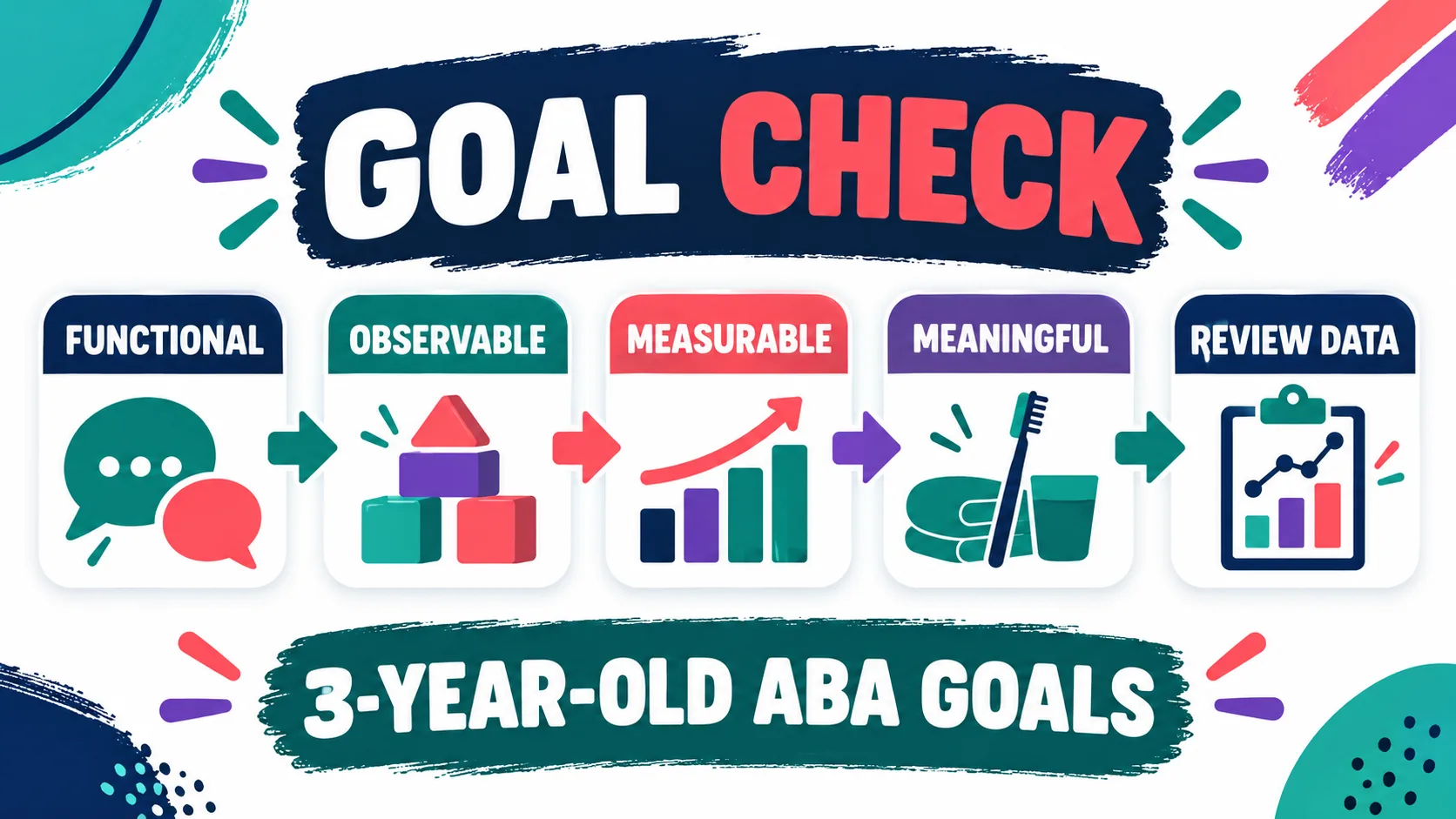
A well-written goal is not simply “improve speech,” “reduce tantrums,” or “act like a three-year-old.” It identifies a response that can be observed, a context in which it matters, and a measurement rule that allows the team to make a decision. It also explains why the skill improves the child’s access, autonomy, communication, safety, or participation.
| Weak wording | What is missing? | More useful direction |
|---|---|---|
| Improve communication | Response form, opportunity, independence, and function. | Request help with speech, sign, gesture, or AAC during a difficult routine, using the child’s available communication. |
| Stop tantrums | Function, safety, replacement communication, and a meaningful outcome. | Teach an effective break or help request and measure whether the child can use it before or during a challenging routine. |
| Play appropriately | The activity, response definition, partner choice, and reason the skill matters. | Join a chosen turn-taking routine for a defined number of opportunities while preserving the child’s right to pause or choose another activity. |
Notice the difference: the stronger direction does not assume that a particular speech form, eye contact pattern, or emotional display is automatically the right target. It focuses on access and function. If the learner already communicates effectively with AAC, replacing that system with speech just because speech looks more typical may be an inappropriate goal.
ABA Goal Examples by Skill Area
The examples below are starting points for a conversation, not ready-to-copy treatment objectives. The exact criterion should come from baseline data and the child’s natural routines.
| Area | Possible functional direction | What to measure |
|---|---|---|
| Communication | Request a preferred item, help, a break, or more time using an available communication mode. | Independent opportunities, prompt level, response latency, and whether the request contacts the intended outcome. |
| Play and social participation | Join a chosen shared activity, take a turn, or communicate “stop” or “my turn” with a partner. | Opportunities, independent responses, duration only when meaningful, and the child’s choice to continue or leave. |
| Daily living | Participate in a routine such as washing hands, dressing, eating, or toothbrushing with an individualized support sequence. | Steps completed independently, prompt type, time, and whether the routine transfers across caregivers or settings. |
| Safety and participation | Use a functional response to pause, ask for help, stay with a caregiver, or follow a safety routine that has been individually assessed. | Correct response in realistic opportunities, prompt dependence, generalization, and any safety risk during teaching. |
Avoid choosing goals because they are popular on a checklist. For example, “eye contact” may not be necessary for communication, and “sit still” may not be the best way to improve participation. Ask what barrier is being addressed, what the child would gain, and whether there is a less intrusive way to teach the same functional outcome.
Define, Observe, and Review
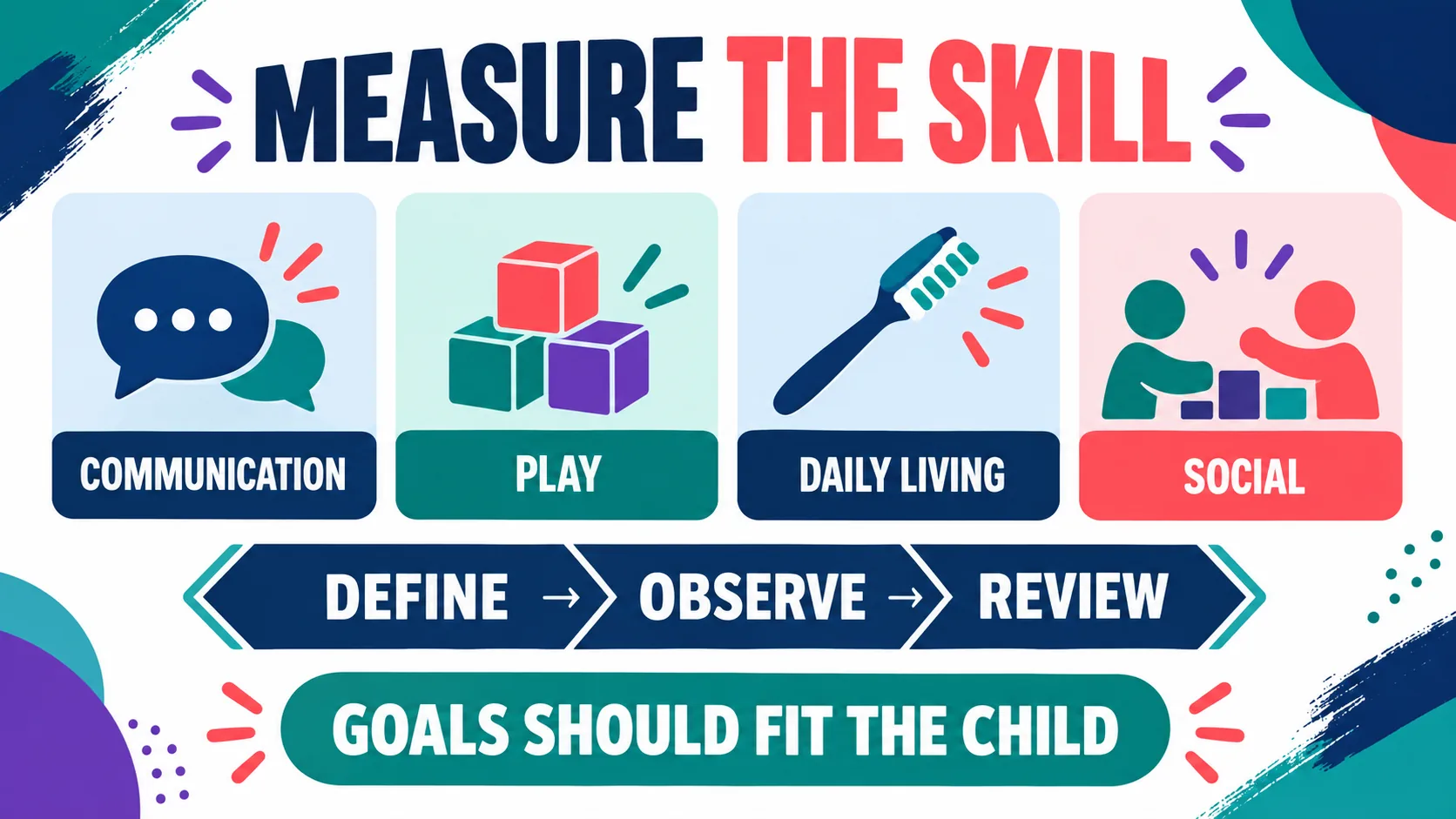
Measurement turns a good intention into a clinical decision. Before teaching begins, the team should define the response, collect baseline information, choose a measurement system that fits the behavior, and agree on when data will be reviewed. A goal that cannot be observed or reviewed can drift into subjective judgment.
| If the team wants to know… | A possible measure | Watch for… |
|---|---|---|
| How often a response occurs | Frequency or rate during a defined routine | Different observation lengths that make counts look better or worse. |
| Whether a skill happens independently | Trial-by-trial accuracy and prompt level | Reporting prompted performance as mastery. |
| How long participation lasts | Duration, only when duration represents a meaningful outcome | Using a longer duration as success when the child is distressed or has no meaningful choice. |
| Whether the skill transfers | Probes across people, materials, routines, or settings | Assuming therapy-room performance automatically generalizes. |
Review should lead to action. If a child communicates independently with one therapist but not with a caregiver, the next decision may involve programming across people, adjusting the cue, improving access to the communication system, or changing the response requirement. It should not automatically mean “more hours” or more demands.
Family Plan-Review Questions
Families do not need to memorize ABA terminology to participate in goal decisions. Ask the provider to explain each target in plain language and connect it to a real routine.
- What routine or opportunity does this goal improve for the child?
- What does the child currently do, and what did baseline data show?
- How will the team count independent responses separately from prompted responses?
- How can the child say “no,” pause, choose another activity, or request a break?
- How will the skill be practiced with meaningful people and in natural settings?
- When will the team review the data, and what would cause the goal to change?
- Could speech-language, occupational, medical, school, or other professional input be needed?
These questions also help distinguish a meaningful target from a compliance-only target. A good plan makes room for communication, autonomy, cultural context, sensory needs, and the child’s actual life. The neurodiversity-friendly ABA guide provides additional context on assent, learner voice, and quality-of-life goals.
BCBA Reasoning Connection
For BCBA students, an age-specific vignette is usually testing decision-making rather than recall of a “correct” three-year-old goal. Start by identifying the target behavior, function, baseline, measurement, and social validity. Then ask whether the proposed goal improves a meaningful outcome and whether the teaching plan includes generalization and maintenance.
The BACB task-list hub is the right place to recheck current exam language. A strong exam answer will not choose a target just because it appears age-appropriate. It will select the option that is observable, measurable, functionally relevant, least intrusive, and supported by data and stakeholder input.
Frequently Asked Questions
What are common ABA goals for a three-year-old?: Common areas may include functional communication, play and social participation, daily living, safety, and transitions. The exact target should come from the child’s strengths, needs, preferences, routines, baseline, and family priorities—not age alone.
Should every three-year-old have the same ABA goals?: No. Two children the same age may communicate, play, regulate, and participate differently. A goal should be individualized and reviewed from data. Developmental milestone pages provide context; they are not treatment prescriptions.
How do I know whether an ABA goal is measurable?: You should be able to identify the response, opportunity, measurement system, prompt level, criterion, and review point. If two observers could not reasonably agree on whether the response occurred, the wording needs clarification.
Where can BCBA candidates practice goal-selection questions?: After reviewing the measurement and ethics logic, candidates can use a Free BCBA Mock Exam to practice distinguishing a measurable, functional target from a vague or poorly matched option. It is a study resource, not a guarantee of certification, licensure, employment, therapy results, or exam success. Sources to recheck: the BACB task-list hub, the CDC age-three milestone reference, and the American Academy of Pediatrics family guidance. Clinical goals should be individualized with qualified professionals and the child/family’s participation. For targeted review, use our aba goals for 3 year old practice questions to apply the concept in exam-style scenarios.
Quick Review Checklist
Use this final checklist to turn aba goals for 3 year old into exam-ready reasoning. The goal is not to memorize a label in isolation; it is to identify the relevant evidence and explain why the best answer fits the scenario. Key ideas to review:
- State the central definition or decision point for aba goals for 3 year old in your own words.
- Identify the detail that makes aba goals for 3 year old different from its closest related ABA term.
- Separate the observable facts in a scenario from assumptions that are not supported by the facts.
- Write one example and one nonexample so you can recognize the concept in a new setting.
Exam application checks:
- Ask what the question is actually requesting before comparing the answer choices.
- Mark the antecedent, response, consequence, or other evidence that supports the selected answer.
- Look for a distractor that describes a related process but does not answer the specific question.
Final self-check:
- Explain how you would verify the interpretation with clear observations or data.
- Change one detail in the scenario and decide whether your answer should change.
- Give a one-sentence rationale that a supervisor or study partner could evaluate.
Take the Free BCBA Mock Exam
When you are ready to apply the idea, use the free practice resource below for additional feedback. Take the Free BCBA Mock Exam



