
A source-first New Jersey pathway guide: separate BACB certification from the NJ LBA license, organize your evidence, and plan the 2027 recheck. If you are searching for how to become a BCBA in NJ, start with one important distinction: New Jersey does not issue the BCBA credential. The national Board Certified Behavior Analyst certification comes from the Behavior Analyst Certification Board (BACB). New Jersey then has its own state licensure layer for people practicing behavior analysis in the state, including the Licensed Behavior Analyst (LBA) process. You should plan these as connected but separate workstreams.
Table of Contents
- How to Become a BCBA in NJ: The Two Credential Layers
- The BACB Certification Path
- The New Jersey LBA License Layer
- A Practical New Jersey Sequence
- Documents and the 2027 Recheck
- Where BCBA Exam Preparation Fits
- Common Planning Mistakes
- Frequently Asked Questions
- Quick Review Checklist
- Take the Free BCBA Mock Exam
The practical sequence is usually: choose the BACB eligibility route, complete the applicable graduate education and behavior-analytic coursework, document supervised fieldwork, submit the certification application, prepare for and pass the BCBA examination, then verify the New Jersey LBA application and jurisprudence steps. Your employer, payer, school, or service program may add requirements, so a BCBA certificate should not be treated as a universal substitute for every New Jersey practice rule.
Quick answer: to become a BCBA in New Jersey, you need to meet the current BACB certification requirements and then check New Jersey’s separate LBA licensure requirements if your role or setting requires state authorization. Start with the current BACB Handbook, the BACB 2027 transition material, and the New Jersey Board of Applied Behavior Analyst Examiners before submitting an application.
How to Become a BCBA in NJ: The Two Credential Layers
The BACB credential and a New Jersey LBA license answer different questions. BACB certification asks whether you meet the national education, coursework, fieldwork, application, and examination standards for the BCBA credential. New Jersey licensure asks whether you meet the state’s requirements to practice behavior analysis under a regulated title in New Jersey. An employer or payer may add another layer for onboarding, background checks, supervision, documentation, or enrollment.
| Layer | What it answers | What to verify |
|---|---|---|
| BACB certification | Whether you qualify for and earn the national BCBA credential. | The current pathway, degree and coursework evidence, supervised fieldwork, application, authorization, and examination rules. |
| New Jersey LBA license | Whether the state board can authorize you under New Jersey’s behavior-analyst licensing law. | The current board application, graduate-degree evidence, BCBA proof, jurisprudence orientation, fees, and portal instructions. |
| Employer or payer | Whether a particular job, contract, school, health plan, or program will accept your credentials. | Written onboarding, background, supervision, credentialing, and service-setting requirements. |
This separation prevents a common planning error: completing the BACB route and assuming that New Jersey paperwork happens automatically. Create one evidence folder for the national credential and another for the New Jersey license. Link the two folders, but do not merge their requirements.
The BACB Certification Path
Start with the current BACB Handbook and requirements documents rather than an old program page. The BACB’s current transition guidance explains that eligibility requirements change on January 1, 2027. It also explains that applicants who want to be reviewed under the current requirements must submit a complete application, including payment and required documents, by December 31, 2026. If you will apply in 2027, use the 2027 pathway and form instructions that apply to your situation.
1. Identify the pathway that fits your education. A master’s or doctoral degree by itself is not enough to assume that you are eligible. Review the current BACB pathway descriptions and determine how your degree, coursework, and program documentation fit the applicable route. Ask the university for the exact transcript, attestation, or program evidence you will need, and save the answer with the date and source version.
2. Plan supervised fieldwork before logging hours. Supervised fieldwork is not simply time spent working in an ABA setting. The activities, supervisor qualifications, observation, supervisory contacts, monthly records, signatures, and final verification must fit the current BACB rules. Before accepting a fieldwork arrangement, ask who will supervise you, which activities can count, how records will be reviewed, and which forms apply. A spreadsheet can organize evidence, but it does not replace an official form or the supervisor’s responsibility. Use the existing BCBA fieldwork and supervision guide for a deeper review. Keep New Jersey licensure rules separate from BACB fieldwork eligibility.
3. Submit a complete certification application. When your evidence is ready, follow the current BACB application steps and use the form family for your pathway. “I finished my degree” and “my application is complete” are not the same status. Check transcripts, coursework evidence, fieldwork records, payment, supervisor documentation, and any required attestations before you submit.
4. Receive authorization and prepare for the examination. Use the current BCBA Test Content Outline and your own practice data to organize review. Eligibility evidence and exam readiness are related, but they are not interchangeable. Passing a practice test does not replace an application document; a complete application does not guarantee a passing exam.
The New Jersey LBA License Layer
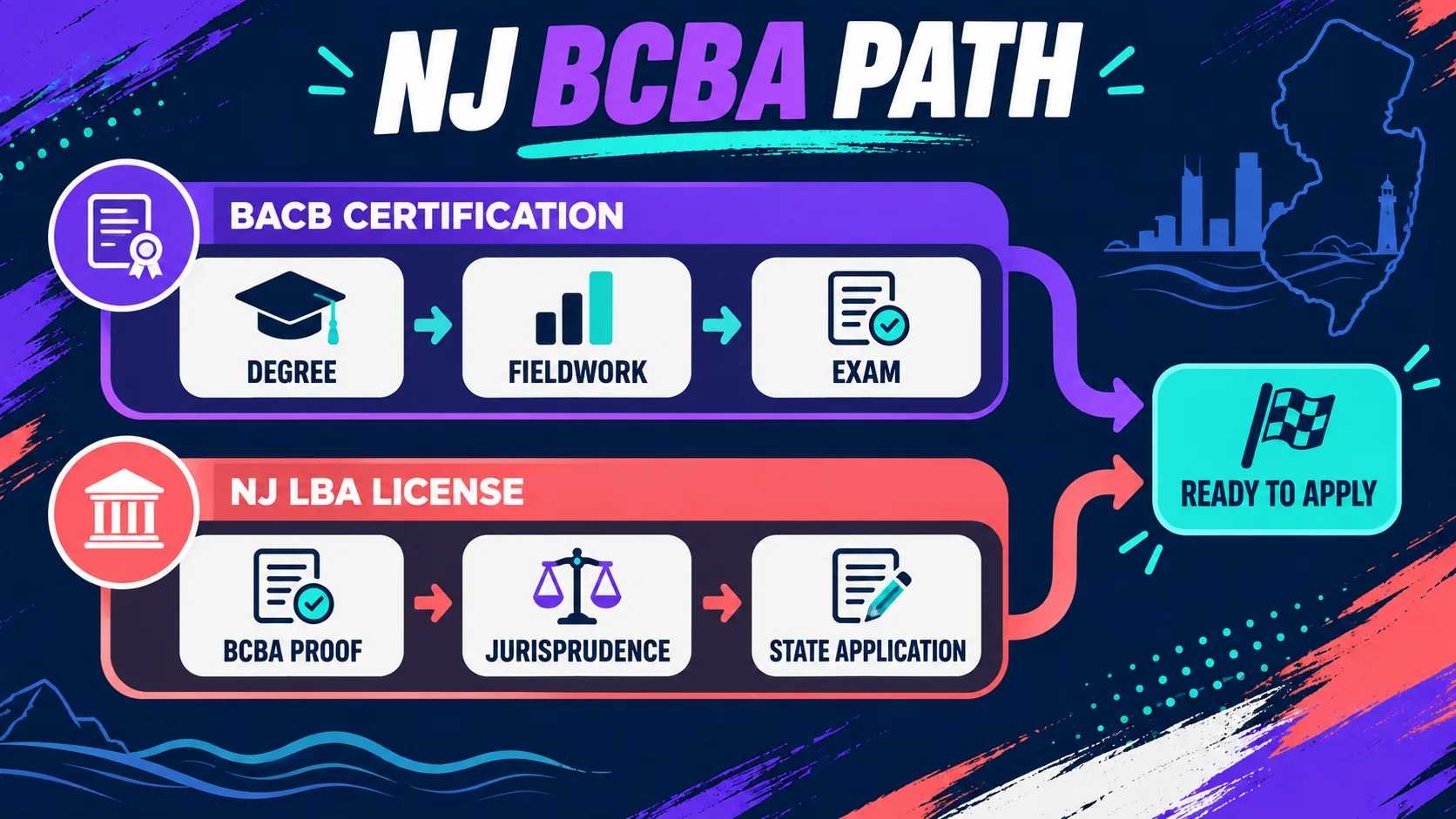
New Jersey’s State Board of Applied Behavior Analyst Examiners publishes a separate state process. Its current FAQ says that an LBA applicant must submit a completed application, proof of a master’s or doctoral degree from a qualifying accredited institution, proof of current BCBA or BCBA-D certification, and completion of the online jurisprudence orientation. The board’s home page also directs applicants to the online licensing portal and provides forms, phases, laws, verification, and other state-specific information.
That list is a planning summary, not a substitute for the application packet. Check the board’s current page for the exact document format, fee, background or identity requirements, portal steps, and any changes after this article’s research date. New Jersey also provides a jurisprudence examination process through its Division of Consumer Affairs. Treat the jurisprudence step as a state-law requirement, not as another version of the national BCBA examination.
| New Jersey item | Planning meaning | Evidence to locate |
|---|---|---|
| Graduate degree | The state application requires graduate-degree evidence from a qualifying institution. | Official transcript and the current board instructions. |
| BCBA or BCBA-D proof | The national credential and the state license are linked, but they are not the same credential. | Current BACB certification evidence and any board-required verification. |
| Jurisprudence | You must learn the New Jersey laws and regulations that govern the profession. | Completion record and the current Division of Consumer Affairs instructions. |
| Online application | The state board, not the BACB, reviews the New Jersey license application. | Portal confirmation, payment record, uploads, and license-status information. |
When you are ready to assemble the state packet, continue with the site’s NJ BCBA licensure application guide.
A Practical New Jersey Sequence
If you are starting from the beginning, use this sequence as a planning map:
- Choose the BACB route. Compare your graduate degree, behavior-analytic coursework, program evidence, and the pathway that will govern your application.
- Ask for written fieldwork details. Confirm supervisor qualifications, activities, observations, monthly review, recordkeeping, and form edition before logging hours.
- Build two evidence folders. Put BACB evidence in one folder and New Jersey LBA evidence in the other. Add the source URL and access date beside every requirement.
- Prepare for the national exam. Use practice questions to find weak domains, then review the definition, example, data pattern, ethical issue, or decision rule behind each miss.
- Submit and monitor the BACB application. Keep proof of payment, document delivery, authorization, and status. Do not assume a completed degree creates a state license.
- Complete the New Jersey layer. Verify the LBA application, BCBA proof, jurisprudence orientation, portal, fee, and any current background or identity instructions.
- Confirm the setting-specific rules. Ask the employer, payer, school, or service program whether it has additional credentialing or supervision requirements.
Documents and the 2027 Recheck
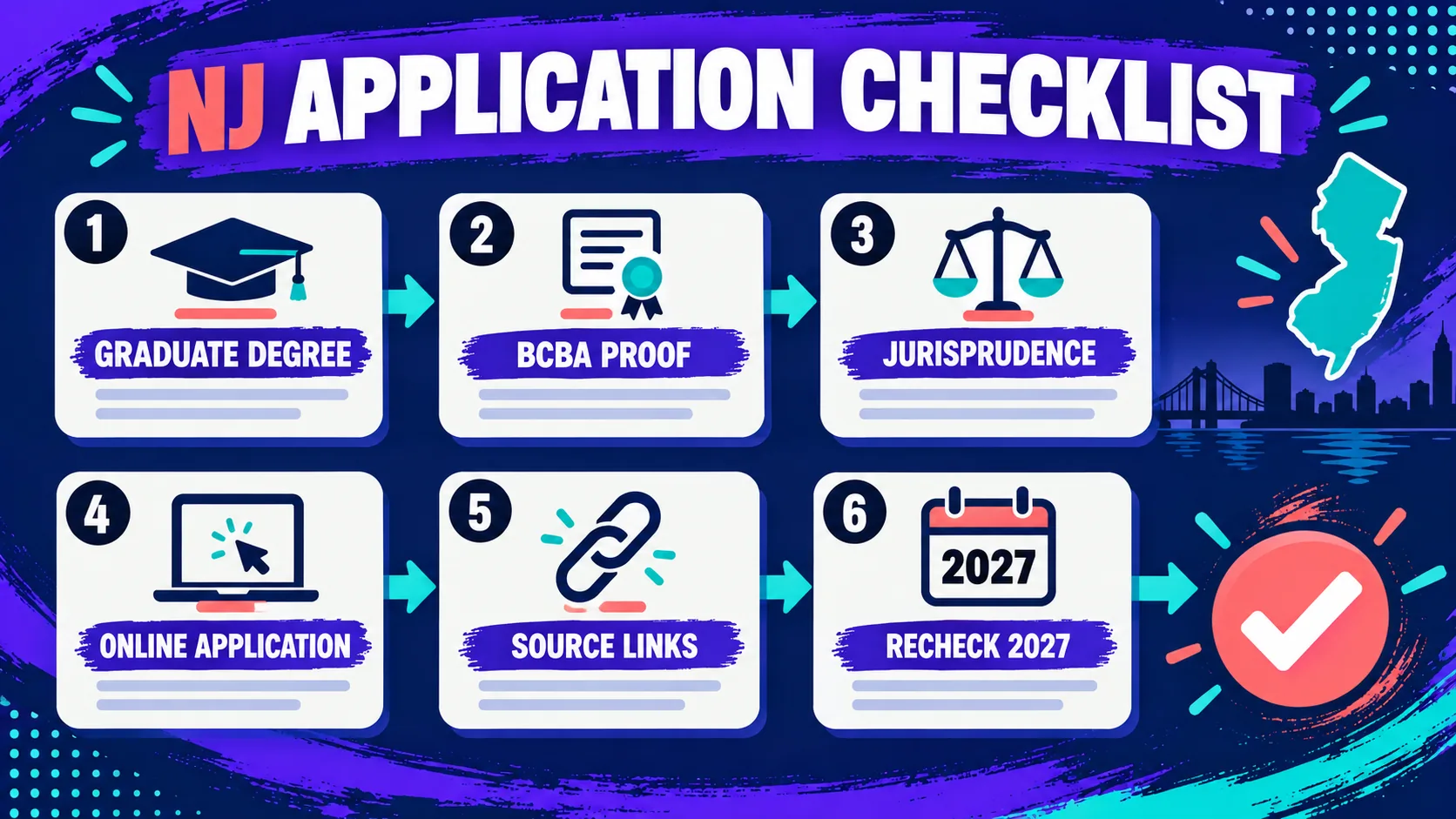
Make the pathway auditable. Save dated copies of the current BACB Handbook, 2027 transition guidance, degree and coursework evidence, fieldwork forms, New Jersey board FAQ, application instructions, jurisprudence information, and portal confirmation. Track evidence instead of relying on memory or a program advertisement.
| Checkpoint | Record | Recheck question |
|---|---|---|
| Degree and coursework | Transcript, course list, syllabi, attestation, or program evidence. | Which current BACB pathway and form edition does this document support? |
| Fieldwork | Monthly records, supervision evidence, observations, signatures, and final forms. | Does the record match the current BACB supervisor and verification instructions? |
| New Jersey license | BCBA proof, graduate-degree proof, jurisprudence record, application, and payment. | Did the state board change an upload, fee, portal, or timing instruction? |
| 2027 source recheck | Access date, source URL, saved document, and next review date. | Does BACB or New Jersey now use a different pathway, form, fee, or deadline? |
The 2027 transition is especially important if you are deciding when to apply. BACB says that an application reviewed under current requirements must be complete by December 31, 2026; new requirements begin January 1, 2027. Do not rush an incomplete application just to beat a date, and do not mix older pathway assumptions with 2027 forms. Compare your actual evidence with the current handbook and transition guidance, then ask your program contact or supervisor to resolve anything unclear.
Where BCBA Exam Preparation Fits
Exam preparation belongs inside the national certification path, not inside the New Jersey jurisprudence step. Use the current BCBA Test Content Outline to organize domains, then use practice questions to expose reasoning gaps. A missed measurement question may reflect a denominator problem, an operational-definition problem, or confusion between a dimension and a procedure. Target the reason, not just the answer letter. Use a simple loop: complete questions, classify each miss, review the governing concept, explain the distractors, and retest later. Keep certification questions and state-law questions separate.
Once you have mapped your eligibility and license tasks, the site’s Free BCBA Mock Exam can serve as a practice checkpoint. Use the results to prioritize review; it is not a certification, licensure, employment, or exam-success guarantee.
Common Planning Mistakes
- Calling every ABA hour “BCBA fieldwork.” Employment experience, BACB supervised fieldwork, and New Jersey licensing evidence may have different definitions and documentation requirements.
- Assuming the national certificate is the state license. BACB issues the BCBA credential; New Jersey’s board handles New Jersey licensure.
- Using an old New Jersey checklist. A portal, fee, form, jurisprudence instruction, or board process can change. Save the access date for every source.
- Mixing the two exams. The BCBA examination tests national certification content. New Jersey jurisprudence tests state laws and regulations. They are separate decisions.
- Studying without an evidence log. If you cannot explain which source governs a requirement, pause and verify it before making a costly program or application decision.
Frequently Asked Questions
Do I need a New Jersey license after becoming a BCBA?: That depends on the role, setting, employer, payer, and current state rules. New Jersey regulates behavior-analytic practice through its state board, so do not assume that BACB certification alone answers every practice or billing question. Check the current LBA application and written requirements for your setting.
Is the New Jersey jurisprudence step the BCBA exam?: No. The BCBA examination is part of the national BACB certification process. The New Jersey jurisprudence step concerns the state’s laws and regulations for applied behavior analysis licensure.
Should I apply before January 1, 2027?: Only if your BACB application can genuinely be complete under the applicable current requirements. Compare your evidence with the current BACB transition guidance and handbook, and separately check New Jersey’s board instructions. A date alone does not make an incomplete application eligible.
Ready to practice the exam decisions inside your certification pathway? Try the Free BCBA Mock Exam, then turn your missed questions into a focused review list. It is a study resource, not a guarantee of certification, licensure, employment, or exam success.
Official sources to recheck: BACB BCBA page, the BACB upcoming changes page, the 2027 transition guidance, the New Jersey behavior analyst board, its LBA FAQ, and the New Jersey jurisprudence information. This article is educational planning information, not legal advice. For targeted review, use our how to become a bcba in nj practice questions to apply the concept in exam-style scenarios.
Quick Review Checklist
Use this final checklist to turn how to become a bcba in nj into exam-ready reasoning. The goal is not to memorize a label in isolation; it is to identify the relevant evidence and explain why the best answer fits the scenario. Key ideas to review:
- State the central definition or decision point for how to become a bcba in nj in your own words.
- Identify the detail that makes how to become a bcba in nj different from its closest related ABA term.
- Separate the observable facts in a scenario from assumptions that are not supported by the facts.
- Write one example and one nonexample so you can recognize the concept in a new setting.
Exam application checks:
- Ask what the question is actually requesting before comparing the answer choices.
- Mark the antecedent, response, consequence, or other evidence that supports the selected answer.
- Look for a distractor that describes a related process but does not answer the specific question.
Final self-check:
- Explain how you would verify the interpretation with clear observations or data.
- Change one detail in the scenario and decide whether your answer should change.
- Give a one-sentence rationale that a supervisor or study partner could evaluate.
Take the Free BCBA Mock Exam
A useful next step is to apply this idea in a fresh set of BCBA-style practice questions and review the feedback. Take the Free BCBA Mock Exam



