
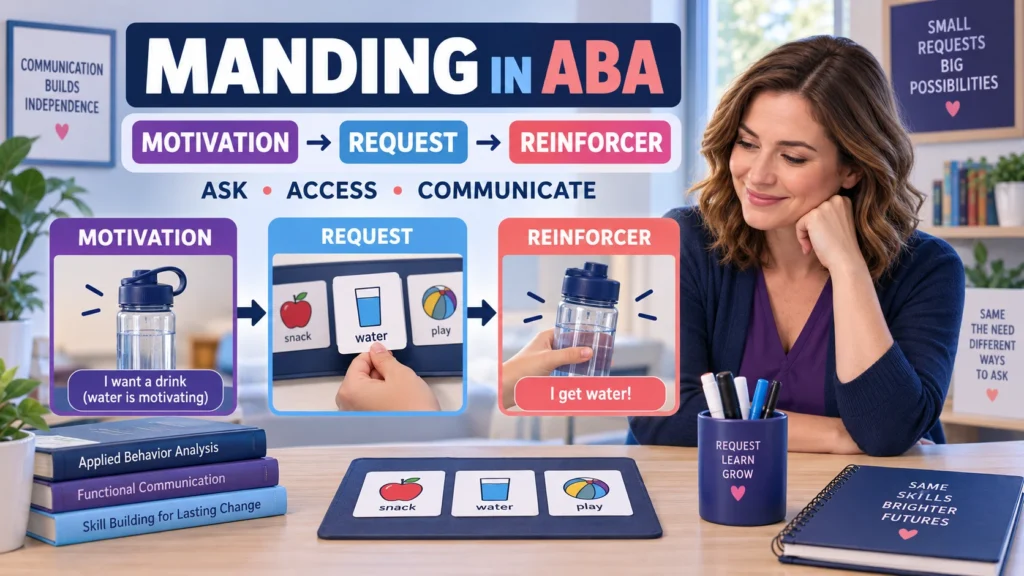
A manding ABA example is a functional request: a current motivating condition makes an outcome valuable, the learner uses an effective communication response, and the requested outcome follows. “Water” said, signed, selected on a device, or exchanged as a picture can function as a mand when thirst or another relevant motivation evokes the request and water reinforces it.
Table of Contents
- What Manding Means in ABA
- A Manding ABA Example in One Sentence
- Mand vs Tact: Look at the Controlling Variables
- Read a Mand Example in ABC Terms
- Build a Mand Teaching Loop
- Use Motivation Without Creating Unnecessary Deprivation
- Fade Prompts and Generalize the Request
- Common Manding Exam Traps
- Frequently Asked Questions
- Sources and Verification Notes
- Take the Free BCBA Mock Exam
People searching for manding ABA example usually need more than a sentence that says “a mand is a request.” They need to identify why the request occurred, what consequence actually reinforced it, how a prompt should be faded, and how the response will work with different people and materials. This guide keeps the analysis functional instead of judging a response by whether it sounds polite or verbal.
The current BACB BCBA Test Content Outline (6th ed.) includes motivating operations, verbal operants, and multiple control. Use the current BACB outline and applicable supervision or clinical guidance as the authority. The examples below are educational study examples, not a client-specific treatment plan or a replacement for qualified assessment.
What Manding Means in ABA
A mand is a verbal operant controlled by motivating variables and maintained by a consequence that is specific to the request. The response can be vocal speech, a sign, a picture exchange, a gesture, written language, or a speech-generating device response. The form matters for access and teaching, but form alone does not identify the operant.
The simplest functional pattern is: a person wants or needs something, communicates a request, and receives the requested item, activity, action, information, or change. A mand can also request removal or termination, such as “break,” “all done,” or a device selection that communicates “stop.” The relevant question is not whether the response looks like a command. It is which variables evoke the response and what consequence strengthens it.
- Motivation: the requested outcome currently has value or its value has changed.
- Response: the learner communicates the request in an available functional form.
- Specific consequence: the requested outcome follows closely enough to reinforce the communication.
- Future effect: the communication becomes more likely in similar motivating conditions.
A Manding ABA Example in One Sentence
Imagine a learner who has been playing outside and appears thirsty. A water bottle is visible but closed. The learner hands over a “water” picture card, the adult immediately opens the bottle and provides water, and the learner later uses the card again when thirsty. The picture-card exchange is a mand because a current motivating condition evoked the request and the specific requested outcome reinforced it.
Now change one variable at a time. If the learner sees a picture of water in a book and labels it “water” while the adult says “nice talking,” the response may be a tact rather than a mand. If the adult asks, “What do you drink?” and the learner says “water,” the response may be an intraverbal. The same word can participate in different verbal operants because the controlling variables and consequences differ.
Mand vs Tact: Look at the Controlling Variables
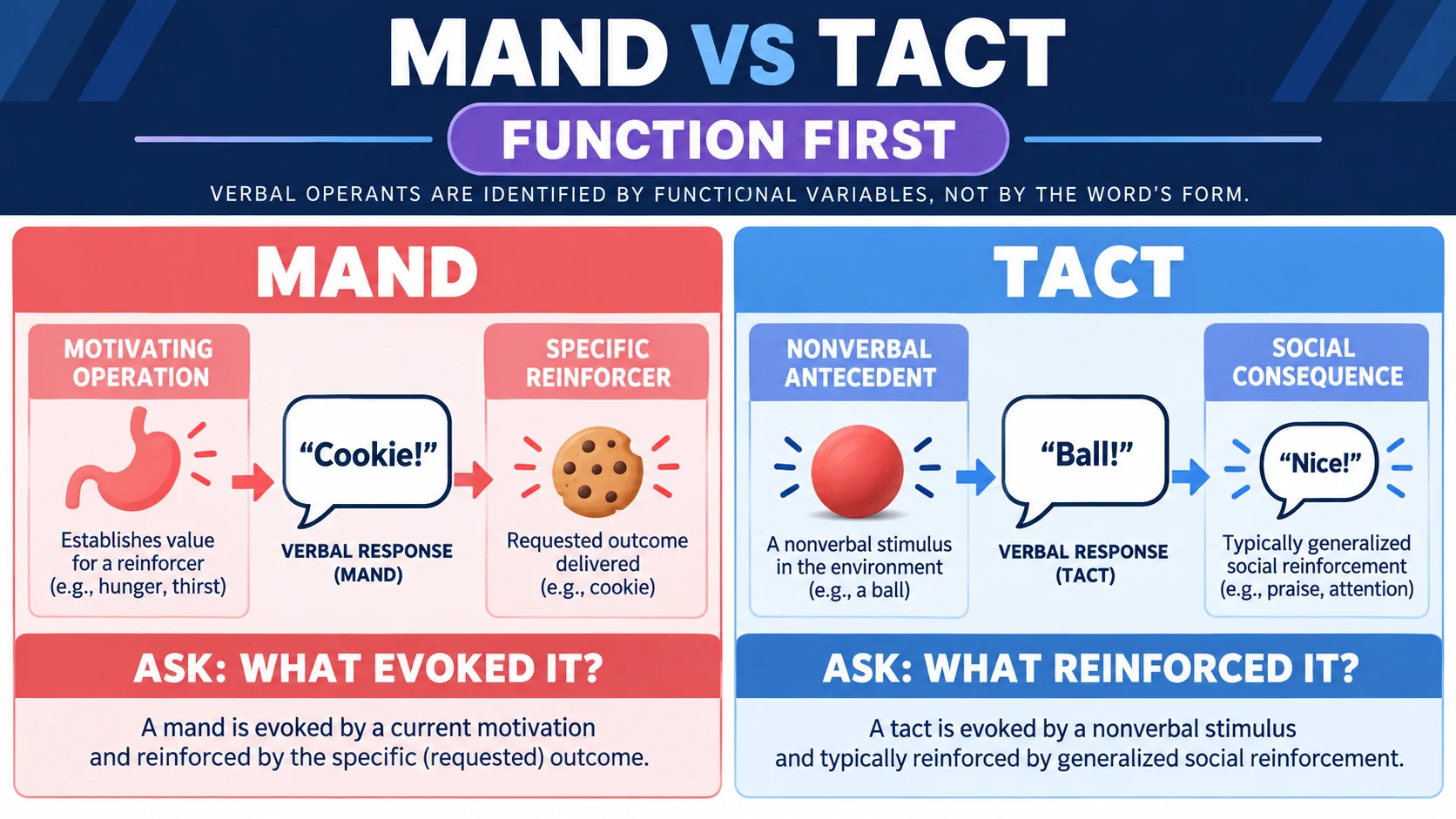
Mand-versus-tact questions are common study traps because both responses can use the same word. Do not classify “cookie,” “ball,” or “water” by its sound. Ask what was present before the response and what consequence followed.
| Question | Mand | Tact |
|---|---|---|
| What evokes it? | A current motivating condition related to the requested outcome. | A nonverbal stimulus or event in the environment. |
| What reinforces it? | The specific item, action, break, information, or other outcome requested. | Typically generalized social reinforcement such as attention or praise. |
| Example | Saying “bubbles” when bubbles are valuable and receiving bubbles. | Saying “bubbles” while watching bubbles and receiving acknowledgment. |
A response can be multiply controlled. A learner may see the item, want it, hear a prompt, and contact a history of reinforcement at the same time. For an exam question, identify the strongest functional relation the stem provides. For practice, collect enough information to determine whether the response is actually contacting the intended consequence.
Read a Mand Example in ABC Terms
ABC language can make an example easier to analyze, but remember that the motivating operation is not the same thing as a discriminative stimulus. A motivating operation changes the value of a consequence and changes the likelihood of behavior that has produced that consequence. A discriminative stimulus signals that reinforcement is available for a response because of a learning history.
| Part of the example | Water-picture example | What to check |
|---|---|---|
| Motivating condition | Time outside and limited recent access make water valuable. | What changed the value of the outcome? |
| Opportunity or cue | The communication materials and an available communication partner are present. | Is the requested outcome available if the response occurs? |
| Response | The learner exchanges or selects the water symbol. | What form is functional for this learner? |
| Consequence | The adult promptly provides water. | Did the specific requested outcome follow and strengthen communication? |
Build a Mand Teaching Loop
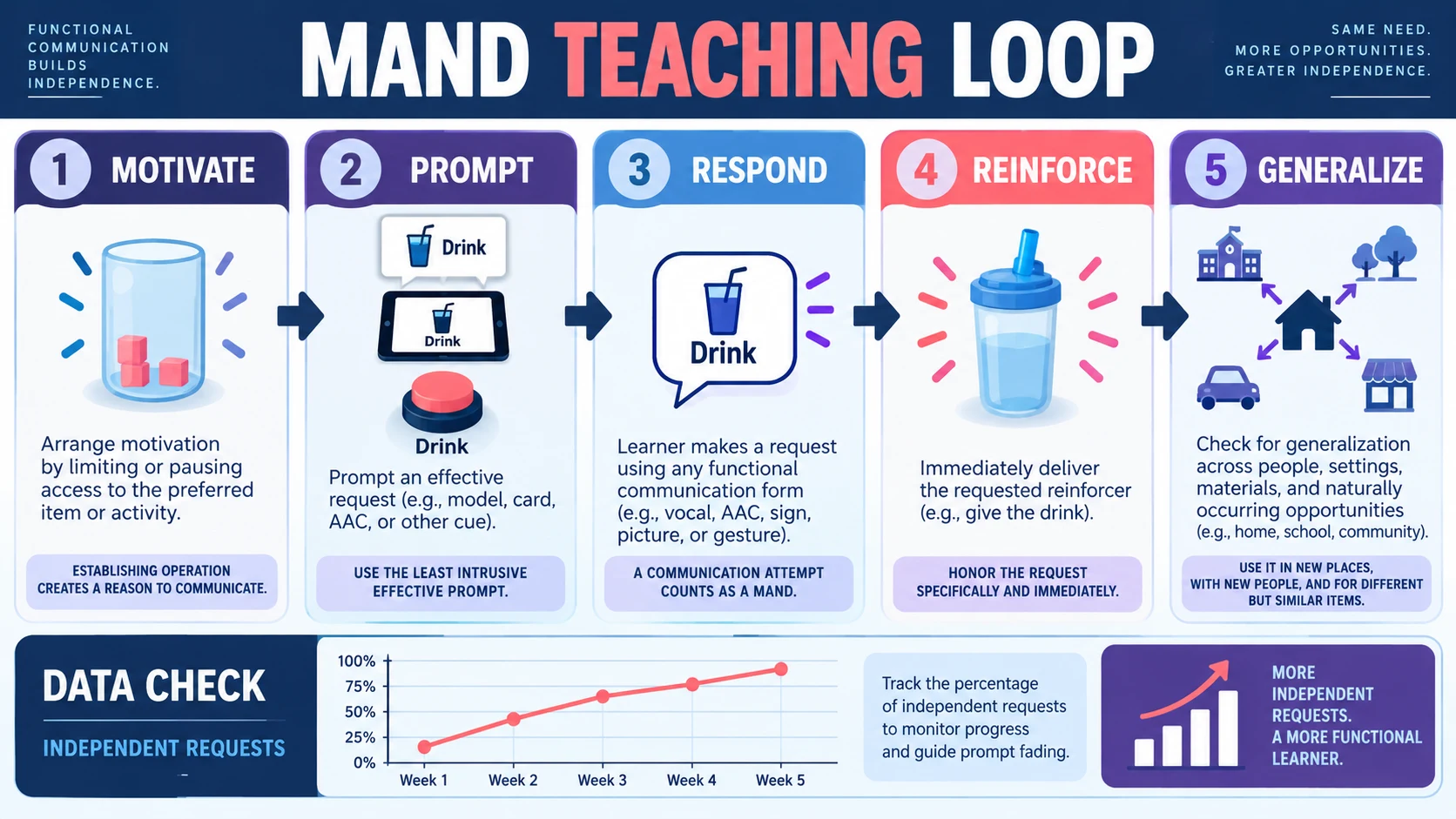
A teaching loop should make functional communication efficient and meaningful. The exact prompting, materials, response criteria, and reinforcement schedule require assessment and qualified clinical direction. As a study model, use five linked steps:
- Arrange a genuine opportunity: notice or ethically contrive a relevant motivation without using unnecessary deprivation, coercion, or unsafe withholding.
- Make the communication response available: place the preferred item, action, break, or communication partner within a reasonable opportunity while preserving choice.
- Prompt the least intrusive effective response: use the learner’s established communication system, then plan how the prompt will be faded.
- Deliver the specific reinforcer quickly: provide what the learner requested when safe and appropriate, rather than substituting praise for the outcome.
- Measure and generalize: track independent requests and check whether the response works with new people, settings, items, and naturally occurring opportunities.
For example, if the goal is a mand for help, the consequence should be useful help, not only “good asking.” Social praise can accompany the outcome, but praise alone may not reinforce a request for help if the learner still cannot access the needed assistance. The response definition should also allow the learner’s communication modality rather than treating speech as the only valid form.
Use Motivation Without Creating Unnecessary Deprivation
Manding instruction depends on motivation, but that does not mean making a person uncomfortable or repeatedly withholding basic needs. A responsible plan uses naturally occurring opportunities, reasonable choice, preference information, and a person-centered understanding of what the learner is communicating. Water, food, medication, safety, toileting, and other essential needs require particular care and should never be treated casually as teaching materials.
- Value: Is the outcome currently valuable to the learner, and how do you know?
- Choice: Can the learner select among reasonable options or communicate “no” or “all done”?
- Access: Is the response an efficient way to obtain the outcome, or are adults creating unnecessary barriers?
- Safety: Could the procedure delay an essential need, increase distress, or create a risk?
- Data: Do observations show more independent functional communication rather than only more prompted responses?
These questions help distinguish teaching a mand from arranging a performance for an adult. The goal is useful communication that improves access, autonomy, and participation.
Fade Prompts and Generalize the Request
A prompt can help a learner contact reinforcement, but a prompt-dependent response is not the same as an independent mand. Record the prompt level and plan a gradual, data-based fade. For a picture-based response, that might mean reducing gestural or positional prompts. For a device response, it might mean changing the distance or cue while keeping the learner’s access to the communication system reliable. Generalization means the mand works outside the exact teaching arrangement. Check across:
- communication partners, including caregivers, teachers, and service providers;
- settings such as home, school, clinic, community, and telehealth when relevant;
- materials, brands, sizes, activities, and naturally available reinforcers;
- response forms, such as speech, sign, picture, gesture, writing, or device use;
- motivation changes, including different times, routines, and levels of access.
Generalization should not mean making the learner prove the request repeatedly before receiving the requested outcome. The team should define what successful independent communication looks like, monitor whether it remains efficient, and update the plan when the context or preferences change.
Common Manding Exam Traps
- “A mand must be spoken.” Vocal speech is one response form; a sign, picture, gesture, writing, or device response can serve the mand function.
- “The item was visible, so it is a mand.” Visibility is not enough. Check motivation and the consequence.
- “The word tells you the operant.” The same word can be a mand, tact, or intraverbal under different controlling variables.
- “Praise is the defining reinforcer.” A mand is typically reinforced by the specific requested outcome.
- “Prompted is independent.” Record prompt level and examine whether the learner initiates and completes the response without the prompt.
- “More requests always means better communication.” Evaluate independence, efficiency, appropriateness, choice, generalization, and the person’s experience.
For targeted practice, use the free BCBA Mock Exam to classify the controlling variables in short scenarios. It is a study resource, not a substitute for the current BACB outline, supervision, or individualized clinical assessment.
Frequently Asked Questions
What is a simple manding ABA example?: A learner who wants bubbles hands over a bubble picture, says “bubbles,” signs the request, or selects it on a device, and then receives bubbles. It is a mand when current motivation evokes the response and the requested outcome reinforces it.
Is asking for a break a mand?: It can be. “Break,” “all done,” or a related response may function as a mand when the learner is motivated to pause or stop and the relevant break or termination consequence follows. Analyze the controlling variables rather than the word alone.
How is a mand different from a tact?: A mand is controlled by motivation and reinforced by a specific outcome. A tact is typically evoked by a nonverbal stimulus and reinforced by generalized social consequences. The same response form can serve either function in different situations.
Should manding always be taught with the preferred item visible?: Not always. Visibility can be one arrangement, but natural opportunities, motivating conditions, and efficient access matter more than a single setup. A qualified team should select procedures that fit the learner, communication system, and context.
What does the BCBA exam test about manding?: The current BCBA Test Content Outline includes motivating operations and the identification and distinction of verbal operants. Expect to analyze the antecedent variables, response, and consequence rather than classify a response from its wording alone.
Sources and Verification Notes
The BACB outline is the primary source for the exam domains referenced here. Study guides and practice examples can make the concepts easier to recognize, but they do not replace current BACB materials or case-specific clinical guidance. Verify the current outline before relying on a task number or terminology.
- BACB BCBA Test Content Outline (6th ed.).
- BACB Test Content Outlines for BACB Certifications.
- BACB BCBA Handbook.
- RBT Hub: Mand definition and example, for explanatory context.
Take the Free BCBA Mock Exam
A useful next step is to apply this idea in a fresh set of BCBA-style practice questions and review the feedback. Take the Free BCBA Mock Exam



