

A BCBA-focused guide to “momentum behavior”: how behavioral momentum relates to response persistence, how a high-probability request sequence is arranged, and which exam clues separate momentum from motivation and reinforcement. The phrase momentum behavior is broad in ordinary search. In this article, it is deliberately narrowed to behavioral momentum in ABA: a way of understanding why behavior may persist when environmental conditions change, plus the high-probability request sequence often taught as an applied procedure. That qualifier matters because “momentum” can also refer to general motivation, business names, or unrelated content.
Table of Contents
- What Does Momentum Behavior Mean in ABA?
- Behavioral Momentum as a Persistence Concept
- How the High-Probability Request Sequence Works
- Momentum, Motivation, and Reinforcement Are Not Synonyms
- Measure Persistence and Check the Right Outcome
- When a Momentum-Based Procedure Needs More Analysis
- A BCBA Classification Routine
- Where Momentum Fits in the BCBA Outline
- Common Momentum Behavior Traps
- Turn the Concept Into Scenario Practice
- Frequently Asked Questions
- Take the Free BCBA Mock Exam
Behavioral momentum is not a promise that an easy request will make every difficult response occur. The BCBA exam may test the concept, the antecedent procedure, the measurement of persistence, or the distinction between a consequence and an establishing operation. Read the stem for the relation it actually describes.
The current BACB Test Content Outline (6th ed.) explicitly includes identifying ways behavioral momentum can be used to understand response persistence. Research on high-probability requests and compliance provides important context, but the BACB Ethics Code hub and current training materials remain the authority for professional application, competence, and client protection.
What Does Momentum Behavior Mean in ABA?
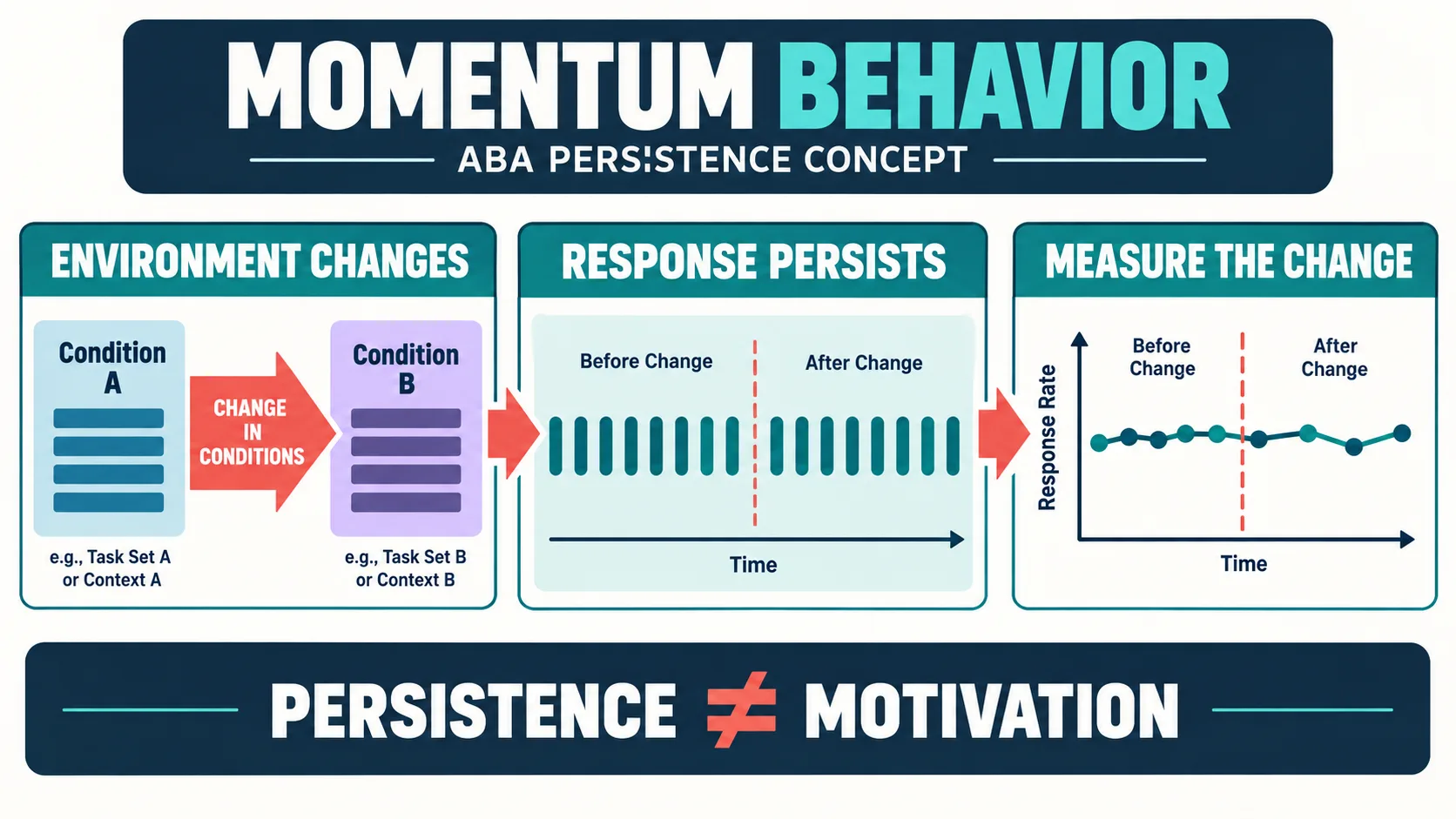
In ABA, behavioral momentum describes the tendency for an established pattern of responding to persist when some environmental condition changes. The metaphor comes from physical momentum, but the behavior-analytic question is about the relation between a response and the conditions that support its persistence. A response may continue even when the current task, cue, or consequence arrangement is altered.
On an exam, “momentum” usually points toward response persistence or resistance to change. It is not simply enthusiasm, willpower, or a learner being “in the mood.” Identify the behavior, the environmental change, and the evidence that responding persisted. If the stem only says that a person looked motivated, there may not be enough information to classify behavioral momentum.
A practical example is a learner who completes a familiar series of instructions and then continues responding when a less-preferred instruction is introduced. The series may be relevant to a high-probability request procedure, but the analyst still needs to measure what happened: compliance, latency, task completion, errors, or another defined response dimension. A good explanation does not treat the word “momentum” as the intervention itself.
Behavioral Momentum as a Persistence Concept
Behavioral momentum is easiest to understand when the question changes an environmental condition after responding has been established. The analyst asks whether the response persists, how much it changes, and which conditions are associated with that persistence. In basic exam language, the concept helps explain why some behavior is more resistant to disruption than other behavior.
Do not confuse a persistence effect with a new skill acquisition procedure. A learner can acquire a response because of reinforcement, prompting, modeling, or shaping. Later, that response may show persistence under a different condition. Acquisition and persistence are related but different questions. Similarly, a response can persist because of a continuing consequence, an unchanged context, or a poorly defined measurement—not necessarily because behavioral momentum was demonstrated.
The safest answer uses operational language: “The target response continued at the defined level after the specified change.” Then identify the condition that changed and the data that support the claim. Avoid inferring momentum from a single successful trial.
How the High-Probability Request Sequence Works
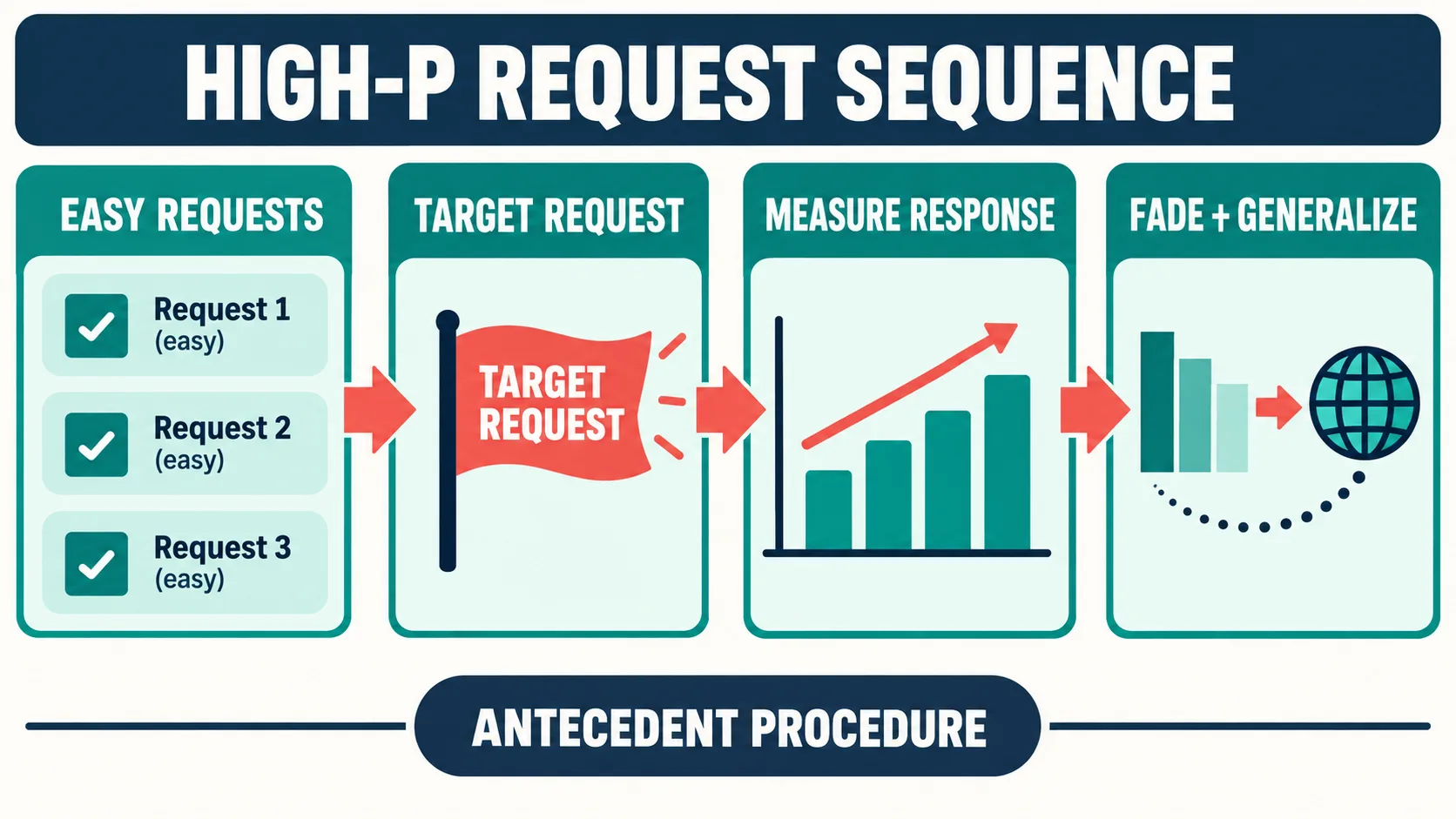
A high-probability request sequence, often called a high-p sequence, presents several requests that the learner is very likely to complete immediately before a request that is less likely to be completed. The classic applied logic is antecedent-based: build a history of responding to easy requests, then present the target request. The sequence is sometimes discussed as an application of behavioral momentum, but the procedure and the broader theory should not be treated as identical.
- Define the target response: Specify what compliance, task initiation, or completion looks like and how quickly it should occur.
- Identify high-p requests: Use simple, mastered requests that have a strong history of quick responding in the relevant context.
- Present the sequence: Deliver a small series of high-p requests with clear instructions and an efficient pace.
- Deliver the low-p request: Present the target request without adding an unrelated demand or changing the measurement rule.
- Measure and adjust: Track the target response, then examine whether the sequence can be faded or generalized safely.
Research has examined high-p sequences in relation to compliance, including work on varied inter-instruction intervals and later fading. That evidence does not mean every learner, request, or setting will respond the same way. The high-p request must be genuinely high probability for that learner and context; an “easy” task chosen only by the adult may not function that way.
Momentum, Motivation, and Reinforcement Are Not Synonyms
Several concepts can appear together in one scenario. The key is to name the relation the question asks about. Behavioral momentum concerns persistence. Motivation concerns changes in the value of a consequence and related behavior. Reinforcement concerns a consequence followed by an increase in future behavior. A high-p sequence is an arranged antecedent procedure.
| Term or procedure | What it asks | Exam cue |
|---|---|---|
| Behavioral momentum | Why does a response persist when an environmental condition changes? | Look for persistence or resistance to change data. |
| High-p request sequence | What antecedent arrangement precedes a low-probability request? | Several easy requests precede the target request. |
| Motivating operation | What changed the value of a consequence and related behavior? | Separate consequence value from a signal that reinforcement is available. |
| Reinforcement | What consequence was followed by an increase in future behavior? | Require evidence of a later increase; do not infer it from preference or praise. |
One scenario can contain all four. An easy request may be followed by praise, which may reinforce responding, while the sequence is used as an antecedent arrangement and later responding is measured for persistence. The correct answer depends on the wording: do not select “motivation” merely because the learner appears engaged.
Measure Persistence and Check the Right Outcome
Measurement makes a momentum claim testable. Before using a high-p sequence, define the low-p response and collect enough baseline information to know whether the request is actually low probability. After the sequence is introduced, compare the target response under the same relevant conditions. A single “yes” is not a complete outcome measure.
- Probability or percentage: the proportion of opportunities in which the learner initiates or completes the target request.
- Latency: the time from the instruction to response initiation.
- Duration or completion: how long the learner engages or whether the task reaches its defined endpoint.
- Error or prompt level: whether responding is independent or requires more assistance.
- Maintenance and generalization: whether the response continues after fading and across people, materials, or settings.
Measure the procedure as well as the learner response. Was the high-p sequence delivered in the planned order? Were the requests truly mastered? Did the adult accidentally add a reinforcer, remove a demand, or change the inter-instruction interval? Procedural integrity helps distinguish a momentum-related hypothesis from an unrelated change in the contingency.
When a Momentum-Based Procedure Needs More Analysis
A high-p sequence is not a universal compliance shortcut. If the target behavior is dangerous, escape-maintained, affected by pain or illness, or associated with a crisis plan, the analyst should use an appropriate assessment and safety process rather than improvising a request sequence. A low-probability request may be low because of skill deficits, unclear instructions, high response effort, competing reinforcement, or an aversive history.
Also consider whether the “easy” requests are meaningful. Repeatedly placing demands before a difficult task can increase response effort or frustration if the sequence is too long. The goal is not to make a person obey every adult instruction. The goal is to support socially significant, safe behavior within an ethical and contextually appropriate plan, with client and caregiver interests considered.
A BCBA Classification Routine
When a question uses “momentum behavior,” use this five-step routine:
- Clarify the keyword: Is the stem about behavioral momentum, a high-p procedure, or a general motivational statement?
- Define the response: Name initiation, compliance, persistence, rate, latency, or another observable dimension.
- Find the change: Identify what environmental condition changed before the response persisted or decreased.
- Check the evidence: Look for repeated data, baseline comparison, fading, or generalization—not one anecdote.
- Separate the relation: Decide whether the answer is about persistence, a consequence, consequence value, stimulus control, or an antecedent procedure.
Where Momentum Fits in the BCBA Outline
The BCBA Test Content Outline places behavioral momentum in Domain B, Concepts and Principles, as a way to understand response persistence. It can also connect to behavior-change procedures, measurement, intervention evaluation, and generalization. The outline does not turn one named procedure into a complete treatment plan; it tells candidates which concepts and skills may be tested.
- Concepts: distinguish behavioral momentum from motivating operations, reinforcement, stimulus control, and response maintenance.
- Measurement: select a dimension that captures persistence and compare behavior under defined conditions.
- Intervention: evaluate whether a high-p sequence is appropriate, implemented with integrity, and supported by data.
- Professional reasoning: consider risk, client preference, competence, context, and generalization before changing a procedure.
Common Momentum Behavior Traps
- Trap: “Momentum means motivation.” Persistence and consequence value are different concepts.
- Trap: “High-p is the same as momentum theory.” The sequence is an applied procedure; the broader concept concerns persistence.
- Trap: “Any easy task is high probability.” The learner’s actual responding in that context determines whether the request qualifies.
- Trap: “One successful target response proves the procedure worked.” Look for repeated, defined measures.
- Trap: “Praise automatically explains the effect.” Reinforcement requires a future increase in the relevant behavior.
- Trap: “Persistence is always desirable.” Evaluate which behavior persists and whether the outcome is safe and socially significant.
Turn the Concept Into Scenario Practice
For each practice item, mark the high-p requests, the low-p request, the measured response, and the environmental change. Then ask what the question actually requests: a definition, a procedure, a measurement, or a data-based decision. This prevents the word “momentum” from pulling you toward an answer that the stem does not support.
Use the Free BCBA Mock Exam to practice behavioral momentum, high-probability request sequences, reinforcement, motivating operations, persistence, and generalization. After a missed item, write whether the error was a concept error, procedure error, measurement error, or unsupported inference. This new page is intentionally separate from the existing behavior-momentum cluster. It targets the ambiguous phrase with an explicit ABA qualifier and a new URL; it does not refresh or replace older momentum pages.
Frequently Asked Questions
What does momentum behavior mean in ABA?
In an ABA/BCBA context, it refers to behavioral momentum: understanding why a defined response pattern persists when an environmental condition changes. What is a high-probability request sequence?
It is an antecedent arrangement in which several requests with a high likelihood of responding are presented before a request with a lower likelihood of responding. Is behavioral momentum the same as a high-p sequence?
No. A high-p sequence is an applied procedure often discussed in relation to momentum, while behavioral momentum is the broader persistence concept. How do I measure momentum-related behavior?
Define the response and compare repeated data across the relevant environmental change. Depending on the question, use probability, latency, duration, completion, errors, prompts, maintenance, or generalization. Does high-p always improve compliance?
No. Effectiveness depends on the learner, request history, setting, procedure integrity, and the function or context of the target behavior. Use assessment and ethical safeguards.
Bottom line: Treat “momentum behavior” as a cue to analyze persistence, not as a synonym for motivation or compliance. Identify the response, the environmental change, the data, and whether the stem is describing a high-p procedure or a broader behavioral-momentum concept.
Take the Free BCBA Mock Exam
When you are ready to apply the idea, use the free practice resource below for additional feedback. Take the Free BCBA Mock Exam



