
A practical, exam-aware guide to BCBA parent training: how to define caregiver goals, use behavior skills training, measure performance, and plan for generalization without reducing family coaching to a handout. If you are searching for BCBA parent training, the most useful answer is more specific than “teach parents ABA.” A BCBA or qualified behavior-analytic team identifies a meaningful caregiver skill, describes it in observable terms, models the skill, gives the caregiver a chance to rehearse it, and uses data and feedback to improve performance. The target is not attendance alone. The target is competent, respectful use of a strategy in the routines that matter to the family.
Table of Contents
- What Does BCBA Parent Training Mean?
- Parent Training vs. Direct Child Sessions
- Write Goals That Can Be Observed and Measured
- How Behavior Skills Training Works for Caregivers
- Measure Caregiver Performance and Client Outcomes
- A Practical Parent-Training Session Workflow
- Plan for Generalization and Contextual Fit
- Ethical and Professional Boundaries
- How Parent Training Appears in BCBA Exam Reasoning
- Common Parent-Training Mistakes
- Turn the Framework Into Scenario Practice
- Frequently Asked Questions
- Take the Free BCBA Mock Exam
Parent training may also be called caregiver training, family coaching, or parent-mediated intervention. Names and service arrangements vary by context. This is an educational framework for BCBA exam reasoning—not individualized treatment advice, a billing guarantee, or a substitute for supervision, consent, and current rules.
The current BACB Test Content Outline (6th ed.) connects this topic to intervention goals, collaboration, procedural integrity, data-based decisions, and supervision. The BCBA Handbook, the BACB’s training and oversight resources, and the Ethics Code hub should remain the authority for current requirements and professional boundaries.
What Does BCBA Parent Training Mean?
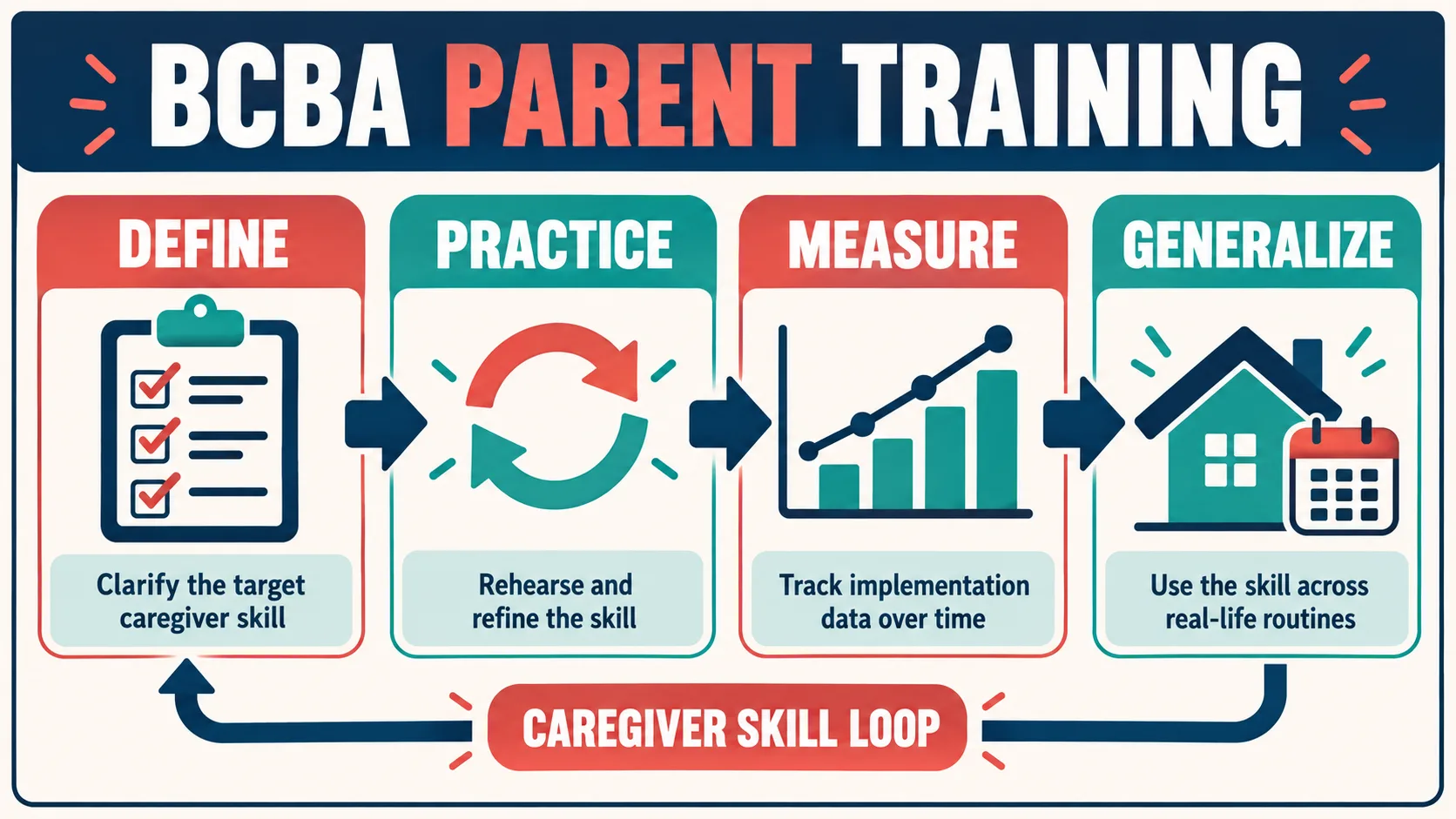
BCBA parent training is structured coaching that helps a parent or caregiver perform a behavior-analytic skill in a relevant routine. The skill might involve arranging an opportunity for communication, delivering reinforcement according to a plan, prompting a replacement response, recording a simple measure, or responding safely to a known behavior pattern. The exact target depends on assessment, the client’s plan, the caregiver’s priorities, and the caregiver’s current skill level.
The “BCBA” part matters because training should match the client’s needs and the caregiver’s context. Good coaching explains the action, its purpose, the correct implementation, what to do when the routine changes, and how progress will be checked.
The “parent” part is not narrow: a grandparent, foster caregiver, teacher, or other support person may be the relevant implementer. Start by asking who supports the routine, what the family wants to improve, and what format makes the skill usable.
Parent Training vs. Direct Child Sessions
Direct sessions focus primarily on the learner’s behavior and skill acquisition. Parent training focuses primarily on the caregiver’s behavior as the person who will arrange opportunities, respond to behavior, or implement part of the plan outside the direct session. The two can support each other, but they are not interchangeable.
For example, a child may correctly request a break with a therapist at a table. A caregiver-training goal might be for the caregiver to create a natural opportunity during homework, prompt the request according to the plan, and reinforce the communication response. The child’s request is an outcome to monitor; the caregiver’s implementation is also a behavior to teach and measure.
Write Goals That Can Be Observed and Measured
A useful parent-training goal names the caregiver response, the condition under which it should occur, the quality or accuracy criterion, and the way progress will be checked. “Parent will understand reinforcement” is difficult to observe. “During the bedtime routine, the caregiver will deliver the programmed reinforcer within 5 seconds of the child using the taught request in at least 80% of observed opportunities across three sessions” gives the team something to teach, measure, and revise.
| Training target | Observable caregiver behavior | Possible measure | Mastery and transfer cue |
|---|---|---|---|
| Communication opportunity | Arranges a choice or pause, waits, and prompts the taught request as written. | Percent of opportunities implemented correctly. | Meet criterion in one routine, then check a second routine. |
| Reinforcement plan | Delivers the planned consequence after the target response and records the opportunity. | Treatment-integrity checklist or interval sample. | Check accuracy with different activities and support levels. |
| Data collection | Defines the response, records the selected dimension, and marks missing opportunities. | Agreement with an observer or comparison to a completed sample. | Use the form independently before reducing coaching. |
| Safety response | Follows the approved response sequence and seeks help when the plan requires it. | Step-by-step fidelity and latency to request support. | Rehearse safely; do not create a dangerous test of the plan. |
Each row describes caregiver behavior, not personality. Translate “be more consistent” into what consistency looks like in one routine. If the goal cannot be observed, the team cannot tell whether the barrier is skill, opportunity, materials, competing demands, or the intervention itself.
How Behavior Skills Training Works for Caregivers
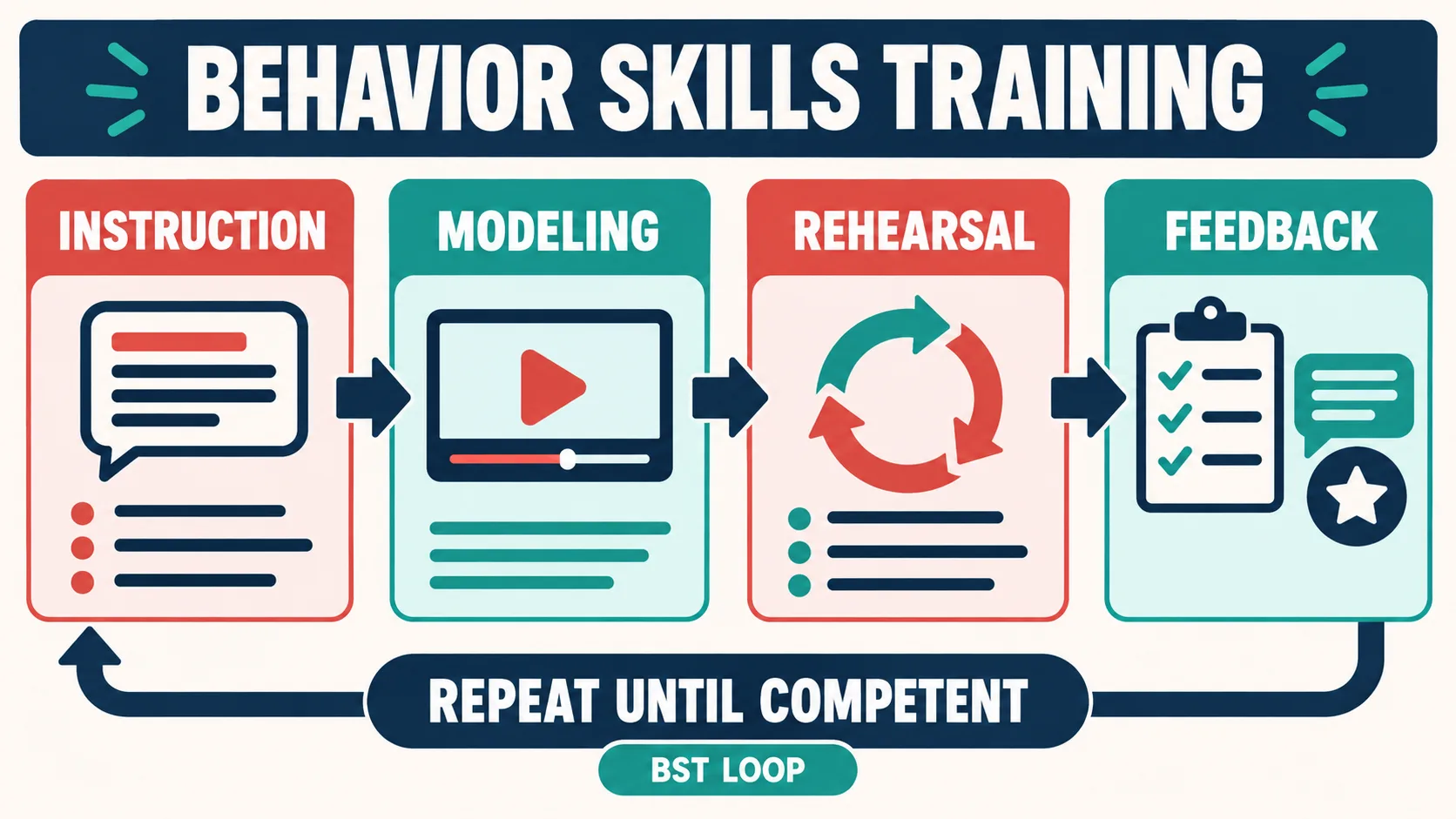
Behavior skills training (BST) is a practical sequence for teaching a person to perform a defined skill. The core steps are instruction, modeling, rehearsal, and feedback. The BACB’s training resources describe these elements for competency-based training; the same logic can be adapted to caregiver coaching when it fits the client, family, and service context.
- Instruction: Explain the target skill in plain language. State when to use it, what to do first, what counts as a correct response, and what to do if the routine does not go as expected.
- Modeling: Demonstrate the skill in the relevant setting. Show the timing, materials, wording, prompts, and reinforcement—not just the ideal final result.
- Rehearsal: Have the caregiver practice through role play, a simulated opportunity, or an appropriate natural routine. Active practice reveals barriers that a lecture can hide.
- Feedback: Give immediate, specific feedback. Reinforce accurate components, describe the next change, and model or rehearse again when the error matters.
BST is not a one-time script. Repeat it until a defined competency criterion is met, then check new people, materials, routines, or settings. If performance is weak, change the training arrangement—not the caregiver label.
Measure Caregiver Performance and Client Outcomes
Parent training becomes data-informed when the team measures more than whether a meeting occurred. At minimum, separate three questions: did the caregiver perform the trained steps, did the client receive the intended opportunity or consequence, and did the client outcome change in a meaningful direction? These measures answer different questions and should not be collapsed into one score.
| Data layer | Question | Example |
|---|---|---|
| Caregiver skill | Can the caregiver perform the taught steps? | 8 correct implementations out of 10 observed opportunities. |
| Procedural integrity | Was the intervention delivered as designed? | Prompt, wait, consequence, and recording steps completed in order. |
| Client outcome | Did the learner’s target or replacement behavior change? | Rate of functional requests during the home routine across days. |
| Social validity | Does the plan fit the family’s priorities and routine? | Caregiver reports the steps are feasible and meaningful, with revision when they are not. |
Data need not be burdensome. A brief opportunity count, fidelity checklist, latency measure, or weekly graph may answer the question. Select the smallest useful measure. If caregiver accuracy is high but the outcome is unchanged, review the assessment, target, reinforcer, opportunity, and plan before assigning blame.
A Practical Parent-Training Session Workflow
A repeatable session structure reduces cognitive load and makes the next decision visible. The details should be individualized, but the sequence below can organize a coaching visit or study scenario.
- Start with the routine and priority. Ask what happened since the last contact, what the caregiver wants to improve, and whether the planned target still matters.
- Review the definition and measure. Confirm what counts, what does not count, and how many opportunities are realistic in the routine.
- Teach one component at a time. Give a concise rationale and instructions that the caregiver can remember under real-world time pressure.
- Model and rehearse. Use the family’s actual materials when possible; then let the caregiver practice while the trainer observes.
- Give feedback and adjust effort. Remove unnecessary steps, clarify wording, and repeat practice until the criterion is met.
- Plan the next transfer check. Decide when, where, and how the team will look for generalization and what data will be brought back.
Plan for Generalization and Contextual Fit
A caregiver may perform a strategy in a quiet coaching session and need support at breakfast, in the car, or during a sibling routine. Plan generalization rather than assuming it; vary people, materials, time, and setting gradually while protecting safety and dignity.
- Use routines the family values. A technically elegant plan that cannot fit the family’s schedule is unlikely to maintain.
- Check response effort. If the caregiver must carry multiple cards, timers, and forms, reduce or redesign the system when possible.
- Use culturally responsive collaboration. Ask how the family defines respectful communication, independence, participation, and success.
- Train the people who actually implement. Include relevant caregivers or support staff with appropriate consent and privacy safeguards.
- Schedule follow-up. A competency check after coaching helps detect drift, new barriers, or a need to update the plan.
Ethical and Professional Boundaries
Parent training is a professional service interaction, not a test of whether a family is “compliant.” Work within competence, explain participation, respect preferences, protect confidentiality, and use data to improve the service. The Ethics Code and applicable law or payer rules outrank any blog checklist.
- Do not promise a particular outcome, insurance payment, number of sessions, or certification benefit from a generic training article.
- Do not ask a caregiver to test a dangerous procedure or change a crisis response without an appropriate plan, training, and support.
- Do not treat a handout as proof of competence; observe rehearsal and provide feedback when the skill is important.
- Document relevant data and collaboration while limiting access to the information needed for the service.
How Parent Training Appears in BCBA Exam Reasoning
On a BCBA-style question, look for the decision the stem is testing. If the question asks how to teach a caregiver to deliver a procedure, BST and performance measurement may be relevant. If it asks whether a goal is well written, choose observable, measurable behavior with a criterion. If it asks why progress cannot be interpreted, inspect procedural integrity, opportunity, data quality, or a change in context.
The current outline connects this reasoning to intervention development, collaboration, data-based decisions, and supervision. Choose answers that make the caregiver skill teachable and feasible while protecting the client; avoid vague motivation, blame, or data-free changes.
Common Parent-Training Mistakes
- Teaching too much at once: choose one functional caregiver response and build fluency before adding layers.
- Measuring attendance only: a meeting occurred, but the team does not know whether the skill was learned or used.
- Using child data as the only caregiver measure: separate implementation accuracy from learner outcome.
- Skipping rehearsal: understanding a verbal explanation does not demonstrate performance.
- Giving global feedback: “be consistent” is less useful than describing the exact step, timing, or opportunity to change.
- Assuming generalization: test the routine and setting where the skill is expected to matter.
- Ignoring feasibility: revise response effort, materials, language, and schedule when the plan does not fit.
Turn the Framework Into Scenario Practice
For each practice question, label the caregiver behavior, learner behavior, context, and measure. Then ask whether the answer teaches, measures, evaluates, or addresses an ethical boundary. This keeps the broad label from hiding the actual decision.
Use the Free BCBA Mock Exam to practice questions about BST, measurable goals, procedural integrity, generalization, collaboration, and data-based decisions. After each item, write down which step you missed: define, model, rehearse, give feedback, measure, or adapt. That error log is more useful than simply counting correct answers.
This new page is intentionally separate from the site’s existing broad parent-training resources. The existing pages remain their own URLs; this article serves the narrower BCBA parent-training query with a competency loop and exam-oriented decision framework.
Frequently Asked Questions
What is BCBA parent training?
It is structured coaching that helps a parent or caregiver perform a behavior-analytic skill in a meaningful routine, with instruction, practice, feedback, and data-informed follow-up. What are the four BST steps?
Instruction, modeling, rehearsal, and feedback. Repeat the cycle until the person meets the defined competency criterion, then check performance in relevant contexts. What should a parent-training goal include?
It should name an observable caregiver response, the condition or routine, a measurable criterion, and how mastery and generalization will be assessed.
Is parent training the same as a child’s ABA session?
No. Direct sessions primarily teach or assess the learner. Parent training primarily teaches the caregiver how to implement or support a plan; both client and caregiver data may matter. Does attending parent training prove that a caregiver is competent?
No. Attendance is exposure to training. Competence is shown through observed performance against a defined criterion, followed by maintenance and generalization checks when relevant.
Bottom line: Strong BCBA parent training is a measurable teaching loop: choose a meaningful caregiver skill, explain it, model it, let the caregiver rehearse, give specific feedback, measure implementation and outcomes, and adapt the plan to the family’s real context.
Take the Free BCBA Mock Exam
When you are ready to apply the idea, use the free practice resource below for additional feedback. Take the Free BCBA Mock Exam



