
A practical guide to modeling in ABA: choose the right model, measure what the learner does, and plan for fading and generalization If you searched for modelling ABA, you are probably looking for the American-English term modeling in ABA. In applied behavior analysis, modeling is a teaching arrangement in which a learner observes a person, video, or other demonstration of a target response and then has an opportunity to perform that response. The demonstration is not the finished intervention by itself. The important question is what the learner does after the model is presented and how the teaching team measures that change.
Table of Contents
- What Does Modeling Mean in ABA?
- The Modeling Sequence
- Types of Modeling in ABA
- Modeling Examples in ABA
- Modeling Versus Prompting, Imitation, and BST
- How to Measure Modeling Outcomes
- Fading, Generalization, and Maintenance
- BCBA Exam Decision Rules
- Frequently Asked Questions
- Quick Review Checklist
- Take the Free BCBA Mock Exam
Modeling can be useful for teaching communication, play, self-care, social behavior, academic routines, and motor skills. It should still be selected because it fits the target, learner prerequisites, setting, and treatment plan—not simply because a video or live demonstration looks engaging.
Quick answer: modeling in ABA means demonstrating a target behavior so the learner can observe and attempt it. A strong modeling procedure specifies the target, selects a live, peer, video, or self-model, provides a clear opportunity to respond, measures performance, and plans how prompts will fade and the skill will generalize.
What Does Modeling Mean in ABA?
Modeling is a form of observational learning: the learner sees a demonstration of a response and then contacts an opportunity to practice it. For example, an instructor might demonstrate how to request a break, a peer might demonstrate how to join a game, or a short video might show the steps for washing hands. The model can be a complete response, a component of a chain, or a comparison showing what a correct response looks like.
In practice, the model should be concrete and observable. “Be more social” is not a modelable target, but “walk to the group, say ‘Can I play?’, and wait for an answer” can be broken into observable responses. Before choosing the demonstration, define what counts as a correct response and identify the measurement that will tell you whether the procedure is helping.
Modeling does not guarantee imitation, skill acquisition, generalization, or maintenance. A learner may watch a demonstration without responding, copy only one component, or perform the skill only with the original model. Those outcomes are reasons to review prerequisites, prompting, reinforcement, task difficulty, and generalization—not reasons to label the learner as “not trying.”
The Modeling Sequence
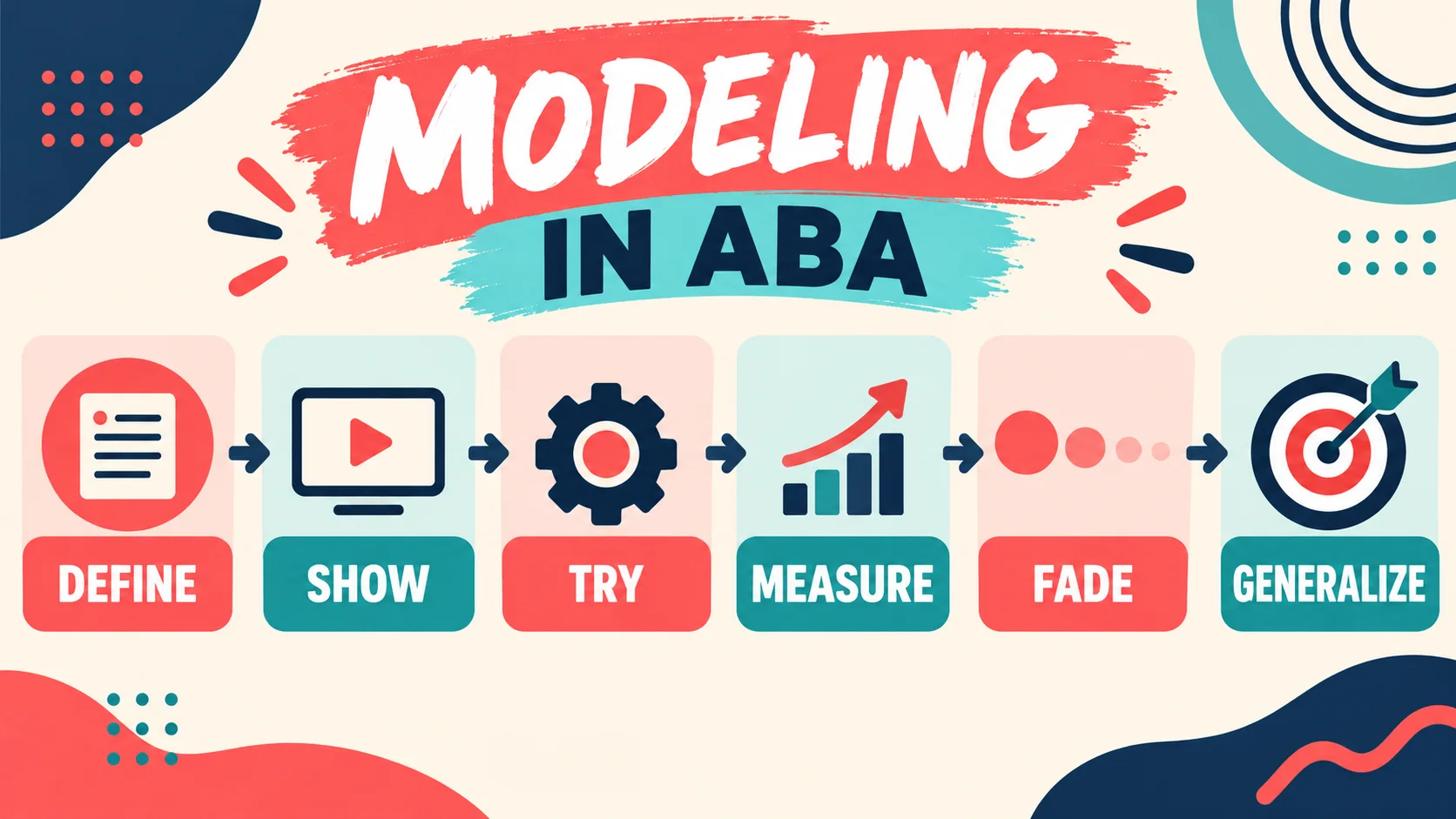
A usable modeling procedure is easier to evaluate when it follows a visible sequence:
- Define the target. Describe the response in observable terms, including the relevant conditions and mastery criterion.
- Show the response. Present a live, peer, video, or self-model that matches the learner’s target and current ability.
- Offer a response opportunity. Give the learner a clear cue and enough time to attempt the target response.
- Measure performance. Record accuracy, independence, latency, duration, rate, or another plan-consistent measure.
- Adjust support. Use the approved prompt, feedback, and reinforcement procedure; do not silently change the treatment plan.
- Fade and generalize. Reduce unnecessary model support and test the skill with new people, materials, settings, or examples.
This sequence prevents a common mistake: measuring how many times a video was shown instead of measuring the learner’s behavior. The model is an antecedent or teaching component; the learner’s response is the outcome that must be evaluated.
Types of Modeling in ABA
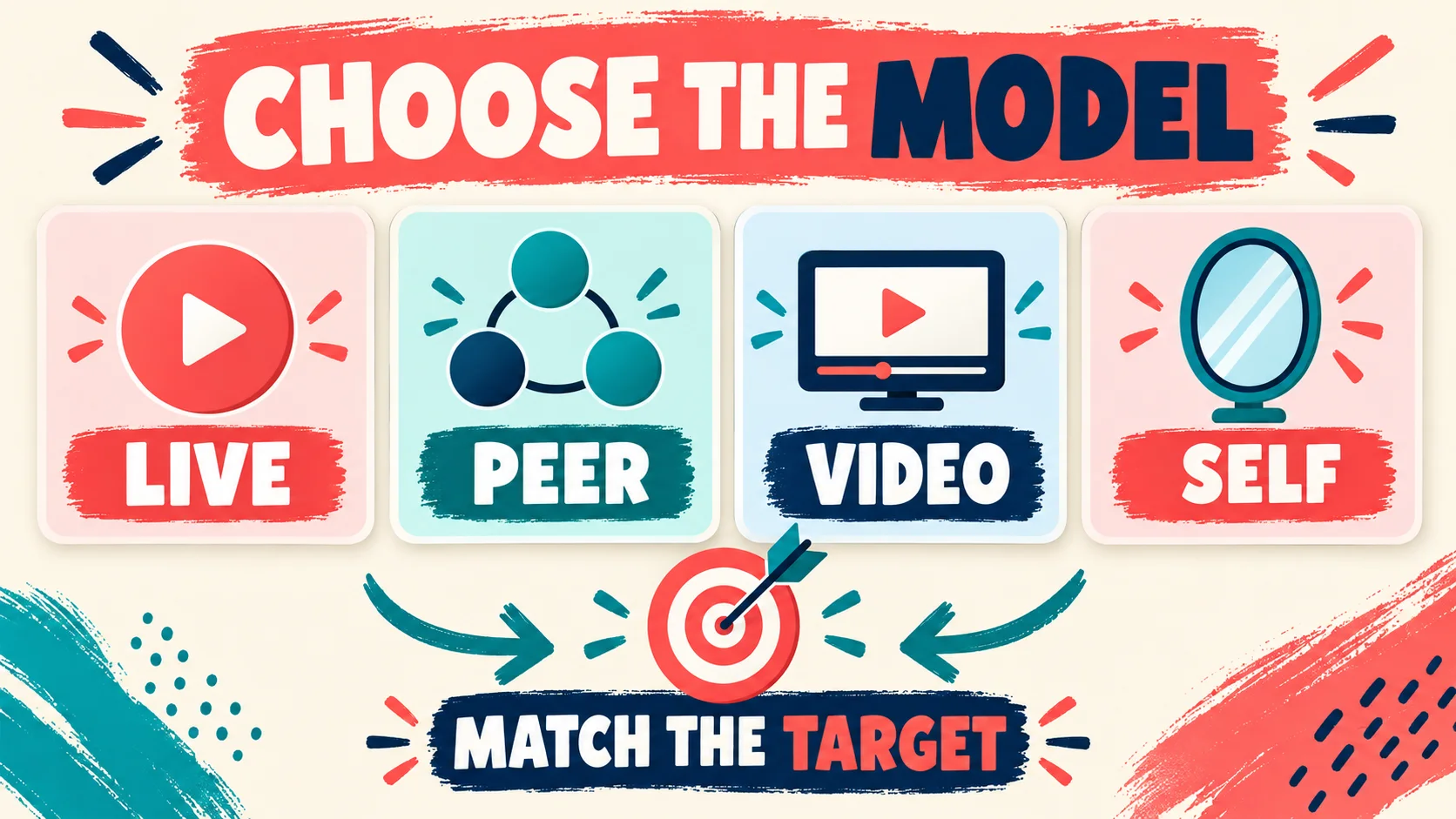
The best model is the one that gives the learner a clear, usable example while fitting the target and the available teaching environment. A model can be combined with other procedures, but the team should be able to identify what part of the arrangement is the model and what part is the prompt, consequence, or feedback.
| Type | What the learner sees | Useful planning question |
|---|---|---|
| Live modeling | An instructor or another person demonstrates the response in the current setting. | Can the learner see the important response components without extra distractions? |
| Peer modeling | A peer demonstrates a social, play, academic, or classroom response. | Is the peer model appropriate, understandable, and available for later practice? |
| Video modeling | A recorded demonstration shows a skill, routine, or social interaction. | Does the recording show the exact target and allow the learner to practice afterward? |
| Self-modeling | The learner watches a recording or edited demonstration featuring their own target performance. | Is the clip accurate, respectful, consented to, and focused on a behavior the learner can practice? |
Model selection should be individualized. A live model may be easiest when the target depends on real materials, while video modeling may provide consistent repetition. A peer model may be useful for social routines, but it does not automatically create generalization. Always evaluate the learner’s response rather than assuming that the most polished model is the most effective one.
Modeling Examples in ABA
Communication: To teach a break request, the instructor can demonstrate picking up a break card, handing it to the communication partner, and moving to the designated break area. The team can then arrange an opportunity and measure independent requests across opportunities. A verbal direction or physical guidance added after the demonstration is a separate prompt and should be recorded as such.
Social play: A peer can demonstrate approaching a game, asking to join, waiting for a response, and taking a turn. The teaching team can measure the number of component steps completed independently, latency to approach, or successful turn exchanges. Practice with more than one peer helps test whether the skill is tied to the original model.
Daily living: A short video can show the steps for preparing a snack. The video should match the actual materials and safety expectations. The learner’s performance can be evaluated by step accuracy, prompt level, or independence across sessions. If the learner watches the video but does not contact the materials, the next decision should address the response opportunity and prerequisites.
Academic routine: An instructor can model how to mark answers on a worksheet, check the example, and request clarification. The target should specify what the learner must do, not merely “pay attention to the model.” Independent work with new items is the stronger test of whether the modeled routine transferred.
Modeling Versus Prompting, Imitation, and BST
These terms often appear together, but they do not mean the same thing. Keeping the boundaries clear improves both treatment descriptions and BCBA exam decisions.
| Term | Core idea | How to tell it apart |
|---|---|---|
| Modeling | Demonstrating the target response for observation. | The learner observes an example before attempting the response. |
| Prompting | An added antecedent support that increases the likelihood of the correct response. | The prompt may be verbal, gestural, visual, model, positional, or physical depending on the plan. |
| Imitation | The learner’s behavior matches or approximates the modeled response. | It describes the learner’s response, not just the demonstration. |
| BST | A package commonly described through instruction, modeling, rehearsal, and feedback. | Modeling is one component; it is not automatically the entire BST package. |
For a focused review of a modeling prompt, see our modeling prompt in ABA guide. For recorded demonstrations, use the narrower video modeling ABA guide. The broad page you are reading owns the overall modeling procedure; those pages support distinct subtopics.
How to Measure Modeling Outcomes
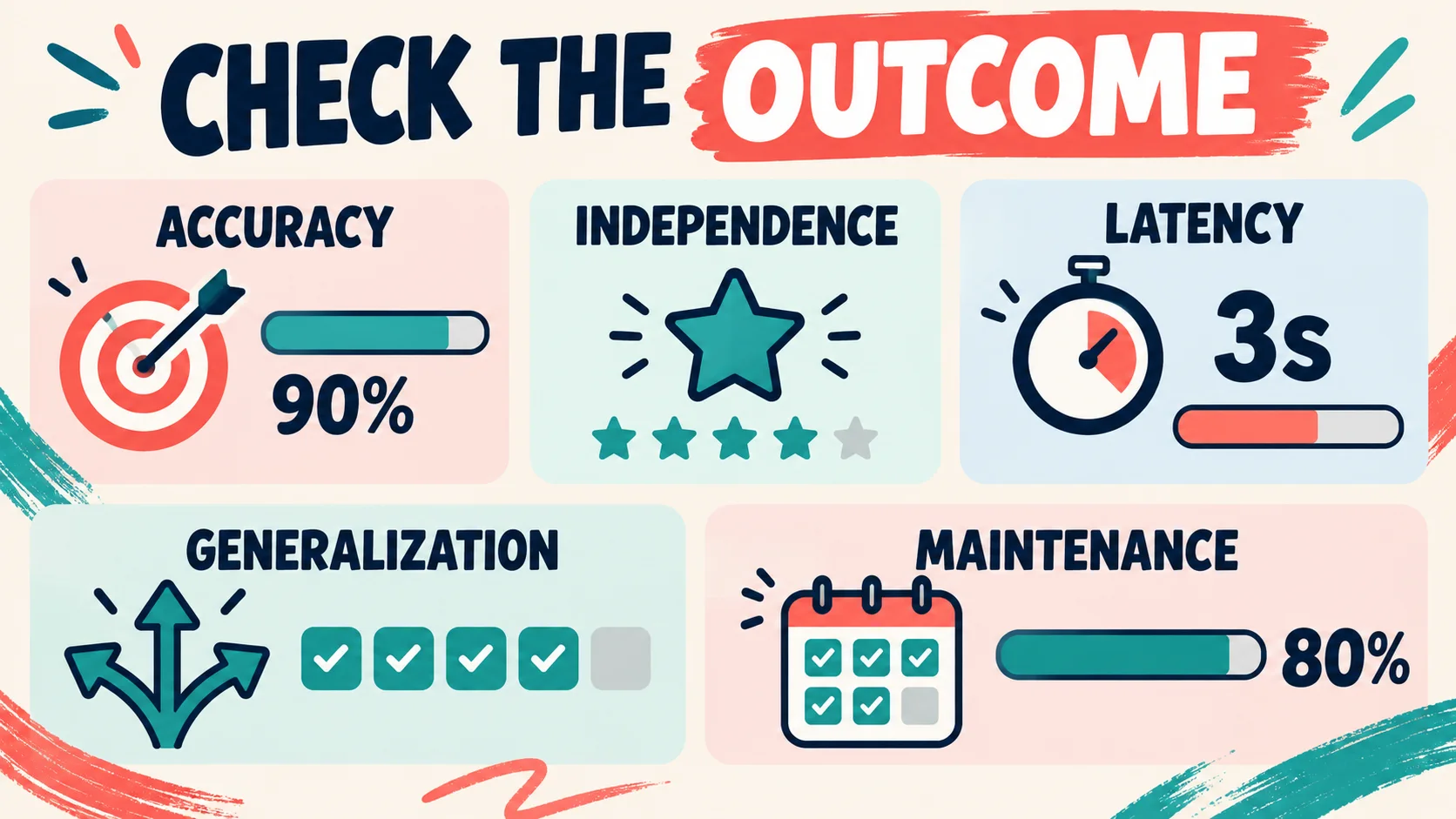
Choose measurement from the target and decision, not from the fact that a model was presented. Depending on the behavior, useful measures may include:
- Accuracy or percentage: correct modeled responses divided by opportunities, when opportunities are clearly defined.
- Independence: the response completed without a specified prompt or with a lower prompt level.
- Latency: time from the instruction or model to the start of the learner’s response.
- Duration: how long the target behavior continues when duration is meaningful.
- Rate or frequency: how often a response occurs within a defined observation period.
- Generalization and maintenance: performance with new people, materials, settings, examples, or after a delay.
“The learner watched the video three times” is exposure data. It may be worth recording, but it does not establish that the target improved. A better note links the demonstration to a response opportunity and reports the learner’s outcome with its unit and context.
Fading, Generalization, and Maintenance
Modeling can accidentally become a dependency if the same demonstration is presented every time and the team never tests independent responding. Plan a fading path early. The exact path depends on the procedure, but it might include shortening the video, removing unnecessary cues, changing the model, increasing the delay before a model, or arranging opportunities in the natural setting. Do not fade a safety-critical or clinically necessary support without an authorized plan.
Generalization should be programmed and measured. Change one relevant feature at a time when needed: a different person, setting, material, example, or instruction. If performance falls only when the peer changes, the team has learned something about stimulus control. If performance remains accurate after the original model is removed and after time passes, maintenance evidence is stronger. When model selection involves a recording of a learner or peer, attend to consent, privacy, dignity, and secure storage. A visually attractive clip is not automatically an appropriate clinical asset.
BCBA Exam Decision Rules
On a BCBA-style question, start by identifying the target response and the arrangement described in the stem. These rules help prevent common distractor errors:
- If the learner watches a demonstration and then practices, the central procedure is modeling; if the question asks what the learner did, look for imitation or independent responding.
- If a model is presented only after an error or delay to increase correct responding, check whether the question is testing a modeling prompt, prompt hierarchy, or prompt-fading issue.
- If instruction, modeling, rehearsal, and feedback are all present, consider BST rather than naming modeling as the entire package.
- If the learner performs only with the original model, choose an answer that addresses generalization or stimulus control instead of assuming mastery.
- If a procedure is proposed without a measurement plan, the stronger clinical answer usually defines the target and outcome before claiming effectiveness.
Use the current BACB BCBA Test Content Outline and BCBA Handbook as the official documents to recheck for current certification and exam information. This educational article is not BACB guidance and does not replace a treatment plan or supervision.
Frequently Asked Questions
What is an example of modeling in ABA?: An instructor demonstrates handing over a break card, then arranges an opportunity for the learner to use the card and records whether the request occurs independently. The demonstration is the model; the learner’s subsequent response is the outcome.
Is modeling a prompt in ABA?: A model can function as a prompt when it is used as an antecedent support to evoke a correct response, but “modeling” can also describe a broader teaching arrangement. Use the question’s context and the defined procedure to decide whether the focus is the model, the prompt, or the learner’s imitation.
What is the difference between modeling and video modeling?: Modeling is the broader procedure. Video modeling is one format in which the demonstration is recorded and replayed. Live, peer, and self-modeling are other possible formats.
How do you know whether modeling worked?: Compare the learner’s defined target performance across opportunities or sessions using a plan-consistent measure, then check whether the skill occurs independently, with new examples, and after the model is faded.
Ready to practice the decision boundaries? Try the Free BCBA Mock Exam, then use your results to choose one measurement, prompting, or generalization topic for review. It is a practice resource, not a prediction of your exam result. Official sources to recheck: BCBA Test Content Outline and BCBA Handbook. Always follow the current treatment plan, supervision requirements, consent procedures, and applicable law or organizational policy.
Quick Review Checklist
Use this final checklist to turn modeling in ABA into exam-ready reasoning. The goal is not to memorize a label in isolation; it is to identify the relevant evidence and explain why the best answer fits the scenario. Key ideas to review:
- State the central definition or decision point for modeling in ABA in your own words.
- Identify the detail that makes modeling in ABA different from its closest related ABA term.
- Separate the observable facts in a scenario from assumptions that are not supported by the facts.
- Write one example and one nonexample so you can recognize the concept in a new setting.
Exam application checks:
- Ask what the question is actually requesting before comparing the answer choices.
- Mark the antecedent, response, consequence, or other evidence that supports the selected answer.
- Look for a distractor that describes a related process but does not answer the specific question.
Final self-check:
- Explain how you would verify the interpretation with clear observations or data.
- Change one detail in the scenario and decide whether your answer should change.
- Give a one-sentence rationale that a supervisor or study partner could evaluate.
Take the Free BCBA Mock Exam
A useful next step is to apply this idea in a fresh set of BCBA-style practice questions and review the feedback. Take the Free BCBA Mock Exam



