
A source-first Pennsylvania pathway guide: separate BACB certification from the state credential, organize your documents, and plan the 2027 recheck. If you are searching for how to become a BCBA in PA, the most important answer is that Pennsylvania involves two related but separate layers. First, you pursue national Board Certified Behavior Analyst certification through the Behavior Analyst Certification Board (BACB). Second, you verify the Pennsylvania credential, employer, payer, and service-setting requirements that apply to the work you want to do. A BCBA certificate alone should not be treated as a universal substitute for every state or workplace requirement.
Table of Contents
- How to Become a BCBA in PA: The Two Credential Layers
- The BACB Certification Path
- The Pennsylvania Credential Layer
- A Practical Pennsylvania Sequence
- Documents and the 2027 Recheck
- Where BCBA Exam Preparation Fits
- Common Planning Mistakes
- Frequently Asked Questions
- Quick Review Checklist
- Take the Free BCBA Mock Exam
The practical order is usually: confirm the BACB route, complete graduate education and behavior-analytic coursework, document supervised fieldwork, apply for and pass the examination, then check the Pennsylvania layer with current state sources. Documents and timing depend on your pathway, so use this article as a planning map rather than a legal promise.
Quick answer: to become a BCBA in Pennsylvania, plan for the current BACB degree/coursework, supervised-fieldwork, application, and examination requirements, then separately verify Pennsylvania’s Behavior Specialist licensure and any employer or payer rules. Start with the current BACB Handbook and Pennsylvania’s official Behavior Specialist Licensure Requirements Snapshot before you submit anything.
How to Become a BCBA in PA: The Two Credential Layers
The BACB certification and Pennsylvania authorization answer different questions. BACB certification asks whether you meet the national education, supervised-fieldwork, application, and examination standards for the BCBA credential. Pennsylvania requirements ask what is needed to practice, bill, work in a particular service system, or hold a state credential in the Commonwealth. An employer may also add its own requirements for supervision, background checks, training, or payer enrollment.
| Layer | What it answers | What to verify |
|---|---|---|
| BACB certification | Whether you qualify for and earn the national BCBA credential. | Current pathway, degree/coursework evidence, supervised fieldwork, application, and examination rules. |
| Pennsylvania credential | Whether you meet the Commonwealth’s current Behavior Specialist licensing requirements for the role and setting. | The official state snapshot, PALS routing, experience, coursework, fees, renewal, and any endorsement route. |
| Workplace or payer | Whether a particular employer, contract, school, health plan, or program will accept your evidence. | Written job, contract, enrollment, supervision, background, and service-specific instructions. |
This separation prevents a common mistake: collecting BACB documents while assuming that Pennsylvania practice questions are handled automatically. Use the national and state checklists as two linked workstreams.
The BACB Certification Path
Start with current BACB documents, not an old blog post or program advertisement. The BACB’s 2027 materials describe two broad eligibility pathways beginning January 1, 2027: an accredited or recognized program route, and a behavior-analytic coursework route. Both still require the applicable degree, preparation, supervised fieldwork, and examination steps in the current requirements and handbook. 1. Confirm the degree and coursework route
First identify which BACB route fits your education history. A master’s or doctoral degree by itself is not enough to assume eligibility. You need evidence that your degree and behavior-analytic content match the route and edition that will govern your application. Ask the school for the exact transcript, course, attestation, or program documentation that the current BACB materials require. Save the answer with the date and the source version. 2. Plan supervised fieldwork before you start logging
Supervised fieldwork is not simply time spent in an ABA setting. Activities, supervision, observation, monthly records, signatures, and final verification must fit current BACB rules. Before accepting a position, ask who will supervise you, which activities can count, how records will be reviewed, and which form family applies. A spreadsheet can reconcile records, but it does not replace an official form or the supervisor’s responsibility.
For a deeper planning step, compare your arrangement with the existing BCBA fieldwork and supervision requirements guide. Keep Pennsylvania employer or service rules separate from BACB fieldwork eligibility; they may overlap, but they are not identical. 3. Submit a complete certification application
When your evidence is ready, follow the current BACB application process and use the correct forms for your pathway. A complete application matters because the 2027 transition has an important timing boundary. The BACB says that an application reviewed under the current 2022 requirements must be complete, including payment and required documents, by December 31, 2026. If your application will be reviewed under 2027 requirements, follow the new pathway and form instructions instead of mixing editions. 4. Prepare for and pass the BCBA examination
After the application and authorization steps are in place, prepare for the examination using the current Test Content Outline and your own performance data. Exam preparation is not a replacement for eligibility evidence. It is the final readiness work that helps you respond to applied questions about measurement, assessment, intervention, ethics, supervision, and professional practice.
The Pennsylvania Credential Layer
Pennsylvania’s official Behavior Specialist Licensure Requirements Snapshot describes a separate state credential. The current snapshot lists a master’s degree or higher in an approved or related field, no examination requirement for that license, at least one year of experience involving functional behavior assessments for individuals under 21, and 1,000 hours of in-person clinical experience with individuals with behavioral challenges or 1,000 related hours with individuals with autism spectrum disorders. It also lists 90 hours of evidence-based coursework across areas such as ethics, assessment, crisis intervention, family collaboration, autism, instructional strategies, co-morbidity and medications, and skill deficits.
Read the snapshot carefully: this is a Pennsylvania Behavior Specialist credential, not a second name for the BACB exam. It also lists initial and renewal fees and child-abuse-reporting continuing education. Before applying, use the current Pennsylvania professional-licensing page and PALS instructions to confirm the board, uploads, payment, and status process.
| Pennsylvania snapshot item | Planning meaning | Evidence to locate |
|---|---|---|
| Graduate degree | Your degree must fit the state-approved or related-field language. | Official transcript and program information. |
| Experience and clinical hours | You need to map the FBA experience and qualifying-hour route before assuming BACB fieldwork satisfies the state item. | Employer records, supervisor verification, dates, setting, and population served. |
| Evidence-based coursework | Separate the state coursework categories from the BACB coursework evidence. | Course syllabi, certificates, transcripts, and the current state checklist. |
| Application and renewal | Use the current state portal and recheck fees, reporting, and renewal instructions. | PALS confirmation, payment receipt, license record, and renewal calendar. |
For the broader distinction between national certification and state authorization, see the site’s current BCBA state-licensure verification guide. The Pennsylvania-specific answer still requires the official Commonwealth page because state terminology and practice rules are not interchangeable from one state to another.
A Practical Pennsylvania Sequence
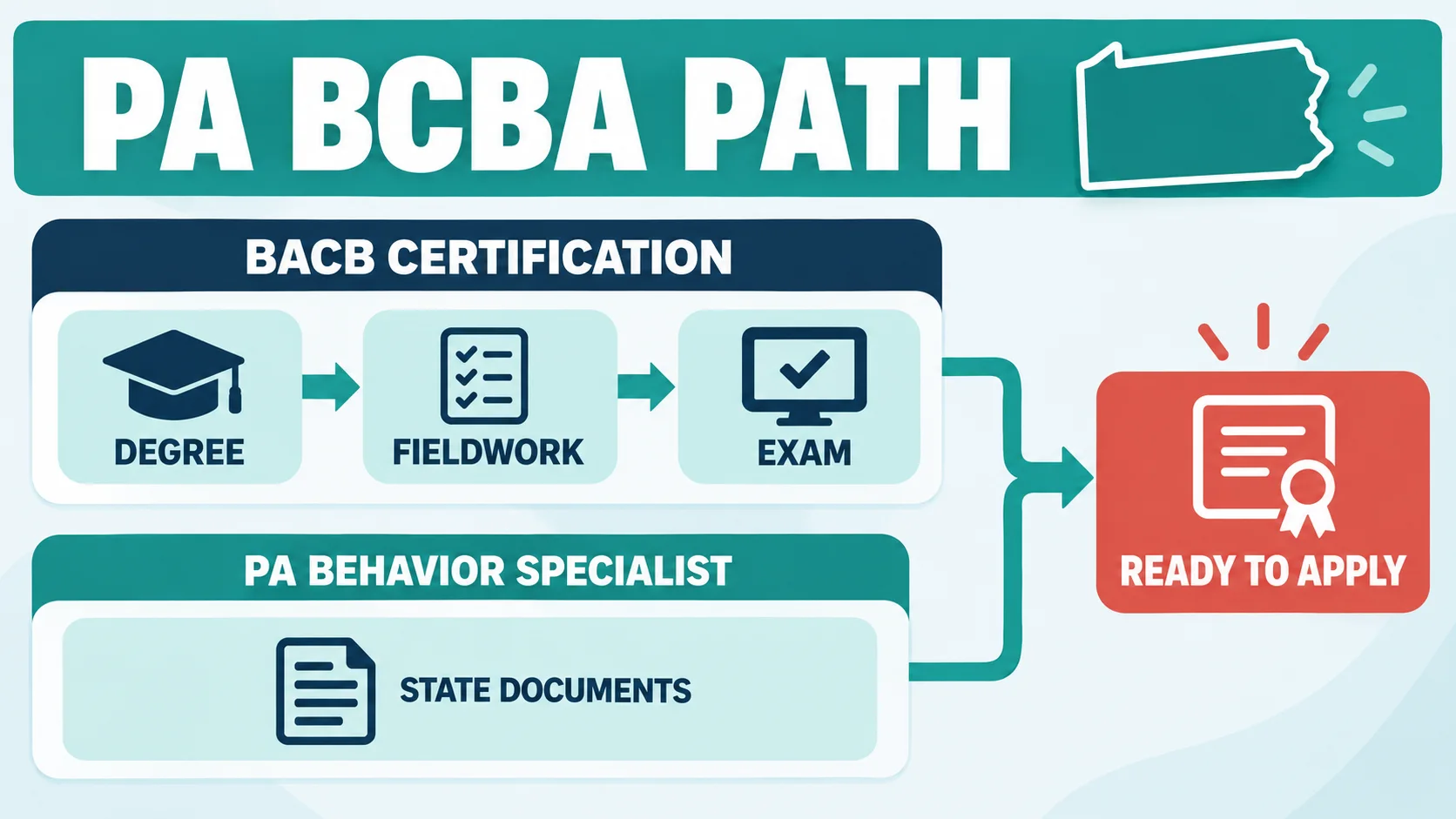
If you are starting from the beginning, use this sequence as a planning checklist:
- Choose the certification route. Compare your graduate degree, behavior-analytic coursework, and the BACB pathway that will govern your application.
- Ask for written fieldwork details. Confirm supervisor qualifications, activities, observation, monthly review, records, and the form edition before you log hours.
- Build a two-column evidence folder. Put BACB evidence in one column and Pennsylvania or employer evidence in the other. Add the source URL and date beside every requirement.
- Prepare for the exam from the current outline. Use practice questions to find weak domains, then return to definitions, examples, data, ethics, and application rules.
- Submit the national application and monitor the status. Do not assume that a completed degree or passed exam automatically creates a Pennsylvania state credential.
- Verify the Pennsylvania route for your intended setting. Check the Behavior Specialist snapshot, PALS, employer, payer, and service-program instructions before you begin work under a particular title.
Documents and the 2027 Recheck
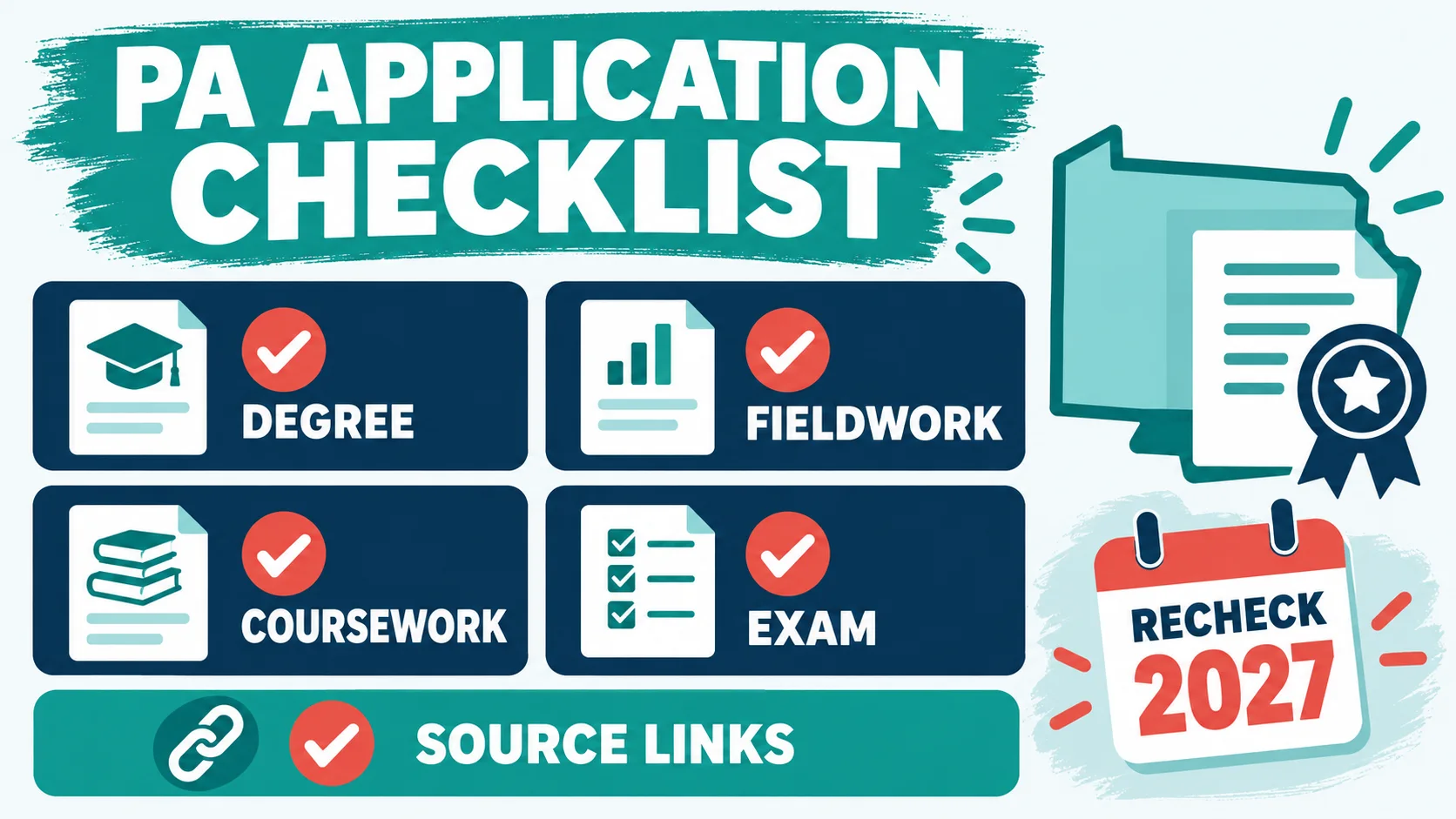
Make the application process auditable. Keep dated copies of the current BACB requirements, handbook, pathway instructions, fieldwork forms, Pennsylvania snapshot, and PALS checklist. Track evidence instead of relying on memory.
| Checkpoint | Record | Recheck question |
|---|---|---|
| Degree and coursework | Transcript, course list, syllabi, attestation or program evidence. | Which current BACB pathway and Pennsylvania category does this document support? |
| Fieldwork | Monthly records, supervision evidence, observations, signatures, final forms. | Does the record match the current BACB form edition and supervisor instructions? |
| Application | BACB submission, payment, authorization, and PALS/state submission evidence. | Is the application complete, and which authority is reviewing it? |
| Source recheck | Accessed date, source URL, saved PDF or screenshot, and next review date. | Did BACB or Pennsylvania change a pathway, form, fee, or deadline? |
The BACB transition matters if you are deciding whether to submit before or after January 1, 2027. The BACB says an application reviewed under current requirements must be complete by December 31, 2026. Do not rush blindly; determine which edition applies to your evidence and whether the application can actually be complete. Do not mix 2022 assumptions with 2027 forms or pathway language.
Where BCBA Exam Preparation Fits
Exam preparation belongs after you understand the eligibility map, but it should begin before the application is submitted. Use the current Test Content Outline to organize domains, then use practice questions to expose reasoning gaps. A missed measurement question may reflect a denominator problem, an operational-definition problem, or confusion between a dimension and a procedure. Target the reason, not only the answer letter.
A good study loop is simple: complete questions, classify each miss, review the concept, explain why distractors are wrong, and retest later. Keep application and state-law questions separate because a correct exam answer does not settle Pennsylvania licensure. The existing Free BCBA Mock Exam is a practice checkpoint, not a score or certification prediction.
Common Planning Mistakes
- Calling every hour “BCBA fieldwork.” Employment experience, Pennsylvania clinical experience, and BACB supervised fieldwork may have different definitions and evidence rules.
- Using an old state guide. A fee, portal, form, or licensing term can change. Use the current Pennsylvania page and record the access date.
- Assuming the acronym PA is enough. The search phrase is shorthand, but the article and application should use the full Pennsylvania terminology and the exact credential name.
- Confusing the state credential with the BACB exam. The Pennsylvania snapshot currently describes no examination requirement for the Behavior Specialist license, while the BACB credential has its own examination step.
- Studying without a decision log. If you cannot explain why an answer is correct and which source governs it, more random questions may not solve the gap.
Frequently Asked Questions
Do I need a Pennsylvania license if I become a BCBA?: That depends on the role, service setting, employer, payer, and current state rules. Do not assume that BACB certification alone answers every Pennsylvania practice or billing question. Check the current Pennsylvania Behavior Specialist snapshot, PALS instructions, and the written requirements of the organization or payer. Does Pennsylvania require a separate BCBA exam?: The BACB credential includes the national examination. Pennsylvania’s current Behavior Specialist snapshot lists no examination requirement for that state license; verify both layers before applying.
Can I use the same fieldwork hours for BACB and Pennsylvania requirements?: Possibly, but do not assume automatic equivalence. The BACB and Pennsylvania state snapshot describe different evidence questions. Ask the relevant authority or supervisor how your specific records should be documented, including population, setting, FBA experience, supervision, and dates. Should I apply before 2027?: Only if your application can genuinely be complete under the applicable rules. Compare your evidence with the current handbook and transition guidance, including the December 31, 2026 complete-application boundary.
Ready to practice the exam decisions that sit inside this pathway? Try the Free BCBA Mock Exam, then turn your missed questions into a focused review list. It is a study resource, not a guarantee of certification, licensure, employment, or exam success.
Official sources to recheck: BACB 2027 transition guidance, the 2027 BCBA Requirements document, the BCBA Handbook, Pennsylvania’s Behavior Specialist Licensure Requirements Snapshot, and the Commonwealth’s professional licensing page. This article is educational planning information, not legal advice. For targeted review, use our how to become a bcba in pa practice questions to apply the concept in exam-style scenarios.
Quick Review Checklist
Use this final checklist to turn how to become a bcba in pa into exam-ready reasoning. The goal is not to memorize a label in isolation; it is to identify the relevant evidence and explain why the best answer fits the scenario. Key ideas to review:
- State the central definition or decision point for how to become a bcba in pa in your own words.
- Identify the detail that makes how to become a bcba in pa different from its closest related ABA term.
- Separate the observable facts in a scenario from assumptions that are not supported by the facts.
- Write one example and one nonexample so you can recognize the concept in a new setting.
Exam application checks:
- Ask what the question is actually requesting before comparing the answer choices.
- Mark the antecedent, response, consequence, or other evidence that supports the selected answer.
- Look for a distractor that describes a related process but does not answer the specific question.
Final self-check:
- Explain how you would verify the interpretation with clear observations or data.
- Change one detail in the scenario and decide whether your answer should change.
- Give a one-sentence rationale that a supervisor or study partner could evaluate.
Take the Free BCBA Mock Exam
A useful next step is to apply this idea in a fresh set of BCBA-style practice questions and review the feedback. Take the Free BCBA Mock Exam



