

A reusable, objective-first template for documenting ABA sessions without turning one blank form into a universal payer or EHR rule If you searched for an ABA session notes template, you probably want something you can copy, fill in quickly, and review later without losing the clinical meaning of the session. A useful note should connect what happened, what was measured, what was done, how the client responded, and what should happen next.
Table of Contents
- What Is an ABA Session Notes Template?
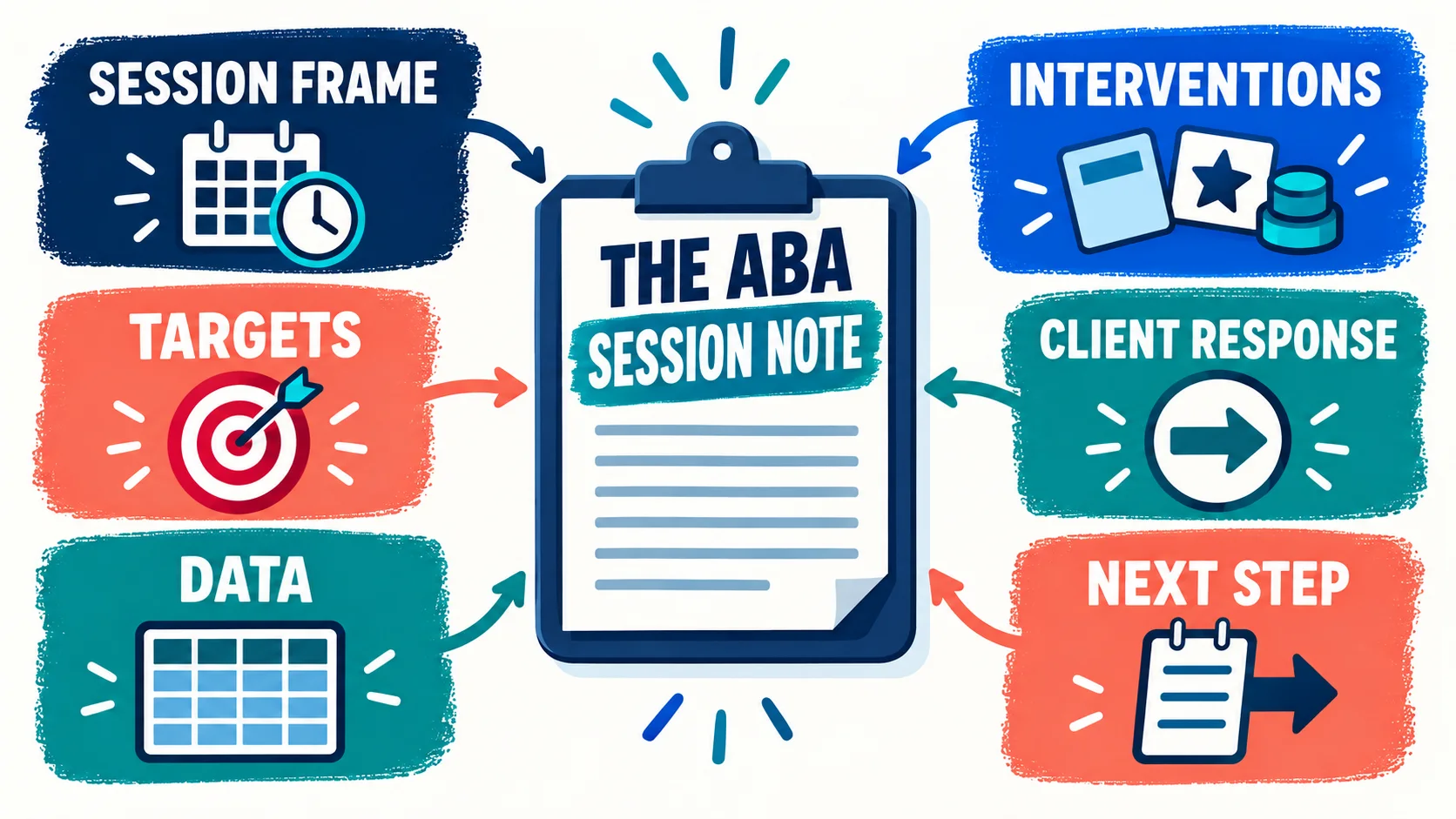
- The Six Fields Every Note Should Organize
- Blank ABA Session Notes Template
- How to Keep the Note Objective
- How the Template Changes by Role
- Fictional Example
- Privacy, Accuracy, and Review Checklist
- Common Template Mistakes
- Turn Documentation Practice Into Better Exam Decisions
- Take the Free BCBA Mock Exam
The template below is an educational starting point, not a promise that one format satisfies every employer, payer, state, contract, or electronic health record. The current BACB Ethics Code for Behavior Analysts requires attention to confidentiality, documentation protection and retention, accurate reporting, and informed consent. Follow the stricter applicable rule when your organization or funder requires additional fields.
Quick answer: a defensible ABA session note usually includes the session frame, targets, objective data, interventions, client response, and a plan-consistent next step. Use observable language, preserve the measurement unit, and never place real client identifiers in a public template or example.
What Is an ABA Session Notes Template?
An ABA session notes template is a structured prompt for recording what occurred during a behavior-analytic service session. It is not a script that tells a practitioner what to say, and it is not a substitute for a treatment plan, behavior intervention plan, supervision agreement, or payer policy. Its job is to reduce omissions and make the record easier for an authorized reviewer to understand. A good template does three things at the same time:
- Preserves the session frame: when, where, who was present, and what service or activity was provided.
- Connects actions to measurement: the reader can see which targets were addressed and what the data actually show.
- Supports the next decision: the note records a plan-consistent next step instead of a vague statement such as “continue as usual.”
Templates found in search results may be built for an RBT, BCBA, caregiver-training visit, direct therapy, supervision, or an AI documentation tool. Start with the role and service type before copying fields from another form. “ABA session notes” is a broad label, not one universal document category.
The Six Fields Every Note Should Organize
The six blocks below are a practical content map. Your organization may split them into more fields, but the reasoning should remain visible.
| Field | What to capture | Quality check |
|---|---|---|
| Session frame | Date, start and end time, duration, setting, provider role, and who was present | Does the frame match the approved schedule and service record? |
| Targets | Programs, replacement behaviors, skill-acquisition targets, or behavior-reduction targets addressed | Are targets connected to the current plan rather than invented for the note? |
| Data | Measurement type, opportunities or observation time, result, and any relevant context | Could another reviewer identify the unit and denominator? |
| Interventions | Procedures used, prompts, reinforcement, antecedent supports, and relevant changes | Does the description match what was actually implemented? |
| Client response | Observable response, progress, barriers, generalization, maintenance, or safety-relevant events | Is the response observable and linked to data or an event? |
| Next step | What continues, what needs review, and what the authorized team member should check next | Does the plan follow from the session instead of making a new unsupported clinical decision? |
Blank ABA Session Notes Template
Copy the structure below into an approved system, then adjust it to your role, service type, and organization’s requirements. Keep the prompts, but remove anything your workflow does not authorize you to complete. A blank form is useful only when the person completing it understands the measurement and scope behind each field.
ABA Session Note — Blank Structure Session frame: Date: ____ Start: ____ End: ____ Duration: ____ Setting: ____ Provider role: ____ People present: ____ Targets addressed: Program or target 1: ____ Target 2: ____ Replacement or skill-acquisition target: ____ Data summary: Target ____ Measurement ____ Observation/opportunities ____ Result ____ Context or limitation ____ Procedures used: Antecedent support ____ Teaching or behavior-change procedure ____ Prompt level ____ Reinforcer or consequence ____ Client response: Observable response and relevant change: ____ Barriers, generalization, or safety event: ____ Next step: Continue ____ Review ____ Communicate to ____ Follow-up date or condition: ____ Review: Objective wording checked: ____ Data unit checked: ____ Confidentiality checked: ____ Signature/approval field: ____
The blank structure is intentionally neutral. For example, “reinforcer” does not mean that every session used the same consequence, and “client response” does not mean that the writer should make a diagnosis. Document what was observed and what the approved plan permits you to report.
How to Keep the Note Objective
Objective writing describes what an observer could identify, count, time, or verify. It does not remove professional judgment; it makes the basis for that judgment visible. Compare these examples:
- Vague: “The client had a bad session and was not cooperative.”
- More objective: “During the first 10-minute work block, the learner left the chair three times after the instruction was presented. After a visual choice and a prompted break request, the learner returned and completed 4 of 5 presented tasks.”
- Vague: “The intervention worked well.”
- More objective: “Following the prompt-fading step, independent requests increased from 2 of 8 opportunities to 5 of 8 opportunities during the final teaching block.”
Keep the measurement type attached to the number. A count without observation time may not answer the same question as a rate, and a percentage without the opportunity count hides useful context. If you are unsure whether a target calls for frequency, rate, duration, percentage, latency, or an interval measure, check the plan and review the measurement logic before completing the note. The site’s rate recording ABA guide can support exam-focused review of that distinction.
How the Template Changes by Role
The same six blocks can appear in different records, but the responsibility for interpreting data or changing a protocol is not interchangeable. Use the role label to prevent a template from silently expanding someone’s scope.
| Role context | Emphasize | Do not imply |
|---|---|---|
| RBT or technician note | What was observed, what data were collected, what procedures were implemented, and what was communicated | Independent diagnosis, unauthorized protocol redesign, or a conclusion outside the role |
| BCaBA note | Implementation, data review, communication, and the supervising BCBA’s direction | A universal authority to change goals or procedures without required oversight |
| BCBA note | Clinical interpretation, treatment-plan connection, supervision or caregiver-training decisions, and documented follow-up | A claim that one template overrides law, payer policy, contract, or informed-consent requirements |
Fictional Example
Here is a short fictional example using initials only. It demonstrates structure, not a required note length or a billing standard:
Session frame: 06/18/2026, 3:00–4:00 p.m., clinic setting. RBT and learner J.R. were present; the supervising BCBA reviewed data remotely according to the approved arrangement. Targets and data: Requesting a break was targeted across 8 opportunities; J.R. used the response independently in 5 opportunities and used a verbal prompt in 2. One opportunity ended before a response because the activity changed.
Procedures and response: The RBT used the current visual choice and prompt-fading procedure. J.R. returned to the task after the break in 3 of 4 opportunities and completed the final work block with 80% independent responding. Next step: Continue the approved break-request program, review the incomplete opportunity with the BCBA, and check whether independent responding generalizes to the classroom routine.
Notice what the example does not do. It does not use a real name, claim that the learner “felt” a certain way, invent a diagnosis, or announce a new treatment change without identifying the authorized review. The note remains useful because it preserves the data and the next decision.
Privacy, Accuracy, and Review Checklist
Before signing or submitting a note, ask:
- Identity: Did I use the approved identifier and keep unnecessary personal information out?
- Time: Do start time, end time, duration, setting, and service details agree across the record?
- Data: Is every number paired with its measurement type, opportunity count, or observation period?
- Accuracy: Did I document what occurred rather than fill a template with assumed or copied details?
- Scope: Did I distinguish implementation from a clinical decision that requires a supervisor or BCBA?
- Confidentiality: Is the note stored, sent, and retained through an approved system?
- Follow-up: Does the next step identify what should be reviewed and by whom?
The BACB Ethics Code states that behavior analysts must follow applicable requirements for storing, retaining, transporting, and destroying professional documentation, and that services and billing should be reported accurately. Those statements do not tell every organization exactly which template to use. They do tell you why a generic internet form should be checked against the current rules before it becomes part of a real workflow.
Common Template Mistakes
- Copying a competitor’s form without checking scope: a field designed for a BCBA may not belong in an RBT record.
- Using adjectives instead of observations: replace “unmotivated” with the observable response, context, and measurement.
- Leaving units out: “10 responses” is incomplete if the reader cannot tell the observation time or opportunities.
- Writing the plan before reviewing the data: let the session evidence and authorized treatment plan guide the next step.
- Putting client information into a public sample: use fictional initials and invented data for training examples.
- Treating the template as compliance by itself: a clean layout cannot fix inaccurate reporting or an outdated organization rule.
Turn Documentation Practice Into Better Exam Decisions
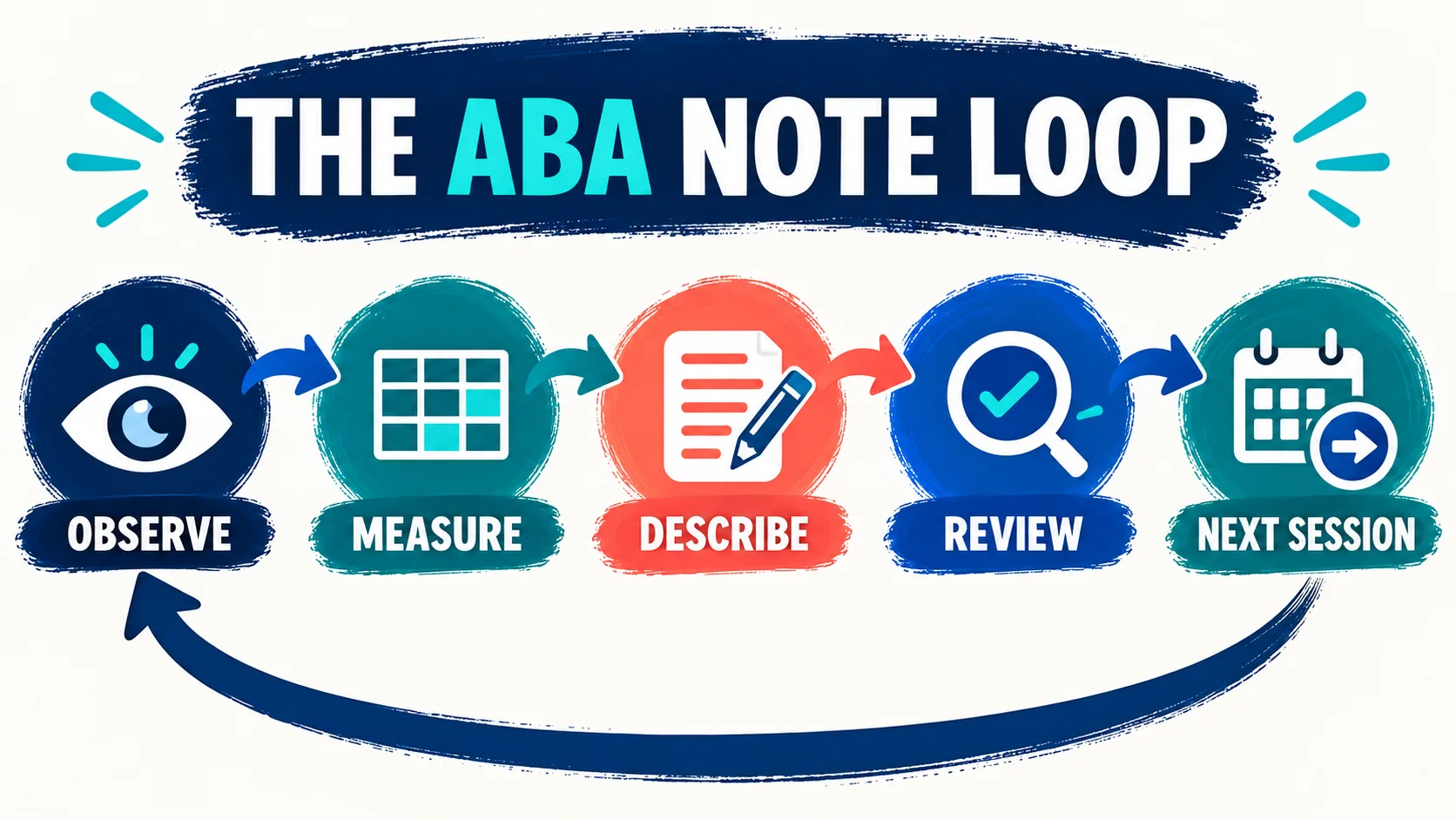
An ABA session notes template is more than a blank form. It is a small decision system: observe the session, measure the target, describe the procedure, review the response, and choose a plan-consistent next step. That same discipline helps BCBA candidates read exam scenarios without skipping the controlling detail.
Once you understand the measurement and objective-language pieces, try the Free BCBA Mock Exam as a practice step. Use the result to identify one measurement or decision skill to review; it is not BACB guidance, a billing form, or a guarantee of an exam result. Official source to recheck: BACB Ethics Code for Behavior Analysts. For current practice, also follow the applicable state, organization, payer, contract, and EHR instructions.
Take the Free BCBA Mock Exam
A useful next step is to apply this idea in a fresh set of BCBA-style practice questions and review the feedback. Take the Free BCBA Mock Exam



