
What Are Conditioned Stimuli? A BCBA Candidate’s Guide
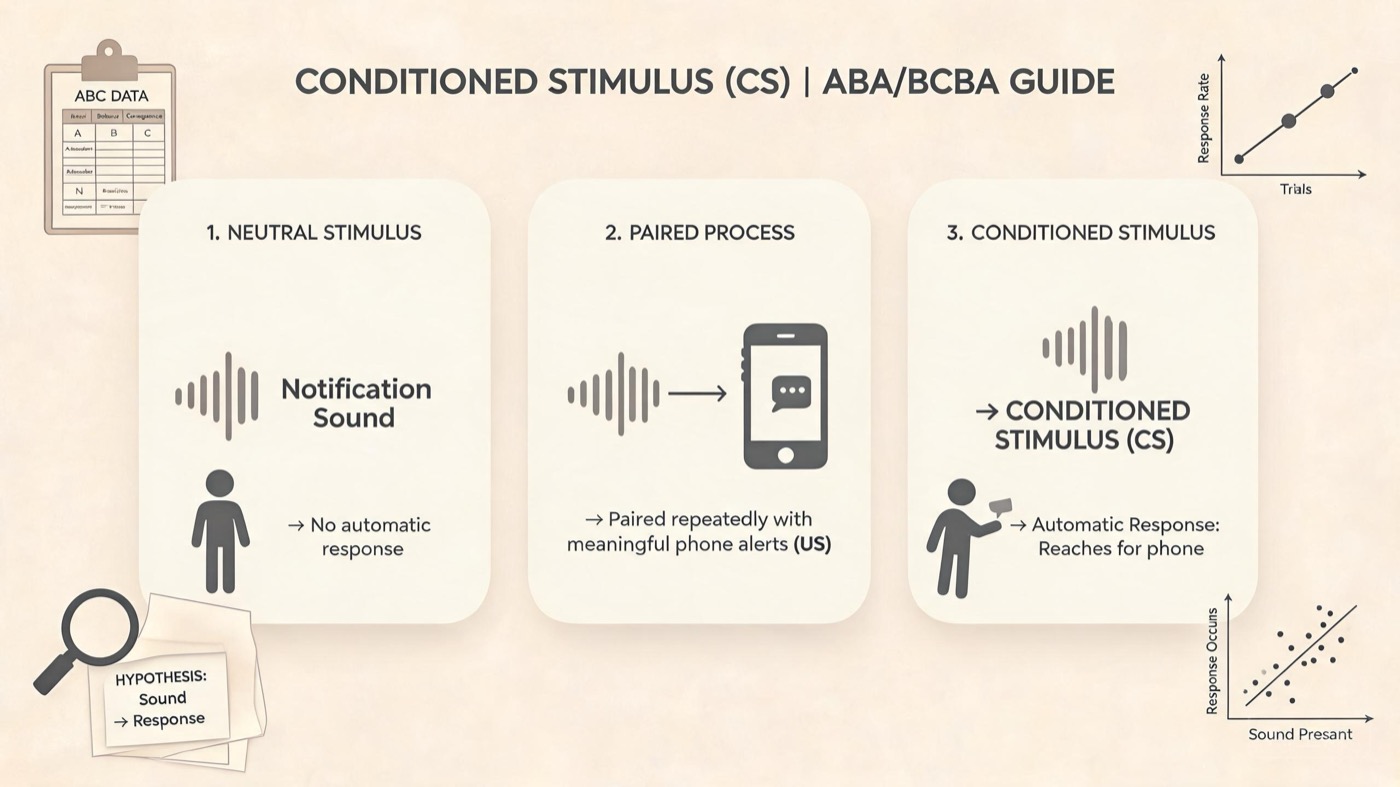
When you hear a familiar notification sound, do you automatically reach for your phone? That sound, once neutral, now triggers a response because it was paired with something meaningful. In ABA, this is a conditioned stimulus (CS). Understanding this concept is essential not only for the BCBA exam but also for designing effective intervention plans. Let’s break it down.
Table of Contents
- What Are Conditioned Stimuli? A BCBA Candidate’s Guide
- Why Conditioned Stimuli Matter on the BCBA Exam
- Real ABA Examples: Conditioned Stimuli in Action
- Quick Checklist for Conditioned Stimuli on the BCBA Exam
- Final Summary: Conditioned Stimuli Made Simple
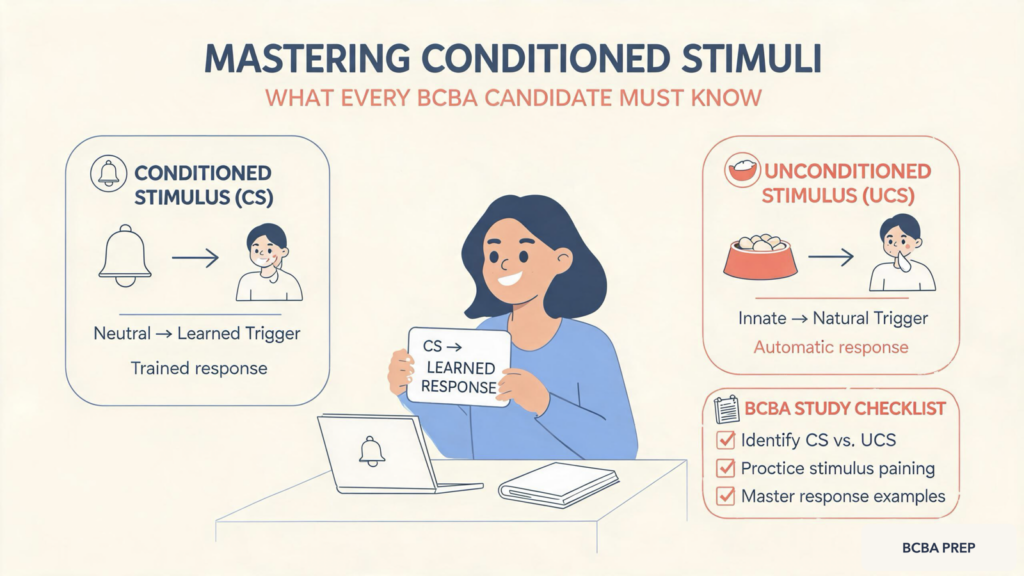
A conditioned stimulus is a previously neutral stimulus that, after repeated pairing with an unconditioned stimulus (US), begins to elicit a conditioned response (CR). This process is central to respondent conditioning (Pavlovian conditioning). For example, a bell tone (neutral) paired with food (US) eventually makes a dog salivate (CR) at the sound alone.
Conditioned vs. Unconditioned Stimuli: Key Distinctions
- Unconditioned Stimulus (US): Naturally elicits a reflexive response without learning (e.g., food, pain, light). Example: Food automatically causes salivation.
- Conditioned Stimulus (CS): Elicits a response only after being paired with a US. Initially, the neutral stimulus has no effect.
- Unconditioned Response (UR): Unlearned reaction to a US (e.g., salivation to food).
- Conditioned Response (CR): Learned reaction to a CS, often similar to the UR but triggered by the CS alone.
- Key Exam Point: The CS is always learned; the US is innate. A stimulus is conditioned only if its effect depends on prior pairing.
The Respondent Conditioning Process
Respondent conditioning follows a simple sequence: a US automatically elicits a UR. Then, a neutral stimulus is repeatedly presented just before the US. Eventually, the neutral stimulus becomes a CS that elicits a CR. For instance, a child may learn to fear a white coat (CS) after pairing with painful injections (US). The CR (crying) occurs even without the injection.
On the BCBA exam, you may be asked to identify which stimulus is conditioned in a clinical vignette. Always trace the history of pairing: ask yourself, “Was this stimulus initially neutral?” If yes, it is a conditioned stimulus.
Why Conditioned Stimuli Matter on the BCBA Exam
Conditioned stimuli appear frequently on the BCBA exam, especially in questions about respondent behavior, stimulus control, and discrimination training. While many exam items focus on operant conditioning, a solid grasp of respondent processes is equally important. For instance, a learner may exhibit anxiety (CR) in a classroom (CS) due to past pairing with aversive events. Recognizing that a CS is at play can guide function-based interventions.
Moreover, the exam often presents scenarios where a discriminative stimulus (SD) and a conditioned stimulus are confused. Remember: SD signals the availability of reinforcement for an operant behavior; CS elicits a reflexive response. Mixing these up is a common mistake.
Common Exam Traps with Conditioned Stimuli
- Confusing CS with SD: An SD signals that a behavior will be reinforced (operant). A CS elicits a reflexive response (respondent). Example: A bell ring signaling food is available (SD) vs. a bell ring causing salivation (CS).
- Thinking CS is always neutral: A CS begins neutral but becomes conditioned. It is no longer neutral after pairing.
- Forgetting CS can be conditioned via operant procedures: For example, through verbal behavior, words can become conditioned stimuli eliciting emotional reactions.
- Overlooking respondent extinction: If the CS is presented repeatedly without the US, the CR will weaken. This is a testable concept.
To avoid traps, always ask: “Is the response reflexive and elicited (respondent) or voluntary and evoked (operant)?” If the response occurs automatically upon stimulus presentation, it is likely a conditioned stimulus at work.
Real ABA Examples: Conditioned Stimuli in Action
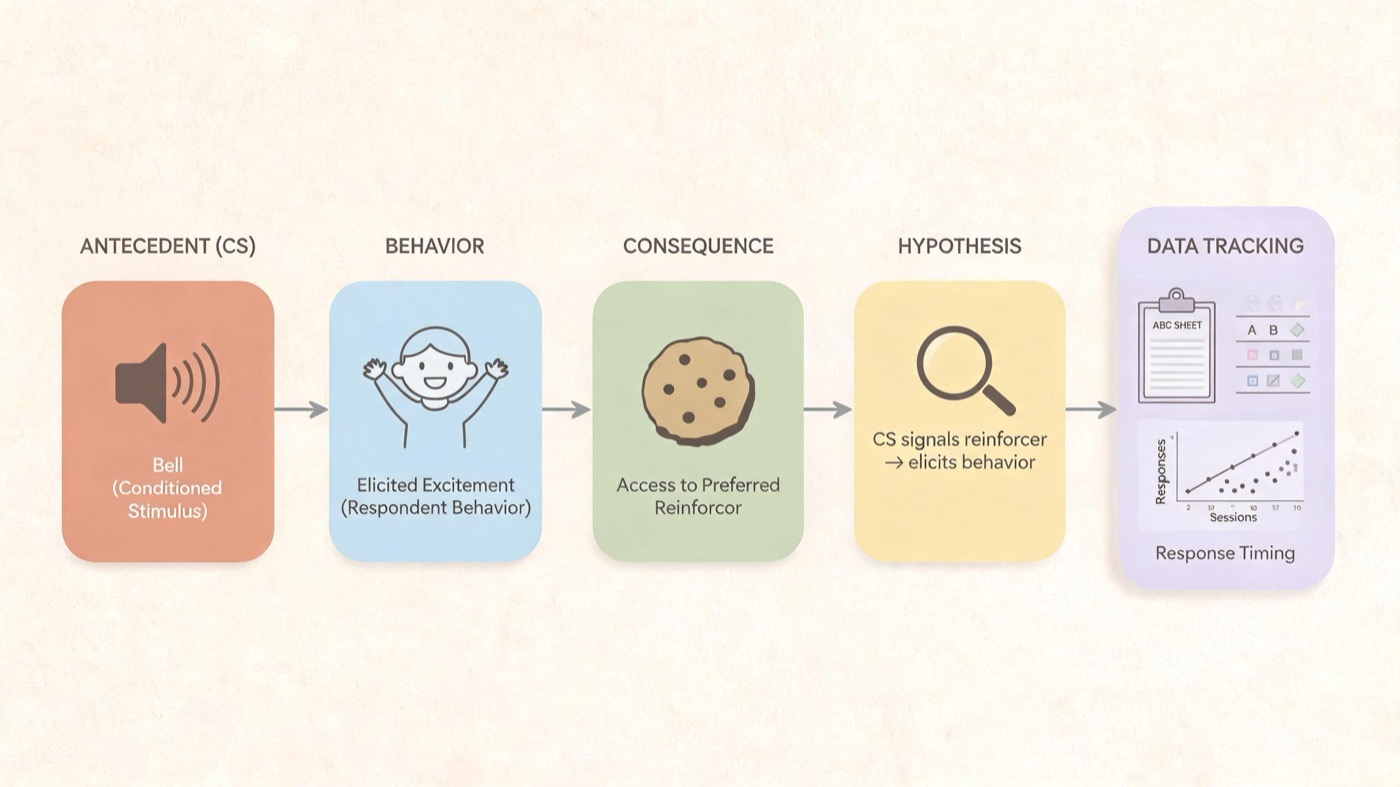
Let’s apply this to real-world scenarios you might see on the exam. Each example includes an ABC format (Antecedent, Behavior, Consequence) with a hypothesized function. Note that respondent behavior is elicited, not reinforced by consequences, so the consequence is often neutral or the behavior’s function is automatic.
Example 1: The Sound of a Refrigerator Door
A child becomes excited when hearing the refrigerator door open. Initially, the door sound (neutral) was paired with the mom getting juice (US), which naturally caused happiness (UR). After repeated pairings, the sound becomes a CS that elicits excitement (CR).
- Antecedent: Fridge door sound
- Behavior: Child approaches kitchen
- Consequence: No juice yet; behavior is elicited, not reinforced
- Function: Respondent (automatic) – the sound elicits approach
Example 2: A Red Light in a Driving Simulator
A driving simulation uses a red light (neutral) paired with a loud horn (US) that causes a startle (UR). After pairing, the red light itself (CS) elicits a startle and brake tapping (CR). This demonstrates how conditioned stimuli can develop for safety responses.
- Antecedent: Red light appears
- Behavior: Taps brakes, heart rate increases
- Consequence: No horn; behavior is elicited
- Function: Respondent (safety reflex)
Example 3: The Therapist’s White Coat
A child cries when seeing the therapist wear a white coat. Initially, the white coat (neutral) was paired with a painful injection (US) that caused crying (UR). Over time, the white coat becomes a CS that elicits crying (CR). This is critical for exam vignettes about medical phobias.
- Antecedent: Therapist in white coat
- Behavior: Crying, attempts to leave
- Consequence: Avoidance of injection; behavior is elicited
- Function: Respondent (automatic negative reinforcement via avoidance?)
Note: While crying is respondent, the avoidance behavior may be operant. The exam may ask you to differentiate.
Quick Checklist for Conditioned Stimuli on the BCBA Exam
Use this checklist to review key points before test day. Each item reinforces a core concept that frequently appears on the exam.
- Define conditioned stimulus as a learned trigger that elicits a conditioned response.
- Identify the CS by finding the stimulus that was neutral before pairing.
- Distinguish CS from discriminative stimulus (SD) – SD signals operant reinforcement; CS elicits respondent behavior.
- Remember that respondent extinction occurs when CS is presented without US.
- Practice with vignettes: underline all antecedents, then determine if each is an SD, MO, or CS.
- Know that conditioned stimuli can also be established in operant contexts (e.g., verbal CS).
Final Summary: Conditioned Stimuli Made Simple
Conditioned stimuli are a foundational concept in respondent conditioning. They are created through stimulus-stimulus pairing and elicit automatic, reflexive behaviors. For the BCBA exam, focus on distinguishing CS from discriminative stimuli, recognizing respondent vs. operant behavior, and applying extinction procedures. Practice with real examples to solidify your understanding. For additional study, check out our guide on respondent vs. operant behavior and learn more about stimulus control in ABA. The BACB task list also covers respondent conditioning under the BACB Task List.



