
Direct answer: If you are asking how to become a BCBA without a degree, first define which degree you mean. If “without a degree” means without any college degree, you cannot become a BCBA through a shortcut. BCBA certification is a graduate-level credential, and the current BACB pathway requires a qualifying master’s degree or higher, behavior-analytic education, supervised fieldwork, an application, and an examination. If you mean “without a bachelor’s degree in ABA” or “without an ABA major,” the answer is different: a related academic background may still fit a current pathway, but you must verify the exact requirements that apply to your application date.
Table of Contents
- How to Become a BCBA Without a Degree: Is It Possible?
- What Does “Without a Degree” Actually Mean?
- Which ABA Roles Can Start Without a Graduate Degree?
- What Does the Current BCBA Pathway Require?
- How Should You Plan Around the 2027 Changes?
- What Is a Realistic Step-by-Step Plan?
- Which Mistakes Should You Avoid?
- BCBA Without a Degree FAQ
- Key Takeaway
- Take the Free BCBA Mock Exam
This distinction is important because search results often blend BCBA certification with entry-level ABA jobs. You can begin learning the field, working in a supervised role, or preparing for a future graduate program without already being a BCBA. You cannot honestly advertise yourself as a BCBA before you meet the credential’s requirements and pass the examination.
How to Become a BCBA Without a Degree: Is It Possible?
No, not if you mean without a qualifying graduate degree. The BACB BCBA overview identifies BCBA certification as graduate-level. The 2027 BCBA requirements also retain a graduate-degree boundary while changing how applicants demonstrate behavior-analytic content and eligibility during the transition.
That answer should not be read as “you need an ABA bachelor’s degree first.” The field has multiple entry points, and some applicants use a bachelor’s degree in psychology, education, special education, or another field before completing qualifying graduate education and behavior-analytic coursework. The deciding documents are your transcripts, the program’s status, your fieldwork records, and the handbook that applies when you apply. A useful rule is:
- No college degree: You are not ready for the BCBA application pathway, but you can explore supervised entry-level work and plan education.
- Bachelor’s degree, not in ABA: You may be able to enter a graduate or coursework route, subject to the BACB rules and program verification.
- Master’s degree, not in ABA: You may need qualifying behavior-analytic coursework and fieldwork; do not assume the degree alone makes you eligible.
- Master’s in an eligible behavior-analytic program: You still must verify fieldwork, application, examination, and transition requirements.
What Does “Without a Degree” Actually Mean?
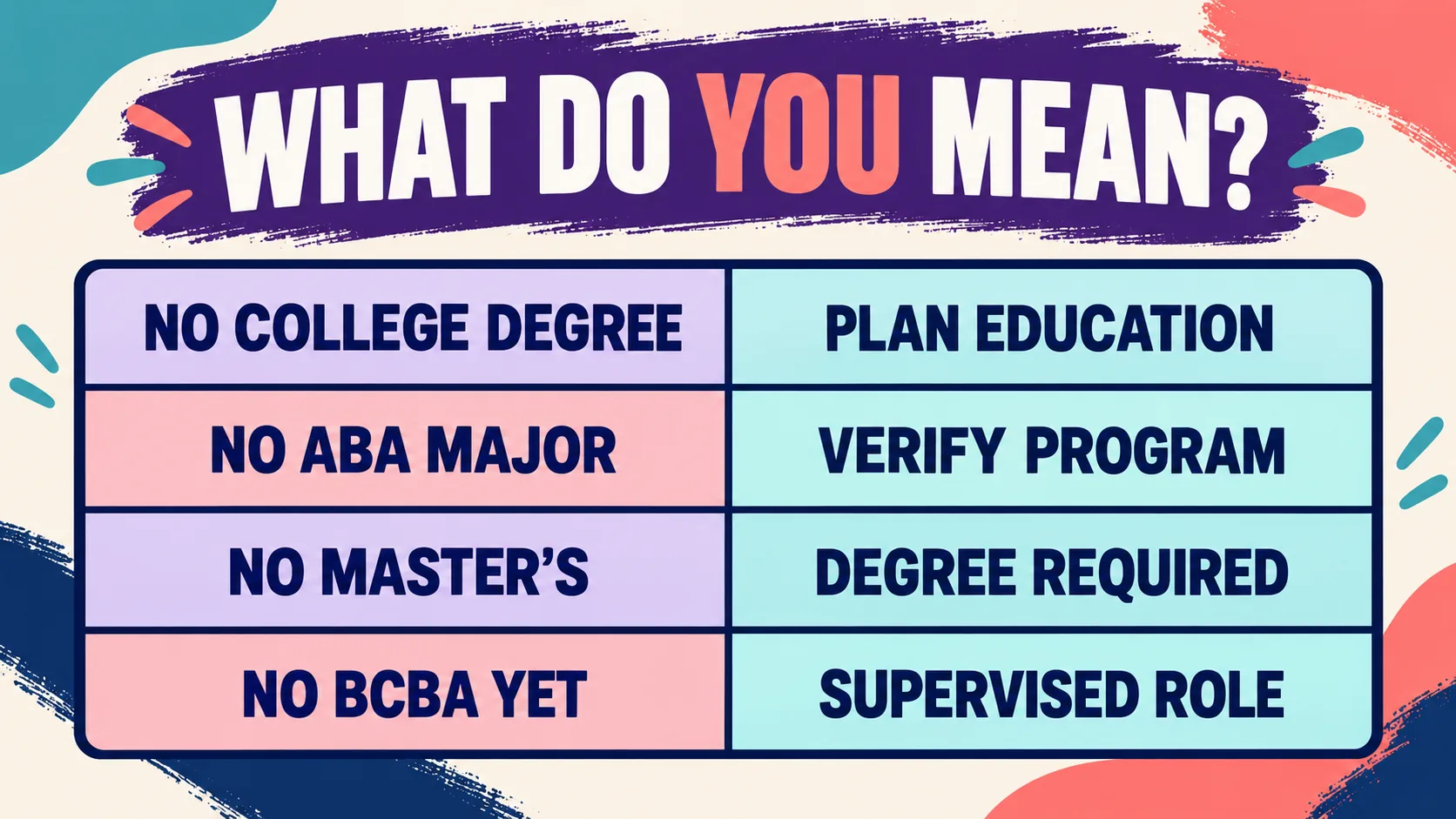
Before choosing a program, rewrite the question in precise language. A person searching how to become a BCBA without a degree may be asking one of four different things: “Can I work in ABA without a degree?” “Can I become an RBT without a college degree?” “Can I become a BCBA without an ABA degree?” or “Can I skip a master’s degree?” Those questions have different answers.
| What you mean | Likely answer | Next check |
|---|---|---|
| No college degree at all | Not a direct BCBA route | Entry-level roles, education plan, and state rules |
| No ABA bachelor’s major | May still be possible through qualifying graduate coursework | Program and BACB pathway verification |
| No master’s degree | Not enough for BCBA certification | Current BCBA degree requirement |
| No BCBA certification yet | You may work only within a supervised role and applicable law | Job scope, supervisor, credential, and state license |
Which ABA Roles Can Start Without a Graduate Degree?
Some people enter behavior-analytic services in technician, behavior technician, direct-support, or related roles. A Registered Behavior Technician (RBT) is a BACB credential with its own eligibility, training, assessment, examination, and supervision requirements. A broad employer label such as “ABA therapist” may describe a job, not a national certification. Read the duties and supervision arrangement instead of treating every title as equivalent.
The BCaBA is a different undergraduate-level certification and is not a substitute for the BCBA. The BACB BCaBA resources explain its supervision boundary. A technician or assistant may implement a plan, collect data, or support daily routines, while the responsible behavior analyst makes or oversees clinical decisions according to the applicable rules and setting.
- Confirm the exact credential named in the job posting.
- Ask who provides ongoing supervision and how feedback is documented.
- Check whether the state protects a title or requires a license for the work.
- Ask whether the role includes implementation, data collection, caregiver training, assessment, or independent treatment decisions.
- Do not accept responsibility beyond your training, credential, supervision, and legal scope.
What Does the Current BCBA Pathway Require?
The exact pathway depends on your application date, but the recurring components are graduate-level education, behavior-analytic content, supervised fieldwork, an application with supporting evidence, and the BCBA examination. The BCBA Handbook is the document to use when checking details.
Do not let a certificate provider promise that a short online course “makes you a BCBA.” A certificate may be useful education, but it is not automatically a qualifying degree, an attested coursework route, a fieldwork arrangement, or an examination pass. Before enrolling, ask the school to show how its degree, coursework, and fieldwork support map to the BACB rules for your intended application date.
- Academic evidence: degree conferral, transcripts, program status, and any required coursework records.
- Fieldwork evidence: supervisor qualifications, contracts, monthly records, and signatures.
- Application evidence: forms, fees, translations if applicable, and accurate disclosure.
- Examination readiness: the current content outline, practice under timed conditions, and error review.
How Should You Plan Around the 2027 Changes?
The BACB has announced significant BCBA and BCaBA requirement changes taking effect January 1, 2027, with a transition boundary for applications under the current requirements. That does not create a no-degree route. It means candidates must identify which requirement set applies to their complete application and keep evidence that fits that set.
Recheck the official recent and upcoming changes page, the 2027 requirements page, and the current handbook before making a payment or setting a fieldwork start date. Program advertising can remain online after a rule changes. A screenshot of a school’s claim is not a substitute for the current BACB source.
What Is a Realistic Step-by-Step Plan?
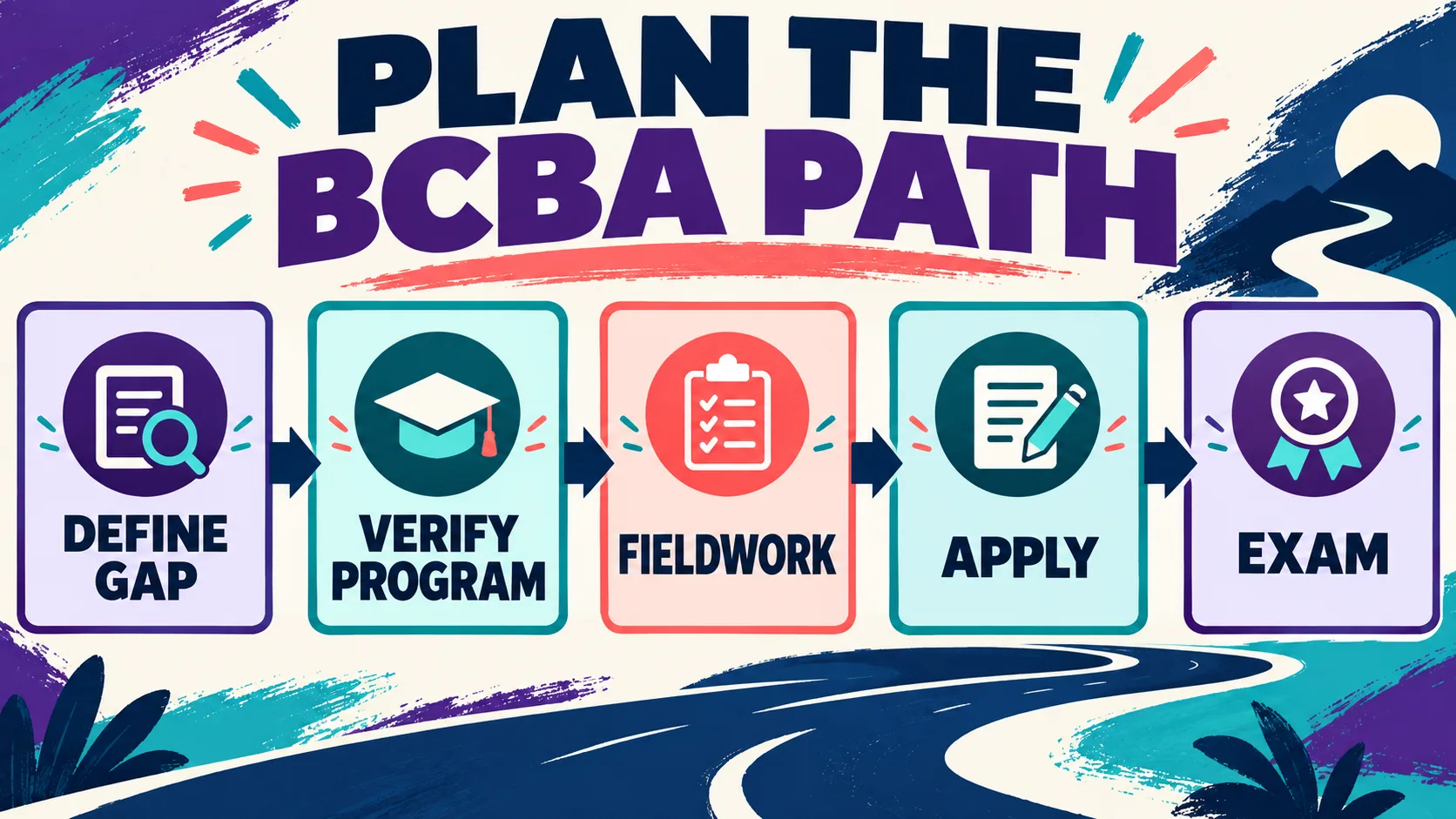
- Define the gap: Write down your highest completed credential, transcript status, relevant coursework, work experience, and target state.
- Choose the near-term role: If you need exposure, compare supervised entry-level positions and ask what training and oversight are included.
- Verify the academic route: Ask the program how it maps to the BACB handbook and whether the answer changes for a 2027 application.
- Plan fieldwork before enrolling: Confirm who will supervise, how hours will be recorded, and what client and service conditions apply.
- Build an evidence folder: Keep transcripts, forms, supervision contracts, monthly records, receipts, and correspondence together.
- Set a recheck date: Re-read the BACB guidance before submitting an application, not only when you first start school.
If you are already preparing for the exam, the free BCBA mock exam can help you practice applying concepts. It is a study resource, not an eligibility evaluation, credential, license, or substitute for supervision.
Which Mistakes Should You Avoid?
- Confusing “ABA job” with “BCBA”: A technician role may be a valid entry point, but it does not confer independent analyst status.
- Assuming any master’s degree qualifies: Degree level and behavior-analytic content are separate checks.
- Ignoring the application date: The 2027 transition changes which documents and pathway rules may apply.
- Starting fieldwork without a written arrangement: Ask the supervisor to explain requirements before counting hours.
- Using old advice: Requirements, forms, and program recognition can change; check official sources at decision points.
BCBA Without a Degree FAQ
Can I become a BCBA with only a high school diploma?: No. You can explore supervised entry-level work and plan your education, but a high school diploma does not meet the graduate-level boundary for BCBA certification.
Do I need a bachelor’s degree in ABA?: Not necessarily. The question is whether your complete education and coursework meet the current BACB pathway. A related bachelor’s degree may lead to a qualifying graduate route, but verify the program and application date.
Do I have to become an RBT first?: Not automatically. RBT work can provide relevant experience, but the BCBA pathway should be planned from the BACB requirements and your supervisor or program’s documented guidance rather than from an assumed sequence.
Can an online certificate replace a master’s degree?: A short certificate should not be assumed to replace a qualifying graduate degree. Ask the provider to identify the exact degree, coursework, fieldwork, and application evidence it supports.
Key Takeaway
There is no legitimate shortcut to BCBA certification that removes the qualifying graduate-degree requirement. There are, however, meaningful ways to enter the field before becoming a BCBA and several education routes for people whose first degree is not in ABA. Define what “without a degree” means, verify the current BACB rules, plan fieldwork carefully, and keep your job title, certification, and state authorization separate. For targeted review, use our how to become a bcba without a degree practice questions to apply the concept in exam-style scenarios.
Take the Free BCBA Mock Exam
When you are ready to apply the idea, use the free practice resource below for additional feedback. Take the Free BCBA Mock Exam



