
Joint play ABA refers to two or more people participating in a shared activity with some coordinated goal, turn-taking, shared attention, or mutual enjoyment. It is more than sitting near another person with separate toys, and it is not a demand to make eye contact, copy a particular gesture, or perform “social” behavior on command.
Table of Contents
- What Is Joint Play ABA?
- Joint Play vs Parallel Play vs Joint Attention
- What Does Joint Play Look Like?
- How to Teach Joint Play Respectfully
- Using Behavioral Skills Training Without Taking Over
- How to Measure Joint Play
- Common Mistakes
- The BCBA Study Lens
- FAQ
- Quick Review Checklist
- Take the Free BCBA Mock Exam
A good joint-play goal starts with the person’s interests and communication. One learner may enjoy building a tower together; another may prefer rolling a car back and forth, taking turns in a sensory game, or adding pieces to a shared pretend-play routine. ABA can help define and measure those actions, but meaningful play still needs choice, flexibility, pauses, and room for the learner to lead.
Research on joint activity schedules, social-play skills, and collaborative play offers useful ideas, but no single play routine fits every person. This guide explains the concept, shows practical examples, and connects teaching to measurement without turning play into forced socializing. Table of Contents
What Is Joint Play ABA?
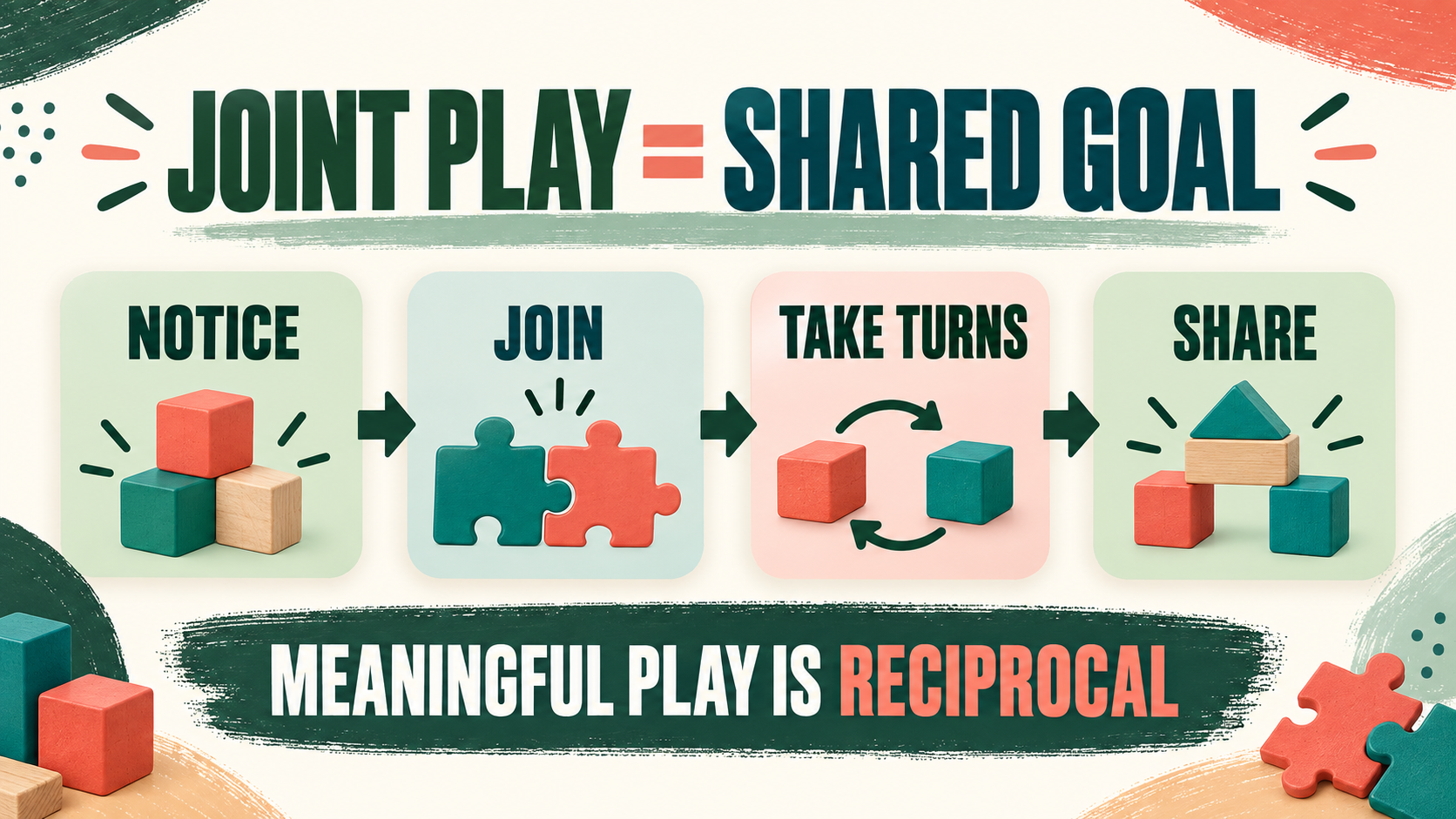
Joint play is shared play in which the participants’ actions are connected. The connection might be a common product, such as building one structure; a shared sequence, such as taking turns rolling a ball; or a shared theme, such as pretending that blocks are food for a toy animal. The exact activity is less important than the reciprocity and shared purpose.
In an ABA context, a practitioner might operationally define one small component: “After a partner rolls the car within arm’s reach, the learner rolls the car back within five seconds on four of five opportunities.” Another target might be “The learner adds one block to a shared tower after the partner places a block, then pauses for the partner’s turn.” These definitions make the behavior observable without declaring that one style of play is universally correct.
The phrase “joint play” should not be used as a shortcut for compliance. A child can participate without looking at a partner’s face. A person who communicates with AAC, gestures, movement, or a different rhythm can still share an activity. The goal is access to meaningful interaction and shared control, not performance of a narrow social script.
Joint Play vs Parallel Play vs Joint Attention
These terms overlap, but they answer different questions:
| Term | Core idea | Example |
|---|---|---|
| Joint play | Participants coordinate actions around a shared activity, goal, or play theme. | Two people build one tower and take turns adding pieces. |
| Parallel play | People play near one another with limited coordination between their actions. | Two children sit side by side, each building a separate tower. |
| Joint attention | Participants coordinate attention toward an object, event, or experience. | A learner points to a moving train and shares the event through a gesture, sound, AAC message, or gaze shift. |
One activity can include all three concepts. Two people may begin with parallel building, share attention when one notices a tall tower, and then move into joint play by adding pieces to the same structure. Do not treat the categories as a ladder in which one form is always “better.” The meaningful question is what the person wants to do and what kind of participation supports that goal.
What Does Joint Play Look Like?
Examples should be concrete enough to observe but flexible enough to honor different interests:
- Back-and-forth play: rolling a ball, car, or soft object to a partner and waiting for the return.
- Shared construction: adding pieces to one tower, track, puzzle, or craft project with a common outcome.
- Cooperative pretend play: taking related roles in a short story, such as preparing food for a toy animal and then serving it.
- Turn-based games: moving pieces, choosing a card, or activating a cause-and-effect toy when the game is genuinely enjoyable and accessible.
- Shared sensory routine: taking turns making a sound, moving an object, or repeating a predictable action with a clear way to pause.
- Partner-supported activity: using a visual or AAC-supported routine to request “more,” “my turn,” “your turn,” “help,” or “finished.”
Notice that none of these examples requires a particular facial expression. The shared connection may be visible in coordinated actions, timing, orientation to the activity, communication, or returning to the routine. The learner’s preferred way of showing enjoyment is part of the observation.
How to Teach Joint Play Respectfully
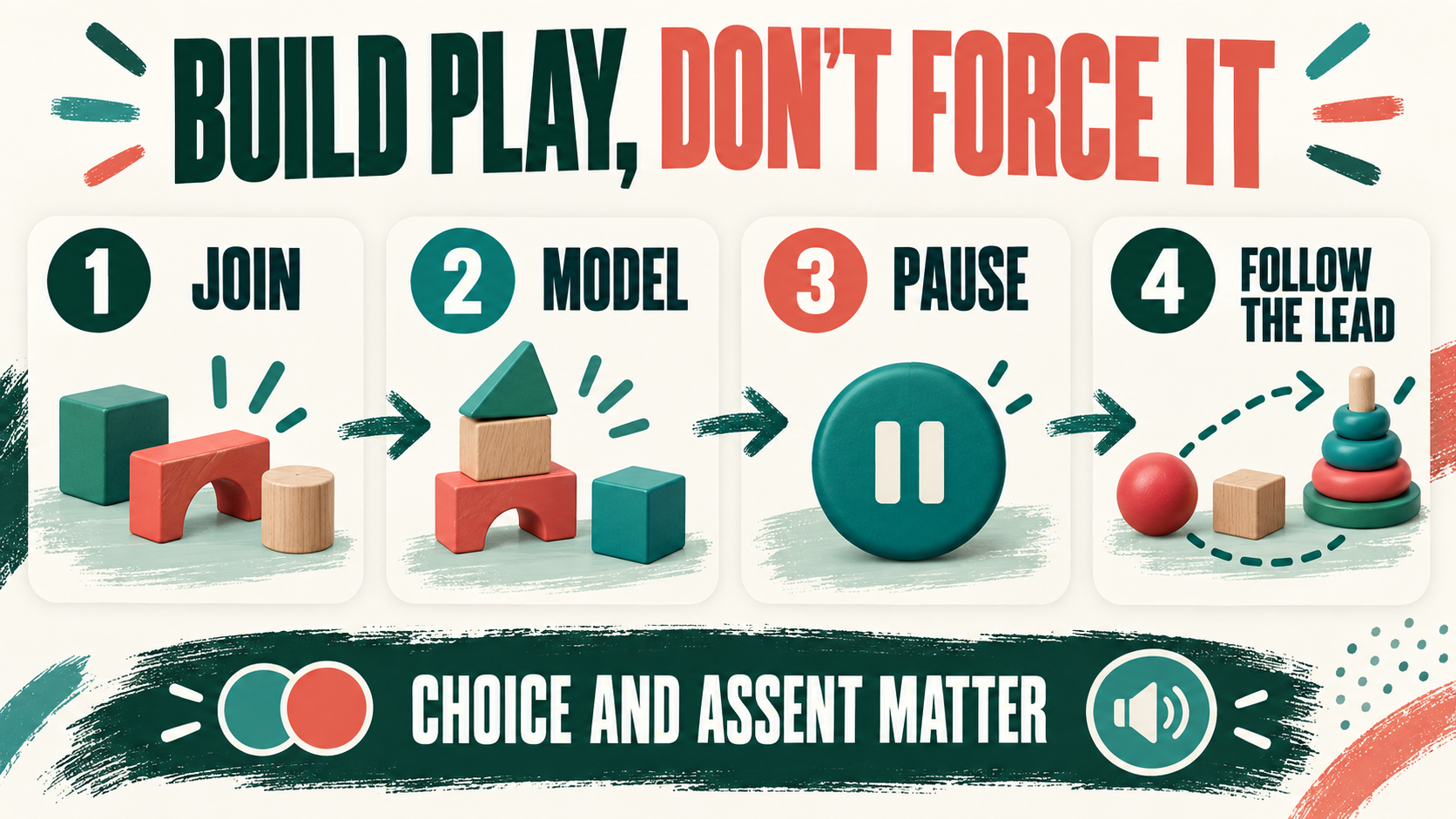
A respectful teaching sequence begins with joining the activity rather than interrupting it. Watch what the learner already does, add a small compatible action, pause, and see whether the learner responds or changes the routine. If the learner moves away, blocks the material, uses a refusal message, or shows distress, treat that information as meaningful—not as a prompt to increase pressure.
- Start with a strong interest: choose a material or action the learner already approaches, controls, or requests.
- Join without taking over: imitate or complement the play at a low response effort instead of removing the learner’s materials.
- Create a natural pause: leave space for a turn, request, gesture, or choice; do not fill every silence with prompts.
- Make the shared goal visible: use a simple visual sequence, a finished product, or a predictable turn marker if that helps.
- Reinforce participation naturally: continue the enjoyable activity, offer a meaningful choice, or acknowledge the learner’s communication.
- Fade support: reduce prompts and allow the learner to initiate, vary the materials, and choose when the routine ends.
Joint play is not successful merely because the learner stays in the area. Ask whether the person has influence over the activity, whether the interaction is reciprocal, and whether the skill transfers to people and settings that matter. A short, self-initiated shared routine may be more meaningful than a long session filled with adult prompts.
Using Behavioral Skills Training Without Taking Over
Behavioral skills training can help a caregiver, peer, or staff member learn how to support play. The familiar components are instruction, modeling, rehearsal, and feedback. For example, a coach might explain how to follow the learner’s lead, model a short pause, rehearse the routine with the adult, and give feedback about waiting rather than adding more demands.
The person receiving support is not a passive object in that training. The adult’s improved behavior should make shared play more accessible, not make the learner perform a predetermined interaction. The team can use data to ask whether adult prompts are decreasing, whether the learner initiates more often, whether turns become more balanced, and whether the learner communicates “stop” or “finished” successfully.
A 2016 Journal of Applied Behavior Analysis study taught social-play skills as part of a program intended to build rapport. The study is useful evidence that play skills and engagement can be measured together, but its participants and procedures should not be treated as a universal protocol for every learner.
How to Measure Joint Play
Choose a measurement system that matches the question. If the goal is a back-and-forth routine, count reciprocal turns or measure the percentage of opportunities with an independent return. If the goal is shared construction, record the number of coordinated contributions and whether the learner can continue when materials or partners change. If the goal is initiation, count learner-led bids rather than only responses to adult prompts.
| Possible target | Measurement | Context to record |
|---|---|---|
| Return a shared object | Independent returns divided by opportunities | Prompt level, object, distance, and whether the learner chose the routine |
| Contribute to one project | Coordinated contributions per session | Materials, partner, shared goal, and whether the project remained enjoyable |
| Initiate or end play | Frequency or latency of a clear initiation/finished signal | Communication mode, partner response, and whether refusal was honored |
Do not report only “minutes in play.” A learner can remain near an activity while being prompted continuously or unable to leave. Pair duration with quality and context: initiation, reciprocity, independence, communication, affect as defined by the individual, choice, and generalization. The practice review Beyond Trial Counts makes a similar measurement point: engagement needs more than a simple tally of trials.
Common Mistakes
- Forcing eye contact: eye contact is not the definition of joint play and may be uncomfortable or unnecessary for shared activity.
- Taking away preferred materials: removing control can make the learner avoid the interaction rather than build a shared routine.
- Prompting every turn: adult control can hide whether the learner initiates, responds, or actually wants to continue.
- Confusing proximity with reciprocity: being near a partner is not the same as coordinating an activity.
- Teaching one script only: a routine that works with one toy and one adult may not generalize to peers, new materials, or a different setting.
- Ignoring the end signal: refusing, pausing, moving away, or communicating “finished” should change the interaction.
Peer-mediated and joint-activity approaches can be promising, but research results are tied to their participants, settings, and procedures. A systematic review of collaborative play describes multiple supports, including peer and technology mediation, while also noting that the area remains underdeveloped. Use the evidence to design a question, not to promise an identical result for every learner.
The BCBA Study Lens
For the BCBA exam, translate “joint play” into observable behavior and socially meaningful outcomes. Define who does what, when, with which materials, and what counts as an independent response. Identify the antecedent, the partner’s response, the likely reinforcer, the measurement system, and the generalization plan.
Also look for the ethical distinction. A strong answer respects assent, communication, dignity, and the person’s ability to decline. It does not assume that adult-selected social behavior is automatically the most important target. A good intervention can teach a useful play skill while preserving choice and allowing different ways to participate. The current BACB test content outline is the correct source for current exam-domain wording. This article is a study aid that applies the measurement and intervention logic to a joint-play example.
FAQ
Is joint play the same as joint attention?: No. Joint attention is coordinated attention toward an object or event. Joint play includes a shared play activity and coordinated actions. They can occur together, but one does not automatically prove the other.
Can joint play be taught in ABA?: It can be a behavior-analytic teaching target when it is socially meaningful, operationally defined, measured, and taught with appropriate choice and assent safeguards. The learner’s interests and communication should shape the routine.
What is a simple joint-play example?: Two partners roll a car back and forth. The measurable target might be an independent return within a defined time after the partner’s roll, while also recording prompts, choice, communication, and whether the learner signals to continue or stop.
Bottom line: joint play in ABA is coordinated, shared activity—not forced eye contact, passive proximity, or adult-controlled compliance. Start with the learner’s interests, build a shared goal, pause for communication, measure reciprocity and independence, and honor the person’s choice to continue or stop. If you are reviewing the BCBA concepts behind these decisions, the free BCBA mock exam is an optional practice resource, not an official BACB exam.
Quick Review Checklist
Use this final checklist to turn joint play aba into exam-ready reasoning. The goal is not to memorize a label in isolation; it is to identify the relevant evidence and explain why the best answer fits the scenario. Key ideas to review:
- State the central definition or decision point for joint play aba in your own words.
- Identify the detail that makes joint play aba different from its closest related ABA term.
- Separate the observable facts in a scenario from assumptions that are not supported by the facts.
- Write one example and one nonexample so you can recognize the concept in a new setting.
Exam application checks:
- Ask what the question is actually requesting before comparing the answer choices.
- Mark the antecedent, response, consequence, or other evidence that supports the selected answer.
- Look for a distractor that describes a related process but does not answer the specific question.
Final self-check:
- Explain how you would verify the interpretation with clear observations or data.
- Change one detail in the scenario and decide whether your answer should change.
- Give a one-sentence rationale that a supervisor or study partner could evaluate.
Take the Free BCBA Mock Exam
If you want a low-pressure way to check your recall, use the free practice resource below. Take the Free BCBA Mock Exam



