
Is the ABA still around? Yes—if you mean applied behavior analysis, the science, profession, and service system are all still active. What has changed is the scale and infrastructure around the field. Today, “ABA” can refer to an applied science, a professional workforce, or a service delivered by a particular organization. Those are related, but they are not interchangeable.
Table of Contents
- Is the ABA Still Around? The Short Answer
- What Does “ABA” Mean in This Question?
- Science, Profession, and Services Are Different Layers
- What Has Changed in ABA?
- Why Do People Ask If ABA Is Still Around?
- How to Check Whether an ABA Program Is Current
- What This Means for BCBA Students
- FAQ
- Quick Review Checklist
- Take the Free BCBA Mock Exam
A September 22, 2026 overview in Behavior Analysis in Practice describes continued professionalization alongside unfinished infrastructure, including uneven funding, licensure, training, and practice supports. So the accurate answer is not “ABA disappeared” or “every ABA service is the same.” The accurate answer is: ABA is still here, but it is a changing profession that must be judged by evidence, qualifications, ethics, and the actual service model. Table of Contents
Is the ABA Still Around? The Short Answer
Is the ABA still around? Yes. Applied behavior analysis remains an active applied science and professional practice. It has journals, university training, certification and licensure systems, professional organizations, employers, payers, and service providers. The field is not frozen in its earliest descriptions, however. Its research, professional infrastructure, public language, and service-delivery models have developed over time.
The word “still” can hide two different questions. Someone may be asking whether the science still exists. Another person may be asking whether a clinic, insurance benefit, job market, or old-style therapy model still looks the same. The first answer is clearly yes. The second answer depends on the state, payer, provider, population, and service being discussed.
There is also acronym noise. ABA can mean American Bankers Association, American Basketball Association, or other organizations. This article uses ABA to mean applied behavior analysis because the site serves BCBA exam learners. If your query concerns banking or sports, it needs a different page and a different search intent.
What Does “ABA” Mean in This Question?
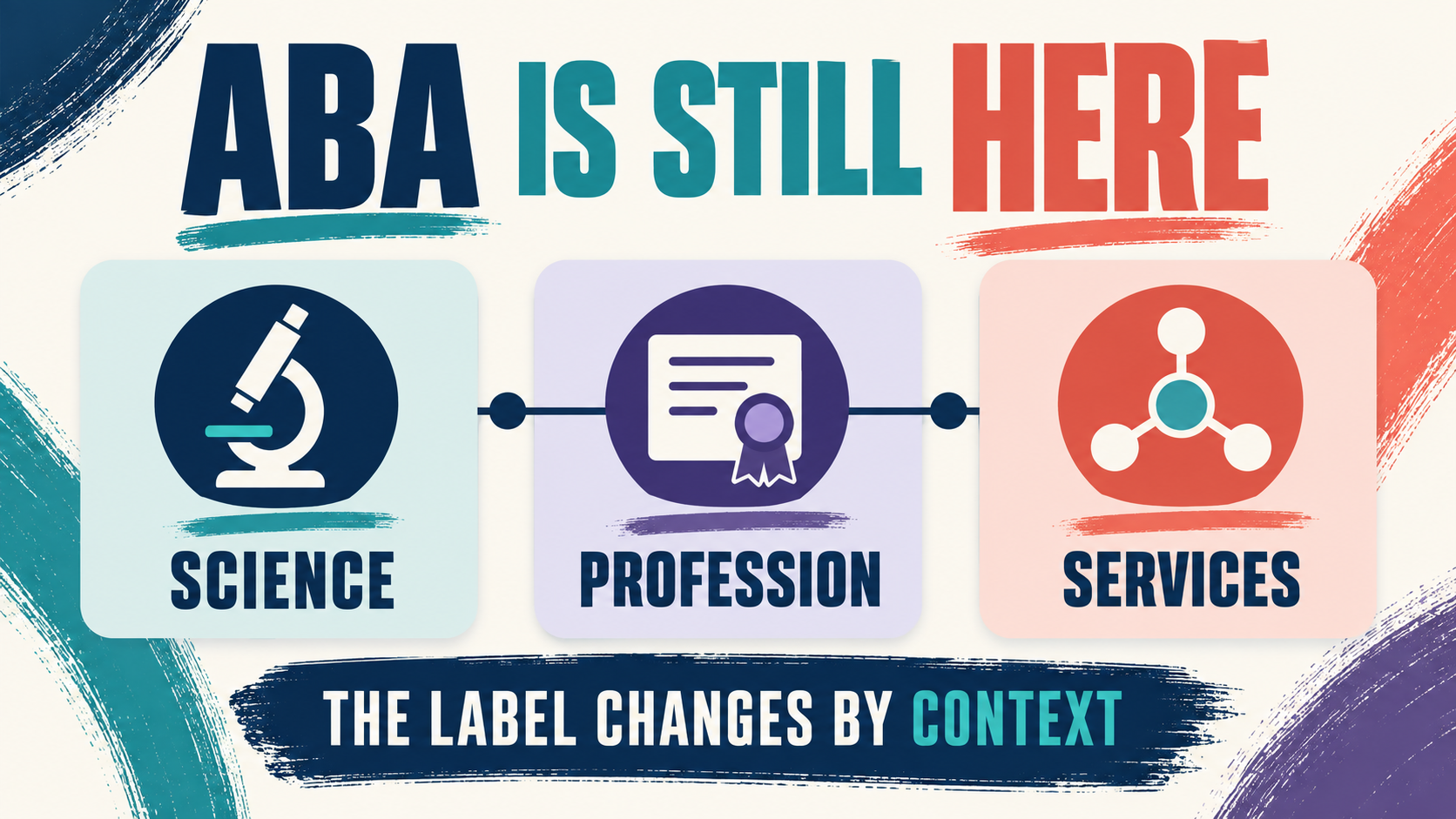
A useful current definition starts by separating the larger discipline of behavior analysis from the applied branch and from professional service delivery. The 2026 overview in Behavior Analysis in Practice describes behaviorism as a philosophical paradigm, experimental analysis of behavior as a basic-science branch, applied behavior analysis as an applied-science branch, and the ABA profession as a separate professional-practice domain.
That distinction matters because a research finding is not automatically a treatment protocol, and a service branded “ABA” is not automatically equivalent to the whole science. Research asks whether a procedure reliably changes socially important behavior under defined conditions. Service delivery applies procedures in real settings, with family priorities, school routines, payer rules, staffing, communication needs, and ethical decisions.
When people say that ABA is “gone,” they may be reacting to a change in language or service design rather than to the disappearance of the field. A provider might use terms such as behavior support, parent coaching, skills training, naturalistic teaching, or functional assessment. Those labels should be examined by looking at goals, procedures, measurement, qualifications, and safeguards—not by assuming that a new label means the science vanished or that an old label guarantees quality.
Science, Profession, and Services Are Different Layers
Use this three-layer model to avoid most confusion:
| Layer | What it does | Question to ask |
|---|---|---|
| Science | Studies principles and procedures that may change behavior in socially meaningful ways. | What question was tested, with what measurement and design? |
| Profession | Organizes education, credentials, ethics, supervision, licensure, and professional judgment. | Who is qualified, accountable, supervised, and licensed where required? |
| Services | Delivers assessment, teaching, support, or consultation to a particular person or organization. | What will happen, what will be measured, and how will the person’s priorities and assent be respected? |
These layers influence one another, but one layer cannot prove the others. A credential does not prove that a specific program is a good fit. A service outcome does not rewrite the research literature. A research article does not give a provider permission to ignore local law or a person’s preferences.
What Has Changed in ABA?
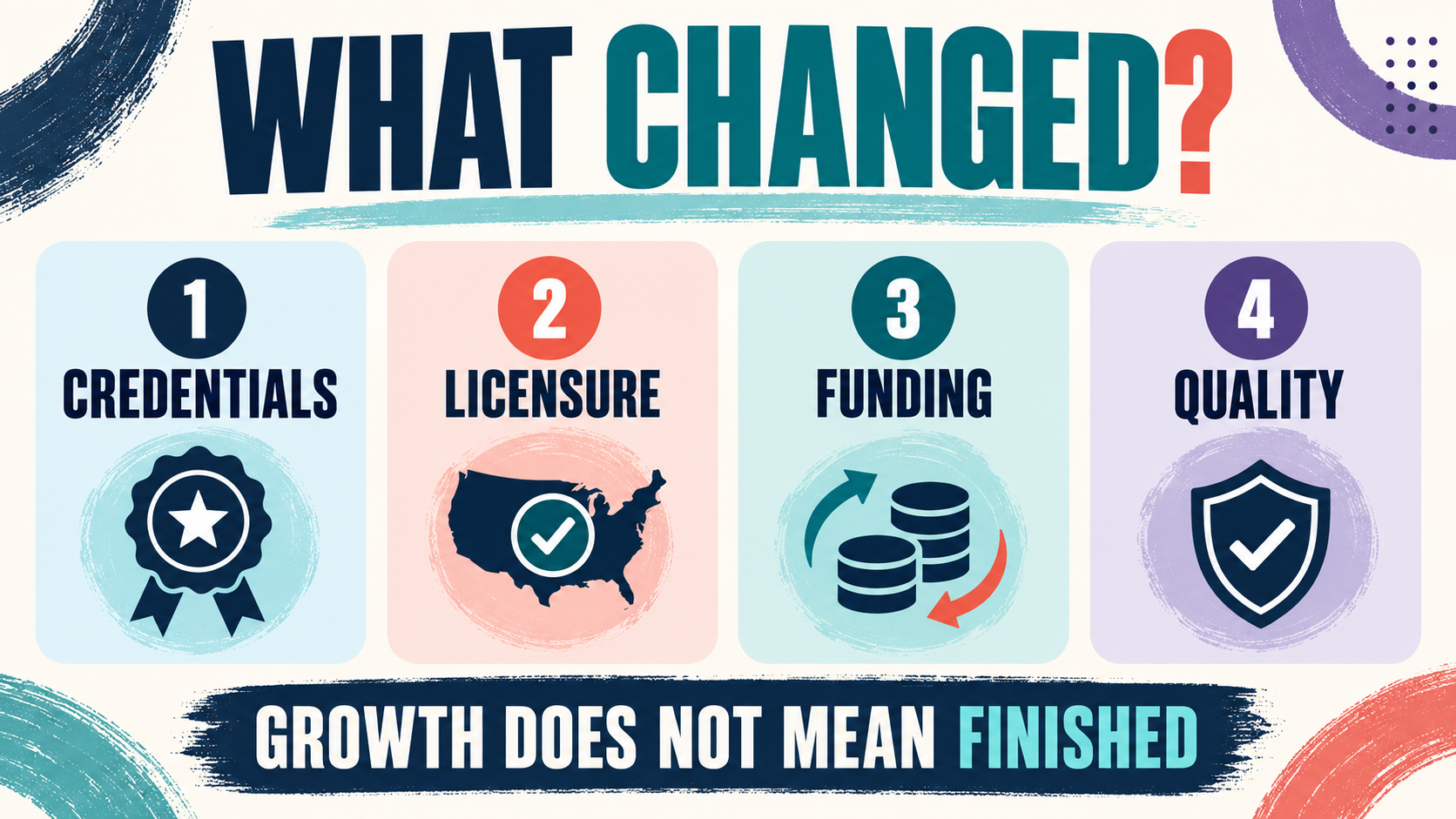
The current profession is larger and more organized than it was several decades ago. The 2026 professional overview describes the development of certification and licensure systems, university training programs, professional and trade associations, healthcare billing systems, and a growing workforce. It reports that, by 2026, behavior-analyst licensure laws had been enacted in 40 states and the District of Columbia, while also noting that national coverage is not complete.
Service delivery has also become more connected to healthcare reimbursement and managed-care systems in the United States. That can increase access for some families, but it also creates administrative pressure, authorization requirements, staffing constraints, and questions about how outcomes are defined. A field can grow and still have uneven quality. “More providers” is not the same as “every provider uses the same standard.”
Training and education are changing as well. The current landscape includes university programs, accreditation pathways, continuing education, supervision requirements, and evolving expectations for ethical and culturally responsive practice. A student researching BCBA work should therefore check the current BACB test content outline and applicable state rules rather than relying on an old study guide or a social-media summary.
Why Do People Ask If ABA Is Still Around?
Several understandable experiences can create this question:
- Terminology changed: a provider may emphasize behavior support, caregiver coaching, or naturalistic teaching instead of using ABA as the headline label.
- Coverage changed: an insurance plan, authorization rule, or local provider network may change even while the broader profession remains active.
- Public criticism changed expectations: families and autistic self-advocates have raised important questions about goals, assent, dignity, communication, and whose outcomes count.
- Training changed: certification, licensure, continuing education, supervision, and university-program recognition continue to develop.
- Local availability varies: a person may not find a suitable provider nearby, which can feel like the field disappeared even when national infrastructure exists.
The right response is not to defend or reject a label automatically. Ask what the service is intended to improve, who selected the target, how progress will be measured, how refusal or assent will be handled, and how the team will coordinate with other professionals. Those questions remain useful whether the provider calls the service ABA, behavior support, or something else.
How to Check Whether an ABA Program Is Current
If you are evaluating a specific program, look for evidence that it operates in the present professional environment:
- Clear qualifications: ask who designs, supervises, and delivers the service. Verify certification and check whether state licensure is required; the BACB licensure resource is a starting point, not a substitute for local legal advice.
- Meaningful goals: the target should relate to communication, learning, participation, safety, independence, relationships, or another outcome the person values—not only adult convenience or surface-level compliance.
- Transparent measurement: ask what is recorded, how often, by whom, and what result would lead to changing or stopping the plan.
- Respect for choice: ask how the person communicates assent, refusal, breaks, preferences, and distress. A current service should not treat silence as agreement.
- Coordination: check how the provider will work with caregivers, schools, healthcare professionals, speech-language professionals, or other supports with appropriate consent.
- Quality review: ask whether the organization has supervision, complaint, incident, privacy, and continuing-education procedures. Accreditation can be useful context, but it does not guarantee a personal fit.
A good screening conversation should make the program more specific, not more mysterious. If the answer is always “that is just how ABA works,” ask for the operational definition, the rationale, the data, and the person’s options.
What This Means for BCBA Students
For BCBA exam preparation, the phrase “is ABA still around?” is an opportunity to separate history, science, professional systems, and service delivery. Know the difference between a conceptual definition and a current practice requirement. Know that certification and state licensure are related but not identical. Know that a procedure can be evidence-informed while still requiring individualized assessment, measurement, supervision, and ethical judgment.
When a scenario asks whether a program is appropriate, avoid choosing the answer with the most impressive label. Look for the option that defines the behavior, identifies a socially meaningful goal, uses data, protects the client’s rights, follows scope and supervision requirements, and evaluates outcomes. That logic is more durable than memorizing whether a particular organization uses the word ABA in its name. The field is still around, but “still around” is a very low standard. The professional question is whether a specific practice is competent, current, evidence-informed, transparent, and respectful.
FAQ
Is ABA being phased out?: There is no general basis for saying that applied behavior analysis has disappeared. The current professional literature describes continued infrastructure and growth, alongside gaps and changes. A particular program, payer benefit, or terminology choice may end or change without ending the field.
Is ABA the same as autism therapy?: No. ABA is an applied science and professional practice used in multiple contexts. Many public discussions focus on autism services, but the acronym does not by itself define the population, target, procedure, or quality of a specific service.
Does a BCBA credential guarantee a good program?: No credential can guarantee that every service is a good fit. A credential identifies a training and certification pathway; the program still needs meaningful goals, competent supervision, valid measurement, ethical safeguards, and coordination appropriate to the person and setting.
Bottom line: ABA is still around, but it is not a single frozen product. It includes a research tradition, a developing profession, and many different service models. Evaluate the layer you actually mean, verify current rules and qualifications, and judge the specific program by its goals, data, safeguards, and fit. If you are studying the professional concepts behind that evaluation, the free BCBA mock exam is an optional practice resource, not an official BACB exam.
Quick Review Checklist
Use this final checklist to turn is the aba still around into exam-ready reasoning. The goal is not to memorize a label in isolation; it is to identify the relevant evidence and explain why the best answer fits the scenario. Key ideas to review:
- State the central definition or decision point for is the aba still around in your own words.
- Identify the detail that makes is the aba still around different from its closest related ABA term.
- Separate the observable facts in a scenario from assumptions that are not supported by the facts.
- Write one example and one nonexample so you can recognize the concept in a new setting.
Exam application checks:
- Ask what the question is actually requesting before comparing the answer choices.
- Mark the antecedent, response, consequence, or other evidence that supports the selected answer.
- Look for a distractor that describes a related process but does not answer the specific question.
Final self-check:
- Explain how you would verify the interpretation with clear observations or data.
- Change one detail in the scenario and decide whether your answer should change.
- Give a one-sentence rationale that a supervisor or study partner could evaluate.
Take the Free BCBA Mock Exam
If you want a low-pressure way to check your recall, use the free practice resource below. Take the Free BCBA Mock Exam



