
Is the statement “automatic reinforcement is reinforcement delivered noncontingently” true or false? The best BCBA exam answer is false. Automatic reinforcement describes a behavior–environment relation in which the behavior produces its own reinforcing consequence without another person mediating the consequence. Noncontingent reinforcement, or NCR, is a procedure in which a reinforcer is delivered independently of the target behavior, often on a time-based schedule.
Table of Contents
- Automatic Reinforcement Is Reinforcement Delivered Noncontingently: True or False?
- What Is Automatic Reinforcement?
- What Is Noncontingent Reinforcement?
- How Are Automatic Reinforcement and NCR Different?
- What Examples Help You Tell Them Apart?
- What Are the Most Common BCBA Exam Traps?
- How Should You Solve This True-or-False Question?
- What Does the Distinction Mean for Intervention Planning?
- Automatic Reinforcement and NCR FAQ
- Quick Review Checklist
- Take the Free BCBA Mock Exam
This distinction matters because both terms can appear next to words such as “independent,” “sensory,” or “without social consequences.” The useful question is not simply whether another person is involved. Ask what produces the consequence and whether the provider is arranging delivery independently of responding. This guide uses the current BCBA Test Content Outline for the examination context and peer-reviewed behavior-analytic sources for the technical distinction. It is an exam-study explanation, not a treatment protocol for a specific client. Table of Contents
Automatic Reinforcement Is Reinforcement Delivered Noncontingently: True or False?
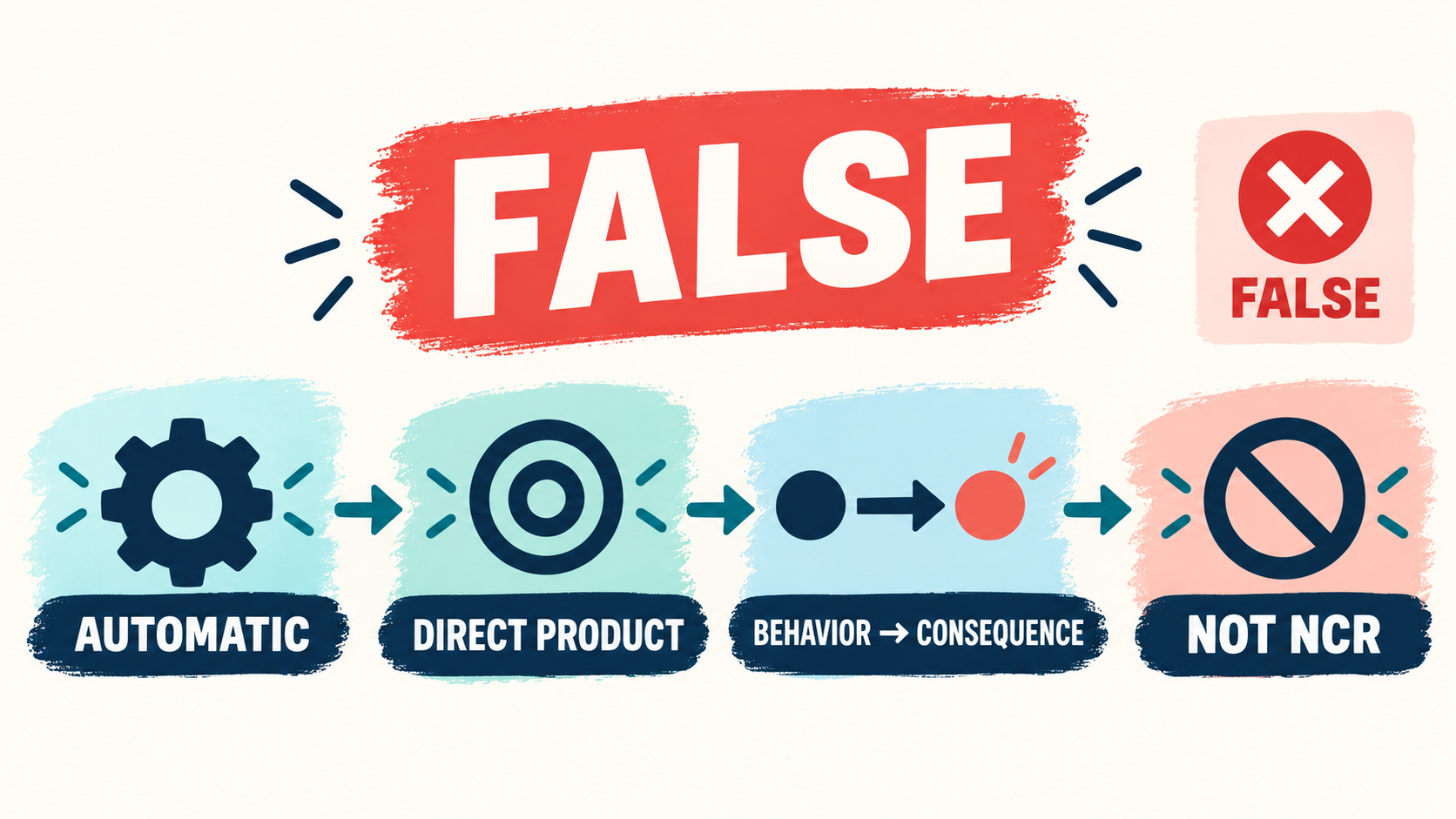
False. The statement confuses a type of reinforcement relation with a reinforcement-delivery procedure. Automatic reinforcement occurs when the maintaining consequence is produced directly by the behavior, rather than being delivered or mediated by another person. Noncontingent reinforcement means that a reinforcer is delivered independently of the target response, usually according to time rather than according to whether the target behavior occurs. A compact exam rule is:
- Automatic reinforcement: the behavior itself, or a direct product of it, produces the reinforcing effect.
- NCR: a person arranges access to a reinforcer on a response-independent schedule.
The terms can interact in one intervention plan, but they are not synonyms. For example, NCR may be used as part of treatment for behavior maintained by automatic reinforcement. That does not turn NCR into the definition of automatic reinforcement.
What Is Automatic Reinforcement?
Automatic reinforcement refers to reinforcement that is not mediated by another person. The behavior produces stimulation, relief, sensory feedback, or another consequence that increases the future likelihood of that behavior. The behavior may continue even when no one is watching, praising, giving an item, or removing a demand.
Imagine a person rubbing a textured surface because the tactile feedback is immediately satisfying. If the tactile product of rubbing is what strengthens future rubbing, the consequence is automatic. The label does not mean that the behavior is random, and it does not mean that the behavior is always harmless or always sensory in the narrow everyday sense. It means the relevant reinforcing consequence is generated directly by the behavior or its natural products rather than being delivered through a social mediator.
A peer-reviewed discussion of automatic reinforcement describes the maintaining reinforcer as a direct consequence of the behavior, not a consequence mediated by another person. That definition is the anchor for the true-or-false answer. The central relation is behavior to consequence—not provider to schedule.
Automatic reinforcement can be difficult to analyze because the exact sensory or internal consequence may not be obvious. A practitioner still needs assessment, careful observation, measurement, and ethical attention to the person’s welfare. “Automatic” is not permission to skip a functional assessment or to assume that every repetitive behavior has the same function.
What Is Noncontingent Reinforcement?
Noncontingent reinforcement, commonly abbreviated NCR, is a behavior-change procedure. A provider delivers access to a reinforcer independently of the target behavior. The schedule can be fixed-time or variable-time, depending on the plan and the evidence supporting it. Because access is not contingent on the target response, the learner does not have to emit that response to receive the scheduled delivery.
For example, a supervisor might arrange brief access to attention on a time-based schedule when a functional assessment supports an attention-related treatment plan. The attention is delivered because the schedule says it is time, not because the person just engaged in the target problem behavior. That is NCR. It is not automatic reinforcement because another person is arranging and delivering the consequence.
NCR can also appear in research on behavior maintained by automatic reinforcement. In those cases, researchers or clinicians may provide competing items, environmental enrichment, or other scheduled access to stimuli while monitoring the target behavior. The intervention is still NCR because the arranged delivery is independent of the target response. The function of the target behavior and the procedure used to change it are separate questions.
How Are Automatic Reinforcement and NCR Different?
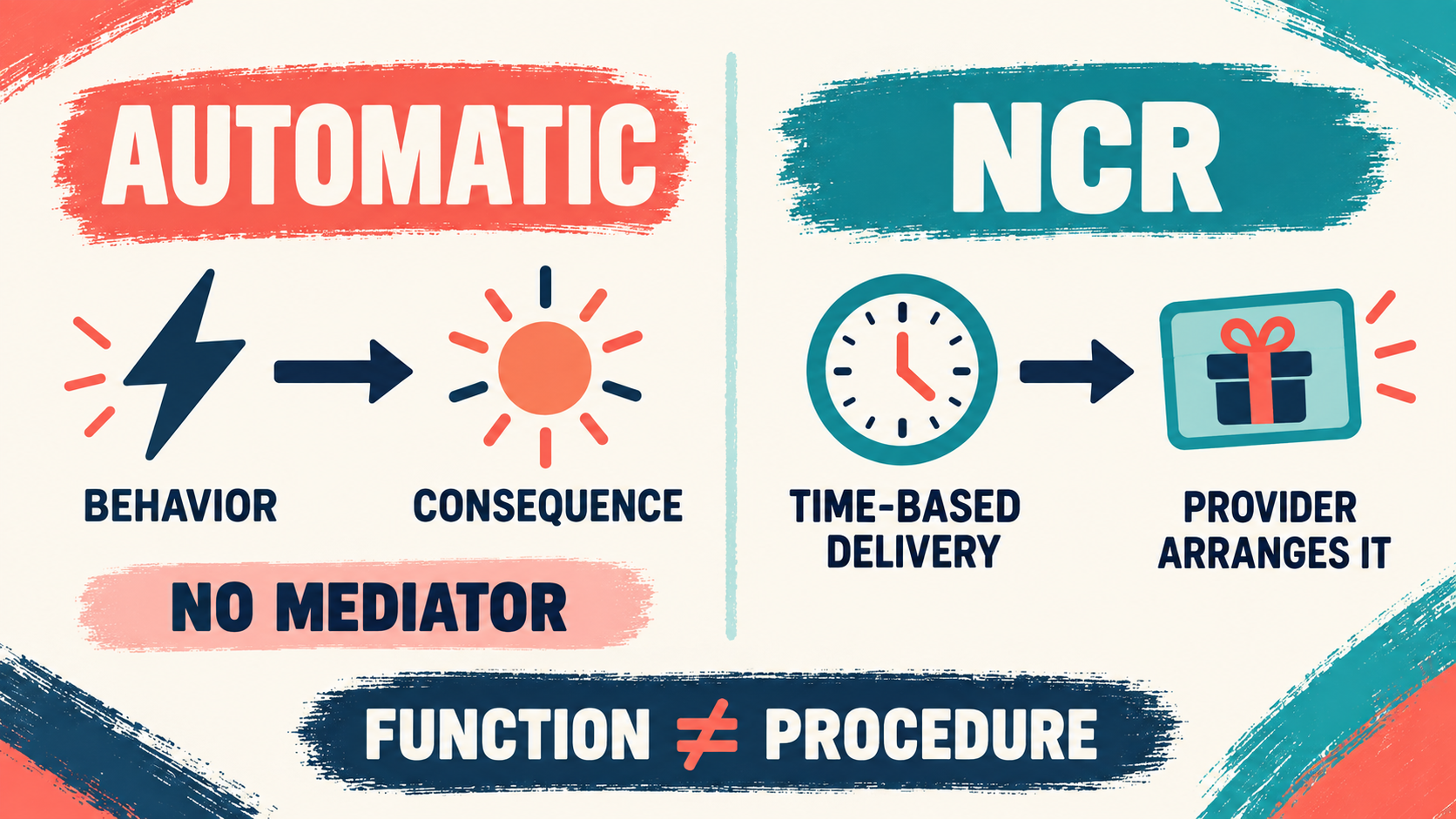
The easiest way to separate the concepts is to identify the role of the consequence, the role of the provider, and the relation between the target response and delivery.
| Feature | Automatic reinforcement | Noncontingent reinforcement |
|---|---|---|
| What is it? | A behavior–consequence relation or function. | A reinforcement-delivery procedure. |
| Who mediates the consequence? | No other person needs to mediate the direct product. | A provider, caregiver, teacher, or environment arranges delivery. |
| Is delivery independent of the target response? | No. The behavior may directly produce its own consequence. | Yes. Delivery is arranged independently of the target response. |
| Common exam clue | Direct sensory feedback, relief, or product of the behavior. | Fixed-time, variable-time, response-independent, or scheduled delivery. |
The phrase “noncontingent” describes the relation between delivery and the target response. The phrase “automatic” describes who or what produces the reinforcing consequence. A question can include both concepts in the same scenario, which is why reading the relation carefully matters.
What Examples Help You Tell Them Apart?
Use paired examples rather than memorizing isolated definitions. In each pair, ask whether the consequence is a direct product of the behavior or an arranged delivery that occurs independently of responding. Example 1: direct product. A person engages in a repetitive movement and immediately experiences a preferred visual or tactile effect produced by that movement. No one presents the effect after the response. If that effect strengthens the behavior, the relation is consistent with automatic reinforcement.
Example 2: scheduled delivery. A teacher provides a brief sensory activity every five minutes regardless of whether the student engaged in the target behavior. The teacher is using a time-based, noncontingent delivery procedure. The activity may compete with or alter the value of the automatic consequence, but the procedure itself is NCR.
Example 3: social consequence. A learner asks for attention, and a caregiver responds with conversation. If the attention increases future requests, the consequence is socially mediated. It is not automatic reinforcement merely because the learner enjoys the attention.
Example 4: escape consequence. A person engages in a behavior and a task is removed by another person. If escape strengthens the behavior, the consequence is socially mediated negative reinforcement. It is not automatic just because the person experiences relief. These examples show why “it feels good” or “it happens without praise” is not enough to answer the question. Identify the behavior–consequence relation and the delivery arrangement.
What Are the Most Common BCBA Exam Traps?
Trap 1: treating “without another person” as “noncontingent.” Automatic reinforcement can occur without a social mediator, but that does not make the behavior’s consequence noncontingent. A direct product can still be produced by the response. Trap 2: treating every time-based procedure as automatic reinforcement. A fixed-time or variable-time schedule points to NCR. It tells you how a provider arranged delivery, not what function originally maintained the target behavior.
Trap 3: assuming automatic means unchangeable. Automatically reinforced behavior can be assessed and may respond to interventions, including competing stimuli, response interruption, differential reinforcement, or environmental changes when those procedures are clinically indicated. The function label does not prescribe one universal treatment.
Trap 4: confusing “reinforcer” with “reinforcement.” A stimulus is not automatically a reinforcer because it is preferred. A reinforcer is defined by its effect: it increases future behavior under relevant conditions. The exam may give you a preferred item, but you still need to examine the functional relation.
How Should You Solve This True-or-False Question?
Use a four-step process when you see the exact wording automatic reinforcement is reinforcement delivered noncontingently true or false:
- Underline the relation word. “Delivered noncontingently” describes a procedure in which delivery is independent of the target response.
- Recall the automatic-reinforcement definition. The behavior or its direct product supplies the relevant consequence without social mediation.
- Compare, do not blend. Automatic reinforcement and NCR may occur in the same treatment discussion, but one is a function/relation and the other is a delivery procedure.
- Choose false and explain the replacement. A strong answer does not stop at “false.” It says that NCR is response-independent delivery, whereas automatic reinforcement is a direct behavior-produced consequence.
This approach is more reliable than trying to remember which flashcard platform marked the statement true. Low-quality question pages often collapse related ABA terms or provide contradictory explanations. The BACB content outline supports studying reinforcement procedures and time-based schedules, but it does not turn a memorized flashcard sentence into a definition.
What Does the Distinction Mean for Intervention Planning?
For exam purposes, keep function and procedure separate. In practice, the distinction is even more important because an intervention must be based on assessment, data, client preferences, contextual fit, and professional judgment. A plan for behavior that appears automatically reinforced may use an arranged procedure such as NCR, but the team should still define the target behavior, specify what is delivered and when, monitor effects, and revise the plan based on data.
Research on NCR and response blocking for automatically reinforced problem behavior illustrates the point: NCR can be one component of a treatment package for an automatically reinforced behavior, but it is not the definition of automatic reinforcement. Research reviews also caution that outcomes can depend on the function, the competing stimulus, the schedule, and the broader treatment context. For a BCBA learner, the practical review checklist is:
- What behavior is being measured?
- What consequence follows the behavior directly?
- Is another person mediating that consequence?
- Is a provider delivering a stimulus on a time-based schedule?
- What data would show whether the procedure is helping?
- What ethical, assent, safety, and contextual factors must be addressed?
Use the free BCBA mock exam as one practice checkpoint for this distinction. Review the explanation after each item and write the functional relation in your own words; do not treat a mock score or a flashcard answer as official BACB guidance.
Automatic Reinforcement and NCR FAQ
Is automatic reinforcement the same as sensory reinforcement?: Not exactly. Sensory consequences are a common example of automatic reinforcement, but the technical definition is broader: the relevant consequence is produced directly by the behavior rather than mediated by another person. Use the scenario’s functional relation, not a casual label, to answer an exam item.
Can NCR be used for automatically reinforced behavior?: Yes. NCR can be arranged as part of an intervention for behavior maintained by automatic reinforcement. That does not make automatic reinforcement and NCR synonyms. One describes the maintaining relation; the other describes how an intervention delivers a consequence.
Does noncontingent mean the behavior has no function?: No. Noncontingent describes how the arranged reinforcer is delivered. It does not say that the target behavior has no function, that the person is not learning, or that the consequence cannot affect future behavior. What is the one-sentence exam answer?: False: automatic reinforcement is a direct behavior-produced consequence without social mediation, while NCR is response-independent delivery arranged by another person or the environment.
The statement “automatic reinforcement is reinforcement delivered noncontingently” is false. Automatic reinforcement describes a direct behavior–consequence relation. NCR describes a procedure for delivering a reinforcer independently of the target response. When the question gives you “direct product,” think automatic reinforcement; when it gives you “fixed-time,” “variable-time,” or “response-independent delivery,” think NCR.
Quick Review Checklist
Use this final checklist to turn automatic reinforcement is reinforcement delivered noncontingently into exam-ready reasoning. The goal is not to memorize a label in isolation; it is to identify the relevant evidence and explain why the best answer fits the scenario. Key ideas to review:
- State the central definition or decision point for automatic reinforcement is reinforcement delivered noncontingently in your own words.
- Identify the detail that makes automatic reinforcement is reinforcement delivered noncontingently different from its closest related ABA term.
- Separate the observable facts in a scenario from assumptions that are not supported by the facts.
- Write one example and one nonexample so you can recognize the concept in a new setting.
Exam application checks:
- Ask what the question is actually requesting before comparing the answer choices.
- Mark the antecedent, response, consequence, or other evidence that supports the selected answer.
- Look for a distractor that describes a related process but does not answer the specific question.
Final self-check:
- Explain how you would verify the interpretation with clear observations or data.
- Change one detail in the scenario and decide whether your answer should change.
- Give a one-sentence rationale that a supervisor or study partner could evaluate.
Take the Free BCBA Mock Exam
When you are ready to apply the idea, use the free practice resource below for additional feedback. Take the Free BCBA Mock Exam



