
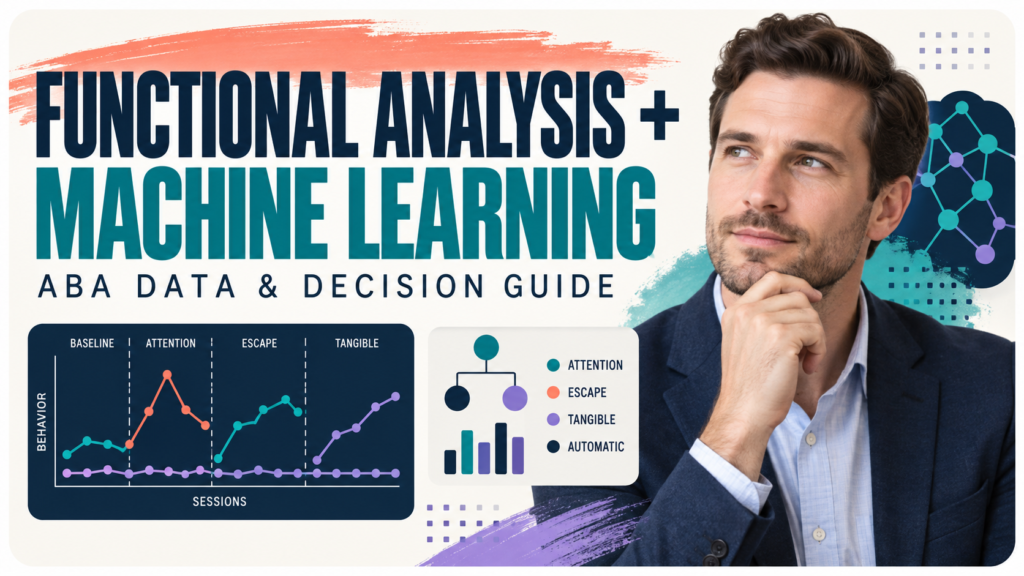
Is functional analysis useful for machine learning? Yes—potentially, when the functional-analysis sessions are collected consistently and the model is treated as decision support rather than as proof. An experimental functional analysis can create structured observations: a condition label, a session number, an opportunity count, a response measure, and relevant context. That structure is more usable for machine learning than a vague narrative note.
Table of Contents
- Is Functional Analysis Useful for Machine Learning?
- What Functional Analysis Means Here—and What It Does Not
- How Functional Analysis Becomes a Dataset
- A Worked Example: Four Conditions, One Target
- Why the Data Can Help Machine Learning
- What the Current Evidence Actually Supports
- Model Checks Before Action
- Where Machine Learning Can Mislead
- The BCBA Study Lens
- FAQ
- Quick Review Checklist
- Take the Free BCBA Mock Exam
The boundary is just as important: a model can find patterns in recorded data, but it cannot turn correlation into demonstrated behavioral function. Experimental control, ethical safeguards, replication, and BCBA judgment still matter. This guide shows how to use the data without turning a research tool into an automatic treatment selector. Table of Contents
Is Functional Analysis Useful for Machine Learning?
It can be useful when repeated functional-analysis sessions supply labeled examples for a supervised-learning problem. A model may summarize patterns or flag cases for closer review, while predictions can generate hypotheses about which conditions deserve replication.
It is not useful if the input is inconsistent, the target is undefined, or the output is treated as a final clinical answer. “The model predicted attention” is not the same as “attention function was experimentally demonstrated.” The first is a statistical output; the second depends on an experimental arrangement and a defensible interpretation of the data.
The best answer is therefore conditional: functional analysis may create valuable training and evaluation data, but machine learning should supplement—never replace—functional assessment, experimental control, ethical review, or the professional judgment of the behavior-analytic team.
What Functional Analysis Means Here—and What It Does Not
In behavior analysis, a functional analysis is an experimental arrangement in which relevant conditions are systematically compared to evaluate whether a consequence is related to a target behavior. The central idea is controlled comparison. A Children’s Hospital of Philadelphia explainer helps distinguish assessment activities from a single informal observation.
This term has a second meaning in mathematics. Mathematical functional analysis studies spaces of functions and operators and is part of the theory behind some areas of machine learning. That is a different topic from a behavior-analytic functional analysis. The exact keyword is ambiguous, so this article uses the behavior-analysis meaning when discussing conditions, response rates, and BCBA decisions, and names the mathematics meaning only to prevent confusion.
An experimental functional analysis also differs from a broader functional behavior assessment. An FBA may include interviews, records, direct observation, and indirect tools; an experimental analysis involves systematic condition comparisons. A machine-learning project must label which kind of data it uses. Mixing caregiver impressions, school notes, and experimental sessions without marking their source does not create a valid functional-analysis dataset.
How Functional Analysis Becomes a Dataset
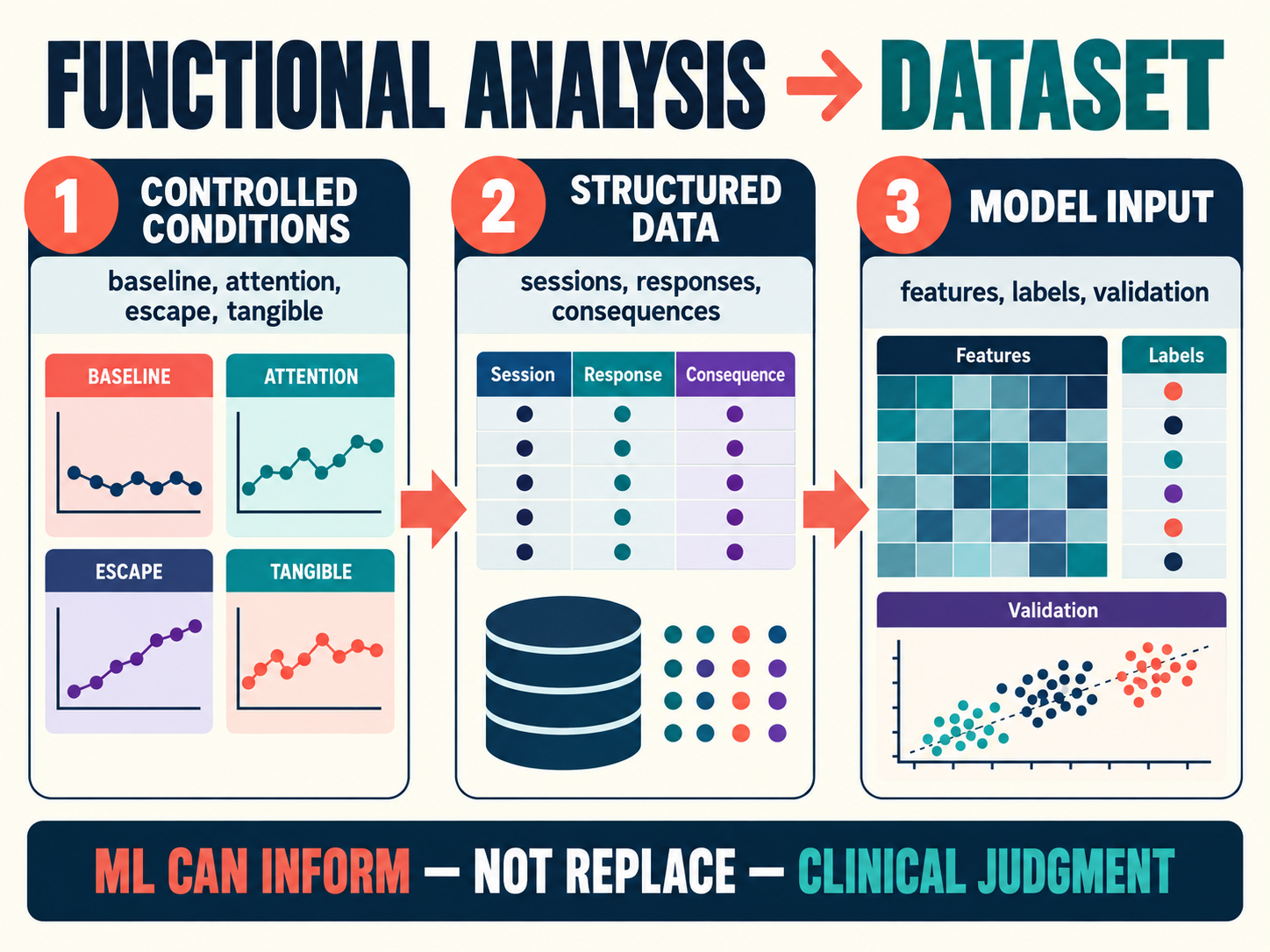
To make the data useful, the research team first defines the unit of analysis. That might be one session, one five-minute segment, one opportunity, or one condition comparison. Each row then needs enough information for another analyst to understand what was measured and under what conditions. The model should not be asked to infer basic definitions that the study team never recorded.
| Field | Example value | Why it matters |
|---|---|---|
| Condition | Attention | Identifies the experimental context being compared. |
| Response measure | Hits per minute | Gives the model a defined outcome instead of a vague label. |
| Session context | Day, setting, implementer, task | Shows whether a pattern might depend on the person or setting. |
| Label or outcome | Highest repeated response rate | Defines what the model is being trained to predict and what it is not claiming. |
Data quality is not just technical. If the target definition changes, or one person records rate while another records duration, the model may learn the measurement change rather than a behavioral pattern. Document agreement, treatment integrity, missing-data rules, and condition timing before training.
A Worked Example: Four Conditions, One Target
Consider this hypothetical example. A team defines one target as the number of problem responses per minute during a 10-minute session. It runs four conditions—attention, escape, tangible, and play—with eight sessions per condition. The table below is invented for teaching purposes; it is not a published result and does not establish a function for any real person.
| Condition | Mean response rate | Possible row-level features |
|---|---|---|
| Attention | 2.1 per minute | Session number, prior rate, implementer, response latency |
| Escape | 6.4 per minute | Task difficulty, demand count, break delivery, session number |
| Tangible | 2.8 per minute | Item type, delay, prior access, response latency |
| Play | 0.7 per minute | Free-play duration, competing activity, session number |
A simple descriptive summary suggests an escape-related pattern in this hypothetical case, but a machine-learning team might ask a different question: given early-session features, can a model correctly flag which condition will show the highest response rate? That prediction could help prioritize review, but it would still need to be checked against the full analysis. The team should not train and test on rows from the same person in a way that lets the model memorize that person’s signature.
Why the Data Can Help Machine Learning
Machine learning is good at finding repeated relationships in structured examples. Functional-analysis data can be attractive because the conditions are named, the outcome is measurable, and the sessions can be repeated. A model might combine response rate, trend, latency, task variables, and session order to estimate a class or rank cases for review. In a larger research dataset, that could reduce the time needed to scan many records.
The value depends on the question. Prediction of a session outcome is not the same as causal explanation. A model may predict high responding in an escape condition because escape sessions were usually longer, harder, or implemented by a particular person. That pattern may be useful for quality improvement, but it does not prove which variable functions as reinforcement. Researchers must preserve the causal logic of the functional analysis instead of letting the model’s convenience redefine the question.
What the Current Evidence Actually Supports
The evidence supports cautious experimentation, not a finished autonomous system. A proof-of-concept paper, Machine Learning for Supplementing Behavioral Assessment, describes models that use assessment-related data to inform which functional-analysis conditions may deserve attention. Its framing is important: false negatives and other errors remain meaningful, so the model supplements assessment rather than replacing clinical judgment.
A 40-year review of functional analysis of problem behavior gives the opposite piece of the puzzle. Functional analysis has a long experimental literature and a logic that depends on controlled condition comparisons. That history cannot be compressed into a label column without losing context. A model may learn from the data, but the experimental design remains the basis for interpreting what a condition comparison means.
The machine-learning tutorial for behavioral research emphasizes the research workflow: define the question, prepare the data, separate training from evaluation, and interpret model performance in relation to the scientific problem. Another ABA study used machine learning to predict treatment-plan type from intake data; it is a useful example of prediction, but prediction of a plan category should not be confused with proof that the predicted plan is effective for an individual. So “Can this model support a defined research task?” is defensible. “Can a model decide function and automatically prescribe treatment?” is not a general claim supported by this evidence.
Model Checks Before Action
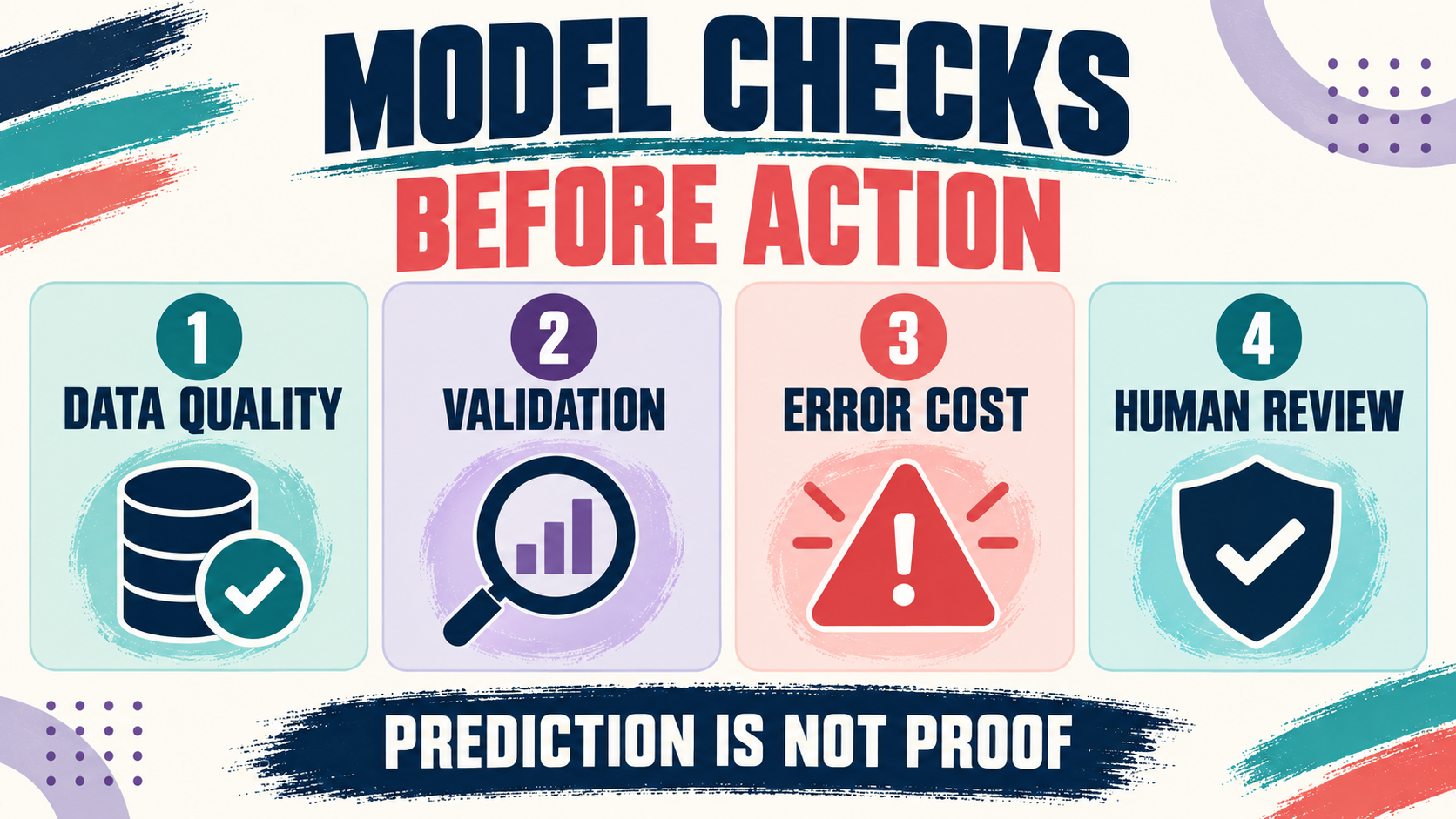
Before anyone acts on a prediction, ask four questions. First, are the data trustworthy? Check definitions, missingness, interobserver agreement, condition fidelity, and whether the same person or site appears in both training and test data. Second, was the model validated on genuinely held-out cases or sessions? Randomly splitting highly related rows can make performance look better than it is.
| Check | Question to ask | Failure if skipped |
|---|---|---|
| Data quality | Are definitions and procedures stable across observers and sessions? | The model learns recording noise or procedural drift. |
| Validation | Does performance hold for new people, settings, or replications? | The model memorizes the training sample. |
| Error cost | Which is more harmful: a false positive or a false negative? | A convenient accuracy score hides an unsafe tradeoff. |
| Human review | Who can challenge the output and request more assessment? | A probability is mistaken for a diagnosis or function. |
For an imbalanced dataset, accuracy alone can be misleading. Report the confusion matrix and consider sensitivity, specificity, precision, recall, calibration, and performance by person or setting. The right metric depends on the decision. If missing a potentially important pattern is more costly than sending a case for review, the threshold should reflect that—and the workflow should still include a qualified human reviewer.
Where Machine Learning Can Mislead
- Small samples: a model can look impressive on a few repeated sessions and fail on a new person. Repeated rows do not equal independent participants.
- Label leakage: if the feature contains information created after the outcome, the model may be given the answer in advance.
- Confounded conditions: a condition may be associated with a particular task, therapist, room, or time of day. The model may learn that shortcut.
- Measurement drift: changes in definitions, observers, or recording systems can masquerade as behavioral change.
- Overgeneralization: a model trained on one population or protocol may not transfer to a different setting, communication profile, or target behavior.
- Automation pressure: once a dashboard produces a score, a team may give it more authority than its validation supports. A score is a prompt for review, not a substitute for review.
These are not reasons to reject machine learning. They are reasons to make the claim narrower. “The model identifies cases for replication under these tested conditions” is easier to defend than “the model discovers function.”
The BCBA Study Lens
For BCBA exam preparation, organize the problem in the same order you would organize an assessment question. Start with the operational definition and measurement system. Identify the antecedent and consequence arranged by the condition. Ask whether the design supports a functional interpretation. Then consider data quality, replication, treatment integrity, and the social importance of the target.
Machine learning adds a second layer. “Features” are the recorded variables; the “label” is the prediction target. The training set is not proof that the label is correct. The test set shows performance on unused data. A human reviewer decides whether the output is relevant, safe, and sufficient for the next step.
A useful exam-style answer therefore avoids two extremes: “technology is always objective” and “technology has no place in behavior analysis.” The stronger answer is conditional, data-based, transparent about error, and consistent with experimental control and professional responsibility. The BACB task-list and outline materials are the appropriate place to confirm current exam-domain wording; this article is a study aid, not an official exam interpretation.
FAQ
Can machine learning identify the function of behavior?: It can estimate a defined label or flag a pattern for review, but a prediction is not the same as an experimentally demonstrated function. The claim must match the design, data quality, validation, and error tolerance.
Does a functional analysis automatically create good machine-learning data?: No. Functional-analysis sessions can be useful data only when the response definition, condition, measurement, context, missing-data rules, and procedural fidelity are recorded consistently. A small or biased dataset can still produce a confident but fragile model.
What is the safest use of a model in this area?: Use it to organize records, screen for cases that deserve closer review, or generate a hypothesis that a qualified team can test. Keep the output reviewable, document uncertainty, and avoid automatic treatment changes based only on a score.
Is this the same as mathematical functional analysis?: No. Mathematical functional analysis studies functions, spaces, and operators. This article uses “functional analysis” in the behavior-analysis sense: a structured experimental comparison of conditions related to a target behavior.
Bottom line: functional analysis can be useful for machine learning when it produces reliable, well-labeled, ethically collected data for a narrow research question. The responsible workflow is controlled conditions → transparent dataset → held-out validation → explicit error costs → human review. If you are studying the BCBA concepts behind that workflow, the free BCBA mock exam is an optional practice resource, not an official BACB exam.
Quick Review Checklist
Use this final checklist to turn is functional analysis useful for machine into exam-ready reasoning. The goal is not to memorize a label in isolation; it is to identify the relevant evidence and explain why the best answer fits the scenario. Key ideas to review:
- State the central definition or decision point for is functional analysis useful for machine in your own words.
- Identify the detail that makes is functional analysis useful for machine different from its closest related ABA term.
- Separate the observable facts in a scenario from assumptions that are not supported by the facts.
- Write one example and one nonexample so you can recognize the concept in a new setting.
Exam application checks:
- Ask what the question is actually requesting before comparing the answer choices.
- Mark the antecedent, response, consequence, or other evidence that supports the selected answer.
- Look for a distractor that describes a related process but does not answer the specific question.
Final self-check:
- Explain how you would verify the interpretation with clear observations or data.
- Change one detail in the scenario and decide whether your answer should change.
- Give a one-sentence rationale that a supervisor or study partner could evaluate.
Take the Free BCBA Mock Exam
If you want a low-pressure way to check your recall, use the free practice resource below. Take the Free BCBA Mock Exam



