

A function-first guide to choosing, teaching, and measuring ABA picture cards without confusing a visual material with a complete communication system. If you are searching for ABA picture cards, the short answer is that a picture card is a visual stimulus or support. It can help a learner request, choose, label, identify, sequence, or participate in a routine. The card itself is not automatically an intervention, an AAC system, or PECS. Its value depends on the response it supports, the consequence that follows, the learner’s access and preferences, and the data the team collects.
Table of Contents
- What Are ABA Picture Cards?
- ABA Picture Cards: Choose by Function
- Teach and Measure ABA Picture Cards
- Do Not Treat Every Card as the Same Tool
- Common Mistakes and Family Questions
- BCBA Reasoning Connection
- Frequently Asked Questions
- Quick Review Checklist
- Take the Free BCBA Mock Exam
That distinction matters because the same picture can serve very different functions. A photo of a snack might be used to request food, choose between two items, label an object, follow a visual schedule, or practice receptive identification. Buying a large card set without defining the learner’s goal can create busy materials without meaningful communication.
Quick answer: Choose ABA picture cards by function first. Define the response, arrange an accessible opportunity, prompt only as needed, deliver a meaningful consequence, fade prompts, and probe the skill with new people and materials. Review data instead of assuming that touching a card equals independent communication.
What Are ABA Picture Cards?
ABA picture cards are cards with photographs, illustrations, symbols, or written labels that function as teaching materials or visual supports. In a behavior-analytic plan, the team should be able to say what the card does in the learning arrangement: it may be an antecedent, a discriminative stimulus, a response option, a prompt, or a way to represent an activity.
For example, a learner may hand over a “help” card, point to a “play” card, match a photo to a real object, select a preferred item from a choice array, or use a sequence of routine cards. These are not the same response. They require different teaching steps and different measures.
Picture cards should also be accessible. Some learners respond best to photographs of familiar objects; others may use line drawings, symbols, text, gestures, speech-generating devices, or a combination. The American Speech-Language-Hearing Association’s AAC information is a useful reminder that communication supports are individualized and can include multiple modes. A card should expand communication, not become a reason to block an available voice, sign, gesture, or device.
If the goal is an exam study aid, an ABA terminology flashcard is a different product from a learner-facing communication card. The site’s ABA terminology flashcards guide covers candidate study materials; this page focuses on selecting and using cards in teaching and daily routines.
ABA Picture Cards: Choose by Function
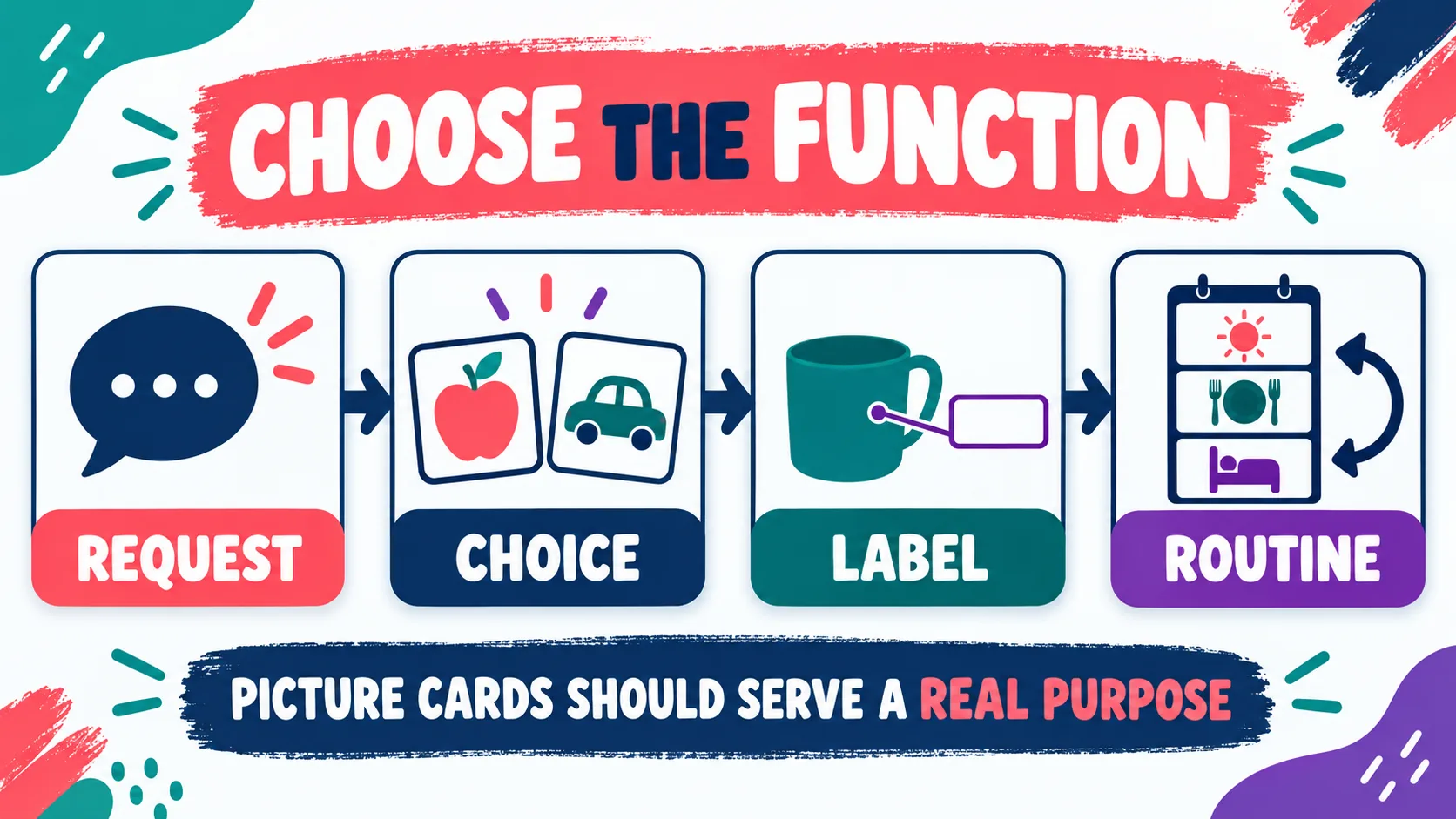
Start by asking what the learner should be able to do with the card. “Use picture cards” is not a measurable goal. “Select a card to request a preferred activity” identifies a response and a useful outcome. The same card can be appropriate in one arrangement and unnecessary or confusing in another.
| Possible function | Example response | Planning question |
|---|---|---|
| Request | Hands over or selects a card for help, break, item, or activity. | Does the card reliably contact the intended outcome, and can the learner reject or change the request? |
| Choice | Selects between two or more available activities or materials. | Are the pictured options actually available, and is “no choice” or “finished” represented? |
| Label | Names or selects a picture when asked, or matches a picture to an object. | Is the task labeling, receptive identification, matching, or a verbal-operant target? |
| Routine | Checks or follows a sequence of activities, then moves to the next step. | Does the visual support independence, or is the learner following adult prompts? |
Then choose the representation. Familiar photographs may be useful when the learner needs to connect a symbol to a real item. Icons can be efficient for repeated routines. Text may support a literate learner. Size, contrast, tactile access, motor demands, and visual complexity matter just as much as the picture itself.
Teach and Measure ABA Picture Cards
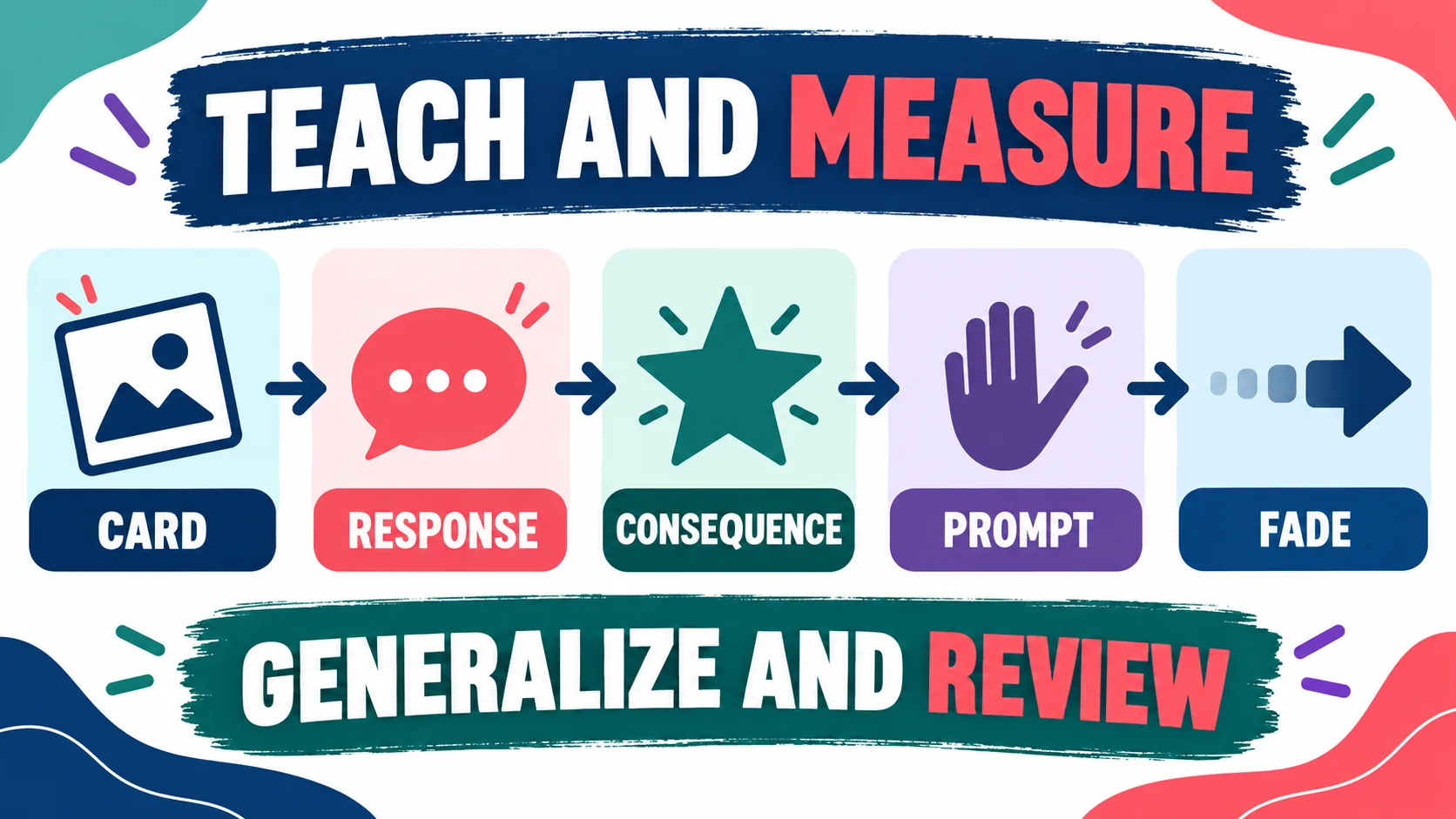
A card should be part of a teaching arrangement, not a test of whether a learner can guess what the adult wants. A simple plan has five connected decisions:
- Define the response. Specify whether the learner points, touches, selects, exchanges, hands over, matches, or uses another response form. State what counts as independent.
- Arrange a meaningful opportunity. Make the relevant item, activity, help, or routine available. Do not require a card response when the learner already has a more efficient accessible communication method.
- Prompt only as needed. Use the least intrusive prompt that supports success and follow a planned fading strategy. A prompt-dependent card response is not the same as independent communication.
- Deliver the programmed consequence. If the card requests a break, help, or an item, the consequence should be meaningful and available under the plan. If the card is for labeling, use the consequence appropriate to that learning goal.
- Probe and generalize. Try new people, materials, rooms, and routines. Check whether the learner uses the card without an adult placing it directly in the response path.
| Question | Possible measure | Interpret carefully |
|---|---|---|
| Can the learner select the correct card? | Independent correct responses across defined opportunities. | A correct touch after a hidden prompt may not be independent. |
| Does the card serve its function? | Whether the request contacts the intended item, help, break, or activity. | Do not count card touching as communication if nothing meaningful follows. |
| Does the skill generalize? | Probes across partners, settings, card formats, and natural routines. | A response in one therapy room does not prove transfer. |
| Is the system still useful? | Family/learner feedback, speed, access, and participation in real routines. | Keep reviewing fit; a card system should not be preserved just because it was once taught. |
Prompt fading should be visible in the data. If the adult always points to the correct card, moves the learner’s hand, or places the card directly in front of the learner, record that support. Otherwise the team may mistake adult behavior for learner independence.
Do Not Treat Every Card as the Same Tool
Several materials look similar but answer different teaching questions. The visual schedule guide covers schedule formats and transitions, while the functional communication training guide focuses on teaching a communication response that replaces a challenging behavior functionally.
| Tool | Primary question | Do not assume |
|---|---|---|
| Generic picture card | What visual stimulus or response option supports the target? | That the card is automatically a communication system. |
| Visual schedule | What happens next, and how can the learner navigate a sequence? | That following a schedule teaches requesting or replaces all communication. |
| PECS | What formal picture-exchange protocol and training sequence is being used? | That any picture exchange or printable card set is PECS. |
| AAC system | What communication mode gives the learner reliable access across people and settings? | That a low-tech card should replace a device, speech, sign, or other effective mode. |
The official PECS information from Pyramid Educational Consultants is the right place to check what PECS refers to. If a learner needs broader AAC assessment or access decisions, involve the appropriate qualified professionals rather than selecting cards from a keyword list alone.
Common Mistakes and Family Questions
- Buying before defining the goal. Start with the routine and function; choose the card format second.
- Using too many cards at once. A large array can add visual and motor demands that hide the actual discrimination skill.
- Requiring a card when the learner already communicates. Keep efficient, accessible speech, sign, gestures, devices, and other modes available.
- Counting prompted touches as mastery. Separate independent, gestural, model, and physical prompt levels.
- Failing to honor refusal. Include “no,” “break,” “finished,” or another accessible way to pause when relevant.
- Never probing outside therapy. Generalization and maintenance require meaningful people, materials, and routines.
Families can ask: What does this card response help my child do? What happens after the response? How is independence measured? How can my child reject an option? What will the team do if the cards are not useful? Which communication professionals should be involved? Clear answers are more valuable than a promise that a particular card set works for everyone.
BCBA Reasoning Connection
For BCBA students, picture-card questions often test the relationship among antecedent, response, consequence, stimulus control, prompting, and generalization. Do not choose the answer that uses the most attractive visual. Choose the procedure that matches the function, gives the learner an accessible response, measures independence, and includes a plan to fade prompts and transfer the skill.
The BACB task-list hub is the place to recheck current exam language. Picture cards may appear in a question about functional communication, discrimination training, prompt fading, visual supports, or generalization. The card is a material; the behavior-analytic reasoning comes from what the learner does and what consequence follows.
Frequently Asked Questions
What are ABA picture cards used for?: They may support requesting, choice-making, labeling, receptive identification, sequencing, transitions, or routine participation. The correct use depends on the learner’s goal and the teaching arrangement. Are ABA picture cards the same as PECS?: No. Generic picture cards are materials. PECS refers to a formal picture-exchange communication protocol. Do not label a card set PECS unless the program and training actually use that system.
How do I know whether a picture-card goal is working?: Track the defined response, independent versus prompted performance, whether the intended consequence follows, and whether the skill transfers to new people and routines. Review learner and family feedback as well as numerical data.
Where can BCBA candidates practice picture-card questions?: After reviewing the function and measurement logic, candidates can try the Free BCBA Mock Exam to practice choosing among prompts, visual supports, communication procedures, and generalization options. It is a study resource, not a guarantee of certification, licensure, therapy results, employment, or exam success. Sources to recheck: the BACB task-list hub, ASHA AAC information, and the official PECS information. Card selection and communication teaching should be individualized, accessible, and reviewed with the learner, family, and qualified professionals.
Quick Review Checklist
Use this final checklist to turn aba picture cards into exam-ready reasoning. The goal is not to memorize a label in isolation; it is to identify the relevant evidence and explain why the best answer fits the scenario. Key ideas to review:
- State the central definition or decision point for aba picture cards in your own words.
- Identify the detail that makes aba picture cards different from its closest related ABA term.
- Separate the observable facts in a scenario from assumptions that are not supported by the facts.
- Write one example and one nonexample so you can recognize the concept in a new setting.
Exam application checks:
- Ask what the question is actually requesting before comparing the answer choices.
- Mark the antecedent, response, consequence, or other evidence that supports the selected answer.
- Look for a distractor that describes a related process but does not answer the specific question.
Final self-check:
- Explain how you would verify the interpretation with clear observations or data.
- Change one detail in the scenario and decide whether your answer should change.
- Give a one-sentence rationale that a supervisor or study partner could evaluate.
Take the Free BCBA Mock Exam
When you are ready to apply the idea, use the free practice resource below for additional feedback. Take the Free BCBA Mock Exam



