
Is ABA good for ADHD? The careful answer is: it can be useful for some observable goals, but it is not a one-size-fits-all ADHD treatment and should not replace diagnosis, medical care, or evaluation of co-occurring conditions. Applied behavior analysis can help a team define a target such as starting homework, transitioning between activities, or using an organizational routine. The team still needs to ask whether that target is the right priority, who is qualified to address the health condition, and whether the plan respects the person’s preferences and dignity.
Table of Contents
- Is ABA Good for ADHD? The Short Answer
- What Does ABA Mean in the ADHD Context?
- When ABA-Informed Support May Help
- What ADHD Guidelines Actually Recommend
- Where ABA Is Not Enough
- How to Evaluate an ABA-Informed Program
- What to Measure: A Simple Example
- Common Misunderstandings
- FAQ
- Quick Review Checklist
- Take the Free BCBA Mock Exam
Current ADHD guidance usually discusses behavior therapy, parent training, classroom supports, environmental changes, and medication decisions rather than promising that every service labeled “ABA” will work for ADHD. This guide explains the overlap and the limits so families, educators, and BCBA students can evaluate a proposal using goals and data instead of a label. Table of Contents
Is ABA Good for ADHD? The Short Answer
ABA may be a reasonable set of methods for a specific, measurable behavior goal related to ADHD, especially when the plan uses function-based assessment, positive reinforcement, environmental supports, and coordinated communication across settings. Examples might include beginning a morning routine, submitting assignments, waiting for a turn, or reducing a clearly defined disruption that interferes with learning.
That statement is different from saying “ABA treats ADHD.” ADHD is a health condition that requires appropriate assessment and a treatment plan from qualified healthcare professionals. The CDC’s ADHD treatment overview describes behavior therapy and medication as treatment options and emphasizes that the best plan depends on the person, family, and environment. A family should therefore judge an ABA-informed service by its target, evidence, coordination, measurement, and fit—not by the acronym alone.
What Does ABA Mean in the ADHD Context?
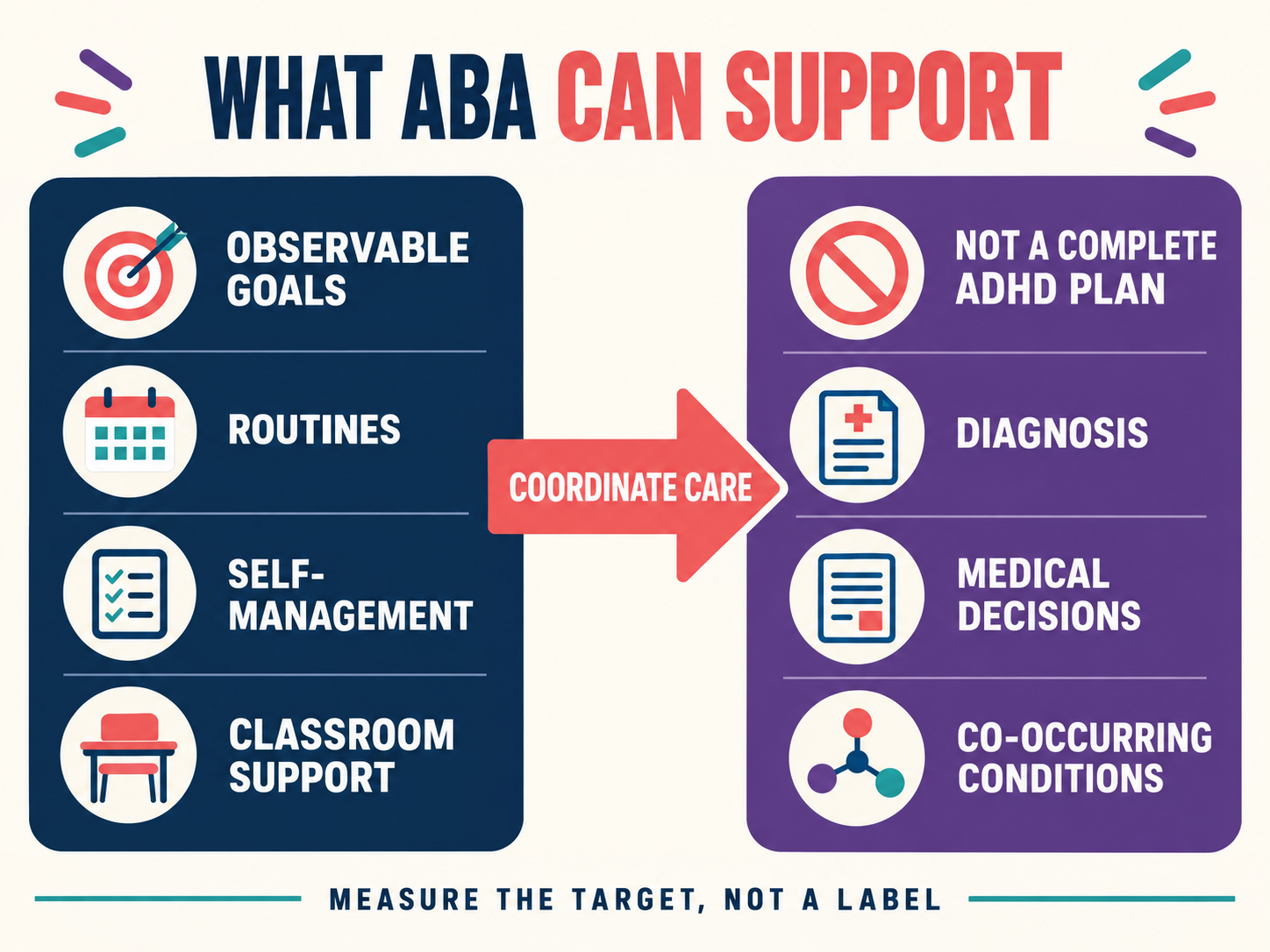
In this context, ABA is best understood as a way to analyze and change relationships between behavior and the environment. A practitioner might define “task initiation” as opening the assignment, gathering the needed materials, and beginning within two minutes of a clear direction. The practitioner can then look at what happens before the behavior, what makes it easier or harder, and what consequence maintains improvement.
This approach can be useful without treating the diagnostic label as the target. “ADHD” is not an observable response to count on a session data sheet. “Started three of four assigned tasks within two minutes” is observable. “Used a visual schedule and checked off the first step” is observable. “Was more compliant” is usually too vague unless the team defines exactly what compliance means and why that behavior matters.
ABA-informed support may overlap with behavioral parent training or classroom management, but the names are not automatically interchangeable. A good plan explains who will implement it, what training they receive, how the person can communicate assent or refusal, and how the team will decide whether to continue, adapt, or stop. The goal should be meaningful participation and functioning, not making a person appear quiet or typical at any cost.
When ABA-Informed Support May Help
Behavior-analytic methods are most defensible when the target is concrete, socially important, and connected to a real context. The following examples show the difference between a useful target and an overbroad promise.
| Possible goal | Observable target | Why context matters |
|---|---|---|
| Starting work | Begins a named assignment within two minutes of the agreed cue | The team can adjust materials, task size, timing, or reinforcement rather than simply repeating “pay attention.” |
| Transitions | Moves from one activity to the next with the agreed visual or verbal signal | A transition may fail because of unclear expectations, response effort, fatigue, or loss of a preferred activity. |
| Organization | Records homework in one agreed system and checks it before leaving | The support should reduce memory and planning demands, not turn into a punishment for forgetting. |
| Class participation | Uses a break request or response card before leaving the instructional area | A functional communication option is more meaningful than suppressing movement without teaching a replacement. |
These are examples of targets, not a universal ADHD program. A goal is only worthwhile if it improves access, learning, safety, relationships, or independence and if the person can participate in choosing or shaping the support whenever possible.
What ADHD Guidelines Actually Recommend
Guidelines help answer an important question: what does the evidence support, and what is merely a marketing claim? The American Academy of Pediatrics guideline describes age-sensitive treatment that can include evidence-based behavior therapy, parent or teacher-administered interventions, medication, or combinations depending on age and circumstances. The NICE guideline emphasizes information, structure, environmental modifications, parent support, and communication with schools and other professionals.
The CDC classroom guidance discusses behavioral classroom management and organizational support. Those recommendations overlap with behavior-analytic tools, but they do not establish that every clinic using the ABA label is an ADHD treatment provider. The practical takeaway is to compare the actual service model with the recommended components.
| Guideline context | What to compare in a proposed service |
|---|---|
| Behavior therapy and parent training | Does the plan teach caregivers practical strategies they can use in daily routines, with feedback and realistic workload? |
| Classroom and organizational supports | Will the team coordinate with school staff and measure participation or work completion in the setting where the difficulty occurs? |
| Medical and developmental assessment | Who evaluates ADHD, sleep, anxiety, learning, language, tics, or other conditions that may change the plan? |
Where ABA Is Not Enough
ABA should not be presented as a substitute for an ADHD evaluation or as a way to decide whether medication is appropriate. The CDC clinical-care guidance notes that clinicians should consider conditions that may coexist with ADHD, including emotional or behavioral disorders, learning or language disorders, autism, sleep problems, and other physical conditions. A behavior plan can be helpful while those questions are being addressed, but it cannot answer them by itself.
Be cautious when a service promises to “fix ADHD,” uses one protocol for every person, discourages collaboration with healthcare or school professionals, or measures only adult compliance. Ask what happens if the person says no, needs a break, communicates differently, or finds a procedure distressing. Support should include assent, choice, reasonable accommodations, and a plan for reducing unnecessary prompts or intensive services over time.
- Diagnosis: a BCBA is not automatically qualified to diagnose ADHD. Confirm which licensed professional handles assessment.
- Medication: medication decisions belong with the prescribing clinician and family or adult patient; an ABA provider should not present behavior data as a replacement for medical advice.
- Co-occurring needs: sleep, anxiety, learning, communication, sensory, and physical factors may require other specialists or accommodations.
- Ethics and dignity: the plan should target meaningful outcomes, not suppress harmless movement, emotion, self-advocacy, or communication simply because adults prefer quiet behavior.
How to Evaluate an ABA-Informed Program
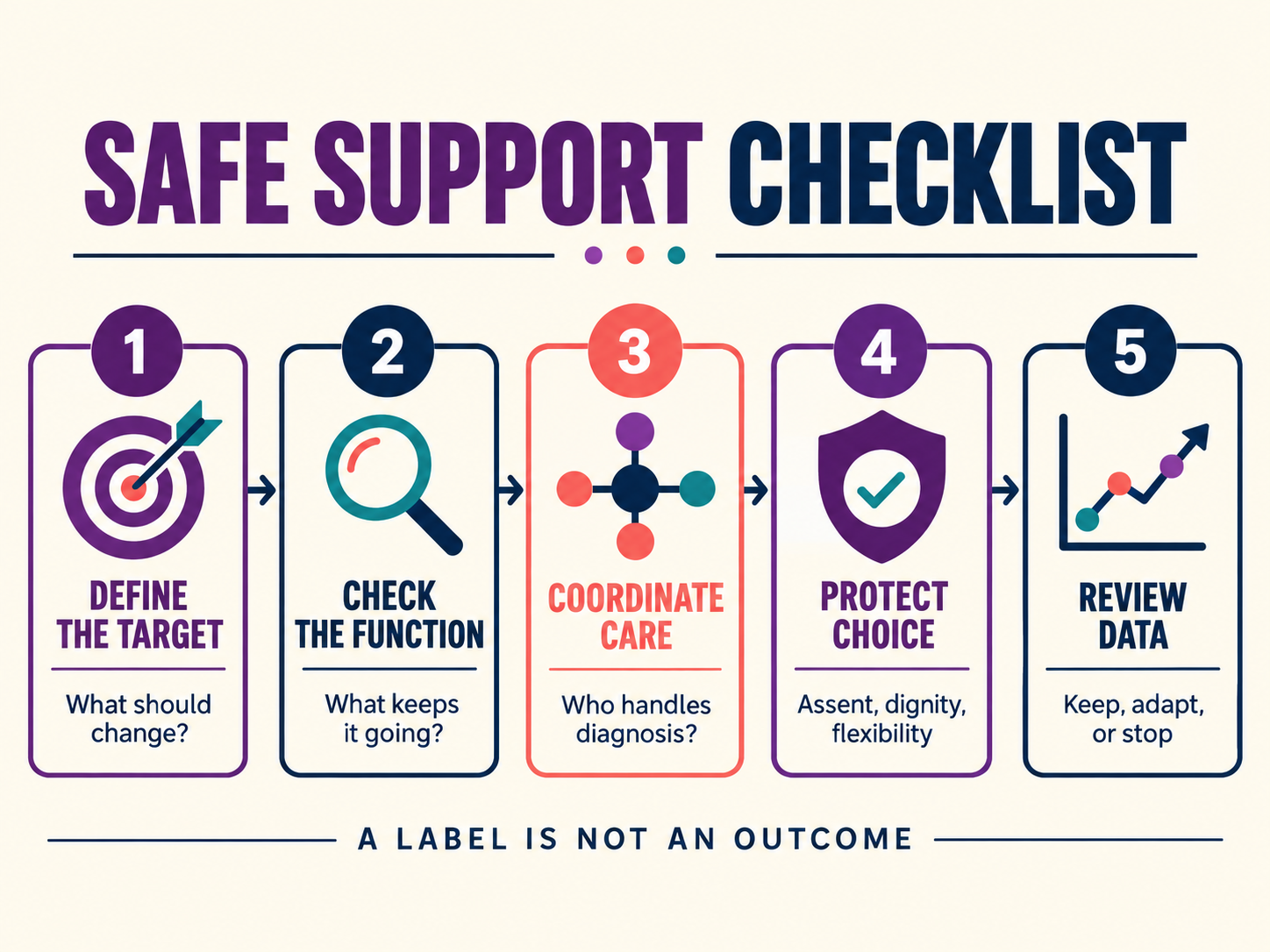
Before agreeing to services, ask for plain-language answers to these questions:
- What exact behavior will be measured? Replace “attention” or “better behavior” with a definition that two observers could score similarly.
- What is the likely function or barrier? The plan should consider task difficulty, unclear directions, sleep, motivation, communication, and environmental demands—not assume the person is choosing to be difficult.
- Who coordinates the plan? Ask how the provider will communicate with the healthcare team, family, and school, with appropriate consent.
- What choices does the person have? Ask how assent, breaks, preferred activities, communication access, and refusal will be honored.
- What data trigger a change? A good plan names when the team will keep, adapt, pause, or stop an intervention.
- How will skills transfer? Ask whether the goal is practiced across the settings, people, and routines where it matters, rather than only in a therapy room.
A provider who welcomes these questions is easier to evaluate than one who relies on the ABA label as the entire explanation. You can also ask whether the proposed service is actually behavior therapy or parent training designed for ADHD, an ABA consultation, a school support, or a combination. The service name should not hide the active ingredients.
What to Measure: A Simple Example
Imagine that a student misses the beginning of assignments. Instead of measuring “ADHD improvement,” the team defines one target: after the teacher gives the agreed cue, the student opens the assignment and writes the first answer within two minutes. During a baseline of 10 opportunities, the student does this independently 3 times. After a support is introduced, the student does it independently 7 times in the next 10 opportunities.
The simple percentage changes from 3/10 = 30% to 7/10 = 70%. That is useful information, but it is not proof that ABA cured ADHD or that the change will generalize. The team should also record prompt level, setting, task difficulty, missed opportunities, and whether the student experiences the routine as acceptable. If performance rises only when an adult stands beside the student, the next decision may be prompt fading or an environmental change rather than more intensity.
Review the trend with the people involved. Does the goal matter to the student? Is the improvement visible at home and school? Did sleep, medication, schedule, teacher, assignment type, or another condition change? Data support better decisions when they are interpreted with context rather than used as a sales score.
Common Misunderstandings
- “ABA” and “behavior therapy” are identical labels. They may share reinforcement, prompting, environmental design, and measurement, but the actual provider, population, goals, and delivery model matter.
- More hours automatically mean better care. Intensity should follow the goal, evidence, context, and the person’s assent—not a preset number that ignores family capacity.
- Behavior support replaces medication or diagnosis. It does not. ADHD care may involve several coordinated components, and the right combination varies.
- A quiet child is necessarily doing better. The meaningful outcome may be learning, self-advocacy, relationships, safety, independence, or access to preferred activities.
If you are studying BCBA concepts, this distinction is also the exam-relevant point: identify the observable target, the environmental variables, the measurement, and the limits of the conclusion. Do not infer a medical outcome from a behavior change that was never defined.
FAQ
Is ABA recommended as a standard treatment for ADHD?: Guidelines commonly recommend or discuss behavior therapy, parent training, classroom supports, environmental modifications, medication, or combinations based on age and circumstances. They do not make a blanket statement that every service marketed as ABA is the correct ADHD treatment. Evaluate the actual goals, provider qualifications, coordination, and data.
Can a BCBA diagnose ADHD?: Do not assume that a BCBA can diagnose ADHD. Ask which qualified healthcare professional handles diagnosis and how behavior services will coordinate with that evaluation. A BCBA may contribute behavior assessment and intervention expertise without replacing medical or mental-health assessment.
What is the safest next step for a family?: Write down the real-life difficulty, ask for a measurable and meaningful target, confirm who handles ADHD assessment and medical decisions, and ask how choice, communication, and data review will be protected. If the answers are vague or promise a cure, seek another opinion.
Bottom line: ABA-informed methods may help with defined routines, participation, self-management, and environmental supports for some people with ADHD. The right question is not “Is ABA always good?” It is “What specific outcome, delivered by whom, with what evidence, safeguards, coordination, and data, is this plan meant to improve?” If you are preparing for BCBA scenarios after reviewing the distinction, the free BCBA mock exam is an optional practice resource, not medical advice or an official BACB exam.
Quick Review Checklist
Use this final checklist to turn is aba good for adhd into exam-ready reasoning. The goal is not to memorize a label in isolation; it is to identify the relevant evidence and explain why the best answer fits the scenario. Key ideas to review:
- State the central definition or decision point for is aba good for adhd in your own words.
- Identify the detail that makes is aba good for adhd different from its closest related ABA term.
- Separate the observable facts in a scenario from assumptions that are not supported by the facts.
- Write one example and one nonexample so you can recognize the concept in a new setting.
Exam application checks:
- Ask what the question is actually requesting before comparing the answer choices.
- Mark the antecedent, response, consequence, or other evidence that supports the selected answer.
- Look for a distractor that describes a related process but does not answer the specific question.
Final self-check:
- Explain how you would verify the interpretation with clear observations or data.
- Change one detail in the scenario and decide whether your answer should change.
- Give a one-sentence rationale that a supervisor or study partner could evaluate.
Take the Free BCBA Mock Exam
If you want a low-pressure way to check your recall, use the free practice resource below. Take the Free BCBA Mock Exam



