

Intraverbal who questions list resources are easiest to use when the answer rule is clear: a “who” question usually calls for a person or role. The learner hears a verbal cue such as “Who repairs a broken bicycle?” and responds with a related answer such as “a bike mechanic.” The key BCBA study point is that the question word is only one part of the analysis. You also need to examine the verbal antecedent, the expected response, the prompt level, and what consequence follows.
Table of Contents
- What Is an Intraverbal Who Question?
- Original Intraverbal Who Questions List
- Who Versus Other WH Questions
- How to Build a Who-Question Study List
- Prompting, Measurement, and Generalization
- BCBA Exam Reasoning and Common Traps
- FAQ
- Quick Review Checklist
- Take the Free BCBA Mock Exam
This guide gives you an original list of who-question examples, separates who from where, what, when, and why, and shows how to study the list without turning memorization into a substitute for stimulus-control analysis. It is educational exam guidance, not a universal language program or a BACB-endorsed question bank. Table of Contents
What Is an Intraverbal Who Question?
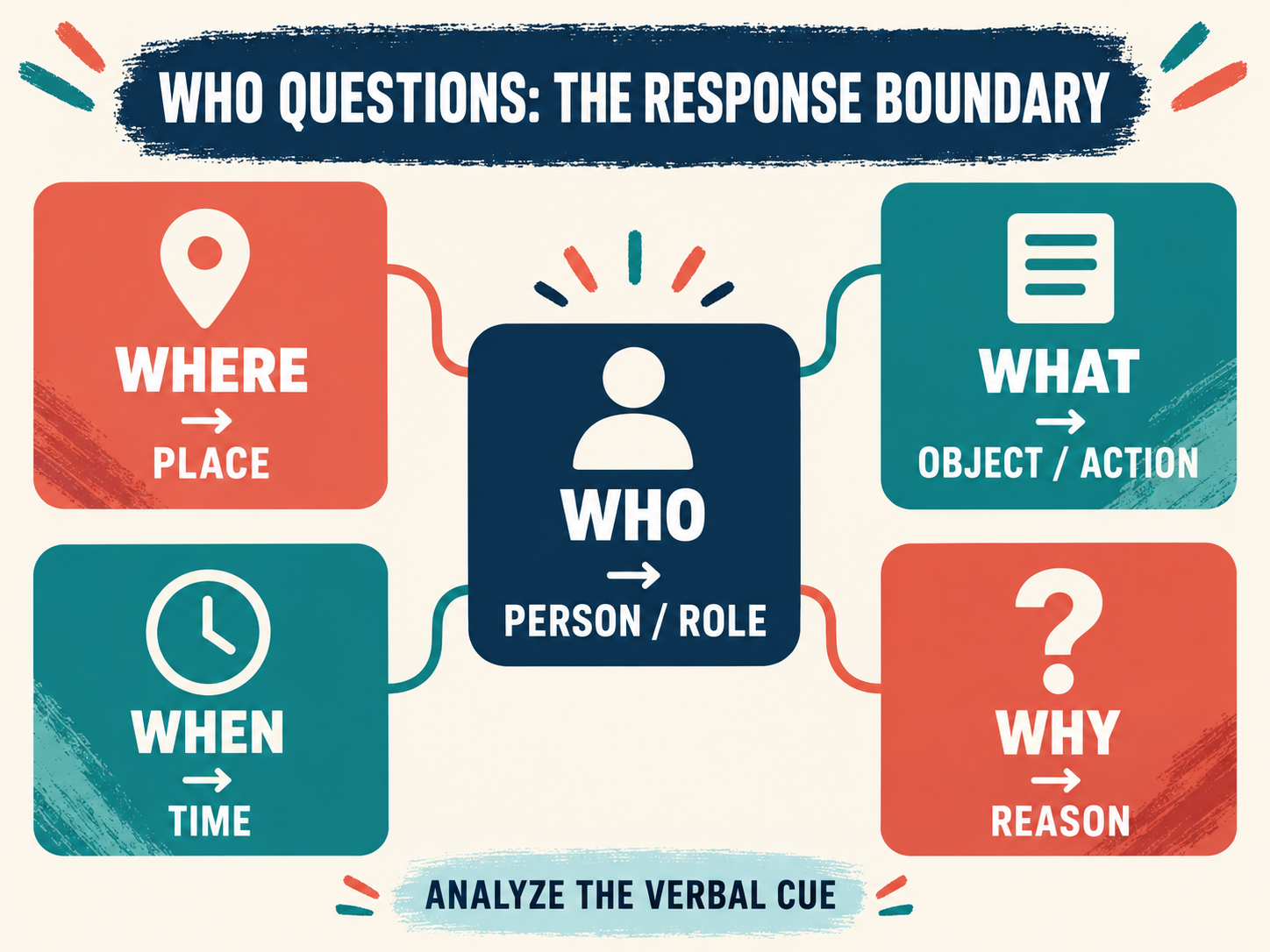
An intraverbal is a verbal response evoked by another person’s verbal behavior without point-to-point correspondence between the cue and the response. In plain language, one person says something and the learner answers, completes, or continues with a related verbal response. A who-question format narrows the expected answer to a person, name, job, or social role. For example, “Who delivers packages?” may evoke “a delivery driver.” The learner does not need to see a delivery truck for the verbal question to be relevant.
The word who does not automatically prove that every response is the same operant. “Who has the missing notebook?” might be used as a mand for information when the speaker is trying to locate a person. “Who helps people choose books?” might be presented as an intraverbal question-answering task during instruction. For BCBA exam reasoning, analyze the entire arrangement instead of classifying a response from the first word of the question.
Likewise, a correct answer can be prompted. If a learner says “librarian” only after hearing a full verbal model, the response may be accurate but not independent. The study target might be independent responding to the natural question, prompted responding during acquisition, or flexible responding across different question wordings. Write that target down before scoring.
The current BCBA Test Content Outline is the right source for current certification scope. This article uses its emphasis on observable behavior, prompting, measurement, generalization, and data-based reasoning as study context; it does not predict official exam questions.
Original Intraverbal Who Questions List
The table below is an original study list, not a reproduction of VB-MAPP, ABLLS-R, or another commercial assessment appendix. Read the cue aloud, hide the response column, and decide the response rule before you practice. Several questions can reasonably accept more than one answer. When that is true, score the defined response class rather than treating the first answer you thought of as the only correct one.
| Who question | Possible answer | Response rule to study |
|---|---|---|
| Who helps you find a book in a library? | A librarian | Person or job role connected to the setting |
| Who repairs a broken bicycle? | A bike mechanic | Role, not a tool or location |
| Who leads a choir rehearsal? | A conductor or choir director | Accept a defined response set when both roles fit |
| Who checks guests in at a museum? | A front-desk worker or greeter | Context determines which role labels are acceptable |
| Who cuts and styles hair? | A barber or stylist | Two responses can belong to one socially relevant class |
| Who grows vegetables on a farm? | A farmer or grower | Define whether a broad or specific role is required |
| Who checks a tooth when it hurts? | A dentist | Specific professional role |
| Who might help a traveler plan a route? | A travel agent or guide | Write the intended context before accepting alternatives |
| Who prepares a prescription at a pharmacy? | A pharmacist or pharmacy technician | The answer class may include more than one trained role |
| Who designs the plans for a new building? | An architect | Person whose professional action matches the cue |
| Who brings a package to your door? | A delivery driver or courier | Accept equivalent role labels if the rule allows them |
| Who studies storms and forecasts weather? | A meteorologist | Technical job label tied to the described activity |
Notice the pattern: the response is not merely “a word that sounds related.” It belongs to a defined person or role class under the cue. If the learner says “library” to the first question, the answer may be associated with the topic but does not satisfy a person-role response rule. If the learner says “someone who works there,” decide in advance whether that broad answer is acceptable or whether the target requires a specific label. A well-designed list makes those scoring decisions visible.
Who Versus Other WH Questions
WH questions can look alike while requiring different response classes. The fastest study check is to ask, “What kind of answer would complete the information request?” The question word is a useful cue, but the full wording and response rule still matter.
| Question form | Typical answer class | Example |
|---|---|---|
| Who? | Person, name, or role | Who repairs bikes? — A bike mechanic. |
| Where? | Place or location | Where do you borrow books? — At the library. |
| What? | Object, action, or event | What fixes a flat tire? — A pump. |
| When? | Time or occasion | When do you check in? — Before the appointment. |
| Why? | Reason or explanation | Why do you wear a helmet? — To protect your head. |
This boundary is a study aid, not a promise that every language sample will fit one box. “Who has the ticket?” can function differently from “Who checks tickets?” because the speaker’s motivation, the information being sought, and the consequence may differ. When a question appears in a BCBA scenario, analyze the antecedent-behavior-consequence arrangement and the response definition before naming the operant.
How to Build a Who-Question Study List
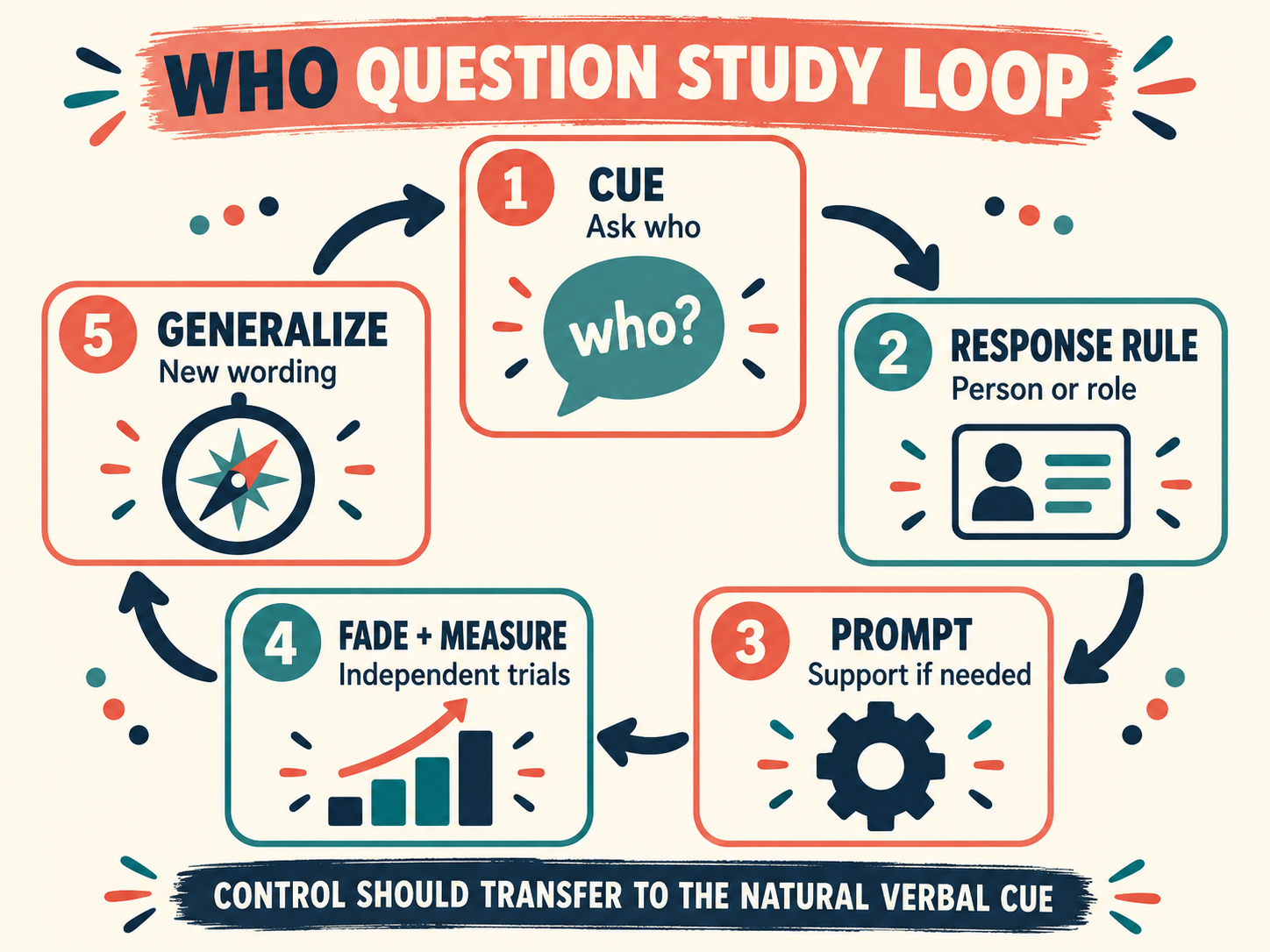
A useful list is short enough to retrieve and precise enough to score. Use the following sequence when you create your own notes or evaluate a study resource:
- Write the exact verbal cue. Record the full question, including the action or setting that narrows the role. “Who helps?” is usually too vague; “Who helps you find a book in a library?” gives the learner a clearer relation.
- Define the answer class. Decide whether the target is a named person, a job title, a family role, or any person who performs the described action. Do this before practicing so your scoring does not change from trial to trial.
- List accepted variants. Include reasonable synonyms only when they fit the same response rule. “Courier” and “delivery driver” may both fit one cue; “door” does not become correct just because a package was mentioned.
- Remove accidental visual prompts. If your goal is responding to a verbal question, hide the answer card, picture, and object. A printed list can help you study, but it can also become the stimulus controlling the response.
- Mix the WH forms. Interleave who, where, what, when, and why questions after the learner or student can respond to each format. Mixing lets you test conditional discrimination instead of relying on a repeated question pattern.
- Plan a generalization check. Change the speaker, wording, role example, or setting when the learning objective calls for flexibility. A new card that repeats the same sentence frame is not automatically a new skill.
For BCBA exam review, make a two-column note: “what the cue asks for” and “what the response rule accepts.” Then cover the answer and answer aloud. If you can only recognize the match after seeing the printed pair, label that as a visual study step rather than independent intraverbal retrieval.
Prompting, Measurement, and Generalization
Prompting should support the target response while control transfers to the natural verbal cue. Suppose the target is “Who repairs a broken bicycle?” and the learner pauses. A teacher may use a prompt that matches the learner’s communication system and teaching plan, such as a partial verbal model or a textual cue. The important measurement question is what happens after the prompt is removed. If the learner answers only after hearing “bike…,” the response is not equivalent to an independent answer to the original question.
Separate independent, prompted, incorrect, and no-response trials. If timing matters, record latency from the end of the question to the response. A simple percentage can hide the difference between eight independent answers out of ten and ten answers after a full model. For a study scenario, name the measure that matches the target: independent accuracy for independent responding, prompt level for transfer, and latency when speed is part of the definition.
Generalization is broader than adding more flashcards. Ask whether the learner responds to a new but equivalent question, a different communication partner, a new setting, or a different acceptable modality when relevant. “Who brings a package?” and “Who delivers mail?” may share a broad role relation, but the response class and scoring rule need to be defined before you call the second cue a generalization probe.
Peer-reviewed research can help you understand how investigators define WH-question targets, prompting arrangements, and independent responding. For example, studies of intraverbal training have examined prompt transfer, complex stimulus control, and question-answering under controlled conditions. They are useful background, not ready-made protocols for every learner. Use current BACB materials and qualified supervision for professional decisions.
BCBA Exam Reasoning and Common Traps
When a BCBA-style item includes a who question, use this five-step check:
- Underline the full verbal antecedent. Do not stop at “who.” The rest of the question may define the role, location, or missing information.
- Identify the required answer class. Is the item asking for a person, a job, a name, or any member of a category?
- Check the controlling variable. Is the answer evoked by the verbal cue, a picture, an object, a written word, or a model?
- Separate prompted from independent performance. A correct response after a prompt is not the same data point as a correct response before the prompt.
- Look for function and consequence. Answering a teacher’s question and asking “Who has my notebook?” may involve different functional arrangements even though both contain the word who.
Common traps include treating a “who” question as automatically intraverbal, counting a place as a correct person answer, accepting one adult-selected answer when the response class is broader, and calling repeated sentence frames generalization. The safest answer is the one that describes observable stimulus control and the defined response—not the one that relies on a memorized label.
If you want more scenario practice after studying this list, you can use the free BCBA mock exam as an optional next step. It is practice material, not an official BACB exam or a guarantee of certification results.
FAQ
What is a simple intraverbal who-question example?: “Who helps you find a book in a library?” with “a librarian” as the defined response is a simple example. The cue is verbal, the expected answer is a person or role, and the answer does not require the learner to see a librarian.
Are all who questions intraverbals?: No. The question word alone does not determine the verbal operant. Consider the full antecedent, the learner’s response, the presence of nonverbal stimuli, the motivation to ask, and the consequence. A who question may be part of an intraverbal task or a mand-for-information arrangement.
How should I study a who-question list for the BCBA exam?: Hide the answer, say the full cue, name the expected answer class, and explain why the response fits. Then compare the same cue with where, what, when, and why versions. Finally, practice identifying prompt level, measurement, and generalization rather than memorizing one answer as universally correct.
Bottom line: a strong intraverbal who questions list is more than a stack of flashcards. It defines the verbal cue, the person-or-role response class, the prompt rule, and the data needed to show independent and flexible responding.
Quick Review Checklist
Use this final checklist to turn intraverbal who questions list into exam-ready reasoning. The goal is not to memorize a label in isolation; it is to identify the relevant evidence and explain why the best answer fits the scenario. Key ideas to review:
- State the central definition or decision point for intraverbal who questions list in your own words.
- Identify the detail that makes intraverbal who questions list different from its closest related ABA term.
- Separate the observable facts in a scenario from assumptions that are not supported by the facts.
- Write one example and one nonexample so you can recognize the concept in a new setting.
Exam application checks:
- Ask what the question is actually requesting before comparing the answer choices.
- Mark the antecedent, response, consequence, or other evidence that supports the selected answer.
- Look for a distractor that describes a related process but does not answer the specific question.
Final self-check:
- Explain how you would verify the interpretation with clear observations or data.
- Change one detail in the scenario and decide whether your answer should change.
- Give a one-sentence rationale that a supervisor or study partner could evaluate.
Take the Free BCBA Mock Exam
If you want a low-pressure way to check your recall, use the free practice resource below. Take the Free BCBA Mock Exam



