

Intraverbal fill ins are a focused type of verbal responding in ABA: a person hears words, part of a phrase, or a question and supplies a related response without simply repeating the verbal stimulus. “Ready, set, ___” followed by “go” is a simple example. The important feature is not the blank itself. It is the controlling relation: a verbal antecedent evokes a response that does not have point-to-point correspondence with the words that came before it.
Table of Contents
- What Are Intraverbal Fill Ins?
- What Are Useful Intraverbal Fill-In Examples?
- How Do Fill-Ins Differ From Echoics and Tacts?
- How Can You Prompt and Transfer Intraverbal Control?
- How Should Independence and Generalization Be Checked?
- What Are Common BCBA Exam Traps?
- Practice Verbal-Behavior Questions
- Take the Free BCBA Mock Exam
- References
For BCBA exam questions, begin by identifying what is present when the response occurs. If the learner is responding to another speaker’s words, think intraverbal. If the learner is repeating the model, think echoic. If an object or event is present and the learner labels it, think tact. The same spoken answer can look different depending on the antecedent and the consequence.
This guide focuses on the narrow fill-in query while complementing our broader intraverbal ABA overview. The examples are original study examples, not a replacement for an individualized language assessment or a learner’s communication plan. A learner may respond vocally, with signs, AAC, or another appropriate communication form; do not treat spoken output as the only valid outcome. Table of Contents
What Are Intraverbal Fill Ins?
An intraverbal fill-in is a response that completes or answers a verbal cue. The cue can be a familiar phrase, a song line, a category prompt, a fact question, or a sentence frame. The response is controlled by the verbal context and is usually maintained by generalized social reinforcement, such as attention, feedback, or continued interaction. The response does not match the antecedent word-for-word. That definition has three parts worth separating:
- The antecedent is verbal: another person says something, or a recorded/written verbal stimulus is presented.
- The response is related but not an echo: the learner supplies a word or phrase that completes the relation.
- The controlling relation matters: the same response can be a tact in one context and an intraverbal in another.
Fill-ins are often an accessible starting point because a highly familiar verbal frame narrows the response field. That does not mean every memorized phrase demonstrates flexible language. A strong program gradually tests variations, new communication partners, new materials, and less predictable verbal contexts so the response is controlled by the relevant words rather than by one exact rehearsal routine.
What Are Useful Intraverbal Fill-In Examples?
Use examples to analyze the antecedent, not to memorize a list. These original examples illustrate different kinds of verbal control:
| Verbal cue | Possible response | Why it can be an intraverbal |
|---|---|---|
| “First we wash, then we…” | “Dry.” | The sentence frame supplies verbal context; no object has to be labeled. |
| “A triangle has how many sides?” | “Three.” | A verbal question evokes a fact response that does not repeat the question. |
| “Name something you wear on your feet.” | “Shoes.” | The category and verbal question narrow the response without requiring an item to be present. |
| “On a rainy day, I might bring an…” | “Umbrella.” | The response is related to the spoken context; it is not a label for a displayed umbrella. |
These are examples for analysis, not universal targets. The appropriate target depends on the learner’s current repertoire, language community, cultural context, goals, and communication system. A BCBA should also ask whether the answer is useful in the learner’s everyday life and whether the program supports spontaneous communication rather than only compliance with adult-led drills.
How Do Fill-Ins Differ From Echoics and Tacts?
The quickest exam strategy is to identify the controlling variable before looking at the response form. An answer such as “blue” does not become an intraverbal merely because it is spoken. If the learner sees a blue card and labels it, the nonverbal stimulus may evoke a tact. If the learner hears “The sky is…” and says “blue,” the verbal frame may evoke an intraverbal.
- Intraverbal: verbal stimulus, no point-to-point correspondence, such as answering “three” after “How many sides does a triangle have?”
- Echoic: verbal stimulus with point-to-point correspondence and formal similarity, such as repeating “triangle” after a model.
- Tact: nonverbal stimulus controls the response, such as seeing a triangle and saying “triangle.”
- Mand: motivation and a specific reinforcer control a request, so a request for “water” is not automatically an intraverbal just because it is vocal.
Multiple control is common in natural language. A question may also include visual, motivational, or contextual variables. For an exam item, use the information the question gives you and identify the variable the author intends to control the response. For clinical programming, collect enough information to determine whether the skill generalizes beyond one prompt or one visual arrangement.
How Can You Prompt and Transfer Intraverbal Control?
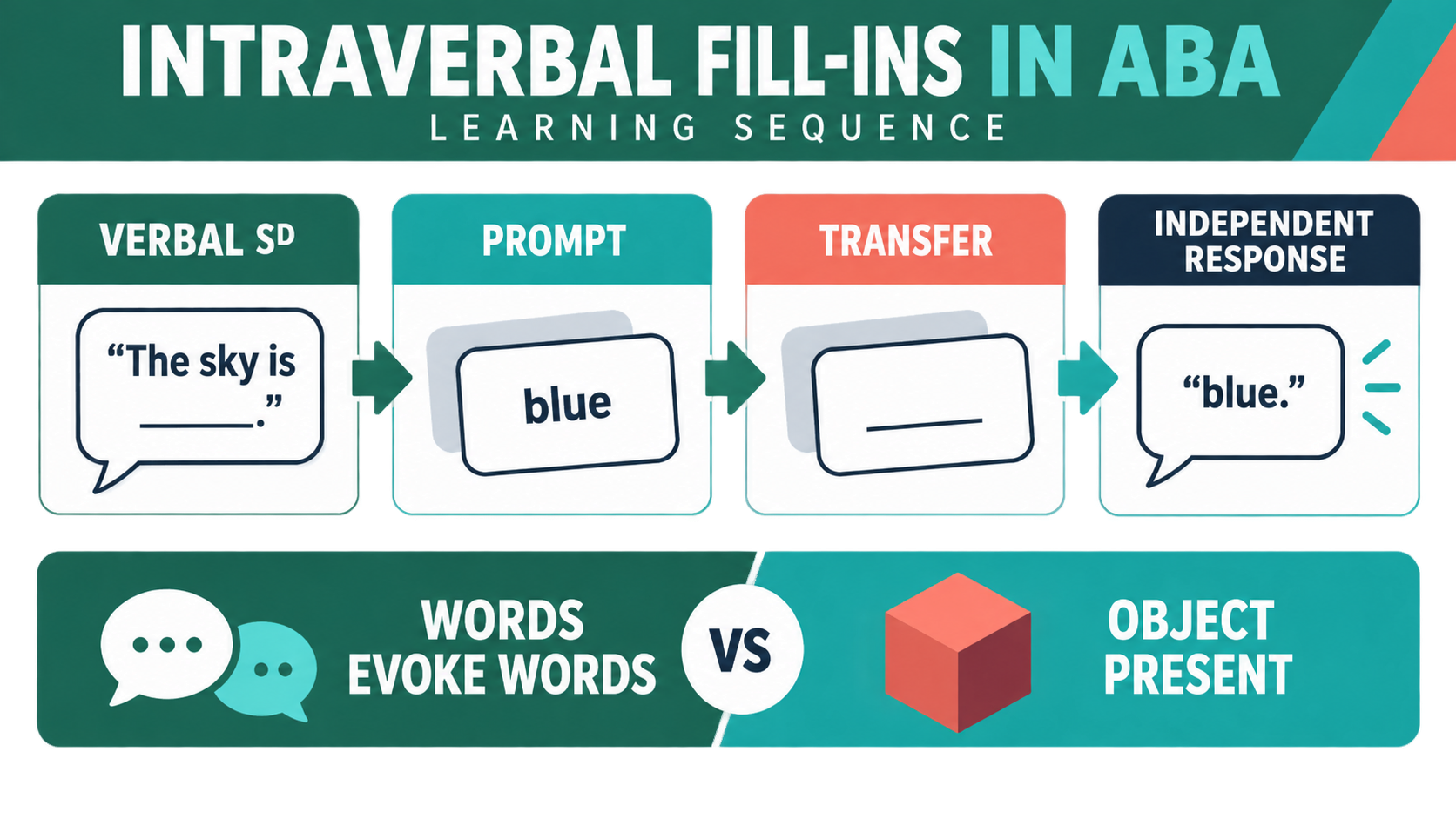
Research on intraverbal instruction has evaluated procedures such as verbal prompting, prompt fading, transfer from a stronger repertoire, and multiple-exemplar training. The general principle is to help the learner contact success while arranging for the original verbal cue—not the extra prompt—to become the controlling stimulus.
- Select a functional, culturally appropriate fill-in that matches the learner’s prerequisite skills and communication mode.
- Present the verbal cue clearly and allow a planned opportunity to respond.
- If needed, provide an immediate prompt that makes the correct response likely, such as a model, partial verbal cue, or transfer prompt approved in the program.
- Re-present the original cue or use a transfer trial so the learner responds to the natural verbal stimulus.
- Deliver the programmed consequence for the response and record whether it was independent, prompted, incorrect, or absent.
- Systematically fade the prompt and vary the examples, voices, settings, and materials.
A prompt that is never faded can become the real cue. For example, if every fill-in is followed by the same exaggerated first sound, the learner may wait for that sound rather than respond to the sentence frame. On the other hand, fading too quickly can produce repeated errors or frustration. The BCBA exam usually rewards the option that arranges effective teaching while planning for transfer and independence.
How Should Independence and Generalization Be Checked?
Define the response before collecting data. Depending on the goal, the team might measure the percentage of independent correct responses across opportunities, the number of prompted trials, latency, or a generalization probe. Do not count a response as independent if the instructor supplied a partial answer, repeated the cue in a different tone, pointed to the answer, or used another unplanned prompt.
Generalization asks whether the learner responds when the wording, partner, setting, materials, or response form changes in a meaningful way. A learner who completes one exact phrase only with one instructor may have memorized a chain without developing flexible intraverbal control. Multiple-exemplar training, varied wording, natural conversation, and reinforcement for functional communication can help the team evaluate broader performance.
Respect the learner’s communication preferences and access needs. A written, signed, or AAC response can be functionally meaningful even when the target is described using verbal-behavior terminology. The measurement system should match the learner’s response form and the actual social or academic goal.
What Are Common BCBA Exam Traps?
- “Any spoken answer is an intraverbal.” False. Identify the antecedent and the correspondence relation.
- “A picture prompt proves intraverbal control.” A picture may add a nonverbal controlling variable; analyze the full arrangement.
- “The learner repeated the first sound, so the trial is independent.” A partial verbal prompt is still a prompt unless the definition says otherwise.
- “The easiest phrase is always the best target.” Select a functional target based on assessment, goals, cultural context, and prerequisite skills.
- “More trials automatically create conversation.” Rote practice must be balanced with varied exemplars, natural opportunities, and generalization checks.
- “Vocal speech is the only valid response.” Communication goals should respect the learner’s effective modality and access needs.
Practice Verbal-Behavior Questions
When you see an intraverbal fill-in question, mark the verbal antecedent, ask whether the response repeats it, and check what prompts or visual cues are present. Then decide whether the question is testing definition, prompting, measurement, or generalization. That sequence prevents a familiar phrase from distracting you from the controlling variable. Our free BCBA mock exam can help you practice these verbal-behavior distinctions under time pressure. Use it as a study aid and verify current exam requirements with BACB materials. Try the Free BCBA Mock Exam
Take the Free BCBA Mock Exam
If you want a low-pressure way to check your recall, use the free practice resource below. Take the Free BCBA Mock Exam
References
- BACB Test Content Outlines
- BACB BCBA Test Content Outline, 6th Edition
- Research on simultaneous prompting and intraverbal responding
- Research on prompting tactics for intraverbal responding



