
Short answer: An intervention planner is a structured decision and documentation tool that helps a behavior analyst move from assessment information to a prioritized goal, a function-matched strategy, an implementation plan, and a measurement-and-review cycle. It is not the intervention itself, it does not replace a functional behavior assessment (FBA), and it is not automatically the same thing as a behavior intervention plan (BIP).
Table of Contents
- What is an intervention planner?
- What should an intervention planner include?
- How does an intervention planner work in ABA?
- How is an intervention planner different from a BIP?
- How should BCBA candidates use an intervention planner?
- What makes a planner data-based?
- What are common intervention-planner mistakes?
- Intervention planner FAQ
- Take the Free BCBA Mock Exam
For BCBA exam preparation, think of an intervention planner as the bridge between “What does the data suggest?” and “How will the team implement and evaluate the plan?” A good planner makes the reasoning visible: it records the behavior definition, relevant context, likely function or maintaining variables, observable goal, selected procedures, implementer responsibilities, data system, and decision rules for review. It should support clinical judgment rather than pretend to make a clinical decision by itself.
This article uses intervention planner in that practical ABA sense. Commercial tools, school templates, assessment reports, and software may use the same label differently. Always check the setting, the source of the data, the qualifications of the person using the tool, and the organization’s documentation requirements. Table of Contents
What is an intervention planner?
An intervention planner is a repeatable framework for organizing intervention decisions. It can be a worksheet, a digital form, a report section, or a software workflow. The format matters less than the logic. The planner should connect assessment evidence to a socially meaningful outcome and show how the team will know whether the plan is helping. In applied behavior analysis, the planner is useful because intervention decisions often involve several linked questions:
- What behavior is occurring, and how is it defined in observable and measurable terms?
- What events occur before and after the behavior?
- What does the assessment suggest about the behavior’s function or maintaining variables?
- What replacement response or skill would be more efficient and socially valid?
- What strategy will change the relevant antecedents, teach the replacement skill, and arrange consequences?
- What measurement system and review rule will guide the next decision?
An intervention planner can therefore support a behavior analyst, teacher, caregiver, or learner team, but it should not be treated as a diagnostic engine or an automatic treatment generator. For a real client, the responsible professional must verify the data, consider risk and consent, follow the applicable code and policy, and supervise implementation within the person’s role.
What should an intervention planner include?
A useful planner contains enough information to preserve the chain of reasoning without burying the team in unrelated detail. The following matrix is a study-friendly way to check whether a planner is complete.
| Planner component | What it answers | BCBA exam check |
|---|---|---|
| Target behavior and baseline | What exactly happens, how often or how long, and what the starting pattern looks like. | Is the definition observable, measurable, and specific enough for reliable data collection? |
| Assessment signal and function hypothesis | Which antecedents, consequences, motivating operations, or contexts may be relevant. | Does the selected strategy match the evidence instead of relying on the behavior’s appearance? |
| Socially meaningful goal | What improvement matters to the learner, family, classroom, workplace, or community. | Is the goal observable, attainable, and connected to quality of life or participation? |
| Strategy and replacement skill | What the team will change, what skill will be taught, and how reinforcement will be arranged. | Are procedures function-based, feasible, ethical, and clearly described? |
| Implementation and measurement plan | Who does what, in which context, how fidelity is checked, and how progress is measured. | Is there a decision rule for continuing, modifying, generalizing, or fading the intervention? |
Some planners also include preferences, cultural and contextual variables, risk safeguards, assent or consent considerations, materials, a review date, and a communication plan. These additions improve usability, but they do not remove the need for assessment and professional oversight.
How does an intervention planner work in ABA?
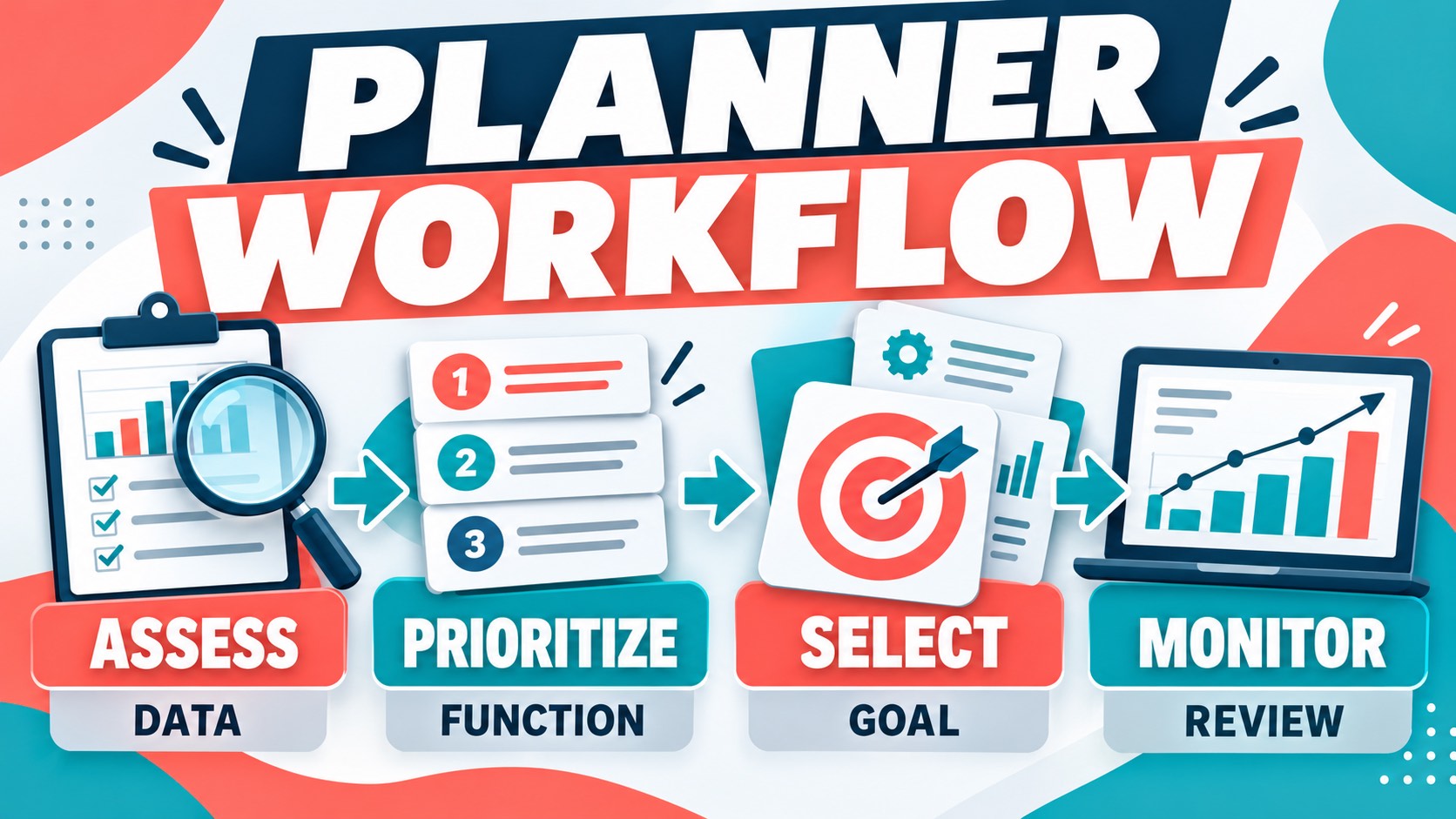
The most defensible workflow is a loop rather than a one-time form. Start with assessment, make a provisional plan, implement it consistently enough to evaluate, inspect the data, and revise the plan when the evidence or context changes.
- Assess. Define the behavior, collect baseline information, review antecedent and consequence patterns, and use the appropriate assessment process. A planner should not turn a vague label such as “noncompliance” into a treatment target without an operational definition.
- Prioritize. Select a target based on safety, social validity, learner priorities, feasibility, and the likely benefit of intervention. A long list of possible targets is not the same as a prioritized plan.
- Select. Choose antecedent strategies, teaching procedures, reinforcement arrangements, and response strategies that are connected to the assessment. Identify the replacement skill and make it efficient enough to compete with the problem behavior.
- Implement. Specify materials, prompts, reinforcement criteria, responsibilities, timing, and training. If the plan cannot be implemented as written, the planner should show what needs clarification or adaptation.
- Monitor. Collect the planned data, check procedural fidelity when relevant, and compare results with the goal. Decide in advance what pattern would trigger a review rather than waiting for frustration to become the decision rule.
For example, suppose a learner leaves a group activity after a difficult instruction. An intervention planner would not jump directly to “use a token board.” It would first clarify the behavior and context, examine whether escape or another consequence is maintaining it, identify an appropriate communication or participation response, and define how the team will measure both leaving and the replacement response. The tool organizes the reasoning; it does not supply the function hypothesis without evidence.
Research on function-based intervention tools supports the value of structured decision support, but a digital planner still depends on the quality of the information entered and the judgment of the professional using it. A tool that makes a plan faster is not necessarily a tool that makes the plan valid.
How is an intervention planner different from a BIP?
The terms are related, but they should not be used as automatic synonyms. A planner is usually the process or framework used to organize decisions. A BIP is a formal intervention document that communicates what the team will implement for a specific learner and target behavior. One planner may help create a BIP, while a BIP may contain information that was first organized elsewhere.
| Question | Intervention planner | Behavior intervention plan |
|---|---|---|
| Primary role | Organizes assessment-to-decision reasoning and review. | Communicates a specific intervention for a specific learner and context. |
| Typical timing | May be used before, during, or after planning and may be revised frequently. | Usually becomes an approved or shared implementation document under a setting’s process. |
| Level of detail | Can be a concise decision map or a detailed planning record. | Should contain the procedures, responsibilities, safeguards, and measurement details needed by its implementers. |
| Exam trap | A template does not create a valid function hypothesis or guarantee an effective procedure. | A BIP is not a substitute for assessment, consent, training, data review, or ethical oversight. |
This distinction is especially useful when evaluating online “intervention planner” tools. A tool may generate a checklist, suggest strategies, or map assessment items to possible interventions. That output may be a starting point, but it should not be presented as an individualized treatment recommendation without the required professional process.
How should BCBA candidates use an intervention planner?
For exam study, use a planner to practice the order of reasoning, not to memorize a brand name or one fixed form. The current BCBA Test Content Outline and the applicable ethics requirements should remain the source of truth for what the exam assesses. A third-party worksheet can help you rehearse the sequence, but it does not replace the official outline. Try this study routine with a short scenario:
- Write an observable target definition and identify one measurement dimension.
- List the most relevant antecedent and consequence information rather than every event in the story.
- State a cautious function hypothesis and identify what evidence would support or weaken it.
- Choose a replacement response that contacts reinforcement and can be taught in the stated context.
- Match the intervention to the hypothesized function and name the data that will show whether it works.
- Write one likely exam distractor, such as choosing a consequence solely because it sounds punitive or selecting a strategy without assessment support.
Then ask whether the plan is feasible and socially valid. A technically elegant procedure that the team cannot implement reliably is not automatically the best answer. On exam questions, look for the option that respects assessment, function, measurement, ethics, and the learner’s context together.
What makes a planner data-based?
A data-based planner does more than contain a graph. It links a measurement system to a decision. The data should answer a defined question, be collected in a way that matches the target, and be reviewed against a stated goal or criterion.
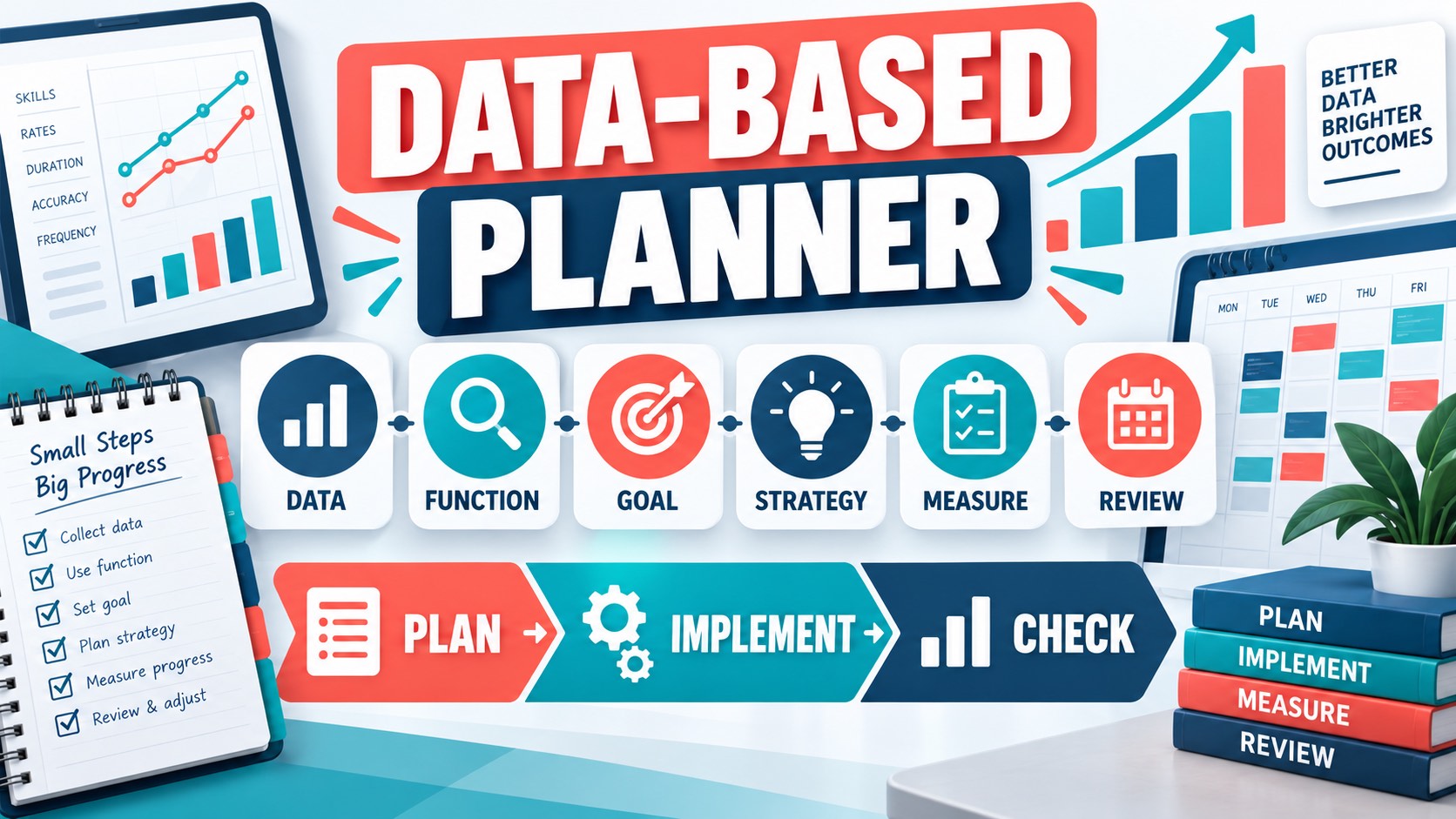
- Data: record the response with a measure that matches the target.
- Function: connect the selected strategy to the best available assessment evidence.
- Goal: define the meaningful outcome and the criterion for progress.
- Review: state when the team will inspect fidelity, generalization, and the next decision.
| Quality check | Weak version | Stronger version |
|---|---|---|
| Target definition | “Improve behavior.” | Defines the response and the measurement dimension in observable terms. |
| Measurement fit | Uses the same convenient measure for every target. | Selects frequency, rate, duration, latency, interval, percentage, or another measure based on the question. |
| Decision rule | Collects data indefinitely or changes procedures after one difficult session. | Defines when to continue, troubleshoot fidelity, modify, generalize, or fade. |
| Outcome and side effects | Tracks only reduction of the target behavior. | Tracks replacement skills, quality-of-life outcomes, generalization, and meaningful risks when relevant. |
For example, if the goal is independent task initiation, a planner might track latency from the instruction to starting, percentage of opportunities initiated independently, and the level of prompting required. A count of “good days” would be less informative because it does not specify what changed or how the team should respond.
Use an established measurement and graphing method appropriate to the target. The planner should also include a fidelity check when poor outcomes could be caused by inconsistent implementation. If the intervention was not delivered as designed, the team should be cautious about concluding that the intervention itself failed.
What are common intervention-planner mistakes?
Watch for these errors in study questions and real-world planning discussions:
- Starting with a favorite procedure: Selecting tokens, extinction, prompting, or a visual schedule before defining the behavior and reviewing assessment evidence.
- Confusing a label with a function: Treating “tantrum,” “avoidance,” or “attention-seeking” as a complete analysis.
- Writing an unmeasurable goal: Using “better,” “calmer,” or “more compliant” without an observable criterion.
- Ignoring the replacement response: Reducing a problem behavior without teaching an efficient, usable alternative.
- Skipping feasibility: Designing a plan that requires materials, timing, or training the team does not have.
- Using a graph without a decision: Displaying data but never stating what pattern will lead to a change.
- Treating software output as authority: Assuming a generated plan is valid because it is formatted or branded.
Quick review: Assess first, define the target, identify relevant variables, prioritize a meaningful goal, select a function-consistent strategy, teach a replacement skill, specify implementation, measure the outcome, check fidelity, and revise from data. For additional practice, you can use the free BCBA mock exam to test the reasoning sequence. It is an independent practice resource, not an official BACB product, does not reproduce official exam questions, and does not guarantee certification or exam performance.
Intervention planner FAQ
Is an intervention planner the same as a treatment plan?: Not necessarily. The label varies by field and organization. In ABA, a planner usually organizes decisions and monitoring, while a treatment plan or BIP is a formal document with setting-specific requirements. Check the form’s purpose, author, approval process, and intended users.
Can an intervention planner replace an FBA?: No. A planner can organize FBA information, but it cannot replace the assessment process, direct observation when appropriate, functional analysis when indicated and authorized, or professional interpretation of the evidence.
Can a teacher or caregiver use an intervention planner?: A teacher or caregiver may use a team-approved checklist or implementation form within the person’s role and training. The BCBA or other qualified professional remains responsible for the assessment and intervention decisions assigned to that professional, and the team should follow local policy.
What is the most important BCBA exam idea?: Do not choose a procedure because it sounds familiar. Choose the option that connects a measurable behavior to assessment evidence, a socially meaningful goal, a function-consistent intervention, ethical implementation, and data-based review.
Bottom line: An intervention planner is valuable when it makes the path from evidence to action—and back from data to revision—easy to see. It is a planning aid, not a shortcut around assessment, consent, supervision, or professional judgment.
Take the Free BCBA Mock Exam
When you are ready to apply the idea, use the free practice resource below for additional feedback. Take the Free BCBA Mock Exam



