
Short answer: Behavior Intervention Plans (BIPs) for elementary students should be concrete, function-based, developmentally appropriate, and easy to use during real classroom routines. A strong plan defines the behavior, identifies what happens before and after it, teaches a replacement skill, arranges reinforcement, tells adults what to do, and includes a simple way to monitor progress. It should fit the child’s communication, classroom schedule, family context, and learning goals.
Table of Contents
- What should an elementary BIP accomplish?
- What makes an elementary BIP different?
- How do you connect the plan to classroom routines?
- What components should the plan include?
- Which elementary BIP strategies fit common needs?
- How should teachers and teams implement it?
- How should progress and generalization be monitored?
- How does the BCBA exam test this topic?
- What mistakes should you avoid?
- Elementary BIP FAQ
- Take the Free BCBA Mock Exam
The phrase behavior intervention plans for elementary students points to a practical application question. The best elementary BIP strategies connect behavioral assessment to the routines in which the student actually learns. Elementary learners spend much of the day moving between instruction, independent work, recess, lunch, specials, and transitions. A plan that works only in a quiet one-to-one session may not transfer to those routines. The goal is not to create a longer document; it is to connect behavioral assessment to supports that a teacher and school team can implement consistently.
Federal guidance describes function-based behavioral support and emphasizes that schools can use positive, proactive approaches to address behavior that interferes with learning. Whether a particular student needs a BIP, how it is documented, and who participates depend on the student’s facts and applicable school procedures. This is a BCBA study guide, not individualized educational or legal advice. Table of Contents
What should an elementary BIP accomplish?
An elementary BIP should make the desired behavior easier to teach and the support plan easier to use. It should help the student access instruction, communicate needs, participate in routines, and build a replacement response that works better than the interfering behavior. It should also help adults respond consistently so the student does not encounter a different contingency in every classroom. A useful plan answers five practical questions:
- What observable behavior is interfering with learning or participation?
- When and where is it most likely to occur?
- What might the student be gaining, avoiding, communicating, or regulating?
- What replacement behavior can the student perform with reasonable effort?
- What will adults do before, during, and after the replacement response?
For example, “the student is disruptive during math” is too broad. A more useful description might be, “During independent math work, the student pushes the worksheet away, calls out to the teacher, and leaves the seat within two minutes of a multi-step task.” That description creates a starting point for examining task difficulty, help-seeking, escape, attention, skill deficits, and the consequences that follow.
What makes an elementary BIP different?
Elementary students are still developing communication, self-management, academic fluency, and tolerance for changes in routine. Their behavior may be affected by task difficulty, fatigue, sensory conditions, peer interactions, unclear directions, or an inefficient way to request help. An elementary plan should therefore use language and supports the child can understand and practice, rather than relying on abstract rules or delayed rewards alone.
Developmentally appropriate does not mean vague or permissive. It means the target behavior is observable, the replacement response is teachable, the reinforcement is practical, and the adult response is consistent with the student’s skills. Visual schedules, brief choice options, help cards, break requests, first-then language, modeled examples, and immediate feedback may be useful when they match the functional assessment and classroom context. Before selecting elementary BIP strategies, check whether the support is:
- understandable to the student and usable with the student’s communication system;
- possible for the teacher to deliver during the actual classroom routine; and
- measurable enough for the team to review without interrupting instruction.
The plan should also preserve dignity and instructional access. A child should not lose meaningful learning opportunities because adults have not arranged an efficient way to communicate or transition. The team should consider how to prevent the behavior, teach a functionally equivalent response, reinforce that response, and respond safely if the behavior still occurs.
How do you connect the plan to classroom routines?
Start with the routine, not with a generic list of consequences. Observe what happens immediately before the behavior, what the student does, and what happens afterward. Then identify the smallest routine change that could prevent the problem while preserving the learning goal. A plan for arrival will look different from a plan for group instruction, recess, or independent work.
| Routine | What to observe | Possible planning question |
|---|---|---|
| Arrival | Who greets the student, what steps are expected, and when does support become available? | Would a predictable check-in or visual sequence make the transition more efficient? |
| Independent work | Task difficulty, response effort, help requests, and the timing of adult attention. | Can the student ask for help, a smaller step, or a brief break before leaving the task? |
| Group instruction | Length of waiting, opportunities to respond, noise, and peer attention. | How can the student participate with a clear response format and frequent feedback? |
| Transition | Warning time, route, materials, stopping one activity, and starting the next. | What cue and replacement response can make the next step predictable? |
The point of the table is not to guess the function from the routine name. The same topography can serve different functions for different students. Leaving the group may avoid difficult work, obtain adult attention, access a preferred activity, or communicate overload. The team should use assessment information rather than assume that every elementary classroom behavior has the same cause.
What components should the plan include?
Good behavior intervention plans for elementary students connect each procedure to an observable decision. They should be brief enough for adults to use during instruction but specific enough that two trained implementers would know what to do. A function-based plan commonly includes the following:
- Strengths and context: interests, communication, successful routines, preferences, and relevant setting events.
- Operational definition: what counts as the target behavior, with examples and nonexamples.
- Baseline and hypothesis: what the data show and what consequence may be maintaining the behavior.
- Prevention: environmental changes, task adjustments, visual cues, choices, or priming.
- Replacement skill: an observable response that produces a functionally relevant outcome.
- Teaching plan: prompts, modeling, practice opportunities, error correction, and fading.
- Reinforcement: what will be delivered, when, by whom, and how it will be thinned responsibly.
- Response procedure: how adults respond to the target behavior while maintaining safety and instructional access.
- Measurement: the student outcome and the critical implementation steps that need monitoring.
- Review plan: who reviews the data, when the team meets, and what would prompt revision.
Elementary plans are often more effective when the replacement behavior is efficient. If a student must complete a long verbal explanation to request help while pushing materials away immediately ends the task, the plan has not made the replacement response competitive. Teach the request, make it easy to perform, and arrange reinforcement so the student contacts the relevant outcome for using the replacement skill.
Which elementary BIP strategies fit common needs?
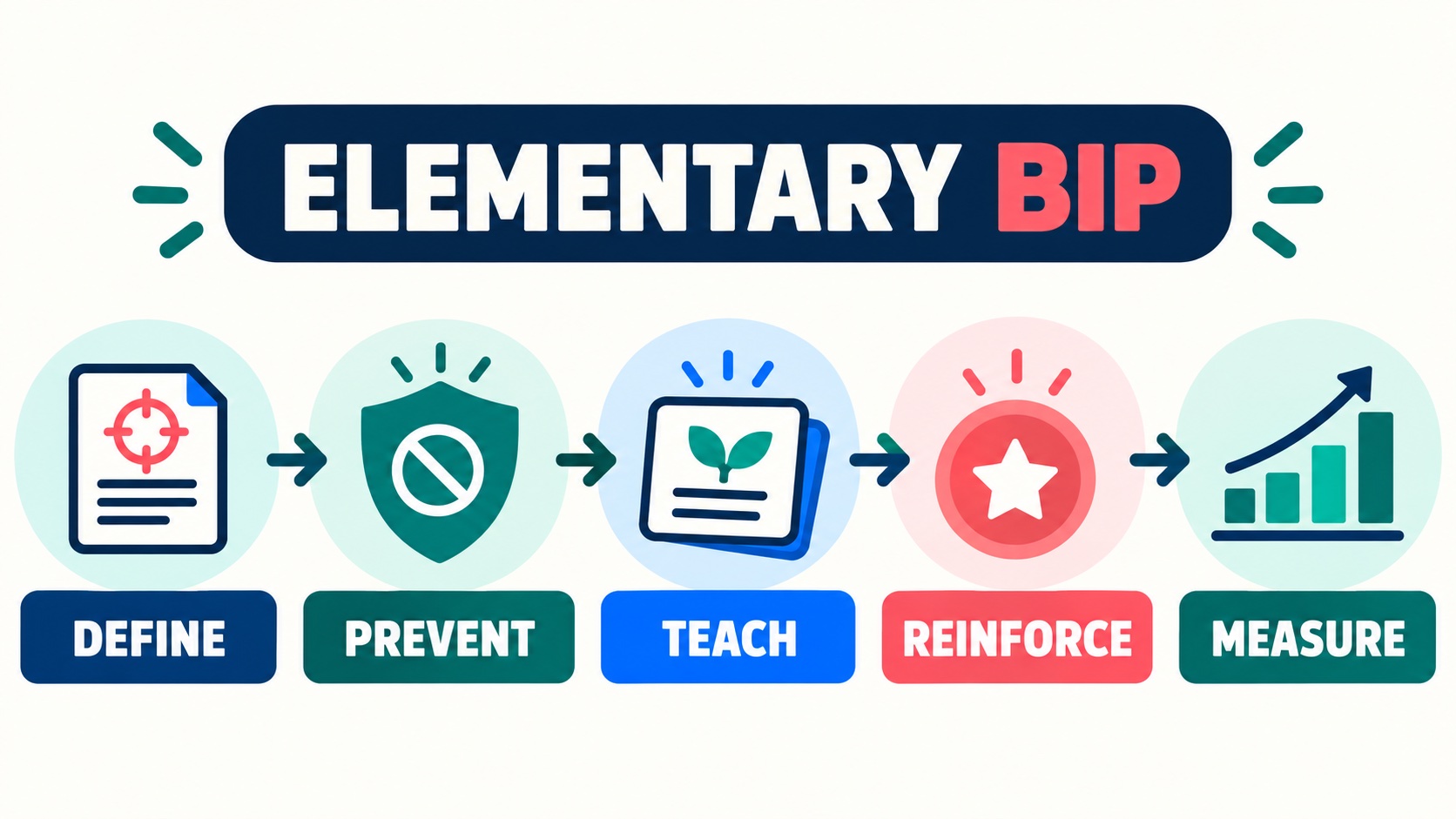
There is no universal elementary BIP strategy. The best selection follows the function and the routine. Prevention changes the antecedent; teaching builds a new response; reinforcement changes the payoff for that response; and measurement tells the team whether the arrangement is working.
| Strategy category | Elementary example | Check before using |
|---|---|---|
| Prevent | Preview a transition, shorten an initial task step, or provide a clear visual cue. | Does the change address an observed antecedent without removing the learning goal? |
| Teach | Teach a help request, break request, transition response, or functional communication form. | Can the student perform it with the available communication system? |
| Reinforce | Deliver the function-relevant outcome promptly after the replacement response. | Is the outcome valuable, practical, and available often enough during teaching? |
| Measure | Record opportunities, independent responses, prompts, and target behavior. | Can the teacher collect it without losing instruction time? |
Avoid treating a token board, visual schedule, or first-then statement as a complete intervention by itself. Those tools may support a plan, but the team still needs a functional hypothesis, a teachable response, a reinforcement arrangement, and a way to decide whether the strategy is helping. The tool is not the function.
How should teachers and teams implement it?
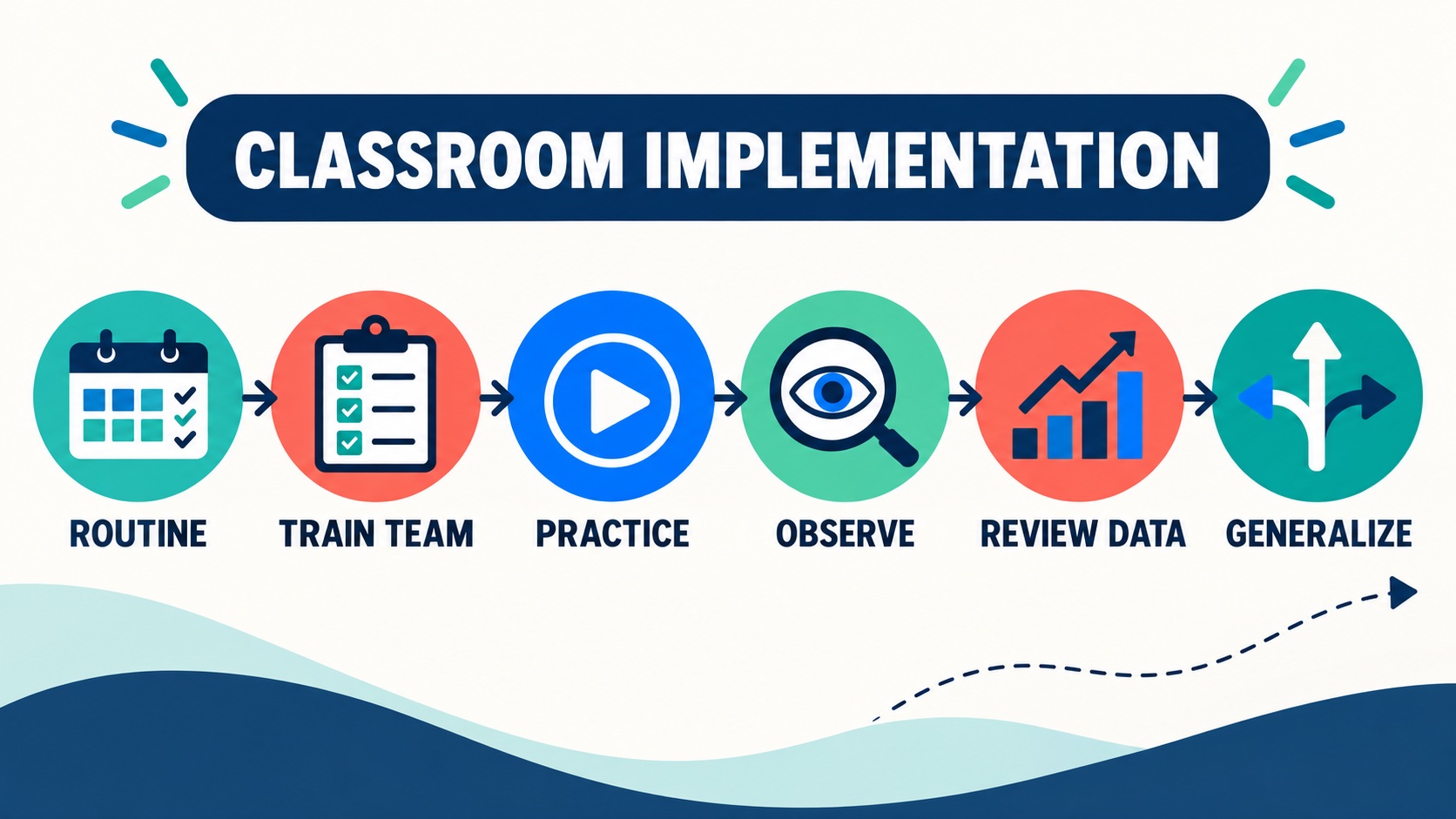
Implementation begins before the plan is handed to the teacher. The people who will use it should help identify classroom constraints, practice the critical steps, and agree on what data can realistically be collected. Team-based approaches to elementary function-based interventions commonly emphasize prevention, teaching a replacement response, reinforcement, and a consistent adult response.
Training can use instruction, modeling, rehearsal, and feedback. For example, the BCBA or behavior specialist can describe the prompt sequence, model it during a transition, let the teacher rehearse, and provide specific feedback. The team can then observe the routine and make sure the plan remains feasible when the classroom is busy. Coaching is not a sign that the teacher failed; it is a way to support treatment integrity in the context where the plan must work.
- Explain the function and the purpose of each critical step.
- Model the prevention, teaching, reinforcement, and response procedures.
- Rehearse with realistic elementary examples and likely variations.
- Observe implementation during the actual routine.
- Give concise feedback and remove unnecessary steps.
- Schedule follow-up review instead of assuming one training session is enough.
Family and student perspectives can improve fit. The team should ask how the student communicates at home, which routines are successful, what the student values, and whether the replacement response can be used across settings. The school plan should coordinate with the educational program without making unsupported assumptions about home circumstances.
How should progress and generalization be monitored?
Collect data that answer two different questions: Is the student learning or using the replacement behavior, and are adults implementing the plan as intended? Depending on the target, the team may measure frequency, duration, latency, percentage of opportunities, task completion, independent communication, prompts, or treatment-integrity steps. The selected measure should match the behavior dimension and be feasible in the classroom.
Generalization should be planned across teachers, materials, peers, locations, times, and routines. A student who requests a break with one specialist may still need teaching with the classroom teacher, on the playground, or during a less preferred subject. Review whether the response contacts the same functional outcome in each setting and whether adult prompts can be faded without losing the skill.
| Data question | Useful indicator | Possible decision |
|---|---|---|
| Is the replacement skill increasing? | Independent responses per opportunity and prompt level. | Continue, fade prompts, or adjust teaching. |
| Is interfering behavior decreasing? | A consistent measure tied to the routine and baseline. | Review function, reinforcement, and implementation if the trend is unchanged. |
| Is the plan implemented? | Percentage of critical steps completed by the responsible adults. | Provide coaching before labeling the intervention ineffective. |
| Does the skill generalize? | Performance with new people, materials, settings, or routines. | Program varied practice and natural reinforcement. |
How does the BCBA exam test this topic?
For current exam-domain framing, use the BACB BCBA Test Content Outline. In an exam scenario, first identify the observable behavior and relevant context, then choose an intervention that is function-based, teachable, measurable, and practical for the elementary setting.
Common distractors include selecting a generic reward without assessing function, changing the plan before checking implementation fidelity, using an age-inappropriate response requirement, or measuring only the student’s behavior while ignoring whether adults completed the plan. The strongest answer often combines direct observation, function-based intervention, teacher support, and ongoing data review.
What mistakes should you avoid?
- Writing for adults only: the student must understand and perform the replacement response.
- Using a generic consequence: the strategy should connect to the likely function.
- Overloading the teacher: too many steps can reduce fidelity during real instruction.
- Skipping nonexamples: unclear definitions create inconsistent data.
- Assuming generalization: teach and monitor across the routines that matter.
- Ignoring implementation data: outcomes cannot be interpreted without knowing what adults did.
Elementary BIP FAQ
Are behavior intervention plans only for students with disabilities?: No single answer applies to every school or jurisdiction. Function-based behavioral support can help any student whose behavior interferes with learning, while IDEA creates specific considerations and duties for eligible students in particular circumstances. The team must follow applicable procedures and individualize the support.
What is an example of an elementary replacement behavior?: A replacement behavior should serve a relevant function. Examples might include handing over a help card instead of pushing work away, using a break request instead of leaving the group, or pointing to a visual choice instead of calling out. The team must verify the function and teach the response under the conditions in which it will be needed.
How long should an elementary BIP be?: There is no useful word-count rule. The plan should contain enough detail for consistent implementation but remove information that does not guide a decision. A one-page quick-reference version may support daily use, while the full educational record contains the assessment and review details required by the team.
Who implements a BIP in an elementary classroom?: Implementation depends on the student’s educational program and team decisions. Teachers, special educators, related-service providers, instructional assistants, and other responsible adults may have defined roles. The plan should state who does what, how they are trained, what data they collect, and when the team reviews progress.
Quick review: start with the routine and function, define the behavior, teach an efficient replacement, arrange reinforcement, train the adults, measure fidelity and outcomes, and program generalization. For additional scenario practice, use the free BCBA mock exam as a practice and feedback resource. It is not an official BACB exam and does not guarantee certification or a passing result.
Take the Free BCBA Mock Exam
When you are ready to apply the idea, use the free practice resource below for additional feedback. Take the Free BCBA Mock Exam



