

Short answer: Intervention strategies for struggling students are planned, measurable supports that match a learner’s academic, engagement, behavior, communication, or access need. The strongest strategy is not the one with the most impressive name. It is the one that defines the target, changes the relevant teaching or environmental variable, measures the response, and is adjusted when the data show that the learner is not progressing.
Table of Contents
- What are intervention strategies for struggling students?
- How do you match an intervention to the need?
- Which academic intervention strategies are commonly considered?
- How do behavior and engagement supports fit?
- How should progress be monitored?
- How do Tier 1, Tier 2, and Tier 3 supports differ?
- How does the BCBA exam test this topic?
- What mistakes should you avoid?
- Intervention strategy FAQ
- Take the Free BCBA Mock Exam
The phrase struggling students is a search term, not a diagnosis. A student may be having difficulty because instruction is not explicit enough, the task is too advanced, the response format creates an access barrier, reinforcement is weak, a prerequisite skill is missing, or a behavior is competing with participation. A BCBA or school team should investigate the instructional context instead of treating the student as the problem.
This guide connects school-based intervention language with behavior-analytic reasoning. It is study support for BCBA candidates, not an individualized IEP, treatment, placement, or legal recommendation. Current guidance from the BACB’s education subspecialty overview describes behavior analysis as a scientific approach to analyzing teaching and learning interactions. Any real plan must also follow the learner’s educational team, consent or assent process, school requirements, professional scope, and current authoritative guidance. Table of Contents
What are intervention strategies for struggling students?
An intervention strategy is a planned way to change instruction, the learning environment, or a learner’s response opportunities in order to improve a defined outcome. In school settings, the outcome may be reading accuracy, math fluency, written expression, task completion, class participation, help-seeking, peer interaction, or a reduction in behavior that blocks learning. The label “intervention” is not enough by itself; the team should describe what will happen, for whom, under which conditions, and how progress will be evaluated. A complete intervention description normally includes:
- Observable target: State what the learner will do, such as read 20 words with a defined accuracy, begin an assignment within two minutes, or request clarification using an agreed response.
- Starting level: Use screening, work samples, observation, or direct measurement to identify the current pattern rather than relying on a general impression.
- Teaching arrangement: Specify models, prompts, examples, practice opportunities, feedback, reinforcement, materials, group size, and timing.
- Measurement system: Select a dimension that matters, such as accuracy, frequency, rate, latency, duration, fluency, independence, or generalization.
- Decision rule: Decide in advance when to continue, fade, intensify, adapt, or reassess the support.
For example, “give the student extra help” is not a sufficiently precise intervention. “Present a short set of grade-level problems, model the first item, provide a least-to-most prompt only after a defined opportunity, deliver specific feedback, and graph independent correct responses across probes” is much more testable. The plan still requires a meaningful goal, appropriate materials, feasible implementation, and a review of whether the intervention fits the student and classroom.
How do you match an intervention to the need?
Begin with the question the data can answer. Is the learner missing a prerequisite skill, failing to discriminate an important feature, responding too slowly, avoiding a difficult task, lacking a reliable communication response, or unable to show knowledge because of an access barrier? These are different problems. A single list of “best strategies” cannot replace assessment and careful observation.
| Observed need | Useful starting question | Possible support direction |
|---|---|---|
| Academic skill is not acquired | Which component or prerequisite is missing? | Explicit instruction, modeling, task analysis, guided practice, error correction, and planned fading. |
| Skill is present but inconsistent | What changes across people, materials, tasks, or times? | More varied exemplars, reinforcement for independent responding, fluency practice, or generalization programming. |
| Participation is low | Is the task too difficult, unclear, lengthy, or effortful relative to the available reinforcement? | Shorter response units, choice, clear expectations, active opportunities to respond, behavior-specific praise, and a functional way to request help or a break. |
| Knowledge cannot be demonstrated | Is the barrier an access or response-format issue rather than a missing skill? | An accommodation, communication support, assistive tool, or changed response format may be needed before adding more teaching. |
The table gives directions for investigation, not automatic prescriptions. A slow worksheet response may reflect a fluency problem, an unmastered prerequisite, or excessive response effort. BCBA questions provide context so you can distinguish a matched intervention from a convenient but poorly matched strategy.
Which academic intervention strategies are commonly considered?
When the target is an academic skill, the intervention should make the learning process visible. A What Works Clearinghouse guide on mathematics intervention emphasizes systematic instruction, mathematical language, representations, and word-problem instruction. The recommendation must still match the subject, grade, target skill, and available evidence; support for one outcome is not automatically effective for every learner.
Use explicit, systematic teaching when the skill is not yet fluent: Explicit instruction can include a clear model, a manageable response unit, guided practice, immediate information about the response, and repeated opportunities to contact the relevant contingency. In ABA terms, the team may arrange prompts, prompt transfer, reinforcement, error correction, and stimulus control so that the learner can contact success while gradually responding more independently. “More practice” is not enough if practice repeatedly rehearses an error or does not contact meaningful feedback.
Arrange practice that produces useful data: Practice should be frequent enough to reveal a pattern, but not so repetitive that it becomes disconnected from the learner’s actual classroom goal. Vary examples when generalization matters. Record whether responses are independent or prompted. If speed matters, measure rate or latency rather than percentage correct alone. If the goal is functional participation, collect data in the natural activity as well as in a teaching trial. Planned fading prevents a temporary prompt from becoming the learner’s permanent requirement.
- Break a complex response into teachable components only when the analysis preserves the meaningful outcome.
- Use examples and nonexamples when the learner must discriminate a feature, category, rule, or stimulus.
- Give feedback that tells the learner what response was effective and arrange another opportunity to respond.
- Program maintenance and generalization instead of assuming that mastery in one worksheet equals classroom performance.
How do behavior and engagement supports fit?
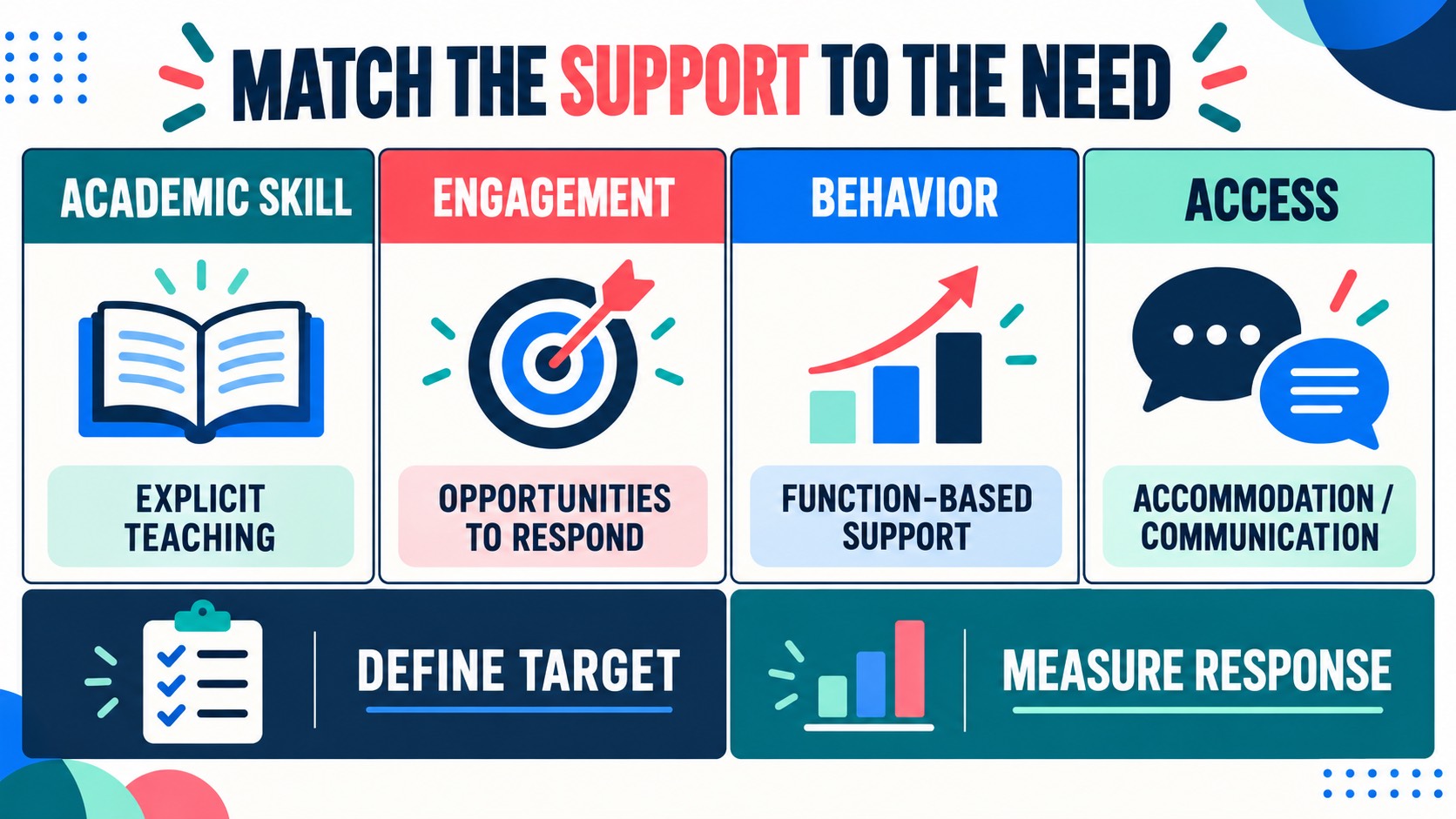
Academic and behavior difficulties can interact, but they should not be collapsed into one vague problem. A student may leave because the work is too difficult, escape has been reinforced, a help-seeking response is missing, or participation produces little reinforcement. Begin with observable definitions and data; a functional behavior assessment or other appropriate assessment may be needed instead of a generic reward chart.
Low-intensity classroom supports may include teaching clear expectations, prompting the expected response, acknowledging appropriate behavior, arranging active opportunities to respond, offering choices, and providing a predictable way to request help. The IES What Works Clearinghouse guide on teacher-delivered behavioral interventions describes these types of low-intensity supports for classroom participation. Their use still depends on age, culture, communication, function, feasibility, and school policy.
| Component | What it changes | What to measure |
|---|---|---|
| Clear expectation and model | Makes the discriminative cue and response requirement more understandable. | Correct responding, latency to begin, and prompt level. |
| Opportunities to respond | Increases contact with practice, feedback, and reinforcement. | Response rate, accuracy, engagement, and opportunities completed. |
| Function-based support | Changes the relevant antecedent or consequence and teaches a feasible alternative response. | Target behavior, replacement behavior, learning access, and treatment integrity. |
| Reinforcement and feedback | Makes the desired response more likely while the learner contacts meaningful outcomes. | Independent responding, preference or choice indicators, and generalization. |
A classroom support is not automatically a behavior intervention plan. If a reader needs the distinction, compare the educational target and data plan with the site’s guide to a behavior intervention plan. The exam-relevant question is not “Which reward is best?” but “What functional relation and measurable outcome does this plan address, and is the least intrusive effective support being implemented with integrity?”
How should progress be monitored?
Progress monitoring turns an intervention from a hopeful activity into a testable decision process. Select a measure that is sensitive to change and matches the target. For reading, this could be correct words per minute, accuracy, or comprehension under a defined probe. For task initiation, latency and percentage of opportunities may be more useful. For behavior that blocks learning, frequency or duration may be relevant, but the team should also measure the replacement behavior and actual access to instruction.
The IRIS Center’s progress-monitoring materials describe selecting a measure, graphing probes, and making data-based instructional decisions. A graph alone does not prove causation. Interpret level, trend, variability, context, fidelity, and opportunities available. If the score is flat, first ask whether the target is appropriate and whether critical steps occurred as planned.
A decision rule might say: continue while independent performance trends toward the goal; adapt one defined component when performance remains below the expected path; and reassess the target or hypothesis after a well-implemented adjustment fails. The exact rule belongs to the qualified team. The BCBA exam rewards data-based logic, not a universal number of sessions.
How do Tier 1, Tier 2, and Tier 3 supports differ?
Multi-tiered systems organize support by intensity and scope, not by permanently labeling students. Tier 1 is core instruction, Tier 2 adds targeted support, and Tier 3 is more intensive and individualized. The tiers do not replace assessment or require repeated failure before a useful adjustment.
| Tier | Typical scope | Decision focus |
|---|---|---|
| Tier 1 | Core classroom instruction and supports available broadly. | Is instruction explicit, accessible, and effective for the group? Who needs additional screening or support? |
| Tier 2 | Targeted small-group or additional support with more frequent monitoring. | Is the learner responding to the supplemental strategy, and which component should be adjusted? |
| Tier 3 | More intensive, individualized instruction or coordinated support. | What precise hypothesis, target, intensity, and fidelity data guide the individualized decision? |
How does the BCBA exam test this topic?
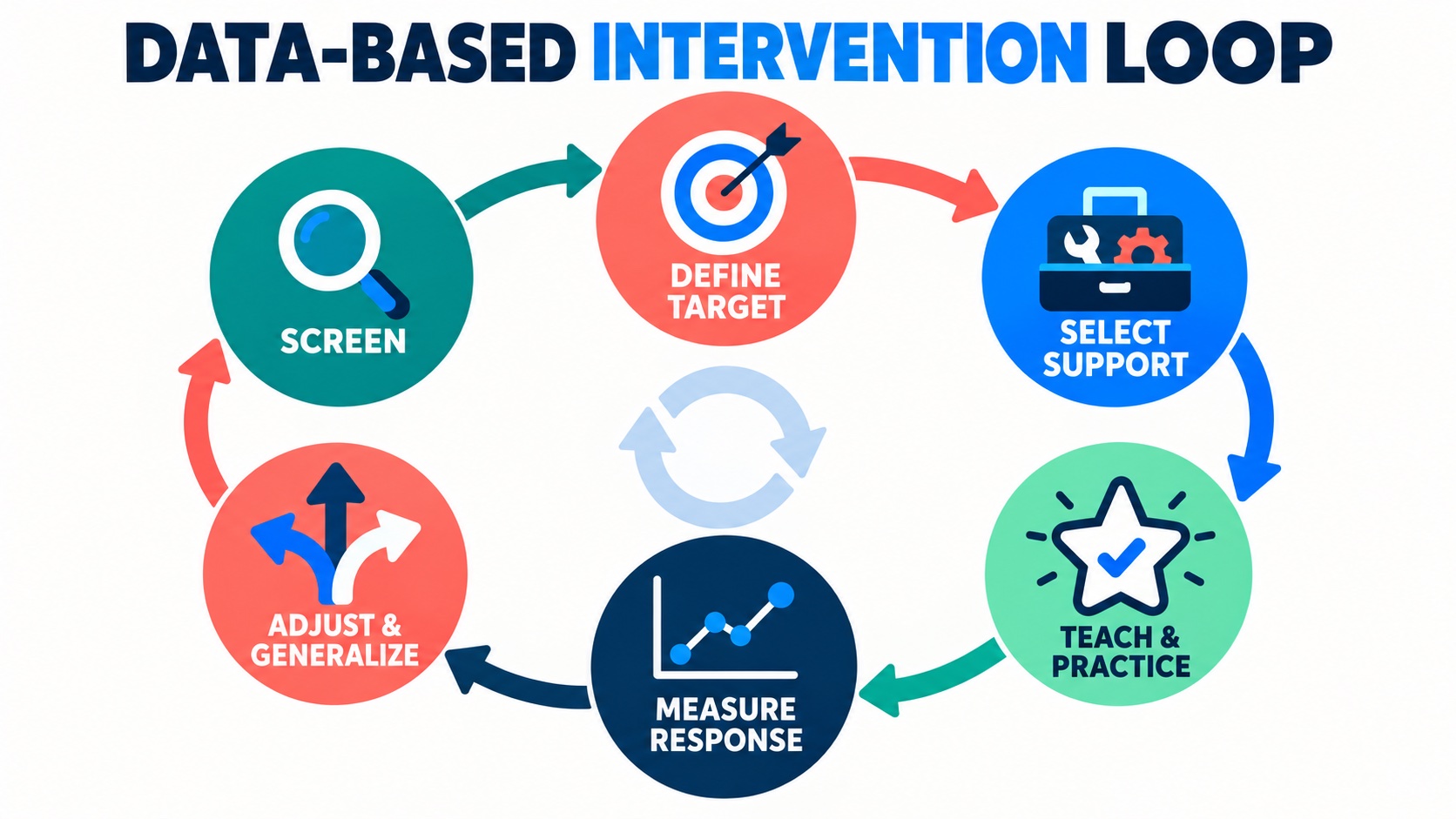
BCBA questions may describe a learner who is falling behind, refusing work, responding only with prompts, or performing well in one setting but not another. The correct answer usually depends on the functional detail in the vignette. Identify the target behavior and the educational outcome first. Then check whether the proposed strategy changes instruction, access, motivation, prompting, reinforcement, or the consequence for a competing behavior.
- Do not choose a named procedure just because it sounds sophisticated. The strategy must match the assessment and target.
- Separate acquisition from fluency and generalization. A learner may know the skill in a teaching trial but need a different plan for speed or transfer.
- Check the measurement dimension. Percentage correct may hide prompt dependence, long latency, low rate, or poor maintenance.
- Look for implementation fidelity. A weak outcome cannot be interpreted confidently when the critical steps were not delivered.
- Respect scope and collaboration. School teams, families, teachers, related-service providers, and qualified behavior professionals may each hold necessary information.
For additional practice, use the evidence-based practice in ABA guide to review how evidence, values, context, and data work together, then use the free BCBA mock exam for intervention-selection scenarios. The mock exam is a practice and feedback resource, not an official BACB product, does not reproduce official exam questions, and does not guarantee certification or performance.
What mistakes should you avoid?
- Using “struggling” as the explanation: describe the observable skill or participation pattern and the conditions in which it occurs.
- Starting with a tool: a worksheet, token board, app, or curriculum is a material or component, not a complete intervention without a target and decision rule.
- Changing too many variables at once: if instruction, prompts, reinforcement, group size, and task difficulty all change together, interpretation becomes difficult.
- Measuring only compliance: a quiet student may still not be learning; pair participation data with accuracy, independence, fluency, or meaningful access.
- Ignoring language and culture: communication, examples, reinforcers, and family priorities should be treated as relevant variables, not afterthoughts.
- Failing to plan for transfer: performance with one adult, worksheet, or room does not automatically generalize to ordinary classroom demands.
- Calling every support evidence-based: evidence must be relevant to the target, population, context, and implementation conditions, and it must be weighed with local data.
Intervention strategy FAQ
What is the best intervention strategy for a struggling student?: There is no universal best strategy. Begin with the target, baseline, context, and likely instructional or behavioral variable. Select the least intrusive support that can reasonably address the need, monitor the response, and adjust from data. “Best” is a contextual and measurable conclusion, not a property of a strategy name.
Are accommodations the same as interventions?: No. An accommodation changes access, presentation, timing, or response format so a learner can participate or demonstrate knowledge. An intervention is a planned change intended to improve a defined outcome. They can be used together, but an accommodation is not automatically a skill-acquisition procedure, and an intervention should not be used to remove an access support that the learner needs.
When should a BCBA consider a behavior plan?: When observable behavior is interfering with learning or safety, the team should define the behavior, review its context and consequences, and use an appropriate assessment process before selecting a plan. The goal is not simply to suppress behavior; it is to improve meaningful participation and teach feasible replacement responses while respecting professional scope, consent or assent, and school procedures.
How do I know whether an intervention is working?: Use a sensitive measure, collect data consistently, compare the pattern with the goal or expected trajectory, and check implementation fidelity. Look at level, trend, variability, independence, generalization, and social validity. If the data are not improving, determine whether the problem is the target, the intervention, the fit, the measurement, or the implementation before concluding that the learner cannot learn.
Bottom line: Effective intervention strategies for struggling students begin with a precise learning or participation target and end with a data-based decision. For BCBA exam questions, match the support to the function and instructional need, distinguish access from acquisition, verify fidelity, and plan for independence and generalization.
Take the Free BCBA Mock Exam
When you are ready to apply the idea, use the free practice resource below for additional feedback. Take the Free BCBA Mock Exam



