

Short answer: Computational functional analysis is an emerging behavior-analytic way to organize and analyze multiple streams of behavioral information so they can support functional analysis. Depending on the project, those streams may include direct observation, verbal behavior, ecological momentary assessment, physiological measures, and environmental context. The computational layer can sort, summarize, or prioritize patterns; it does not replace experimental control or the behavior analyst’s interpretation.
Table of Contents
- What is computational functional analysis?
- What data can it organize?
- How is it different from traditional functional analysis?
- What does a computational functional-analysis workflow look like?
- How does it relate to machine learning and automated analysis?
- What should BCBA candidates remember?
- What are the common exam and practice traps?
- Computational functional analysis FAQ
- Take the Free BCBA Mock Exam
The phrase is easy to overstate. Computational functional analysis is not a new BACB credential, a guaranteed clinical method, or an automatic diagnosis engine. It is best understood as a developing framework for using structured data and computational support around functional-analysis questions. For BCBA candidates, the important distinction is between collecting or processing evidence and demonstrating a functional relation through an appropriate assessment.
This guide defines the term in plain language, separates it from traditional functional analysis, machine learning, and automated graph interpretation, and gives a careful study workflow. The goal is to understand what computational tools may add—and what they cannot prove on their own. Table of Contents
What is computational functional analysis?
Computational functional analysis uses computational methods to help organize, combine, and interpret information relevant to functional analysis. The word computational describes what happens to the data: software or a structured algorithm may align timestamps, summarize observations, detect repeated patterns, or present competing hypotheses. The words functional analysis describe the behavioral question: which environmental variables are functionally related to the target behavior?
A useful boundary is that computational support can improve the visibility and consistency of evidence, but it does not automatically establish causation. A program can identify that behavior occurs more often after demands, during a particular routine, or near a physiological change. Those patterns may guide a hypothesis or the next assessment step. They do not, by themselves, demonstrate that the demand, routine, or physiological event caused the behavior.
One recent behavior-analytic discussion describes computational functional analysis as a framework for organizing multiple streams of behavioral data, including direct observation, verbal behavior, ecological momentary assessment, physiological measures, and environmental context. That is a useful way to understand the phrase, but it should not be confused with a universally standardized protocol. The exact data sources, algorithms, and decision rules depend on the project and must be described rather than assumed. For a BCBA learner, the safest one-sentence definition is:
- Computational functional analysis is computational support for organizing and interpreting function-relevant behavioral data.
- It can help a team find patterns, compare observations, and make analysis more systematic.
- It does not turn correlation into causation or remove the need for functional assessment expertise.
What data can it organize?
The value of a computational approach depends on the quality and relevance of the inputs. A large dataset is not automatically a useful dataset. Each stream needs a clear operational definition, a time frame, a measurement rule, and a reason for inclusion. Otherwise, a tool may produce a polished summary of poorly specified information.
| Data stream | What it may contribute | Quality question |
|---|---|---|
| Direct observation | A time-linked record of antecedents, behavior, and consequences | Are the behavior and context operationally defined? |
| Verbal behavior or reports | Descriptions of events, communication, and setting conditions | Is the source identified and separated from direct observation? |
| Ecological momentary assessment | Repeated in-the-moment samples across routines or locations | Are prompts, missing entries, and reactivity documented? |
| Physiological measures | Additional time-linked signals that may be compared with behavior | Does the signal have a justified behavioral interpretation? |
| Environmental context | Information about tasks, people, locations, and transitions | Are relevant events time-stamped and consistently coded? |
These streams are not interchangeable. A caregiver report, a sensor signal, and a directly observed response answer different questions and carry different sources of error. Computational organization can place them on a common timeline, but the alignment does not make them equivalent measures. The analyst still has to ask whether the measure is valid for the intended decision and whether missing or noisy data could change the conclusion.
How is it different from traditional functional analysis?
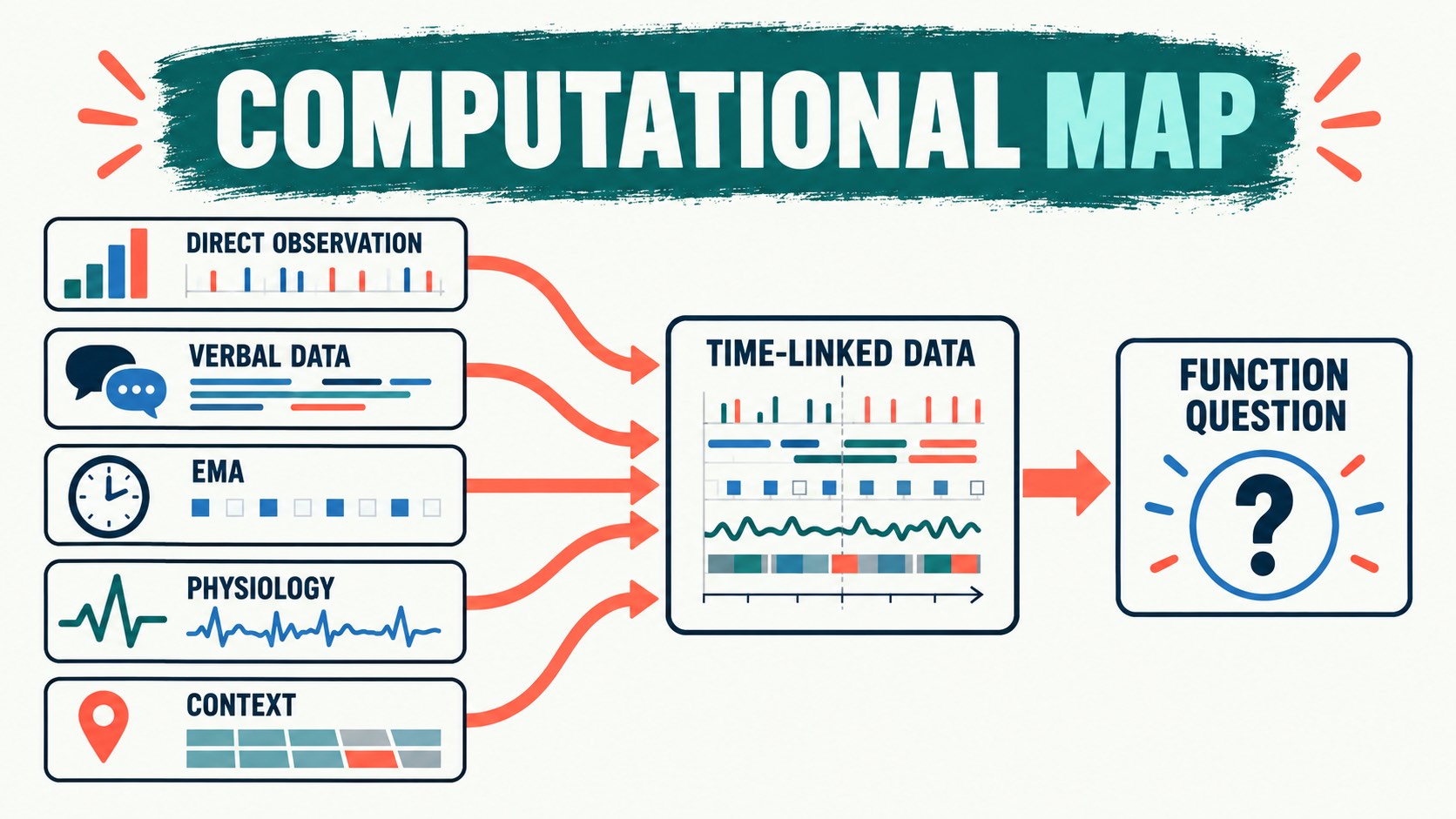
Traditional functional analysis is an assessment arrangement in which environmental conditions are systematically manipulated and behavior is measured to evaluate functional relations. Computational functional analysis may support that work by organizing data, applying decision rules, or integrating additional context. The computational layer is therefore better viewed as an aid around the analysis than as a replacement for the logic of experimental control.
| Question | Traditional functional analysis | Computational support |
|---|---|---|
| Primary purpose | Evaluate whether arranged environmental conditions relate functionally to behavior | Organize, summarize, compare, or prioritize evidence |
| Main evidence | Repeated measurement across systematically arranged conditions | Structured data streams and a stated computational rule |
| What it can show alone | A pattern of differentiation when the design and data support it | A pattern, prediction, or decision aid—not automatic causal proof |
| Human role | Design, safety, measurement, interpretation, and treatment decision | Define inputs, inspect outputs, check limitations, and retain professional judgment |
A computational summary can be useful before, during, or after an assessment. For example, it may reveal that observations are concentrated during a particular transition, help a team prioritize which episodes to inspect, or apply a consistent rule to a set of functional-analysis graphs. But the output must be interpreted in relation to the measurement system and design. A dashboard cannot repair an undefined target behavior, an uncontrolled contingency, or an inappropriate comparison.
What does a computational functional-analysis workflow look like?
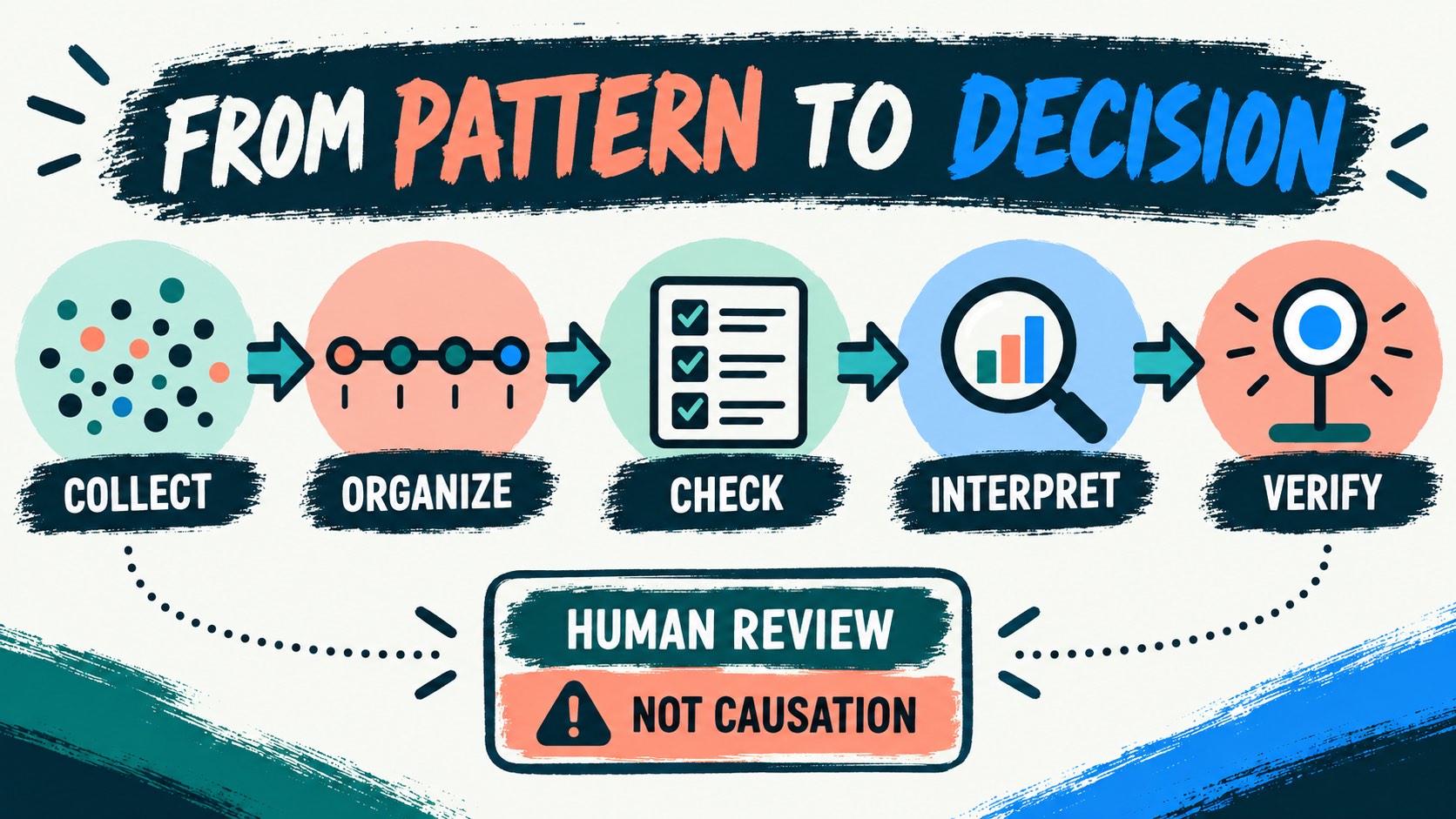
A defensible workflow starts with the behavioral question, not the software. The team should be able to explain what decision the output will support and what evidence would count against the working hypothesis. The following sequence is a study-friendly model, not a universal clinical protocol:
- Define the target and decision. State the observable response, the relevant context, and what the team needs to decide.
- Map the data sources. Record who collected each measure, when it was collected, how it was coded, and what is missing.
- Align the timeline. Place observations, context events, and other signals on a common time scale without pretending they have identical validity.
- Choose a transparent rule. Specify whether the tool is summarizing, classifying, predicting, or applying a visual-analysis criterion.
- Inspect the output against the raw data. Look for coding errors, missingness, outliers, and patterns created by the algorithm rather than the behavior.
- Decide what requires further assessment. Use the result to guide questions or next steps, not to skip measurement or professional review.
This order matters because different analytic jobs have different standards. Descriptive pattern finding is not the same as a prediction model, and a prediction model is not the same as an experimental demonstration. The word “analysis” in a product description does not tell you which of those jobs the system performs.
How does it relate to machine learning and automated analysis?
Computational functional analysis is broader than machine learning. A computational workflow may use simple data alignment, descriptive statistics, a transparent decision rule, a graphing routine, or a machine-learning model. Machine learning is one possible tool, not the definition of the framework.
Research on automated and semi-automated functional-analysis interpretation illustrates the distinction. Some studies have evaluated scripts or statistical supplements that help interpret functional-analysis data. These systems can improve consistency or agreement with human raters under the conditions studied, but they still depend on the data, criteria, and scope of the validation. A tool that performs well in one dataset does not automatically generalize to every learner, behavior, setting, or design.
- Descriptive computation: summarizes frequencies, durations, patterns, or context links without claiming prediction.
- Decision support: applies stated criteria to help a reviewer compare possible interpretations.
- Machine learning: estimates patterns from training data and requires careful validation, error analysis, and scope limits.
- Experimental functional analysis: evaluates functional relations through systematic environmental arrangements and repeated measurement.
The categories can interact, but they should not be collapsed. If a question asks which method demonstrates a functional relation, answer from the design and manipulation, not from the fact that a computer processed the data.
What should BCBA candidates remember?
The BACB BCBA Test Content Outline (6th ed.) provides the current examination framework for behavior assessment and related concepts. It should not be used to claim that computational functional analysis is a named BACB procedure or that a particular tool will appear on the examination. Use the topic as an application of familiar principles: operational definitions, measurement, experimental control, visual analysis, validity, and limits of inference. When a stem mentions software, artificial intelligence, sensors, or a large dataset, translate it back into basic behavior-analytic questions:
- What behavior was measured, and is the definition observable and complete?
- What environmental variables were arranged, observed, or merely correlated?
- What comparison or design supports the conclusion?
- What source of error, missing data, or bias could change the output?
- Is the result a description, a prediction, a decision aid, or evidence of a functional relation?
What are the common exam and practice traps?
- Calling a dashboard a functional analysis: visualization is not the same as systematic manipulation.
- Treating correlation as function: repeated co-occurrence can generate a hypothesis but does not automatically demonstrate causation.
- Assuming more data means better evidence: irrelevant, noisy, or poorly defined data can make interpretation less reliable.
- Confusing automated interpretation with automatic treatment selection: a decision aid should not be described as a replacement for professional review.
- Overgeneralizing validation: agreement in one study or dataset does not prove universal accuracy.
- Inventing BACB status: do not describe computational functional analysis as an official BACB certification method or guarantee.
Computational functional analysis FAQ
Is computational functional analysis an official BACB procedure?: Not as a named procedure in the current BCBA Test Content Outline. It is an emerging phrase for computational support around function-relevant behavioral data. Always describe the specific method, data, and decision rule rather than treating the label as a credential or standard protocol. Does computational functional analysis replace a functional analysis?: No. Computational tools may organize or interpret information, but software processing alone does not create the systematic environmental comparison needed to support a functional relation.
Is computational functional analysis the same as machine learning?: No. Machine learning may be one tool inside a computational workflow. A workflow can also use transparent rules, descriptive summaries, time alignment, or graphing without machine learning.
Why does data quality matter so much?: Because an algorithm can consistently process an invalid measure and still produce a neat output. Operational definitions, reliable measurement, accurate timestamps, missing-data checks, and scope-appropriate validation remain essential.
Bottom line: computational functional analysis is best studied as a developing data-and-decision support framework. Start with the behavioral question, define and inspect the evidence, distinguish patterns from functional relations, and keep human interpretation and ethical safeguards in the loop. For structured practice applying these distinctions, try the free BCBA mock exam. It is an independent practice resource, not an official BACB exam, and it does not guarantee certification or a passing result.
Take the Free BCBA Mock Exam
When you are ready to apply the idea, use the free practice resource below for additional feedback. Take the Free BCBA Mock Exam



