
Short answer: The phrase behavior intervention plans are confidential documents is a useful study shortcut, but it needs a boundary. BIPs should usually be handled as sensitive, restricted documents, but “confidential” does not mean that nobody may ever see one. The correct access decision depends on the setting, the type of record, the person’s role, the purpose of the request, consent, safety needs, applicable law, and organization policy.
Table of Contents
- Behavior intervention plans are confidential documents: what that means
- Why is a BIP sensitive information?
- Who may access a behavior intervention plan?
- When can BIP information be disclosed?
- How much BIP information should be shared?
- How do FERPA, HIPAA, and BACB ethics differ?
- What confidentiality traps appear on the BCBA exam?
- Behavior intervention plan confidentiality FAQ
- Quick Review Checklist
- Take the Free BCBA Mock Exam
For a BCBA exam question, do not answer from the word confidential alone. First identify who holds the record and what information is being requested. Then ask whether the requester has a legitimate role or authorization, whether a safety or legal exception applies, and whether the same purpose can be met with less information. This article is educational study support, not legal advice or a substitute for a school, employer, payer, or jurisdiction-specific policy.
The BACB Ethics Code for Behavior Analysts treats confidentiality as including documentation, data, and verbal, written, or electronic communication. That gives BCBA candidates a useful starting point: protect BIP information, disclose it only for a permitted purpose, and avoid sharing more than the situation requires. Table of Contents
Behavior intervention plans are confidential documents: what that means
In ordinary practice, a BIP should be protected from casual, unnecessary, or public access because it can contain identifying information, descriptions of behavior, assessment results, safety procedures, and individualized intervention details. That is why training materials often state that behavior intervention plans are confidential documents.
However, that sentence is a study shortcut, not a complete legal rule for every setting. A BIP may be part of a school education record, a clinical service record, a payer file, or an organization’s internal documentation system. Each context can create different access rights and disclosure procedures. A parent or legally authorized representative may have rights to service documentation, while a staff member with no legitimate educational or treatment role may not have a right to read the full plan. Keep these three distinctions separate:
- Confidential: the information is protected and cannot be shared casually.
- Authorized access: an appropriate person may need the information to provide services, support safety, or fulfill a defined professional responsibility.
- Permitted disclosure: a rule, consent, safety need, contract, or other valid basis allows specific information to be shared for a specific purpose.
Why is a BIP sensitive information?
A behavior intervention plan translates assessment information into instructions for prevention, teaching, responding, and monitoring. Even a de-identified-looking plan can become identifiable when combined with a student’s classroom, schedule, target behavior, or staff names. A public copy can also reveal safety procedures or personal details that were never intended for a general audience.
| BIP element | Why it may be sensitive | Study question |
|---|---|---|
| Identifying information | Names, dates, locations, or combinations of details can identify a person. | Who is authorized to see the record? |
| Behavior definitions and assessment findings | They describe a person’s behavior and learning history in an individualized context. | Is the requester asking for a genuine service purpose? |
| Prevention, teaching, and response procedures | The procedures may include safety-sensitive or individualized implementation details. | Does the person need the whole plan or only selected instructions? |
| Progress data and review notes | Data can reveal patterns, outcomes, and information about the person or service team. | What is the minimum information needed for the stated purpose? |
The plan’s sensitivity does not mean that it should be hidden from the people who need it to implement services safely. A plan that no authorized implementer can access cannot guide consistent intervention. The exam distinction is not “share versus never share”; it is “protect the information while providing appropriate, purpose-limited access.”
Who may access a behavior intervention plan?
Access is usually role-based and purpose-based. The same person might appropriately receive one part of a plan for implementation while not automatically receiving every assessment note, progress graph, or unrelated clinical record. The table below is a study framework, not a substitute for the governing policy in a particular case.
| Potential recipient | What to verify | Common mistake |
|---|---|---|
| Client, parent, or legally authorized representative | Applicable access rights, consent rules, custodial status, and the record holder’s procedure. | Assuming every family request is handled identically in every setting. |
| Treatment or implementation team | Whether the person has a current role and needs the information to perform assigned responsibilities. | Sending the complete record to everyone on a broad email list. |
| School official or education partner | Whether the record is an education record and whether the recipient has a legitimate educational interest. | Treating “works at the school” as automatic permission to read everything. |
| Contractor, vendor, or outside professional | The service agreement, role, privacy safeguards, permitted purpose, and rules for redisclosure. | Assuming an outside request is valid because the requester sounds professional. |
| Public, curious coworker, or unrelated staff member | A specific permitted basis; curiosity is not a professional purpose. | Leaving a plan visible or discussing identifiable details in a public area. |
For school records, the U.S. Department of Education explains that FERPA generally limits disclosure of personally identifiable information and permits access by school officials with a legitimate educational interest under applicable conditions. That does not mean every BIP in every school is governed by one identical workflow, so read the question’s setting before choosing an answer.
- Confirm the requester’s identity and current role.
- Identify the exact purpose of the request.
- Check the record holder’s policy and any consent or authorization.
- Share only the portion required for that purpose.
- Use a secure approved channel and document the decision when required.
When can BIP information be disclosed?
The BACB Ethics Code says behavior analysts protect confidential information and disclose it only under recognized circumstances, such as informed consent, protecting a client or other person from harm, resolving certain contractual issues, preventing a reasonably likely crime involving harm, or when compelled by law or court order. The exact application still depends on the facts and on other governing requirements.
| Possible basis | What the BCBA should check | Exam-safe wording |
|---|---|---|
| Informed consent or authorization | Who authorized the disclosure, what records are covered, for what purpose, and to whom. | Share within the scope of the valid authorization. |
| Safety or serious risk | The facts, urgency, applicable emergency rule, and the people able to reduce the risk. | Disclose what is necessary to address the permitted safety purpose. |
| Law, court order, or policy requirement | The actual requirement, deadline, recipient, and documentation process. | Follow the applicable rule; do not invent a broader disclosure. |
| Treatment or service coordination | The recipient’s role, the purpose, safeguards, and the amount needed to coordinate care. | Access for service delivery is not the same as unrestricted access. |
Notice the pattern: confidentiality rules usually protect information while allowing carefully justified access. A good answer rarely says “share everything” or “never share anything.” It identifies the permitted purpose, the appropriate recipient, the least amount of information that meets the purpose, and the required documentation.
How much BIP information should be shared?
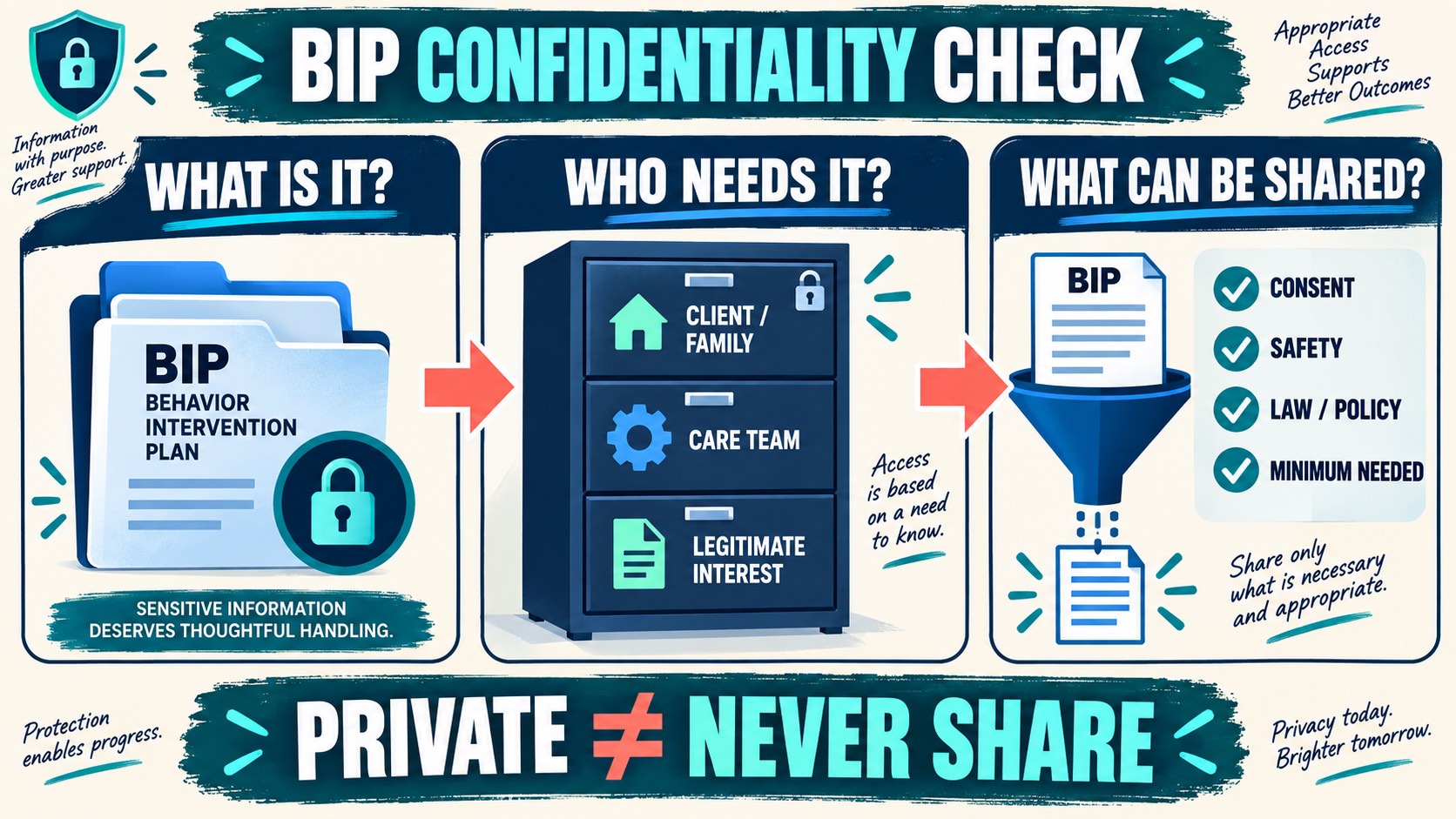
Use a minimum-necessary mindset when the governing rule calls for it. The U.S. Department of Health and Human Services describes HIPAA’s minimum-necessary principle as taking reasonable steps to limit uses, disclosures, and requests to the amount needed for the intended purpose. The principle does not answer every BIP question by itself, but it is a useful safeguard against sending a complete file when a short implementation summary would work.
Consider this study scenario: a trained classroom implementer asks how to respond when a student engages in a defined target behavior. The implementer may need the operational definition, prevention steps, replacement-skill instruction, and response procedure. That request does not automatically justify access to unrelated assessment notes, historical records, billing information, or every progress graph.
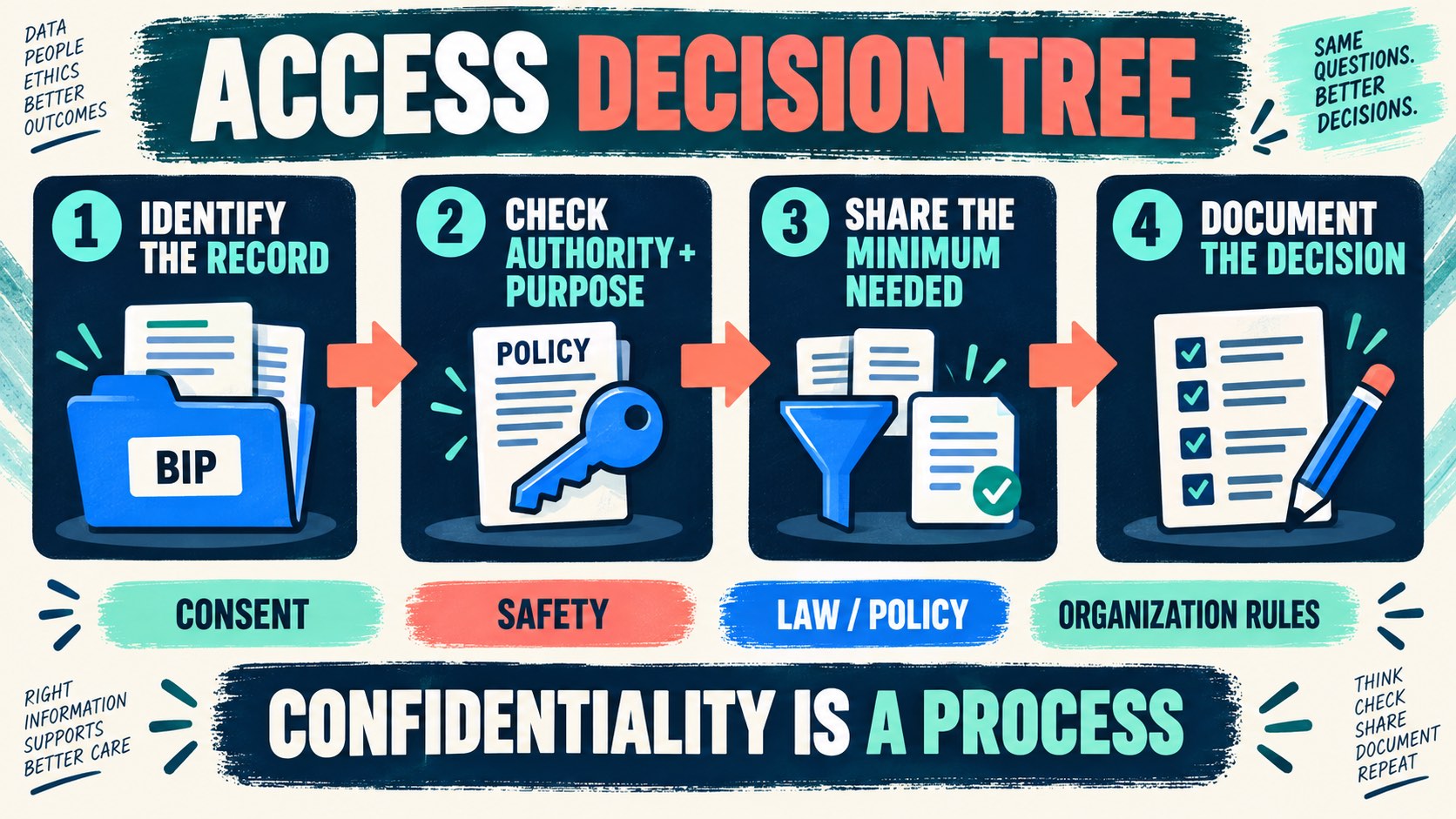
- Identify the record. Is the request for the BIP, an implementation summary, raw data, or another record?
- Check authority and purpose. Confirm the requester, role, consent, policy, and reason for access.
- Limit the content. Remove unrelated identifiers and details when the purpose can be met without them.
- Use a protected channel. Follow the organization’s approved system rather than personal email, shared drives, or public messaging.
- Document the decision. Record what was shared, with whom, why, and under which policy when documentation is required.
How do FERPA, HIPAA, and BACB ethics differ?
BCBA exam questions often place confidentiality inside a legal or ethical framework. Do not treat FERPA, HIPAA, and the BACB Ethics Code as interchangeable. They can overlap, but they answer different questions and may apply to different record holders.
| Framework | What it helps you analyze | Do not assume |
|---|---|---|
| FERPA | Personally identifiable information in education records, consent, school-official access, and legitimate educational interest. | That every BIP is automatically an education record or that every school employee may read it. |
| HIPAA | Protected health information held by a covered entity, permitted uses and disclosures, safeguards, and minimum necessary limits where applicable. | That HIPAA applies to every school record, every provider, or every BIP. |
| BACB Ethics Code | Professional duties to protect information, obtain consent when required, communicate limits, and follow applicable rules. | That an ethics code replaces a jurisdiction’s law, employer policy, contract, or record-access procedure. |
When a question gives you a school, clinic, payer, or home-service setting, use that detail. If the question is asking what a behavior analyst should do ethically, start with protecting confidentiality and checking the applicable requirement. If it asks which law governs a record, identify the record holder and context before naming FERPA or HIPAA.
What confidentiality traps appear on the BCBA exam?
Use the following checklist to slow down the most common errors:
- Absolute language: “Never share” and “always public” are usually warning signs. Look for the permitted purpose and limits.
- Role confusion: A person’s job title alone does not establish unrestricted access. Ask what responsibility the person has in this case.
- Full-file thinking: A legitimate request for one implementation detail does not automatically justify sending every page of the record.
- Law swapping: FERPA, HIPAA, and BACB ethics are not interchangeable labels. Read the setting and record type.
- Emergency overreach: A safety concern can permit urgent action, but it does not automatically authorize unrelated or unlimited disclosure.
- Unsecured communication: The correct recipient does not make an unapproved public channel appropriate.
Quick review: Protect the BIP, identify the record holder, verify the requester’s role, confirm the purpose and authorization, check safety or legal requirements, share only what is needed, use a secure channel, and document the decision when required.
For additional unofficial study practice, you can use the free BCBA mock exam. It is practice and feedback support only; it is not an official BACB product, does not reproduce official exam questions, and does not guarantee certification or exam performance.
Behavior intervention plan confidentiality FAQ
Are behavior intervention plans always confidential?: They should be handled as sensitive information, but the exact access and disclosure rules depend on the setting, record holder, applicable law, consent, contracts, and organization policy. Avoid turning a general study statement into an absolute rule.
Can a parent or legal representative access a BIP?: Access may be available under the applicable service or education-record framework, but the process can vary. Verify identity, legal authority, record ownership, and the organization’s documented procedure before releasing records.
Is sharing a BIP with a teacher automatically a confidentiality violation?: No. A teacher or implementer may need relevant information to fulfill an assigned responsibility. The key questions are whether the person has a legitimate role, whether the purpose is permitted, and whether the shared content is limited to what is needed.
Does HIPAA automatically cover every BIP?: No. HIPAA depends on the covered entity and the type of protected health information involved. A school record may be governed primarily by an education-record framework, while a clinic may have different obligations. Analyze the context instead of guessing from the document title. The safest BCBA exam reasoning is precise rather than absolute: confidentiality protects the information, authorized access supports service delivery, and disclosure must stay tied to a valid purpose and the applicable rules.
Quick Review Checklist
Use this final checklist to turn behavior intervention plans are confidential documents into exam-ready reasoning. The goal is not to memorize a label in isolation; it is to identify the relevant evidence and explain why the best answer fits the scenario. Key ideas to review:
- State the central definition or decision point for behavior intervention plans are confidential documents in your own words.
- Identify the detail that makes behavior intervention plans are confidential documents different from its closest related ABA term.
- Separate the observable facts in a scenario from assumptions that are not supported by the facts.
- Write one example and one nonexample so you can recognize the concept in a new setting.
Exam application checks:
- Ask what the question is actually requesting before comparing the answer choices.
- Mark the antecedent, response, consequence, or other evidence that supports the selected answer.
- Look for a distractor that describes a related process but does not answer the specific question.
Final self-check:
- Explain how you would verify the interpretation with clear observations or data.
- Change one detail in the scenario and decide whether your answer should change.
- Give a one-sentence rationale that a supervisor or study partner could evaluate.
Take the Free BCBA Mock Exam
When you are ready to apply the idea, use the free practice resource below for additional feedback. Take the Free BCBA Mock Exam



