
If you are looking for the Inside the BACB podcast, you may want official explanations of certification, fieldwork, ethics, examination development, or upcoming requirement changes. The podcast is useful, but it should be treated as a starting point for study—not as a permanent substitute for a current handbook, policy page, or examination document.
Table of Contents
- What Is the Inside the BACB Podcast?
- Where Can You Find Official Episodes, Captions, and Resources?
- How Should You Check Whether a Podcast Episode Is Current?
- How Do Transcripts and Closed Captions Help BCBA Study?
- Which Inside the BACB Topics Are Useful for BCBA Candidates?
- How Can You Use the Podcast for Fieldwork Planning?
- How Should You Study Episodes About the 2027 Requirements?
- Can the Podcast Replace the Ethics Code?
- What Are Common Inside the BACB Podcast Study Mistakes?
- A Listen, Verify, Apply Workflow
- Inside the BACB Podcast FAQ
- Take the Free BCBA Mock Exam
This guide explains how to find the official show, use episodes and transcripts, connect an episode to the right BACB resource, and check whether an older discussion is still current. The goal is simple: listen for context, verify the rule, and then apply the information to your BCBA study plan. That habit is especially important when an episode discusses a date-sensitive requirement or a change that will take effect in a future examination cycle.
What Is the Inside the BACB Podcast?
Inside the BACB is the Behavior Analyst Certification Board’s official podcast for general information about the BACB and the behavior-analytic profession. The BACB’s podcast page directs listeners to the show on Spotify and Apple Podcasts and also points to video versions with closed captions. The same page warns readers to check the date because some older episodes may contain information that is no longer current.
That description gives the podcast a useful role. It can explain why a process exists, introduce a topic in plain language, surface questions you should investigate, and point you toward an official handbook or resource. It does not mean that every sentence in every episode is the controlling authority for your eligibility, fieldwork, certification, ethics, or exam preparation. Think of an episode as an orientation layer:
- Listen for the context: identify the problem, policy area, or professional question being discussed.
- Open the linked source: find the current BACB handbook, requirements page, ethics resource, or exam document connected to the topic.
- Record the date: note when the episode was published and whether it describes a current rule, a future change, or a historical explanation.
- Apply only after verification: use the current official source when a decision depends on exact wording, dates, forms, or eligibility conditions.
Where Can You Find Official Episodes, Captions, and Resources?
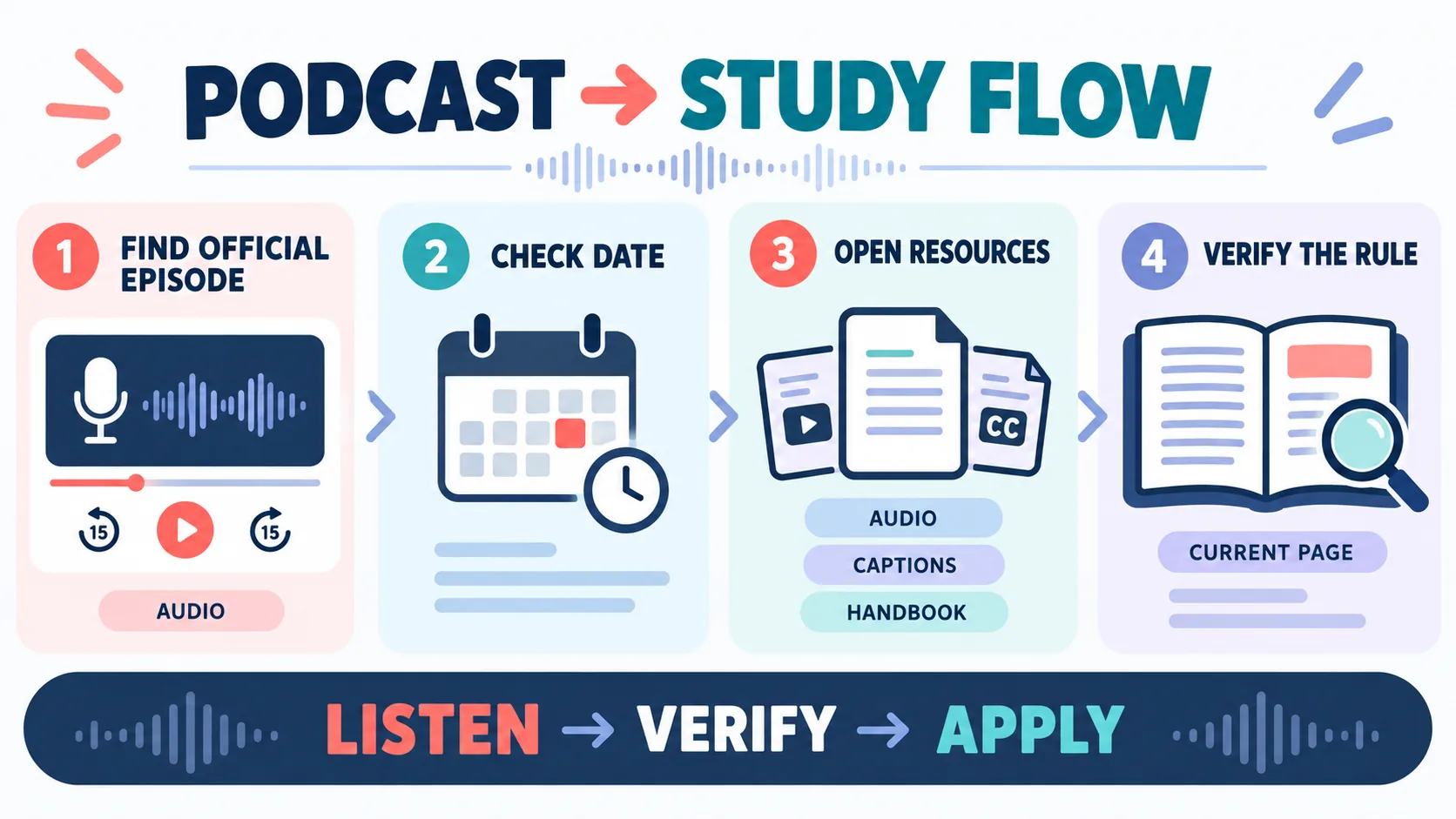
Start with the BACB’s official Inside the BACB podcast hub. It is the best place to confirm that you are using an official BACB link and to see how the organization currently describes the show. The hub includes episode links and directs users to BACB video content for transcribed versions or closed captions.
You can also use the Inside the BACB listing on Apple Podcasts when you want to follow the audio feed. A platform listing is convenient for playback, but the official BACB site should remain your reference point for linked resources, current handbooks, and date-sensitive announcements.
When the audio is difficult to search, look for the corresponding BACB video or captioned version. The BACB’s podcast video category can help you locate a visual version of an episode. Captions are useful for finding a phrase, but a caption transcript is still a record of what was said. It is not automatically a replacement for the current policy or handbook that governs the issue.
Save the episode title, publication date, official URL, and any linked document in your study notes. If you later find that a handbook has changed, you can update the note without having to rediscover the entire conversation.
How Should You Check Whether a Podcast Episode Is Current?
The safest approach is a short freshness audit. Do it before you copy a deadline, eligibility rule, supervision condition, exam detail, or ethics interpretation into your notes.
- Identify the claim: write the exact statement you want to rely on. “This episode discusses fieldwork” is too broad; “this experience meets the current fieldwork requirement” is a specific claim that needs a current source.
- Find the date: record the episode date and the date of the page or handbook that you use to verify it. A newer page may clarify or replace an older explanation.
- Match the authority: use the current BCBA Handbook for certification requirements, the current ethics materials for ethics questions, and the current exam or testing page for examination logistics.
- Look for transition language: terms such as “beginning in,” “effective,” “will change,” “currently,” and “for applications submitted after” can change the meaning of the sentence.
- Write a bounded note: separate what the episode explains from what the current source requires.
The BACB’s own podcast hub cautions that some older episodes may be outdated. That is not a reason to ignore the show; it is a reason to use the show as a map. The map helps you locate the correct current page, while the current page controls the next action.
How Do Transcripts and Closed Captions Help BCBA Study?
Transcripts make an episode more useful for review. You can search for a term, copy a short paraphrase into a study note, identify a speaker’s example, and return to the exact point later. Captions also support learners who process written information more efficiently than audio alone. Use a transcript in three passes:
- First pass—orientation: skim headings, captions, or the episode description to identify the main topic and the names of official resources.
- Second pass—extraction: write down only the concepts, definitions, examples, and questions that are relevant to your current study goal.
- Third pass—verification: compare every date-sensitive or compliance-sensitive note with the current BACB page or handbook.
Do not treat an automatically generated caption as a perfect legal or technical transcript. Acronyms can be misheard, punctuation can change the meaning of a sentence, and a speaker may qualify a statement several seconds later. If a phrase affects an application, supervision plan, or examination decision, listen to the surrounding context and verify it in the official written source.
Which Inside the BACB Topics Are Useful for BCBA Candidates?
The podcast archive can support several different study tasks. The value depends on the topic and on how you connect it to the current source.
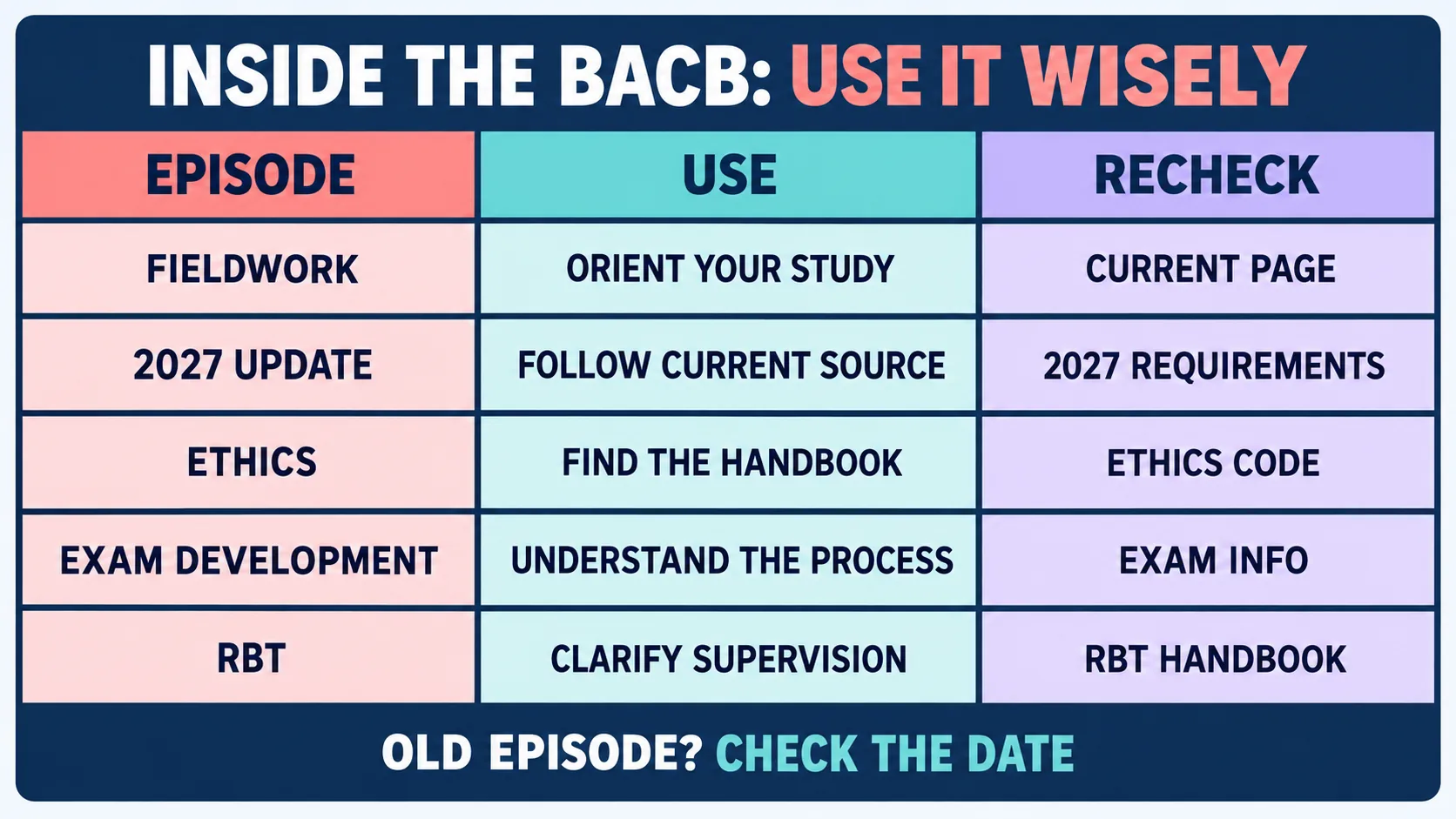
| Episode topic | Best study use | Recheck against |
|---|---|---|
| Fieldwork | Understand supervision language and build questions for your supervisor | Current BCBA Handbook and fieldwork guidance |
| 2027 update | Create a transition checklist and distinguish present rules from future requirements | BACB 2027 BCBA and BCaBA requirements page |
| Ethics | Recognize an ethical issue and identify the relevant standard | Current Ethics Code and official ethics resources |
| Exam development | Understand why exams use content outlines and defensible development processes | Current examination information and handbook |
| RBT supervision | Clarify role boundaries and supervision questions in a team setting | Current RBT Handbook and applicable BACB guidance |
For example, the BACB currently highlights episodes about making sense of fieldwork and understanding updates to the 2027 BCBA and BCaBA requirements. Those topics are highly relevant to candidates, but the study note should still label whether a point describes a rule that applies now, a future requirement, or a general explanation of the change.
How Can You Use the Podcast for Fieldwork Planning?
A fieldwork episode can help you prepare better questions before meeting with a supervisor. Listen for the difference between supervision, unrestricted activities, documentation, monthly requirements, and the responsibilities of the trainee and supervisor. Then open the current BCBA Handbook and the fieldwork guidance linked by the BACB. Build a one-page fieldwork check:
- What requirement or term did the episode explain?
- What exact current source defines it?
- Which part applies to my certification path and date?
- What documentation would demonstrate that the requirement was met?
- What question should I ask my supervisor before recording hours?
This prevents a common mistake: hearing a useful example and assuming that the example is a universal approval. Your fieldwork arrangement must satisfy the current rules and be documented in the required way. The podcast can improve your questions; it cannot approve your individual plan.
How Should You Study Episodes About the 2027 Requirements?
Future requirements need especially careful labeling. Read the official 2027 BCBA and BCaBA requirements page together with any Inside the BACB episode that discusses the change. Make two columns in your notes: “current pathway” and “2027 pathway.” Add the effective date, affected applicants, transition language, and the official document that supports each entry.
Do not use a future requirement to tell a current applicant what they must do unless the official transition rules say that it applies. Conversely, do not assume that an older episode remains a complete guide after a transition begins. A future-policy episode is most useful when it helps you ask, “Which date and application pathway control my situation?”
When you write about the 2027 change, avoid vague phrases such as “the BCBA exam is changing” without a date and source. Explain what was verified, what remains subject to the current handbook, and where the reader should check for updates. That is more helpful for searchers than repeating a dramatic but incomplete announcement.
Can the Podcast Replace the Ethics Code?
No. An ethics episode can help you recognize a dilemma, hear how a professional frames competing duties, or find an official resource. The current BACB ethics resources and Ethics Code are the materials to use when you need the standard, reporting process, or current guidance. For exam preparation, turn the episode into a reasoning exercise:
- Describe the facts without adding assumptions.
- Identify the people, duties, risks, and possible conflicts.
- Locate the current ethical standard or official resource.
- Choose the action that protects clients and follows the applicable requirements.
- Document what additional consultation or clarification is needed.
That method keeps the podcast in its proper role. A speaker’s example can expand your professional judgment, but it should not be quoted as though it were the text of the Ethics Code.
What Are Common Inside the BACB Podcast Study Mistakes?
Podcast-based learning becomes less effective when the audio is separated from source control. Watch for these errors:
- Using the newest-sounding statement: a recent episode may discuss a future change, not a rule that applies today.
- Copying a transcript without context: a caption may omit the qualification that came before or after the sentence.
- Confusing explanation with authority: an accessible conversation can explain a policy without replacing its written requirements.
- Ignoring the audience: a point for supervisors, employers, RBTs, or educators may not answer a BCBA applicant’s question.
- Keeping no citation note: without the episode date and source URL, you may not know which version informed your study plan.
- Studying passively: listening repeatedly feels productive, but retrieval questions and source checks create stronger study evidence.
A Listen, Verify, Apply Workflow
Use this six-step process for any Inside the BACB episode:
- Choose one question: decide whether you are studying fieldwork, ethics, exam development, a future change, or professional context.
- Listen once for the map: note the major terms, speakers, examples, and official resources mentioned.
- Listen again for evidence: pause at claims that include dates, quantities, eligibility conditions, or “must” language.
- Open the current source: verify the claim in the relevant BACB handbook, requirements page, ethics code, or exam information.
- Create retrieval questions: write three to five questions that require you to recall the rule, identify the limitation, or choose the next verification step.
- Set a refresh date: revisit the source before an application, exam appointment, fieldwork decision, or public article is finalized.
This approach turns a podcast episode into an active study asset. It also makes your notes durable: if the page changes, you know which source and date to recheck instead of rereading every episode from the beginning.
Inside the BACB Podcast FAQ
Is Inside the BACB an official podcast?: Yes. The BACB maintains an official podcast hub and links to the Inside the BACB show. Use the BACB site to confirm the current episode and resource links.
Does the podcast have transcripts?: The BACB podcast page directs users to BACB video content with closed captions or transcribed versions. Captions help with search and review, but date-sensitive claims still need to be verified against the current written source. Can I study only from Inside the BACB?: No. Use episodes for orientation, context, and questions. Use the current handbook, requirements, ethics, and examination materials for the rules and definitions that control your pathway.
How should I handle an old episode?: Record its publication date, identify the claim, and compare it with the current BACB page. If the topic involves a transition or policy change, check the effective date and applicant pathway before relying on it.
Once you have verified the source boundary, you can use practice questions to test whether you can identify the population, rule, date, and evidence in a scenario. Try our free BCBA mock exam as a next step, then return to the current BACB source whenever a question involves a requirement or policy detail.
Take the Free BCBA Mock Exam
If you want a low-pressure way to check your recall, use the free practice resource below. Take the Free BCBA Mock Exam



